
Ambient Loop Energy Network Market Report 2026
Global Outlook – By Component ( Hardware, Software, Services), By Source Type ( Geothermal, Waste Heat, Air Source, Water Source, Other Source Types), By Application ( Residential, Commercial, Industrial), By End-User ( Urban Infrastructure, Smart Cities, Industrial Parks, Campuses, Other End-Users) – Market Size, Trends, Strategies, and Forecast to 2030
Ambient Loop Energy Network Market Overview
• Ambient Loop Energy Network market size has reached to $1.98 billion in 2025 • Expected to grow to $4.37 billion in 2030 at a compound annual growth rate (CAGR) of 17.2% • Growth Driver: Surge In Investments In Smart City Projects Fueling The Growth Of The Market Due To Rapid Urbanization And Rising Demand For Intelligent Urban Infrastructure • North America was the largest region in 2025 and Asia-Pacific is the fastest growing region.What Is Covered Under Ambient Loop Energy Network Market?
Ambient loop energy network is an advanced energy distribution concept that enables the capture, conversion, and continuous circulation of low-grade or residual energy from the surrounding environment into usable electrical power. It operates through interconnected systems that harvest ambient energy sources such as thermal gradients, vibration, radiofrequency signals, or kinetic motion and redistribute them through a closed-loop or shared energy infrastructure. The main components of ambient loop energy network include hardware, software, and services. Hardware refers to physical infrastructure such as heat exchange systems, loop distribution networks, and sensing devices that enable efficient transfer and management of thermal energy across connected systems. These solutions are categorized by source type including geothermal, waste heat, air source, water source, and other source types. The key applications of residential, commercial, and industrial, and they are used by several end users such as urban infrastructure, smart cities, industrial parks, campuses, and others.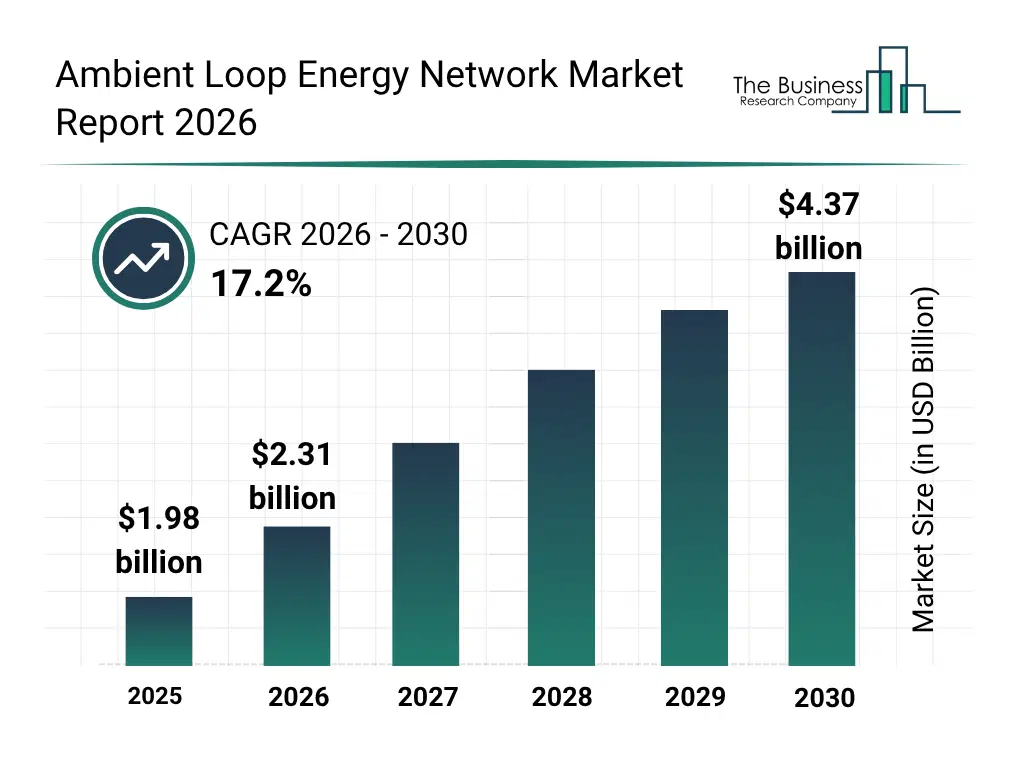
What Is The Ambient Loop Energy Network Market Size and Share 2026?
The ambient loop energy network market size has grown rapidly in recent years. It will grow from $1.98 billion in 2025 to $2.31 billion in 2026 at a compound annual growth rate (CAGR) of 17.0%. The growth in the historic period can be attributed to growing demand for energy efficient infrastructure systems, rising investments in renewable and distributed energy technologies, expansion of industrial automation and monitoring systems, increasing adoption of smart grid technologies, technological advancements in ambient energy harvesting components.What Is The Ambient Loop Energy Network Market Growth Forecast?
The ambient loop energy network market size is expected to see rapid growth in the next few years. It will grow to $4.37 billion in 2030 at a compound annual growth rate (CAGR) of 17.2%. The growth in the forecast period can be attributed to increasing implementation of smart city energy management systems, rising adoption of self powered IoT devices, growing investments in sustainable urban infrastructure projects, expansion of predictive energy optimization platforms, increasing demand for decentralized low carbon energy networks. Major trends in the forecast period include increasing deployment of ambient energy harvesting systems in smart infrastructure projects, rising adoption of closed loop energy sharing networks in industrial facilities, growing integration of waste heat recovery technologies into distributed energy systems, expansion of low power energy harvesting applications for remote monitoring devices, increasing development of decentralized energy circulation platforms for continuous power optimization.
Global Ambient Loop Energy Network Market Segmentation
1) By Component: Hardware, Software, Services 2) By Source Type: Geothermal, Waste Heat, Air Source, Water Source, Other Source Types 3) By Application: Residential, Commercial, Industrial 4) By End-User: Urban Infrastructure, Smart Cities, Industrial Parks, Campuses, Other End-Users Subsegments: 1) By Hardware: Smart Sensors, Energy Meters, Control Units, Edge Computing Devices, Communication Modules, Energy Storage Interface Systems 2) By Software: Energy Management Software, Real Time Monitoring Software, Predictive Maintenance Software, Energy Analytics Platforms, Demand Response Optimization Software, Load Forecasting Systems 3) By Services: Consulting And Advisory Services, Installation And Integration Services, Maintenance And Support Services, Managed Energy Services, Data Analytics Services, Training And Enablement ServicesWhat Are The Drivers Of The Ambient Loop Energy Network Market?
The rising investments in smart city projects are expected to propel the growth of the ambient loop energy network market going forward. Smart city projects refer to planned initiatives that use digital technologies, data-driven systems, and connected infrastructure to improve the efficiency, sustainability, and quality of urban life. Investment in smart city projects is growing due to rapid urbanization, which is increasing pressure on urban infrastructure and driving the need for smarter, more efficient, and sustainable city management solutions. Ambient loop energy networks help smart city projects by enabling continuous, wireless, and efficient energy distribution to IoT-enabled urban infrastructure, improving real-time connectivity, reducing dependence on wired power systems, and supporting scalable, sustainable, and intelligent city operations. For example, in January 2024, the Institute of the Americas, a US-based non-profit organization, projected that global spending on smart city initiatives in 2023 would surpass $190 billion. Therefore, the rising investments in smart city projects are driving the growth of the ambient loop energy network industry. The growing focus on energy efficiency is expected to propel the growth of the ambient loop energy network market going forward. Energy efficiency refers to using less energy to perform the same task or produce the same result while reducing energy waste. The emphasis on energy efficiency is growing due to rising industrial energy costs as companies are trying to reduce expenses by using less energy for the same level of production or output. Ambient loop energy network supports energy efficiency by enabling shared low-temperature heating and cooling systems that recover and redistribute waste heat between buildings, reduce individual energy consumption, and optimize overall energy use across connected infrastructure. For instance, in March 2024, according to the Department for Energy Security and Net Zero, a UK-based government department, ECO continues to be the largest energy efficiency scheme. In 2023, measures delivered through ECO accounted for 83% of all installations. That year, ECO implemented 265,000 measures, representing a 61% increase compared to 2022, as delivery under ECO4 expanded following its launch in April 2022 after the conclusion of ECO3. Therefore, the growing focus on energy efficiency is driving the growth of the ambient loop energy network industry. An increasing renewable energy integration is expected to propel the growth of the ambient loop energy network market going forward. Renewable energy integration refers to the growing incorporation of variable power sources such as solar and wind into electricity grids, which introduces intermittency and frequency fluctuations that must be actively managed. Renewable energy integration is increasing due to government decarbonization targets, as countries are actively expanding the use of solar and wind power to reduce greenhouse gas emissions and transition toward low-carbon energy systems. Ambient loop systems help renewable energy integration by efficiently balancing variable energy supply and demand through thermal energy storage, redistribution, and reuse across buildings and districts, reducing grid fluctuations caused by intermittent renewable sources such as solar and wind. For instance, in August 2025, according to the Atlantic Renewables, a UK-based solar energy company, the UK solar industry experienced a significant 22% increase in home solar panel installations in the first half of 2025 compared to the same period in 2024. Therefore, the increasing renewable energy integration is driving the growth of the ambient loop energy network industry.Key Players In The Global Ambient Loop Energy Network Market
Major companies operating in the ambient loop energy network market are ENGIE S.A., Daikin Industries Ltd., Salas O’Brien Inc., Qvantum Energy Technology AB, ARANER S.L., Kensa Contracting Ltd., E.ON SE, Glen Dimplex Group, FCG Finnish Consulting Group, Genius Energy Lab LimitedRegional Outlook
North America was the largest region in the ambient loop energy network market in 2025. Asia-Pacific is expected to be the fastest-growing region in the forecast period.The regions covered in this market report are Asia-Pacific, South East Asia, Western Europe, Eastern Europe, North America, South America, Middle East, Africa. The countries covered in this market report are Australia, Brazil, China, France, Germany, India, Indonesia, Japan, Taiwan, Russia, South Korea, UK, USA, Canada, Italy, Spain.What Defines the Ambient Loop Energy Network Market?
The ambient loop energy network market consists of revenues earned by entities by providing services such as energy harvesting system deployment, distributed energy network management, smart grid integration, energy storage coordination, system monitoring and optimization, and infrastructure maintenance. The market value includes the value of related goods sold by the service provider or included within the service offering. The ambient loop energy network market also includes sales of energy harvesting devices, ambient energy transducers, power management units, micro energy storage systems, smart sensors, control modules, and distributed energy networking hardware. Values in this market are ‘factory gate’ values, that is, the value of goods sold by the manufacturers or creators of the goods, whether to other entities (including downstream manufacturers, wholesalers, distributors, and retailers) or directly to end customers. The value of goods in this market includes related services sold by the creators of the goods.How is Market Value Defined and Measured?
The market value is defined as the revenues that enterprises gain from the sale of goods and/or services within the specified market and geography through sales, grants, or donations in terms of the currency (in USD unless otherwise specified). The revenues for a specified geography are consumption values that are revenues generated by organizations in the specified geography within the market, irrespective of where they are produced. It does not include revenues from resales along the supply chain, either further along the supply chain or as part of other products.What Key Data and Analysis Are Included in the Ambient Loop Energy Network Market Report 2026?
The ambient loop energy network market research report is one of a series of new reports from The Business Research Company that provides ambient loop energy network market statistics, including ambient loop energy network industry global market size, regional shares, competitors with a ambient loop energy network market share, detailed ambient loop energy network market segments, market trends and opportunities, and any further data you may need to thrive in the ambient loop energy network industry. This ambient loop energy network market research report delivers a complete perspective of everything you need, with an in-depth analysis of the current and future scenario of the industry.Ambient Loop Energy Network Market Report Forecast Analysis
| Report Attribute | Details |
|---|---|
| Market Size Value In 2026 | $2.31 billion |
| Revenue Forecast In 2030 | $4.37 billion |
| Growth Rate | CAGR of 17.2% from 2026 to 2030 |
| Base Year For Estimation | 2025 |
| Actual Estimates/Historical Data | 2020-2025 |
| Forecast Period | 2026 - 2030 |
| Market Representation | Revenue in USD Billion and CAGR from 2026 to 2030 |
| Segments Covered | Component, Source Type, Application, End-User |
| Regional Scope | Asia-Pacific, Western Europe, Eastern Europe, North America, South America, Middle East, Africa |
| Country Scope | The countries covered in the ambient loop energy network market report are Australia, Brazil, China, France, Germany, India, Indonesia, Japan, Taiwan, Russia, South Korea, UK, USA, Canada, Italy, Spain. |
| Key Companies Profiled | ENGIE S.A., Daikin Industries Ltd., Salas O’Brien Inc., Qvantum Energy Technology AB, ARANER S.L., Kensa Contracting Ltd., E.ON SE, Glen Dimplex Group, FCG Finnish Consulting Group, Genius Energy Lab Limited |
| Customization Scope | Request for Customization |
| Pricing And Purchase Options | Explore Purchase Options |