

Anti Jamming Equipment Market Report 2026
Global Outlook – By Product Type (Anti-Jamming Antennas, Receivers And Terminals, System Components, Countermeasure Systems, Protective Hardware), By Platform (Airborne, Ground, Naval, Space), By Technique (Nulling Systems, Beam Steering Systems, Excision Systems, Frequency Hopping), By Application (Position, Navigation And Timing, Surveillance And Reconnaissance, Flight Control, Targeting), By End User (Defense And Military, Aerospace, Government Agencies, Commercial Telecommunications, Maritime) – Market Size, Trends, Strategies, and Forecast to 2030
Anti Jamming Equipment Market Overview
• Anti Jamming Equipment market size has reached to $4.43 billion in 2025 • Expected to grow to $7.21 billion in 2030 at a compound annual growth rate (CAGR) of 10.3% • Growth Driver: Increasing Investments In Defense Modernization Programs Fueling The Growth Of The Market Due To Rising Demand For Resilient Navigation And Communication Systems • Market Trend: Enhancing Navigation Reliability With Next-generation Anti-Jamming And Sensor Fusion Systems • North America was the largest region in 2025 and Asia-Pacific is the fastest growing region.What Is Covered Under Anti Jamming Equipment Market?
Anti-jamming equipment refers to systems designed to detect, suppress, or mitigate intentional and unintentional radio frequency interference that can disrupt signal reception. It ensures reliable operation of communication, navigation, or sensing systems by filtering or nullifying interfering signals while preserving the desired input. This technology is commonly used to maintain signal integrity in environments where electronic interference or signal degradation is present. The main product types of anti jamming equipment include anti-jamming antennas, receivers and terminals, system components, countermeasure systems, and protective hardware. Anti-jamming antennas refer to specialized communication components designed to resist signal interference and maintain reliable connectivity in hostile electronic environments. These systems are deployed across platforms such as airborne, ground, naval, and space and are based on techniques including nulling systems, beam steering systems, excision systems, and frequency hopping. The various applications involved are position, navigation and timing, surveillance and reconnaissance, flight control, and targeting, and they are used by several end users such as defense and military, aerospace, government agencies, commercial telecommunications, and maritime.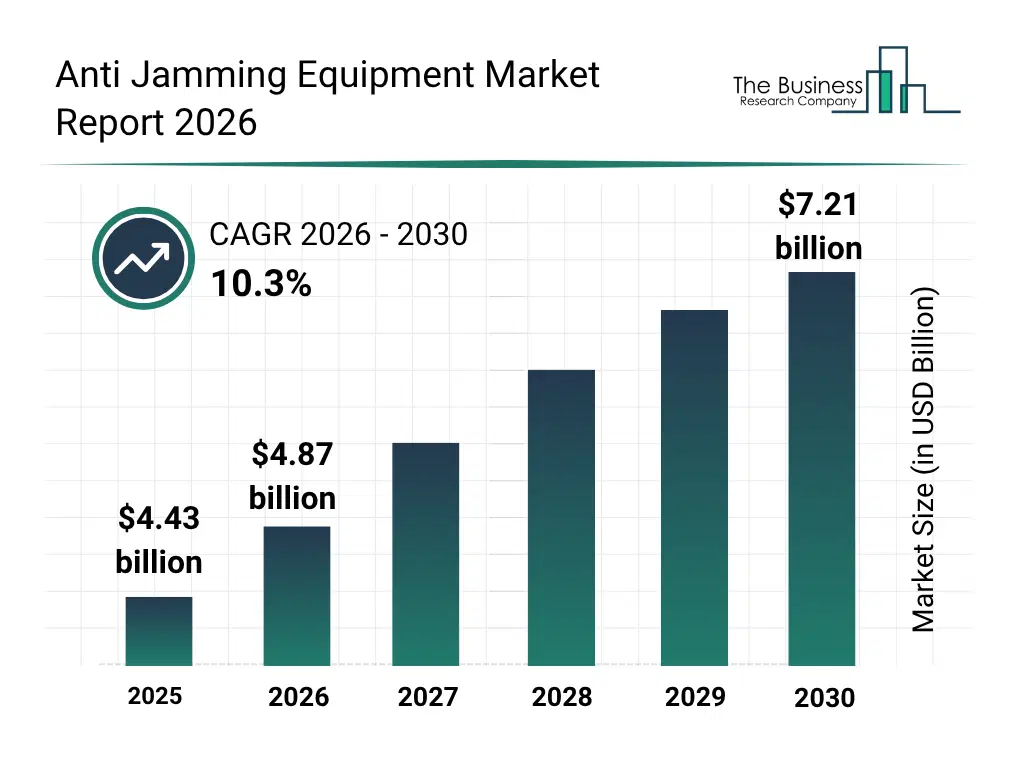
What Is The Anti Jamming Equipment Market Size and Share 2026?
The anti jamming equipment market size has grown rapidly in recent years. It will grow from $4.43 billion in 2025 to $4.87 billion in 2026 at a compound annual growth rate (CAGR) of 10.0%. The growth in the historic period can be attributed to rising electronic warfare threats and signal jamming incidents, increasing adoption of satellite-based navigation systems, growth in military communication modernization programs, expansion of aerospace and defense electronics, increasing dependency on gnss-based timing and positioning systems.What Is The Anti Jamming Equipment Market Growth Forecast?
The anti jamming equipment market size is expected to see rapid growth in the next few years. It will grow to $7.21 billion in 2030 at a compound annual growth rate (CAGR) of 10.3%. The growth in the forecast period can be attributed to rising geopolitical tensions driving defense modernization, expansion of autonomous military and unmanned systems, increasing demand for resilient multi-frequency navigation systems, growth in commercial satellite communication networks, advancement in adaptive beamforming and AI-based interference mitigation technologies. Major trends in the forecast period include AI-enabled adaptive signal interference detection systems, cybersecurity-driven rf spectrum protection and encryption integration, autonomous systems enhancing real-time navigation resilience in contested environments, iot-enabled connected defense communication and signal integrity monitoring, industry 4.0 adoption in advanced electronic warfare manufacturing systems.
Global Anti Jamming Equipment Market Segmentation
1) By Product Type: Anti-Jamming Antennas, Receivers And Terminals, System Components, Countermeasure Systems, Protective Hardware 2) By Platform: Airborne, Ground, Naval, Space 3) By Technique: Nulling Systems, Beam Steering Systems, Excision Systems, Frequency Hopping 4) By Application: Position, Navigation And Timing, Surveillance And Reconnaissance, Flight Control, Targeting 5) By End User: Defense And Military, Aerospace, Government Agencies, Commercial Telecommunications, Maritime Subsegments: 1) By Anti-Jamming Antennas: Controlled Reception Pattern Antennas, Multi Element Antennas, Adaptive Beamforming Antennas, Null Steering Antennas, Directional Antennas 2) By Receivers And Terminals: Global Navigation Satellite System Receivers, Anti-Jamming Receivers, Navigation Terminals, Timing Receivers, Multi Frequency Receivers 3) By System Components: Signal Processing Units, Beamforming Modules, Radio Frequency Filters, Power Amplifiers, Control Units 4) By Countermeasure Systems: Electronic Countermeasure Systems, Signal Jamming Detection Systems, Interference Mitigation Systems, Spoofing Detection Systems 5) By Protective Hardware: Shielding Enclosures, Electromagnetic Protection Devices, Surge Protection Devices, Hardened Casings, Cable Protection SystemsWhat Is The Driver Of The Anti Jamming Equipment Market?
The increasing investments in defense modernization programs are driving the growth of the anti-jamming equipment market during the historical period. Defense modernization programs refer to initiatives aimed at upgrading and enhancing military capabilities through advanced technologies, systems, and infrastructure to improve operational effectiveness and readiness. The increasing investments in defense modernization programs are driven by rising security threats, as they necessitate advanced, resilient military technologies to ensure superior situational awareness and operational readiness in contested environments. Anti jamming equipment helps defense modernization programs by enhancing the resilience of navigation and communication systems against signal interference, thereby improving mission accuracy, operational reliability, and battlefield effectiveness in contested environments. For instance, in March 2023, according to the U.S. Department of Defense, a US-based government department, the FY 2024 budget of $842 billion, including $145.0 billion for RDT&E (up 4.0% from FY 2023) and allocations of $4.7 billion for jam-resistant capabilities and $1.3 billion for GPS III Follow-On and Next-Generation Operational Control System development, highlighting defense modernization efforts. Therefore, the increasing investments in defense modernization programs are driving the growth of the anti-jamming equipment market.Key Players In The Global Anti Jamming Equipment Market
Major companies operating in the anti jamming equipment market are Lockheed Martin Corporation, General Dynamics Corporation, Northrop Grumman Corporation, BAE Systems plc, Thales S.A., L3Harris Technologies Inc., Leonardo Società per azioni, Elbit Systems Ltd., Israel Aerospace Industries Ltd., Saab Aktiebolag, Trimble Inc., ASELSAN Elektronik Sanayi ve Ticaret A.Ş., General Atomics, Rohde & Schwarz GmbH & Co. KG, HENSOLDT AG, QinetiQ Group plc, Sierra Nevada Corporation, Furuno Electric Co. Ltd., Mayflower Communications Company Inc., Evolve Dynamics Ltd.Global Anti Jamming Equipment Market Trends and Insights
Major companies operating in the anti-jamming equipment market are focusing on developing advanced positioning, navigation, and timing (PNT) protection solutions, such as integrated anti-jamming and sensor fusion systems, to enhance signal resilience, improve navigation accuracy, and ensure uninterrupted operation of GNSS-dependent platforms in contested and interference-heavy environments. Integrated anti-jamming and sensor fusion systems are technologies that combine GNSS anti-jamming protection with multiple sensor data sources to ensure accurate, resilient positioning and navigation in contested environments. For instance, in March 2025, Inertial Labs Inc., a US-based company specializing in inertial navigation, positioning, and motion sensing solutions, launched an advanced anti-jamming solution designed to improve GNSS resilience in challenging environments. It is developed to support enhanced operational reliability, the solution enables improved interference mitigation, stronger positioning accuracy, and continuous navigation capability in GNSS-challenged conditions, strengthening performance for defense and high-precision applications reliant on uninterrupted satellite signals.What Are Latest Mergers And Acquisitions In The Anti Jamming Equipment Market?
In April 2024, Evolve Dynamics Limited, a UK-based provider of advanced anti-jamming and jam-resistant technology, partnered with Doodle Labs to enhance resilient UAV communications and deliver improved anti-jamming capability for the SKY MANTIS 2 platform. Through this partnership, Evolve Dynamics and Doodle Labs aim to enhance UAV communication resilience by integrating advanced anti-jamming and jam-resistant technologies to ensure reliable operation in GPS and RF-contested environments. Doodle Labs LLC is a Singapore-based company that provides advanced anti-jamming, electronic warfare (EW)-resilient communication systems.Regional Outlook
North America was the largest region in the anti jamming equipment market in 2025. Asia-Pacific is expected to be the fastest-growing region in the forecast period. The regions covered in this market report are Australia, Brazil, China, France, Germany, India, Indonesia, Japan, Taiwan, Russia, South Korea, UK, USA, Canada, Italy, Spain. The countries covered in this market report are Australia, Brazil, China, France, Germany, India, Indonesia, Japan, Taiwan, Russia, South Korea, UK, USA, Canada, Italy, Spain.What Defines the Anti Jamming Equipment Market?
The anti-jamming equipment market consists of revenues earned by entities by providing services such as managed anti-jamming services, training and operational support services, and upgrade and modernization services. The market value includes the value of related goods sold by the service provider or included within the service offering. The anti-jamming equipment market includes sales of signal processing units, frequency selective limiters, antenna array systems, and navigation protection units. Values in this market are ‘factory gate’ values, that is, the value of goods sold by the manufacturers or creators of the goods, whether to other entities (including downstream manufacturers, wholesalers, distributors, and retailers) or directly to end customers. The value of goods in this market includes related services sold by the creators of the goods.How is Market Value Defined and Measured?
The market value is defined as the revenues that enterprises gain from the sale of goods and/or services within the specified market and geography through sales, grants, or donations in terms of the currency (in USD unless otherwise specified). The revenues for a specified geography are consumption values that are revenues generated by organizations in the specified geography within the market, irrespective of where they are produced. It does not include revenues from resales along the supply chain, either further along the supply chain or as part of other products.What Key Data and Analysis Are Included in the Anti Jamming Equipment Market Report 2026?
The anti jamming equipment market research report is one of a series of new reports from The Business Research Company that provides anti jamming equipment market statistics, including anti jamming equipment industry global market size, regional shares, competitors with a anti jamming equipment market share, detailed anti jamming equipment market segments, market trends and opportunities, and any further data you may need to thrive in the anti jamming equipment industry. This anti jamming equipment market research report delivers a complete perspective of everything you need, with an in-depth analysis of the current and future scenario of the industry.Anti Jamming Equipment Market Report Forecast Analysis
| Report Attribute | Details |
|---|---|
| Market Size Value In 2026 | $4.87 billion |
| Revenue Forecast In 2030 | $7.21 billion |
| Growth Rate | CAGR of 10.3% from 2026 to 2030 |
| Base Year For Estimation | 2025 |
| Actual Estimates/Historical Data | 2020-2025 |
| Forecast Period | 2026 - 2030 |
| Market Representation | Revenue in USD Billion and CAGR from 2026 to 2030 |
| Segments Covered | Product Type, Platform, Technique, Application, End User |
| Regional Scope | Asia-Pacific, Western Europe, Eastern Europe, North America, South America, Middle East, Africa |
| Country Scope | The countries covered in the anti jamming equipment market report are Australia, Brazil, China, France, Germany, India, Indonesia, Japan, Taiwan, Russia, South Korea, UK, USA, Canada, Italy, Spain. |
| Key Companies Profiled | Lockheed Martin Corporation, General Dynamics Corporation, Northrop Grumman Corporation, BAE Systems plc, Thales S.A., L3Harris Technologies Inc., Leonardo Società per azioni, Elbit Systems Ltd., Israel Aerospace Industries Ltd., Saab Aktiebolag, Trimble Inc., ASELSAN Elektronik Sanayi ve Ticaret A.Ş., General Atomics, Rohde & Schwarz GmbH & Co. KG, HENSOLDT AG, QinetiQ Group plc, Sierra Nevada Corporation, Furuno Electric Co. Ltd., Mayflower Communications Company Inc., Evolve Dynamics Ltd. |
| Customization Scope | Request for Customization |
| Pricing And Purchase Options | Explore Purchase Options |