

Anti-Jamming Market Report 2026
Global Outlook – By Receiver Type (Military And Government Grade, Commercial Transportation Grade), By Platform (Airborne Platforms, Land-Based Platforms, Naval Platforms, Space-Based Platforms), By Application (Flight Control, Surveillance And Reconnaissance, Position, Navigation, And Timing, Targeting, Casualty Evacuation, Other Applications) – Market Size, Trends, Strategies, and Forecast to 2030
Anti-Jamming Market Overview
• Anti-Jamming market size has reached to $5.2 billion in 2025 • Expected to grow to $8.49 billion in 2030 at a compound annual growth rate (CAGR) of 10.2% • Growth Driver: Rising Defense Budgets Fueling Growth In The Anti-Jamming Market • Market Trend: Strategic Investments Fuel The Anti-Jamming Market • Asia-Pacific was the largest region in 2025.What Is Covered Under Anti-Jamming Market?
Anti-jamming refers to a device or system used to prevent jamming in communications or electronic devices to protect vulnerable positions in modern infrastructure systems, such as battlefield systems, by ensuring continuous operation of GPS systems in high-frequency jamming areas to reduce wireless traffic. The main receiver types of anti-jamming include military and government-grade, and commercial transportation grades. Military and government-grade anti-jamming refers to a military-grade device that safeguards battlefield systems by assuring the continued operation of critical timing systems in the event of high radio frequency (RF) jamming. The different technologies used in anti-jamming systems include nulling, beam steering, and civilian techniques. These systems are widely used in flight control, surveillance & reconnaissance, position, navigation & timing, targeting, casualty evacuation, and other are applications.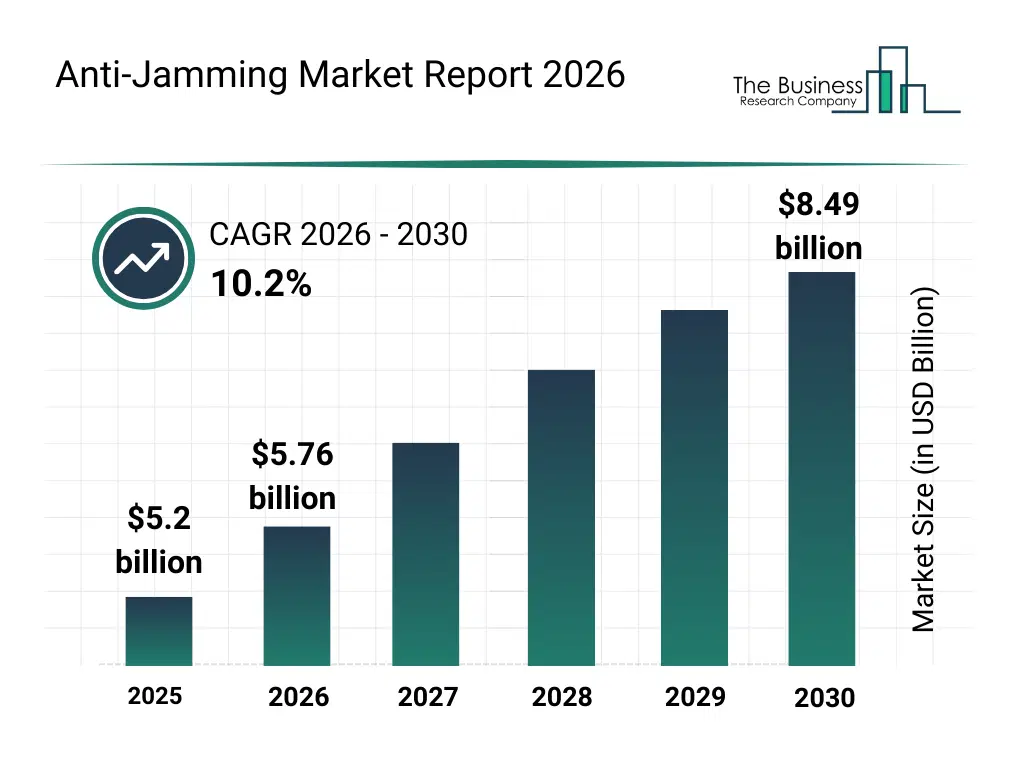
What Is The Anti-Jamming Market Size and Share 2026?
The anti-jamming market size has grown rapidly in recent years. It will grow from $5.2 billion in 2025 to $5.76 billion in 2026 at a compound annual growth rate (CAGR) of 10.7%. The growth in the historic period can be attributed to increasing reliance on satellite navigation systems, rising electronic warfare threats, expansion of defense communication networks, adoption of gps-based navigation in military operations, increased vulnerability of wireless systems.What Is The Anti-Jamming Market Growth Forecast?
The anti-jamming market size is expected to see rapid growth in the next few years. It will grow to $8.49 billion in 2030 at a compound annual growth rate (CAGR) of 10.2%. The growth in the forecast period can be attributed to increasing investments in electronic warfare countermeasures, rising demand for resilient navigation solutions, expansion of anti-jamming systems in commercial aviation, growing focus on battlefield situational awareness, increasing deployment of next-generation defense communication systems. Major trends in the forecast period include increasing adoption of gps anti-jamming technologies, rising deployment of beam steering and nulling techniques, growing integration of anti-jam systems in defense platforms, expansion of resilient positioning and navigation solutions, enhanced focus on signal integrity protection.
Global Anti-Jamming Market Segmentation
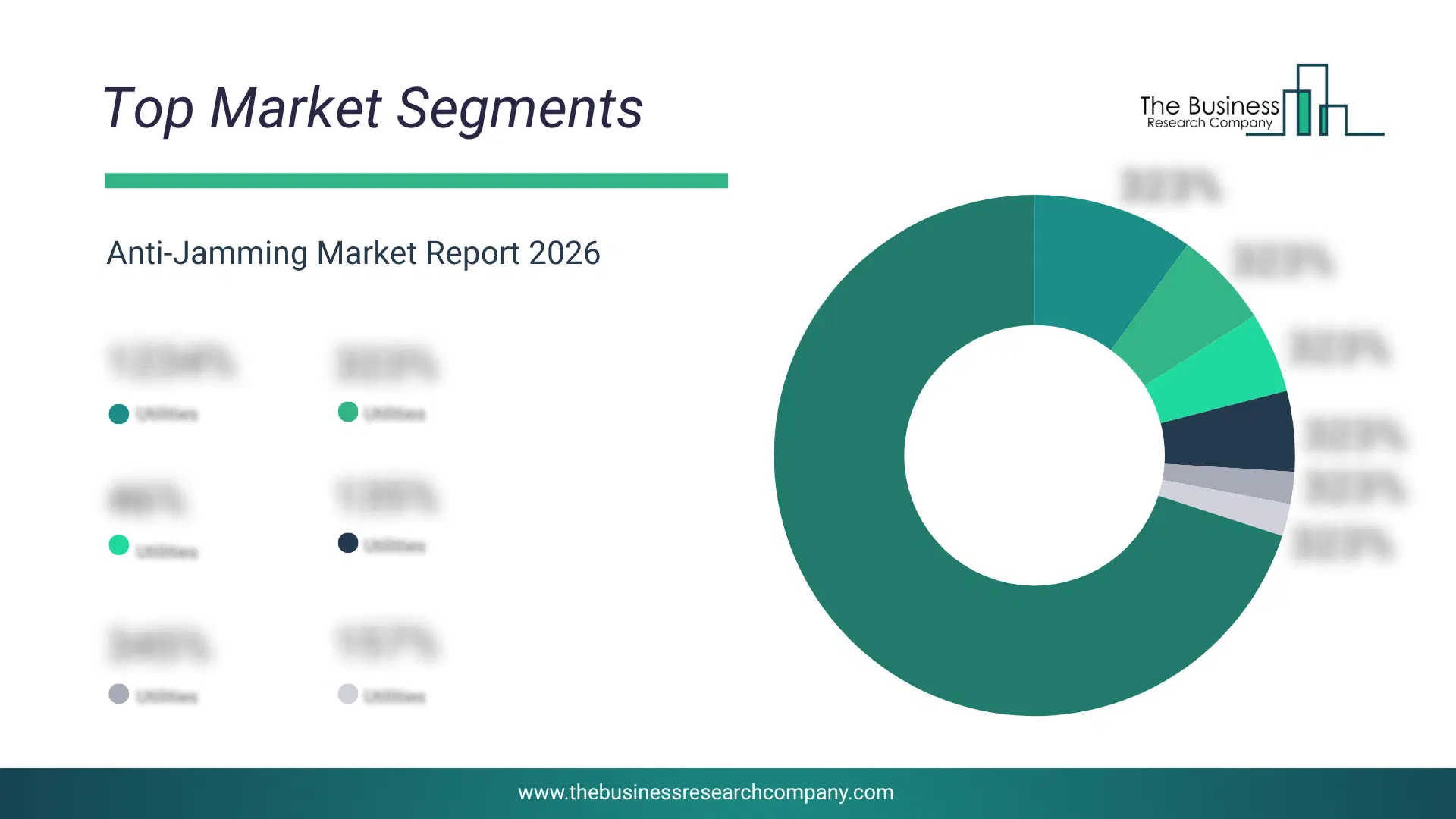
1) By Receiver Type: Military And Government Grade, Commercial Transportation Grade 2) By Platform: Airborne Platforms, Land-Based Platforms, Naval Platforms, Space-Based Platforms 3) By Application: Flight Control, Surveillance And Reconnaissance, Position, Navigation, And Timing, Targeting, Casualty Evacuation, Other Applications Subsegments: 1) By Military And Government Grade: Tactical Communication Systems, Navigation Systems, Surveillance And Reconnaissance Systems 2) By Commercial Transportation Grade: Aviation Systems, Maritime Systems, Ground Transportation SystemsWhat Is The Driver Of The Anti-Jamming Market?
The increasing allotment of higher military and defense budgets by most governments are the significant factor driving the growth of the anti-jamming market. The governments of different countries are allotting more money to the military and defense to enhance the nation's security and establish technically advanced military bases with innovative machinery and defense systems. This higher allocation of defense budgets is expected to boost demand for anti-jamming products, as it is one of the significant ways to enhance the nation's security in sensitive environments. In the United States, defense spending makes up $754 billion of the $7.2 trillion annual budget for 2022, which is approximately 10.5% of the US budget. Similarly, in India, for the 2022-2023 budget, the government increased the Ministry of Defense's (MoD) budget allocations by 9.8% to approximately $70. 6 billion (INR 5.25 trillion). Therefore, the increasing military and defense budgets are expected to driving growth in anti-jamming industry.Key Players In The Global Anti-Jamming Market
Major companies operating in the anti-jamming market are BAE Systems plc; Cobham Ltd.; Thales Group; Collins Aerospace; InfiniDome Ltd.; RTX Corporation; Raytheon Technologies Corporation; NovAtel Inc.; Mayflower Communications; Furuno Electric Company; Harris Corporation; Lockheed Martin Corporation; Boeing Company; U-blox Holding AG; Israel Aerospace Industries; L3Harris Technologies Inc.; Orolia SAS; Forsberg Services Ltd; TUALCOM ELECTRONICS INC.; Septentrio NV; Hexagon AB; Singapore Technologies Engineering Ltd; Rohde & Schwarz GmbH & Co. KG; Safran Electronics & Defense Services India Private Limited; Telephonics Corporation; Trimble Inc.; UrsaNav Inc.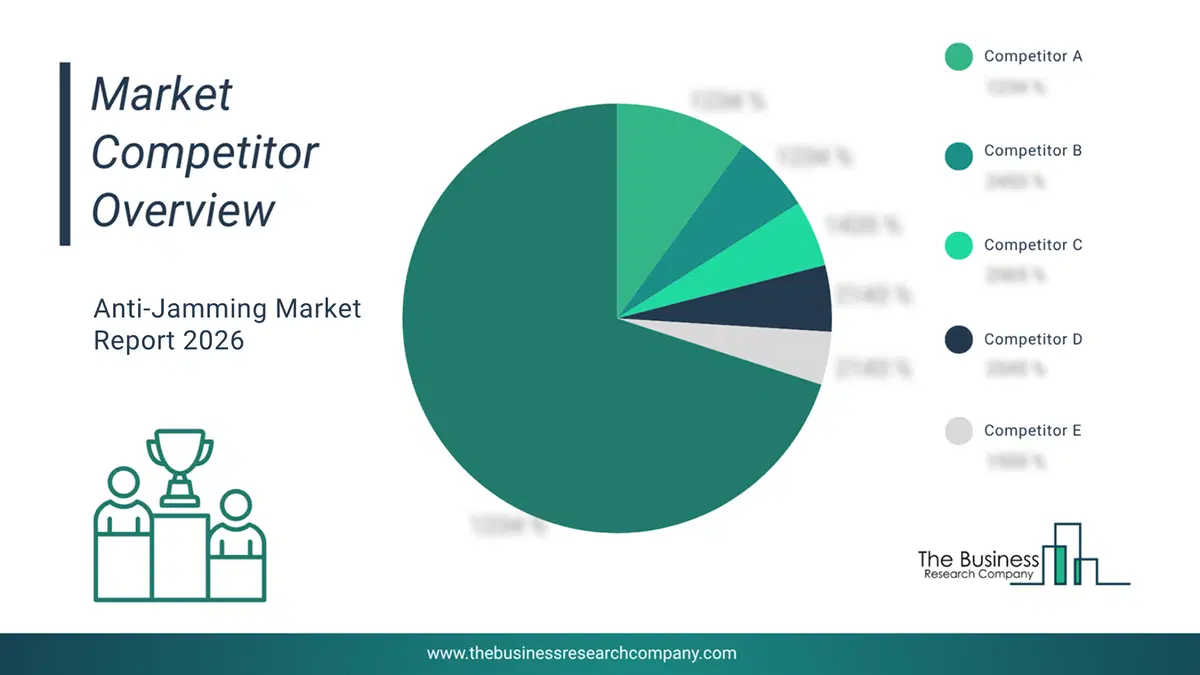
This chart is for illustrative purposes; the full report includes a detailed competitor analysis and comprehensive overview of the top 10 companies in the market.
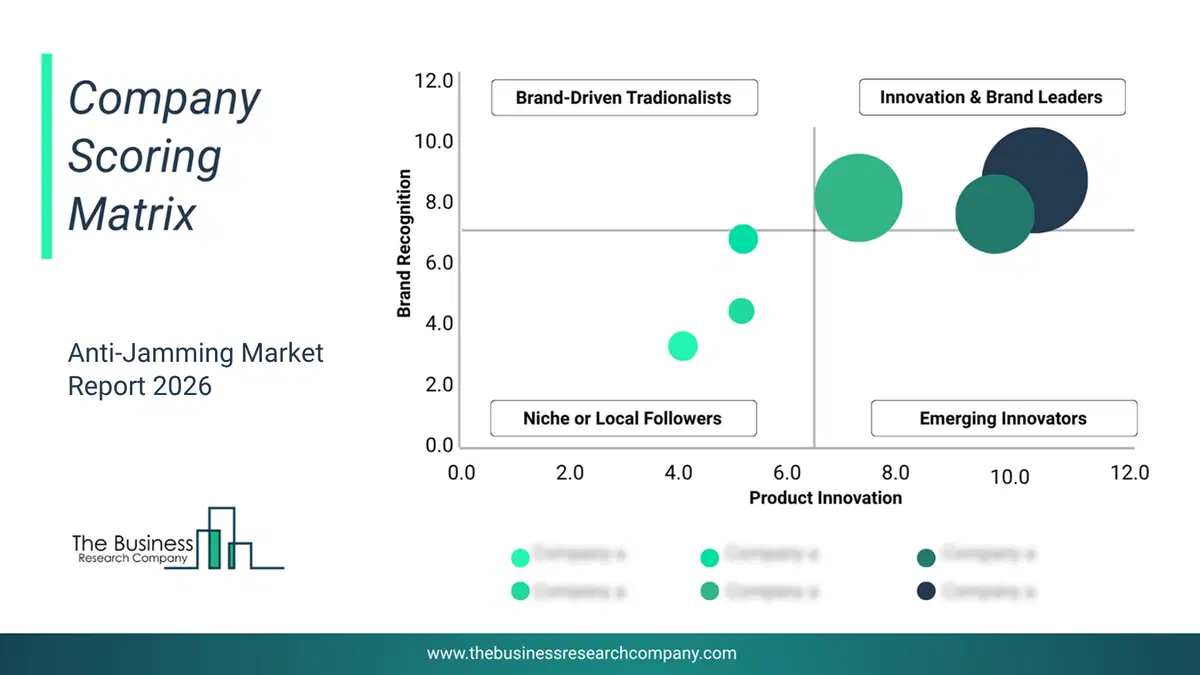
This chart maps companies by product innovation and brand strength, with bubble size indicating relative revenue, helping identify market leaders, challengers, and niche players. This is an illustrative chart; the full report provides a complete and accurate competitive analysis.
Global Anti-Jamming Market Trends and Insights
Major companies operating in the anti-jamming market are focusing on strategic investments to strengthen product deployment and expand their global defense partnerships. Strategic investment refers to the allocation of capital by companies to support innovation, scale production, and access critical markets through financially advantageous collaborations. For instance, in April 2023, Infini Dome, an Israel-based provider of anti-jamming solutions, raised $9 million in Series A funding led by Hanwha Aerospace, one of South Korea’s major corporations. This funding is aimed at accelerating the deployment of infiniDome’s advanced GPSdome2 solution to key defense organizations, including the U.S. Department of Defense (DoD), Israeli Defense Prime, South Korean Army (ROK Armed Forces), and Indian Armed Forces.What Are Latest Mergers And Acquisitions In The Anti-Jamming Market?
In September 2024, the International Federation of Air Traffic Controllers’ Associations (IFATCA), an India-based and the International Federation of Air Line Pilots’ Associations (IFALPA) entered into a formal partnership to cooperate on addressing GNSS jamming and spoofing. Through this collaboration, the two associations aim to enhance aviation safety by sharing expertise, coordinating technical guidance, and developing procedures to mitigate the risks associated with GPS signal interference. IFATCA is an India-based global association representing air traffic controllers, while IFALPA is an international trade association representing airline pilots and advocating for safe and secure air transport operations.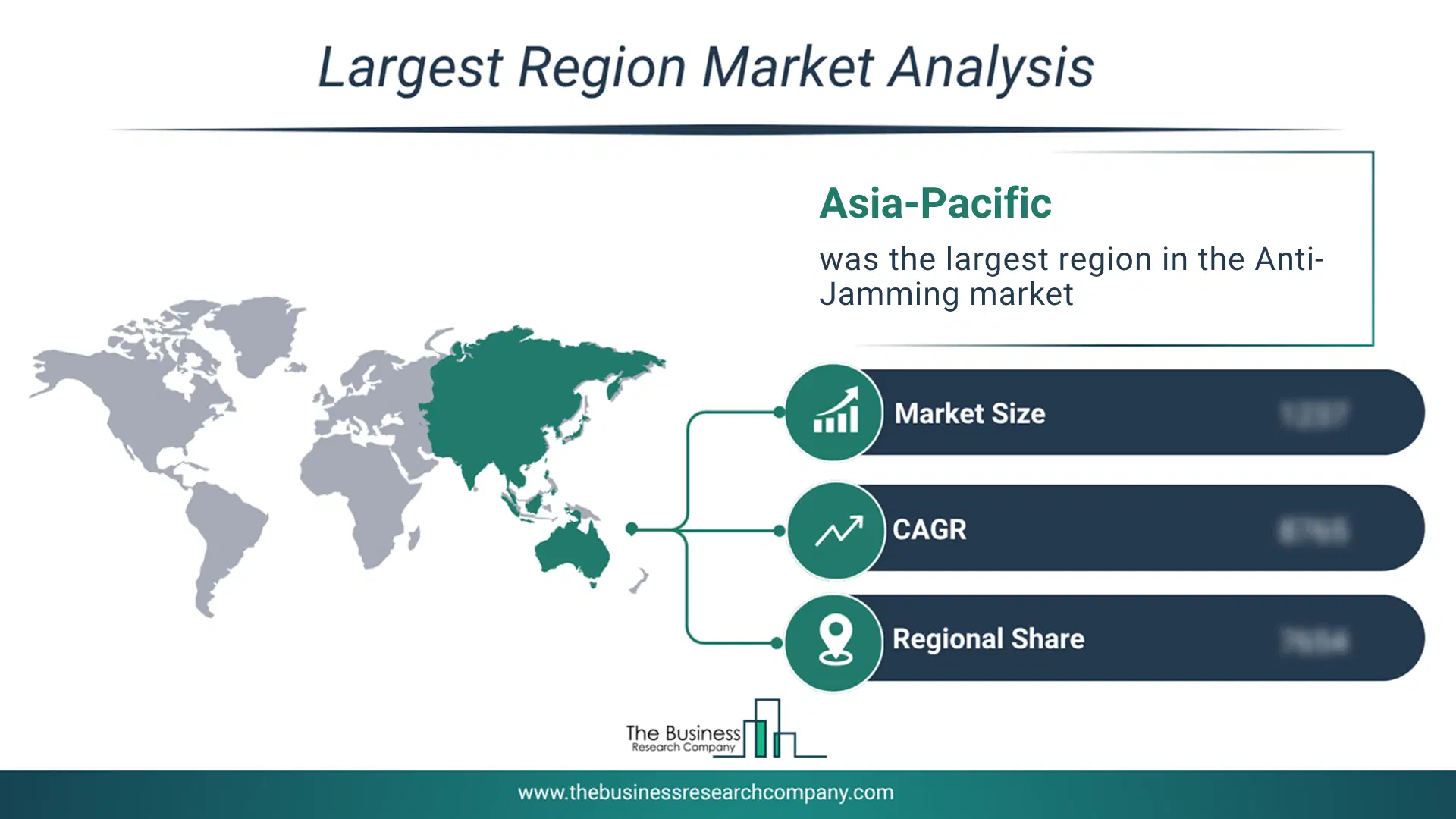
Regional Insights
Asia-Pacific was the largest region in the anti-jamming market in 2025 and is expected to be the fastest-growing region in the forecast period. The regions covered in this market report are Asia-Pacific, South East Asia, Western Europe, Eastern Europe, North America, South America, Middle East, Africa. The countries covered in this market report are Australia, Brazil, China, France, Germany, India, Indonesia, Japan, Taiwan, Russia, South Korea, UK, USA, Canada, Italy, SpainWhat Defines the Anti-Jamming Market?
The anti-jamming market consists of the sale of proactive jammers and reactive jammers. Values in this market are ‘factory gate’ values, that is the value of goods sold by the manufacturers or creators of the goods, whether to other entities (including downstream manufacturers, wholesalers, distributors and retailers) or directly to end customers. The value of goods in this market includes related services sold by the creators of the goods.How is Market Value Defined and Measured?
The market value is defined as the revenues that enterprises gain from the sale of goods and/or services within the specified market and geography through sales, grants, or donations in terms of the currency (in USD unless otherwise specified). The revenues for a specified geography are consumption values that are revenues generated by organizations in the specified geography within the market, irrespective of where they are produced. It does not include revenues from resales along the supply chain, either further along the supply chain or as part of other products.
This chart presents market attractiveness based on a quantitative evaluation of growth, competition, strategic alignment, and risk, offering a clear view of opportunity areas for decision-making. This chart is for illustrative purposes; the full report contains the complete analysis.

This chart highlights the Total Addressable Market (TAM) by estimating the maximum revenue opportunity using an assumption-driven approach, supporting strategic planning and opportunity sizing across markets. The chart is illustrative; the full report provides a more comprehensive analysis.
What Key Data and Analysis Are Included in the Anti-Jamming Market Report 2026?
The anti-jamming market research report is one of a series of new reports from The Business Research Company that provides market statistics, including industry global market size, regional shares, competitors with the market share, detailed market segments, market trends and opportunities, and any further data you may need to thrive in the anti-jamming industry. The market research report delivers a complete perspective of everything you need, with an in-depth analysis of the current and future state of the industry.Anti-Jamming Market Report Forecast Analysis
| Report Attribute | Details |
|---|---|
| Market Size Value In 2026 | $5.76 billion |
| Revenue Forecast In 2030 | $8.49 billion |
| Growth Rate | CAGR of 10.2% from 2026 to 2030 |
| Base Year For Estimation | 2025 |
| Actual Estimates/Historical Data | 2020-2025 |
| Forecast Period | 2026 - 2030 |
| Market Representation | Revenue in USD Billion and CAGR from 2026 to 2030 |
| Segments Covered | Receiver Type, Platform, Application |
| Regional Scope | Asia-Pacific, Western Europe, Eastern Europe, North America, South America, Middle East, Africa |
| Country Scope | The Countries Covered In This Market Report Are Australia, Brazil, China, France, Germany, India, Indonesia, Japan, Taiwan, Russia, South Korea, Uk, Usa, Canada, Italy, Spain. |
| Key Companies Profiled | BAE Systems plc, Cobham Ltd., Thales Group, Collins Aerospace, InfiniDome Ltd., RTX Corporation, Raytheon Technologies Corporation, NovAtel Inc., Mayflower Communications, Furuno Electric Company, Harris Corporation, Lockheed Martin Corporation, Boeing Company, U-blox Holding AG, Israel Aerospace Industries, L3Harris Technologies Inc., Orolia SAS, Forsberg Services Ltd, TUALCOM ELECTRONICS INC., Septentrio NV, Hexagon AB, Singapore Technologies Engineering Ltd, Rohde & Schwarz GmbH & Co. KG, Safran Electronics & Defense Services India Private Limited, Telephonics Corporation, Trimble Inc., UrsaNav Inc. |
| Customization Scope | Request for Customization |
| Pricing And Purchase Options | Explore Purchase Options |