
Antimicrobial Plastics Market Report 2026
Global Outlook – By Product (Commodity Plastics, Engineering Plastics, High-Performance Plastics), By Additive (Inorganic, Organic), By Application (Medical Devices, Healthcare Equipment, Consumer Products, Food Contact Surfaces, Packaging), By End-Use (Building And Construction, Automotive And Transportation, Healthcare, Packaging, Food And Beverage, Textile, Consumer Goods, Other End-Uses) – Market Size, Trends, Strategies, and Forecast to 2030
Antimicrobial Plastics Market Overview
• Antimicrobial Plastics market size has reached to $60.17 billion in 2025 • Expected to grow to $109.87 billion in 2030 at a compound annual growth rate (CAGR) of 12.8% • Growth Driver: Increasing Penetration In Food And Beverages, Packaging, And Healthcare To Drive Growth Of Antimicrobial Plastics Market • Market Trend: Sanitized Launches Puretec For Enhanced Antimicrobial Performance In Synthetic Sportswear • Asia-Pacific was the largest region in 2025 and North America is the fastest growing region.What Is Covered Under Antimicrobial Plastics Market?
Antimicrobial plastics refer to synthetic polymer material containing an integrated and active component that inhibits bacteria growth. Antimicrobials can inhibit or alter one or more of the following cell functions of microorganisms such as cell wall synthesis, protein synthesis, cell membrane functions and nucleic acid synthesis. Antimicrobial plastics are used in healthcare to reduce the spread of microorganisms such as staph, strep, and methicillin-resistant staphylococcus aureus (MRSA) infections. The main type of product of antimicrobial plastics includes commodity plastics, engineering plastics and high-performance plastics. The inorganic market consists of sales of antimicrobial plastics by entities (organizations, sole traders, and partnerships) that are used in petrochemical industries. Inorganic antimicrobial plastics are an inorganic polymer that has a skeletal structure that lacks carbon atoms in the backbone. The main type of additive includes organic and inorganic. The antimicrobial plastics are applied in refining & petrochemical, metals, power generation and others and used in building & construction, automotive & transportation, healthcare, packaging, food & beverage, textile, consumer goods and others.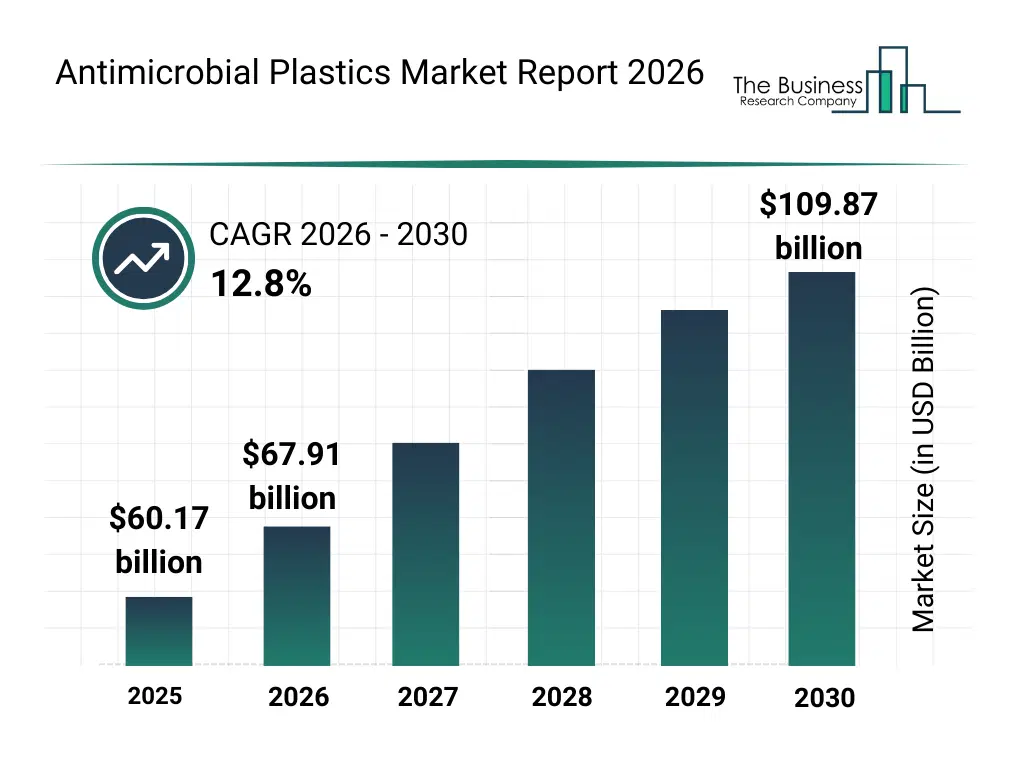
What Is The Antimicrobial Plastics Market Size and Share 2026?
The antimicrobial plastics market size has grown rapidly in recent years. It will grow from $60.17 billion in 2025 to $67.91 billion in 2026 at a compound annual growth rate (CAGR) of 12.9%. The growth in the historic period can be attributed to rising hospital-acquired infection concerns, increased use of plastics in healthcare devices, growing awareness of antimicrobial materials, expansion of plastic usage in food packaging, availability of inorganic antimicrobial additives.What Is The Antimicrobial Plastics Market Growth Forecast?
The antimicrobial plastics market size is expected to see rapid growth in the next few years. It will grow to $109.87 billion in 2030 at a compound annual growth rate (CAGR) of 12.8%. The growth in the forecast period can be attributed to growing demand for antimicrobial consumer goods, rising investments in healthcare infrastructure, expansion of antimicrobial applications in automotive interiors, increasing regulatory focus on hygiene standards, development of bio-based antimicrobial additives. Major trends in the forecast period include increasing adoption of antimicrobial additives in medical plastics, rising demand for infection-resistant polymer surfaces, growing use of high-performance antimicrobial engineering plastics, expansion of antimicrobial packaging applications, enhanced focus on long-lasting antimicrobial efficacy.
Global Antimicrobial Plastics Market Segmentation
1) By Product: Commodity Plastics, Engineering Plastics, High-Performance Plastics 2) By Additive: Inorganic, Organic 3) By Application: Medical Devices, Healthcare Equipment, Consumer Products, Food Contact Surfaces, Packaging 4) By End-Use: Building And Construction, Automotive And Transportation, Healthcare, Packaging, Food And Beverage, Textile, Consumer Goods, Other End-Uses Subsegments: 1) By Commodity Plastics: Polyethylene (PE), Polypropylene (PP), Polyvinyl Chloride (PVC), Polystyrene (PS) 2) By Engineering Plastics: Polycarbonate (PC), Polyamide (Nylon), Acrylonitrile Butadiene Styrene (ABS), PBT (Polybutylene Terephthalate) 3) By High-Performance Plastics: Polyetheretherketone (PEEK), Polysulfone (PSU), Polyphenylene Sulfide (PPS), FluoropolymersWhat Is The Driver Of The Antimicrobial Plastics Market?
The increasing penetration in food and beverages, packaging, and healthcare is expected to drive the growth of the antimicrobial plastics market going forward. Packaging for food and beverages using antimicrobial plastics provides protection, tamper resistance, and unique physical, chemical, or biological requirements for the food and beverages. Widespread penetration of food and beverages, packaging, and healthcare in antimicrobial plastics is boosting the growth of the market. For instance, in December 2024, according to the FoodNavigator, a UK-based leading online B2B digital media platform, total “CPG” (consumer-packaged-goods) store?sales volumes for food and beverage rose 1.1% in 2024 the first increase in three years. Therefore, the increasing penetration in food and beverages, packaging, and healthcare is expected to propel the growth of the antimicrobial plastics industry.Key Players In The Global Antimicrobial Plastics Market
Major companies operating in the antimicrobial plastics market are DuPont de Nemours Inc., BASF SE, Microban International, Sanitized AG, RTP Company, Milliken & Company, PolyOne Corporation, Lonza Group, BioCote Ltd., Wells Plastics Ltd., Akcros Chemicals, Addmaster (UK) Ltd., SANITIZED Preservation AG, Microbe Inotech Laboratories Inc., Tosaf, Radici Group, Americhem, Mexichem Specialty Compounds, King Plastic Corporation, Biomerics LLC, Ferro Corporation
This chart is for illustrative purposes; the full report includes a detailed competitor analysis and comprehensive overview of the top 10 companies in the market.
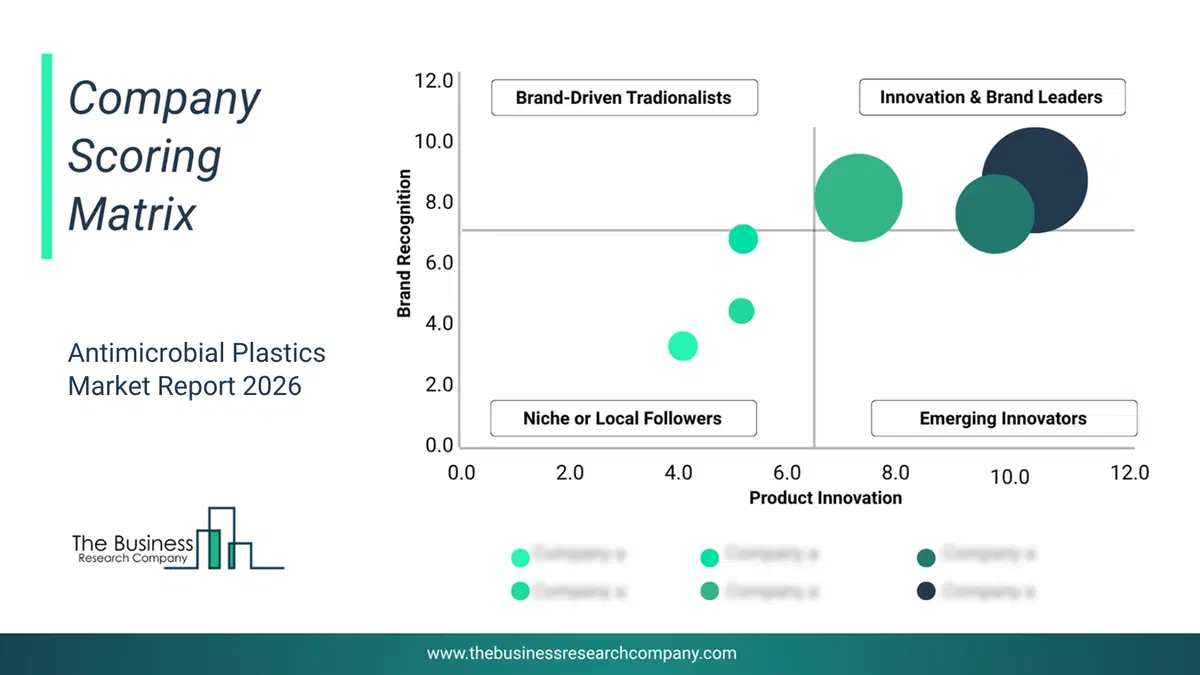
This chart maps companies by product innovation and brand strength, with bubble size indicating relative revenue, helping identify market leaders, challengers, and niche players. This is an illustrative chart; the full report provides a complete and accurate competitive analysis.
Global Antimicrobial Plastics Market Trends and Insights
Major companies operating in the antimicrobial plastics market are developing innovative technologies, such as antimicrobial and antifungal additives, to enhance material protection, prevent microbial growth, and meet rising demand for hygienic and durable plastic products across multiple industries. Antimicrobial and antifungal additives are specialized substances incorporated into materials to inhibit the growth of bacteria, mold, and fungi by interfering with their metabolic activity, helping prevent contamination, odors, discoloration, and material degradation compared to untreated plastics. For instance, in December 2023, Avient Corporation, a US-based provider of specialized and sustainable material solutions and services, launched Cesa Withstand. Designed to improve the performance of thermoplastic polyurethane (TPU)-laminated products, Cesa Withstand helps control microbial growth across sectors, including medical, outdoor, aviation, marine, and industrial markets. It restricts the formation of bacteria, mold, and fungi on treated surfaces, thereby preventing odor, staining, and reduced mechanical strength. The solution has been validated through international standards such as JIS 2801 and rigorous antifungal testing and is tailored for applications such as medical beds, transparent tent materials, and ice bags.What Are Latest Mergers And Acquisitions In The Antimicrobial Plastics Market?
In July 2024, DuPont de Nemours, Inc, a US-based multinational chemical company Donatelle Plastics Incorporated for $313 million With this acquisition, DuPont's aims to expand its healthcare solutions, particularly in high-growth therapeutic areas such as electrophysiology, drug delivery, diagnostics, cardiac rhythm management, neurostimulation, and orthopedic extremities. Donatelle Plastics Incorporated, Us-based medical device contract manufacturer company.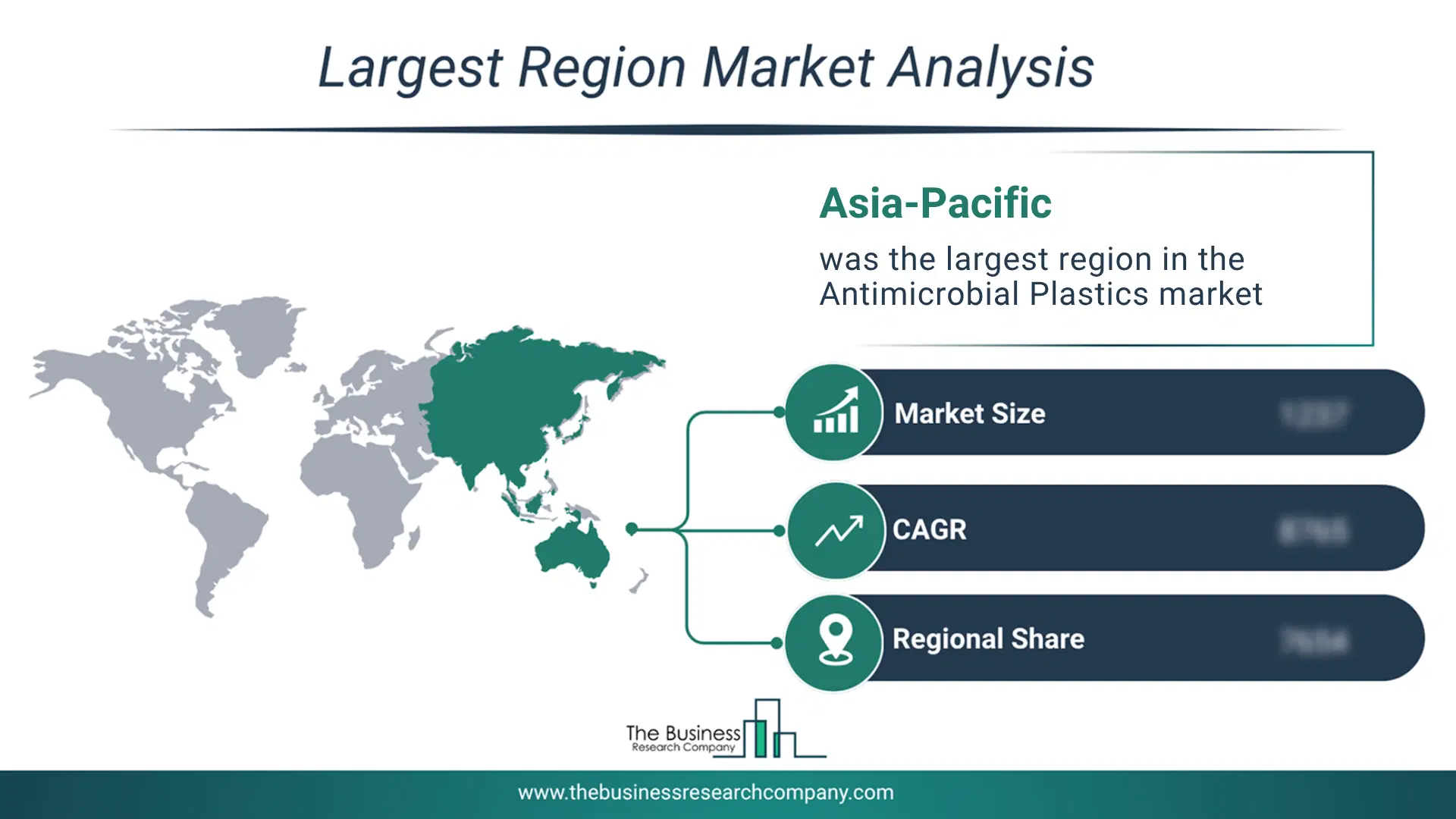
Regional Outlook
Asia-Pacific was the largest region in the antimicrobial plastics market in 2025. North America is expected to be the fastest-growing region in the forecast period. The regions covered in this market report are Asia-Pacific, South East Asia, Western Europe, Eastern Europe, North America, South America, Middle East, Africa. The countries covered in this market report are Australia, Brazil, China, France, Germany, India, Indonesia, Japan, Taiwan, Russia, South Korea, UK, USA, Canada, Italy, Spain.What Defines the Antimicrobial Plastics Market?
The antimicrobial plastics market consists of sales of polyamide, polybutylene terephthalate, polycarbonate, and PC/ABS blends. Values in this market are ‘factory gate’ values, that is the value of goods sold by the manufacturers or creators of the goods, whether to other entities (including downstream manufacturers, wholesalers, distributors and retailers) or directly to end customers. The value of goods in this market includes related services sold by the creators of the goods.How is Market Value Defined and Measured?
The market value is defined as the revenues that enterprises gain from the sale of goods and/or services within the specified market and geography through sales, grants, or donations in terms of the currency (in USD unless otherwise specified). The revenues for a specified geography are consumption values that are revenues generated by organizations in the specified geography within the market, irrespective of where they are produced. It does not include revenues from resales along the supply chain, either further along the supply chain or as part of other products.
This chart presents market attractiveness based on a quantitative evaluation of growth, competition, strategic alignment, and risk, offering a clear view of opportunity areas for decision-making. This chart is for illustrative purposes; the full report contains the complete analysis.

This chart highlights the Total Addressable Market (TAM) by estimating the maximum revenue opportunity using an assumption-driven approach, supporting strategic planning and opportunity sizing across markets. The chart is illustrative; the full report provides a more comprehensive analysis.
What Key Data and Analysis Are Included in the Antimicrobial Plastics Market Report 2026?
The antimicrobial plastics market research report is one of a series of new reports from The Business Research Company that provides market statistics, including Market Report 2026?global market size, regional shares, competitors with the market share, detailed market segments, market trends and opportunities, and any further data you may need to thrive in the antimicrobial plastics Market Report 2026? The market research report delivers a complete perspective of everything you need, with an in-depth analysis of the current and future state of the Market Report 2026?Antimicrobial Plastics Market Report Forecast Analysis
| Report Attribute | Details |
|---|---|
| Market Size Value In 2026 | $67.91 billion |
| Revenue Forecast In 2030 | $109.87 billion |
| Growth Rate | CAGR of 12.9% from 2026 to 2030 |
| Base Year For Estimation | 2025 |
| Actual Estimates/Historical Data | 2020-2025 |
| Forecast Period | 2026 - 2030 |
| Market Representation | Revenue in USD Billion and CAGR from 2026 to 2030 |
| Segments Covered | Product, Additive, Application, End-Use |
| Regional Scope | Asia-Pacific, Western Europe, Eastern Europe, North America, South America, Middle East, Africa |
| Country Scope | The countries covered in the report are Australia, Brazil, China, France, Germany, India, Indonesia, Japan, Taiwan, Russia, South Korea, UK, USA, Canada, Italy, Spain. |
| Key Companies Profiled | DuPont de Nemours Inc., BASF SE, Microban International, Sanitized AG, RTP Company, Milliken & Company, PolyOne Corporation, Lonza Group, BioCote Ltd., Wells Plastics Ltd., Akcros Chemicals, Addmaster (UK) Ltd., SANITIZED Preservation AG, Microbe Inotech Laboratories Inc., Tosaf, Radici Group, Americhem, Mexichem Specialty Compounds, King Plastic Corporation, Biomerics LLC, Ferro Corporation |
| Customization Scope | Request for Customization |
| Pricing And Purchase Options | Explore Purchase Options |