
Artificial Intelligence (AI)-Based Orthopedic Imaging Market Report 2026
Global Outlook – By Component (Software, Hardware, Services), By Modality (X-Ray, Computed Tomography (CT), Magnetic Resonance Imaging (MRI), Other Modalities), By Deployment Mode (On-Premises, Cloud-Based), By Application (Fracture Detection, Bone Age Assessment, Joint Disease Diagnosis, Bone Tumor Detection, Other Applications) – Market Size, Trends, Strategies, and Forecast to 2030
Artificial Intelligence (AI)-Based Orthopedic Imaging Market Overview
• Artificial Intelligence (AI)-Based Orthopedic Imaging market size has reached to $2.2 billion in 2025 • Expected to grow to $9.56 billion in 2030 at a compound annual growth rate (CAGR) of 34.1% • Growth Driver: Increasing Incidence Of Musculoskeletal Disorders Fueling The Growth Of The Market Due To Rising Aging Population And Joint Degeneration • Market Trend: AI-Powered Innovation Enhances Real-Time Tendon Detection • North America was the largest region in 2025 and Asia Pacific is the fastest growing region.What Is Covered Under Artificial Intelligence (AI)-Based Orthopedic Imaging Market?
Artificial Intelligence (AI)-based orthopedic imaging refers to the use of AI algorithms to analyze medical images of the musculoskeletal system, including bones, joints, and soft tissues. It assists radiologists and orthopedic specialists in identifying fractures, degenerative changes, and other abnormalities more quickly and accurately. It helps to enhance diagnostic precision, streamline workflow, and support personalized treatment planning in orthopedic care. The main components of artificial intelligence (AI)-based orthopedic imaging include software, hardware, and services. Software refers to digital tools that use AI to analyze musculoskeletal images, helping detect abnormalities, improve diagnostic accuracy, and support treatment planning. It is applied across various modalities such as X-ray, computed tomography (CT), magnetic resonance imaging (MRI), and others. It can be deployed either on-premises or cloud-based modes, and is used in applications including fracture detection, bone age assessment, joint disease diagnosis, bone tumor detection, and others.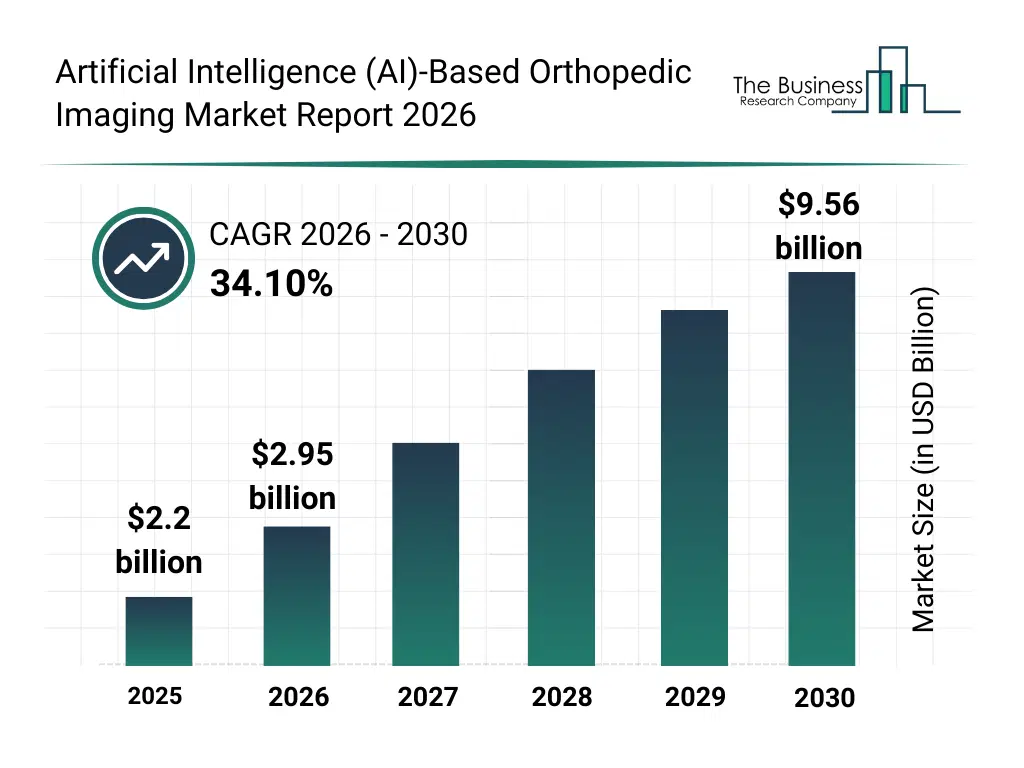
What Is The Artificial Intelligence (AI)-Based Orthopedic Imaging Market Size and Share 2026?
The artificial intelligence (ai)-based orthopedic imaging market size has grown exponentially in recent years. It will grow from $2.2 billion in 2025 to $2.95 billion in 2026 at a compound annual growth rate (CAGR) of 34.4%. The growth in the historic period can be attributed to increasing prevalence of orthopedic disorders, rising number of imaging centers, adoption of digital radiography, early ai adoption in imaging, growth of hospital it infrastructure.What Is The Artificial Intelligence (AI)-Based Orthopedic Imaging Market Growth Forecast?
The artificial intelligence (ai)-based orthopedic imaging market size is expected to see exponential growth in the next few years. It will grow to $9.56 billion in 2030 at a compound annual growth rate (CAGR) of 34.1%. The growth in the forecast period can be attributed to demand for personalized orthopedic care, integration with predictive analytics, expansion of cloud-based imaging, increasing ai-driven diagnostics adoption, growth in minimally invasive orthopedic procedures. Major trends in the forecast period include AI-assisted fracture detection, predictive orthopedic analytics, cloud-based imaging platforms, integration with hospital pacs systems, automated bone density analysis.
Global Artificial Intelligence (AI)-Based Orthopedic Imaging Market Segmentation
1) By Component: Software, Hardware, Services 2) By Modality: X-Ray, Computed Tomography (CT), Magnetic Resonance Imaging (MRI), Other Modalities 3) By Deployment Mode: On-Premises, Cloud-Based 4) By Application: Fracture Detection, Bone Age Assessment, Joint Disease Diagnosis, Bone Tumor Detection, Other Applications Subsegments: 1) By Software: Image Analysis And Processing Software, Visualization And Detection Software, Workflow Management Software, Diagnostic And Predictive Analytics Software, Machine Learning And Deep Learning Algorithms 2) By Hardware: Imaging Systems, AI-Integrated Imaging Devices, Graphics Processing Units (GPUs) Or Processing Units, Workstations And Servers, Data Storage Systems 3) By Services: Installation And Integration Services, Training And Education Services, Consulting Services, Maintenance And Support Services, Cloud-Based Artificial Intelligence (AI) ServicesWhat Is The Driver Of The Artificial Intelligence (AI)-Based Orthopedic Imaging Market?
The increasing incidence of musculoskeletal disorders is expected to propel the growth of the artificial intelligence (AI)-based orthopedic imaging market going forward. Musculoskeletal disorders refer to conditions affecting muscles, bones, joints, tendons, and ligaments that cause pain or impair movement. The rise in incidence of musculoskeletal disorders is due to the aging population, as people naturally experience joint degeneration and reduced bone density over time. Artificial intelligence (AI)-based orthopedic imaging aids in musculoskeletal disorder diagnosis by delivering precise image analysis, enabling early detection of abnormalities. It reduces diagnostic errors through automated interpretation, improving clinical efficiency and supporting personalized treatment planning. For instance, in January 2024, according to the Office for Health Improvement and Disparities, a UK-based government department, the prevalence of long-term musculoskeletal (MSK) conditions in people aged 16 and over who self-reported was 18.4% in 2023, an increase from 17.6% in 2022. Therefore, the increasing incidence of musculoskeletal disorders is driving the growth of the artificial intelligence (AI)-based orthopedic imaging industry.Key Players In The Global Artificial Intelligence (AI)-Based Orthopedic Imaging Market
Major companies operating in the artificial intelligence (ai)-based orthopedic imaging market are United Imaging Intelligence Co. Ltd., Carestream Health Inc., Brainlab AG, Materialise NV, Aidoc Medical Ltd., Qure.ai Technologies Private Limited, Clarius Mobile Health Corp., Quibim S.L., RSIP Vision Ltd., GLEAMER SAS, Nano-X Imaging Ltd., CurveBeam AI Inc., AZmed SAS, VUNO Inc., Radiobotics ApS, PeekMed – Peek Health S.A., ImageBiopsy Lab GmbH, Synapsica Healthcare Pvt. Ltd., Oxipit UAB, Milvue SAS, Raylytic Software GmbH
This chart is for illustrative purposes; the full report includes a detailed competitor analysis and comprehensive overview of the top 10 companies in the market.
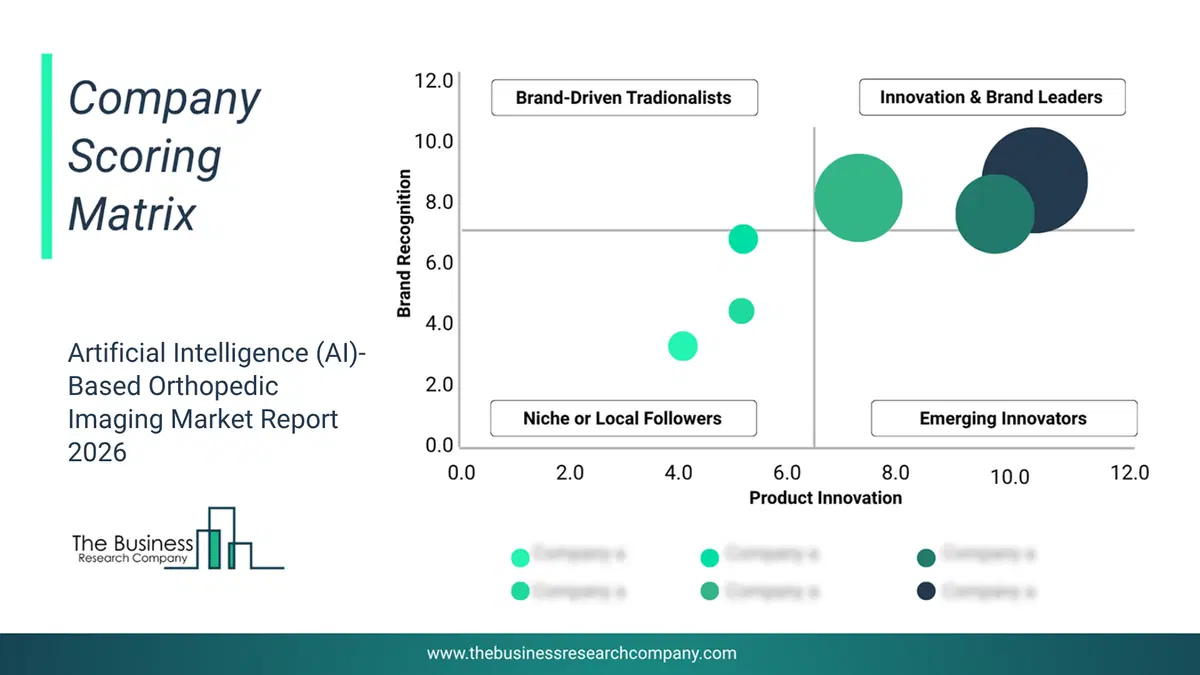
This chart maps companies by product innovation and brand strength, with bubble size indicating relative revenue, helping identify market leaders, challengers, and niche players. This is an illustrative chart; the full report provides a complete and accurate competitive analysis.
Global Artificial Intelligence (AI)-Based Orthopedic Imaging Market Trends and Insights
Major companies operating in the artificial intelligence (AI)-based orthopedic imaging market are focusing on developing advanced solutions, such as advanced AI models, to enhance diagnosis, streamline workflows, and support personalized care. Advanced AI models refer to sophisticated algorithms that analyze medical images to detect abnormalities, automate interpretation, and support personalized treatment. For instance, in February 2023, Clarius Mobile Health, a Canada-based medical imaging company, received US Food and Drug Administration (FDA) 510(k) clearance for its Clarius musculoskeletal (MSK) AI model, designed to automatically identify and measure tendons in the foot, ankle, and knee using AI, and will be compatible with the Clarius L7 HD3 and L15 HD3 handheld ultrasound scanners. This innovation aims to simplify musculoskeletal ultrasound by assisting clinicians in real-time tendon detection, labeling, and measurement, improving workflow, standardizing measurements, and reducing interobserver variability. This AI-enhanced scanner makes high-definition imaging more accessible and user-friendly, enabling faster, more accurate patient care.What Are Latest Mergers And Acquisitions In The Artificial Intelligence (AI)-Based Orthopedic Imaging Market?
In March 2025, moveUP.care, a Belgium-based healthcare company, acquired Deep Structure.ai for an undisclosed amount. With this acquisition, moveUP aims to strengthen its U.S. presence and enhance orthopedic care by using Deep Structure’s AI solutions to enable personalized, efficient, and evidence-based treatment. Deep Structure.ai is a US-based medical equipment manufacturing company specializing in artificial intelligence (AI)-based orthopedic imaging and care solutions.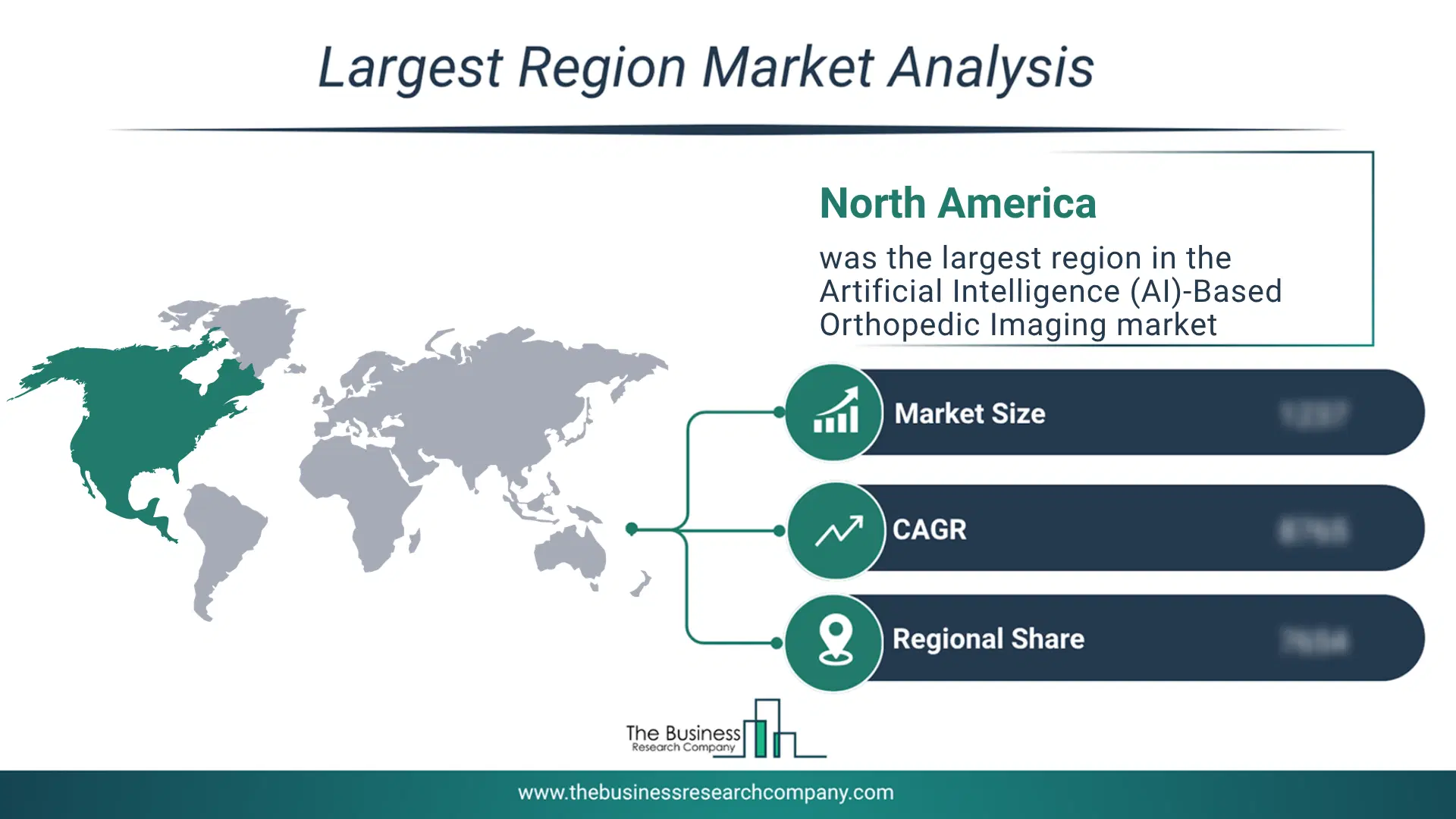
Regional Outlook
North America was the largest region in the artificial intelligence (AI)-based orthopedic imaging market in 2025. Asia-Pacific is expected to be the fastest-growing region in the forecast period. The regions covered in this market report are Asia-Pacific, South East Asia, Western Europe, Eastern Europe, North America, South America, Middle East, Africa. The countries covered in this market report are Australia, Brazil, China, France, Germany, India, Indonesia, Japan, Taiwan, Russia, South Korea, UK, USA, Canada, Italy, SpainWhat Defines the Artificial Intelligence (AI)-Based Orthopedic Imaging Market?
The artificial intelligence (AI)-based orthopedic imaging market consists of revenues earned by entities by providing services such as automated image interpretation, fracture detection, bone density assessment, joint degeneration analysis, surgical planning support, workflow optimization, and clinical decision support for musculoskeletal disorders. The market value includes the value of related goods sold by the service provider or included within the service offering. The artificial intelligence (AI)-based orthopedic imaging market also includes sales of AI-powered imaging software, digital radiology platforms, orthopedic diagnostic tools, and automated image analysis systems. Values in this market are ‘factory gate’ values, that is the value of goods sold by the manufacturers or creators of the goods, whether to other entities (including downstream manufacturers, wholesalers, distributors and retailers) or directly to end customers. The value of goods in this market includes related services sold by the creators of the goods.How is Market Value Defined and Measured?
The market value is defined as the revenues that enterprises gain from the sale of goods and/or services within the specified market and geography through sales, grants, or donations in terms of the currency (in USD unless otherwise specified). The revenues for a specified geography are consumption values that are revenues generated by organizations in the specified geography within the market, irrespective of where they are produced. It does not include revenues from resales along the supply chain, either further along the supply chain or as part of other products.
This chart presents market attractiveness based on a quantitative evaluation of growth, competition, strategic alignment, and risk, offering a clear view of opportunity areas for decision-making. This chart is for illustrative purposes; the full report contains the complete analysis.

This chart highlights the Total Addressable Market (TAM) by estimating the maximum revenue opportunity using an assumption-driven approach, supporting strategic planning and opportunity sizing across markets. The chart is illustrative; the full report provides a more comprehensive analysis.
What Key Data and Analysis Are Included in the Artificial Intelligence (AI)-Based Orthopedic Imaging Market Report 2026?
The artificial intelligence (ai)-based orthopedic imaging market research report is one of a series of new reports from The Business Research Company that provides market statistics, including industry global market size, regional shares, competitors with the market share, detailed market segments, market trends and opportunities, and any further data you may need to thrive in the artificial intelligence (ai)-based orthopedic imaging industry. The market research report delivers a complete perspective of everything you need, with an in-depth analysis of the current and future state of the industry.Artificial Intelligence (AI)-Based Orthopedic Imaging Market Report Forecast Analysis
| Report Attribute | Details |
|---|---|
| Market Size Value In 2026 | $2.95 billion |
| Revenue Forecast In 2030 | $9.56 billion |
| Growth Rate | CAGR of 34.1% from 2026 to 2030 |
| Base Year For Estimation | 2025 |
| Actual Estimates/Historical Data | 2020-2025 |
| Forecast Period | 2026 - 2030 |
| Market Representation | Revenue in USD Billion and CAGR from 2026 to 2030 |
| Segments Covered | Component, Modality, Deployment Mode, Application |
| Regional Scope | Asia-Pacific, Western Europe, Eastern Europe, North America, South America, Middle East, Africa |
| Country Scope | The countries covered in the report are Australia, Brazil, China, France, Germany, India, Indonesia, Japan, Taiwan, Russia, South Korea, UK, USA, Canada, Italy, Spain. |
| Key Companies Profiled | United Imaging Intelligence Co. Ltd., Carestream Health Inc., Brainlab AG, Materialise NV, Aidoc Medical Ltd., Qure.ai Technologies Private Limited, Clarius Mobile Health Corp., Quibim S.L., RSIP Vision Ltd., GLEAMER SAS, Nano-X Imaging Ltd., CurveBeam AI Inc., AZmed SAS, VUNO Inc., Radiobotics ApS, PeekMed – Peek Health S.A., ImageBiopsy Lab GmbH, Synapsica Healthcare Pvt. Ltd., Oxipit UAB, Milvue SAS, Raylytic Software GmbH |
| Customization Scope | Request for Customization |
| Pricing And Purchase Options | Explore Purchase Options |