
Artificial Intelligence (AI)-Enhanced Antenatal Remote Monitoring Market Report 2026
Global Outlook – By Component (Software, Hardware, Services), By Technology (Artificial Intelligence Analytics, Internet Of Things (IoT) Enabled Monitoring, Cloud Based Platforms, Mobile Health Applications), By Deployment Mode (Cloud Based, On Premises), By Application (High Risk Pregnancy Management, Routine Prenatal Care, Fetal Monitoring, Maternal Health Monitoring, Other Applications), By End User (Hospitals, Clinics, Homecare Settings, Diagnostic Centers, Other End Users) – Market Size, Trends, Strategies, and Forecast to 2030
Artificial Intelligence (AI)-Enhanced Antenatal Remote Monitoring Market Overview
• Artificial Intelligence (AI)-Enhanced Antenatal Remote Monitoring market size has reached to $1.47 billion in 2025 • Expected to grow to $3.32 billion in 2030 at a compound annual growth rate (CAGR) of 17.7% • Growth Driver: Surge In Rising Investments In Digital Health Fueling The Growth Of The Market Due To Increasing Venture Capital Inflows Into AI-Enabled Healthcare Solutions • Market Trend: Technological Advancement In Artificial Intelligence (AI) Algorithms Reshaping Fetal Heart Rate Pattern Recognition In Perinatal Care • North America was the largest region in 2025 and Asia-Pacific is the fastest growing region.What Is Covered Under Artificial Intelligence (AI)-Enhanced Antenatal Remote Monitoring Market?
Artificial intelligence (AI)-enhanced antenatal remote monitoring refers to the use of AI-driven digital health solutions to remotely monitor and evaluate the health of pregnant women and developing fetuses throughout pregnancy. These technologies help enable early identification of pregnancy-related complications, enhance maternal and fetal health outcomes, minimize unnecessary hospital visits, and provide continuous, personalized prenatal care through real-time data analysis and predictive insights. The main components of artificial intelligence (AI)-enhanced antenatal remote monitoring include software, hardware, and services. Software refers to AI-powered platforms used for real-time analysis of maternal and fetal health data to enable early risk detection and continuous prenatal monitoring. These systems are built using technologies such as artificial intelligence analytics, internet of things (IoT) enabled monitoring, cloud based platforms, and mobile health applications and are deployed through cloud based and on premises deployment modes. The key applications of high risk pregnancy management, routine prenatal care, fetal monitoring, maternal health monitoring, and others, while the end-use includes hospitals, clinics, homecare settings, diagnostic centers, and others.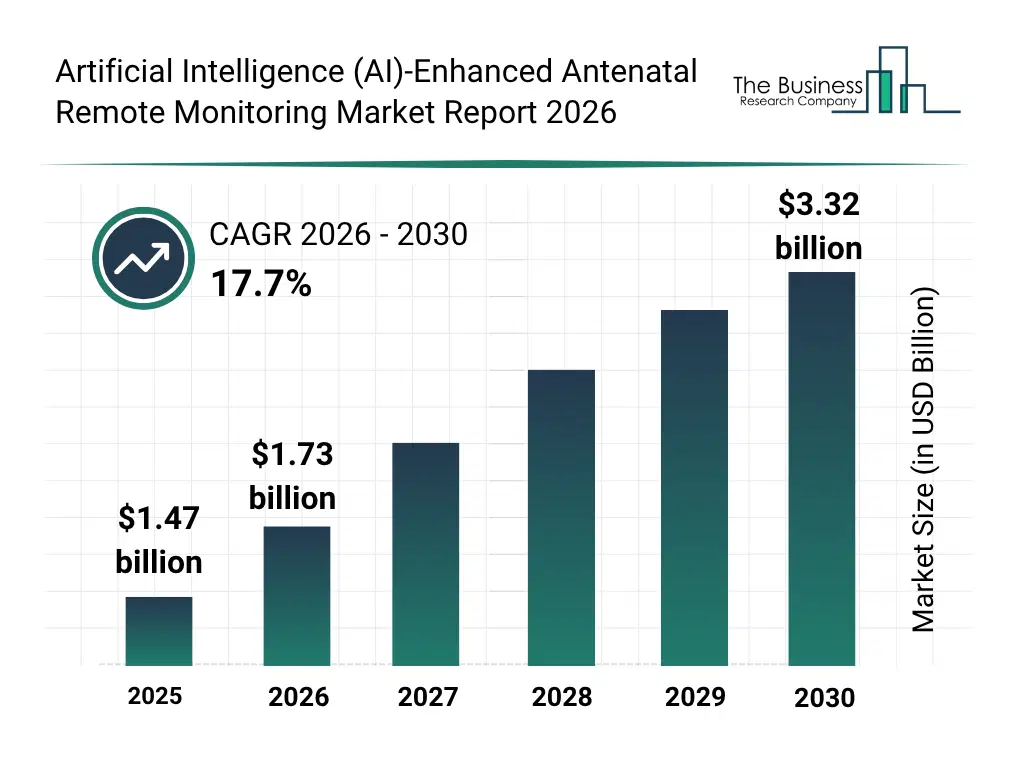
What Is The Artificial Intelligence (AI)-Enhanced Antenatal Remote Monitoring Market Size and Share 2026?
The artificial intelligence (AI)-enhanced antenatal remote monitoring market size has grown rapidly in recent years. It will grow from $1.47 billion in 2025 to $1.73 billion in 2026 at a compound annual growth rate (CAGR) of 17.5%. The growth in the historic period can be attributed to increasing prevalence of high risk pregnancies, rising adoption of telemedicine and remote healthcare services, growing awareness regarding maternal and fetal health monitoring, advancements in wearable and connected medical devices, increasing healthcare digitalization initiatives.What Is The Artificial Intelligence (AI)-Enhanced Antenatal Remote Monitoring Market Growth Forecast?
The artificial intelligence (AI)-enhanced antenatal remote monitoring market size is expected to see rapid growth in the next few years. It will grow to $3.32 billion in 2030 at a compound annual growth rate (CAGR) of 17.7%. The growth in the forecast period can be attributed to growing integration of AI based predictive analytics in prenatal care, rising demand for home based maternal healthcare solutions, increasing investments in cloud based healthcare infrastructure, expanding adoption of remote patient monitoring services in emerging economies, growing focus on personalized and preventive prenatal healthcare. Major trends in the forecast period include integration of predictive AI algorithms for early pregnancy complication detection, rising adoption of IoT enabled wearable fetal and maternal monitoring devices, increasing use of cloud based antenatal data management and analytics platforms, growing implementation of precision medicine approaches in prenatal monitoring solutions, expansion of immersive virtual prenatal consultation and patient engagement experiences.
Global Artificial Intelligence (AI)-Enhanced Antenatal Remote Monitoring Market Segmentation
1) By Component: Software, Hardware, Services 2) By Technology: Artificial Intelligence Analytics, Internet Of Things (IoT) Enabled Monitoring, Cloud Based Platforms, Mobile Health Applications 3) By Deployment Mode: Cloud Based, On Premises 4) By Application: High Risk Pregnancy Management, Routine Prenatal Care, Fetal Monitoring, Maternal Health Monitoring, Other Applications 5) By End User: Hospitals, Clinics, Homecare Settings, Diagnostic Centers, Other End Users Subsegments: 1) By Software: Data Analytics Platforms, Remote Monitoring Applications, Clinical Decision Support Systems, Patient Engagement Platforms, Telehealth Software Solutions 2) By Hardware: Wearable Monitoring Devices, Portable Monitoring Devices, Home Based Monitoring Equipment, Sensor Based Monitoring Devices, Connected Medical Devices 3) By Services: Remote Patient Monitoring Services, Teleconsultation Services, Data Management Services, Technical Support And Maintenance Services, Training And Education ServicesWhat Is The Driver Of The Artificial Intelligence (AI)-Enhanced Antenatal Remote Monitoring Market?
The rising investments in digital health are expected to propel the growth of the artificial intelligence (AI)-enhanced antenatal remote monitoring market going forward. Investments in digital health involve funding advanced healthcare technologies, connected medical devices, digital platforms, and AI-based solutions to enhance healthcare efficiency, patient monitoring, and clinical outcomes. Investments in digital health are rising due to the growing adoption of telemedicine to improve healthcare access and convenience for patients. Investments in digital health support artificial intelligence (AI)-enhanced antenatal remote monitoring by advancing connected healthcare infrastructure, wearable technologies, and data-driven maternal care solutions that enable continuous remote tracking of maternal and fetal health for early risk detection and personalized prenatal care. For instance, in January 2026, according to Rock Health Inc., a US-based health technology company, annual funding for US digital health startups increased by 35% to reach $14.2 billion in 2025 from $10.5 billion in 2024. Therefore, the rising investments in digital health are driving the growth of the artificial intelligence (AI)-enhanced antenatal remote monitoring industry.Key Players In The Global Artificial Intelligence (AI)-Enhanced Antenatal Remote Monitoring Market
Major companies operating in the artificial intelligence (ai)-enhanced antenatal remote monitoring market are GE HealthCare Technologies Inc., Siemens Healthineers AG, Philips Healthcare, Oracle Health Inc., Medtronic plc, Masimo Corporation, Garmin Health Inc., Withings Health Solutions SAS, Current Health Ltd., Sibel Health Inc., Pulsenmore Ltd., PeriGen Inc., Validic Inc., HeraMED Limited, Nuvo Group Ltd., Babyscripts Inc., Marani Health, Bloomlife Inc., Janitri Innovations Private Limited, CareNX Innovations Private Limited, MindChild Medical Inc.Global Artificial Intelligence (AI)-Enhanced Antenatal Remote Monitoring Market Trends and Insights
Major companies operating in the artificial intelligence (AI)-enhanced antenatal remote monitoring market are focusing on developing advanced AI-powered fetal monitoring solutions to enhance early detection of fetal distress, improve clinical decision-making, and support better management of high-risk pregnancies. Artificial intelligence (AI)-powered fetal monitoring refers to the use of artificial intelligence algorithms to analyze fetal heart rate patterns and provide predictive insights that assist clinicians in identifying abnormal conditions during pregnancy. For instance, in February 2025, PeriGen Inc., a US-based perinatal software company, received Food and Drug Administration (FDA) clearance for Patterns 3.0, its artificial intelligence (AI)-powered fetal heart rate pattern recognition platform designed to expand monitoring capabilities from 36 weeks to 32 weeks of gestational age. The platform provides early warning alerts for indeterminate and abnormal fetal heart rate patterns in high-risk preterm pregnancies while integrating with clinical workflow decision-support systems to support timely interventions and help address nursing shortages in labor and delivery environments.What Are Latest Mergers And Acquisitions In The Artificial Intelligence (AI)-Enhanced Antenatal Remote Monitoring Market?
In August 2024, Samsung Medison Co., Ltd., a South Korea-based medical equipment company, acquired Sonio SAS for an undisclosed amount. Through this acquisition, Samsung Medison strengthened its AI-enhanced antenatal remote monitoring capabilities by integrating Sonio’s cloud-based fetal ultrasound analytics, real-time diagnostic assistance, and maternal-fetal imaging technologies into its women’s health and tele-sonography ecosystem. Sonio SAS is a France-based artificial intelligence (AI)-powered maternal-fetal imaging and prenatal diagnostic software company providing cloud-based antenatal monitoring and fetal ultrasound analytics solutions.Regional Outlook
North America was the largest region in the artificial intelligence (AI)-enhanced antenatal remote monitoring market in 2025. Asia-Pacific is expected to be the fastest-growing region in the forecast period. The regions covered in this market report are Australia, Brazil, China, France, Germany, India, Indonesia, Japan, Taiwan, Russia, South Korea, UK, USA, Canada, Italy, Spain. The countries covered in this market report are Australia, Brazil, China, France, Germany, India, Indonesia, Japan, Taiwan, Russia, South Korea, UK, USA, Canada, Italy, Spain.What Defines the Artificial Intelligence (AI)-Enhanced Antenatal Remote Monitoring Market?
The artificial intelligence (AI)-enhanced antenatal remote monitoring market consists of revenues earned by entities by providing services such as remote pregnancy monitoring, prenatal data analysis, fetal health tracking, maternal wellness monitoring, virtual prenatal support, and predictive health monitoring. The market value includes the value of related goods sold by the service provider or included within the service offering. The artificial intelligence (AI)-enhanced antenatal remote monitoring market also includes sales of fetal monitors, wearable pregnancy trackers, smart blood pressure monitors, portable ultrasound devices, maternal vital sign monitors, fetal dopplers, smartwatches for pregnancy monitoring, wireless biosensors, and remote patient monitoring kits. Values in this market are ‘factory gate’ values, that is, the value of goods sold by the manufacturers or creators of the goods, whether to other entities (including downstream manufacturers, wholesalers, distributors, and retailers) or directly to end customers. The value of goods in this market includes related services sold by the creators of the goods.How is Market Value Defined and Measured?
The market value is defined as the revenues that enterprises gain from the sale of goods and/or services within the specified market and geography through sales, grants, or donations in terms of the currency (in USD unless otherwise specified). The revenues for a specified geography are consumption values that are revenues generated by organizations in the specified geography within the market, irrespective of where they are produced. It does not include revenues from resales along the supply chain, either further along the supply chain or as part of other products.What Key Data and Analysis Are Included in the Artificial Intelligence (AI)-Enhanced Antenatal Remote Monitoring Market Report 2026?
The artificial intelligence (AI)-enhanced antenatal remote monitoring market research report is one of a series of new reports from The Business Research Company that provides artificial intelligence (AI)-enhanced antenatal remote monitoring market statistics, including artificial intelligence (AI)-enhanced antenatal remote monitoring industry global market size, regional shares, competitors with a artificial intelligence (AI)-enhanced antenatal remote monitoring market share, detailed artificial intelligence (AI)-enhanced antenatal remote monitoring market segments, market trends and opportunities, and any further data you may need to thrive in the artificial intelligence (AI)-enhanced antenatal remote monitoring industry. This artificial intelligence (AI)-enhanced antenatal remote monitoring market research report delivers a complete perspective of everything you need, with an in-depth analysis of the current and future scenario of the industry.Artificial Intelligence (AI)-Enhanced Antenatal Remote Monitoring Market Report Forecast Analysis
| Report Attribute | Details |
|---|---|
| Market Size Value In 2026 | $1.73 billion |
| Revenue Forecast In 2030 | $3.32 billion |
| Growth Rate | CAGR of 17.7% from 2026 to 2030 |
| Base Year For Estimation | 2025 |
| Actual Estimates/Historical Data | 2020-2025 |
| Forecast Period | 2026 - 2030 |
| Market Representation | Revenue in USD Billion and CAGR from 2026 to 2030 |
| Segments Covered | Component, Technology, Deployment Mode, Application, End User |
| Regional Scope | Asia-Pacific, Western Europe, Eastern Europe, North America, South America, Middle East, Africa |
| Country Scope | The countries covered in the artificial intelligence (AI)-enhanced antenatal remote monitoring market report are Australia, Brazil, China, France, Germany, India, Indonesia, Japan, Taiwan, Russia, South Korea, UK, USA, Canada, Italy, Spain. |
| Key Companies Profiled | GE HealthCare Technologies Inc., Siemens Healthineers AG, Philips Healthcare, Oracle Health Inc., Medtronic plc, Masimo Corporation, Garmin Health Inc., Withings Health Solutions SAS, Current Health Ltd., Sibel Health Inc., Pulsenmore Ltd., PeriGen Inc., Validic Inc., HeraMED Limited, Nuvo Group Ltd., Babyscripts Inc., Marani Health, Bloomlife Inc., Janitri Innovations Private Limited, CareNX Innovations Private Limited, MindChild Medical Inc. |
| Customization Scope | Request for Customization |
| Pricing And Purchase Options | Explore Purchase Options |