

Automated Material Handling (AMH) Market Report 2026
Global Outlook – By Product Type (Hardware, Software, Services), By System Type (Unit Load Material Handling System, Bulk Load Material Handling System), By Function (Storage, Transportation, Assembly, Other Functions), By End-User (Airport, Automotive, Food And Beverages, Retail, Warehousing, And Distribution, Logistic Centers, General Manufacturing, Pharmaceuticals, Post and Parcel, Other End-Users) – Market Size, Trends, Strategies, and Forecast to 2030
Automated Material Handling (AMH) Market Overview
• Automated Material Handling (AMH) market size has reached to $58.84 billion in 2025 • Expected to grow to $101.74 billion in 2030 at a compound annual growth rate (CAGR) of 11.5% • Growth Driver: Surge In Industrial Automation Fuels Growth Of Automated Material Handling Market • Market Trend: Automated Material Handling Companies Embrace Technological Advancements With Autonomous And Remote-Controlled Systems • North America was the largest region in 2025 and Asia-Pacific is the fastest growing region.What Is Covered Under Automated Material Handling (AMH) Market?
Automated material handling (AMH) refers to the use of automated systems and technology to move, store, control, and protect materials and products throughout the processes of manufacturing, warehousing, distribution, and disposal. This involves integrating equipment such as conveyors, automated guided vehicles (AGVs), robotics, automated storage and retrieval systems (AS/RS), and sorting systems, often managed by software that optimizes the flow and storage of goods. Automated material handling (AMH) aims to improve efficiency, reduce labor costs, minimize errors, and enhance safety by automating tasks that traditionally require manual intervention. The main product types of automated material handling (AMH) are hardware, software, and services. Hardware refers to the physical components of a system that are used in material handling and warehouse management. Hardware is integral to automated material handling (AMH) as it forms the backbone of the system. The various system types include unit load material handling systems, and bulk load material handling systems with various functions such as storage, transportation, assembly, and others. These are used by various end-users such as airports, automotive, food and beverages, retail, warehousing, and distribution, logistic centers, general manufacturing, pharmaceuticals, post and parcels, and others.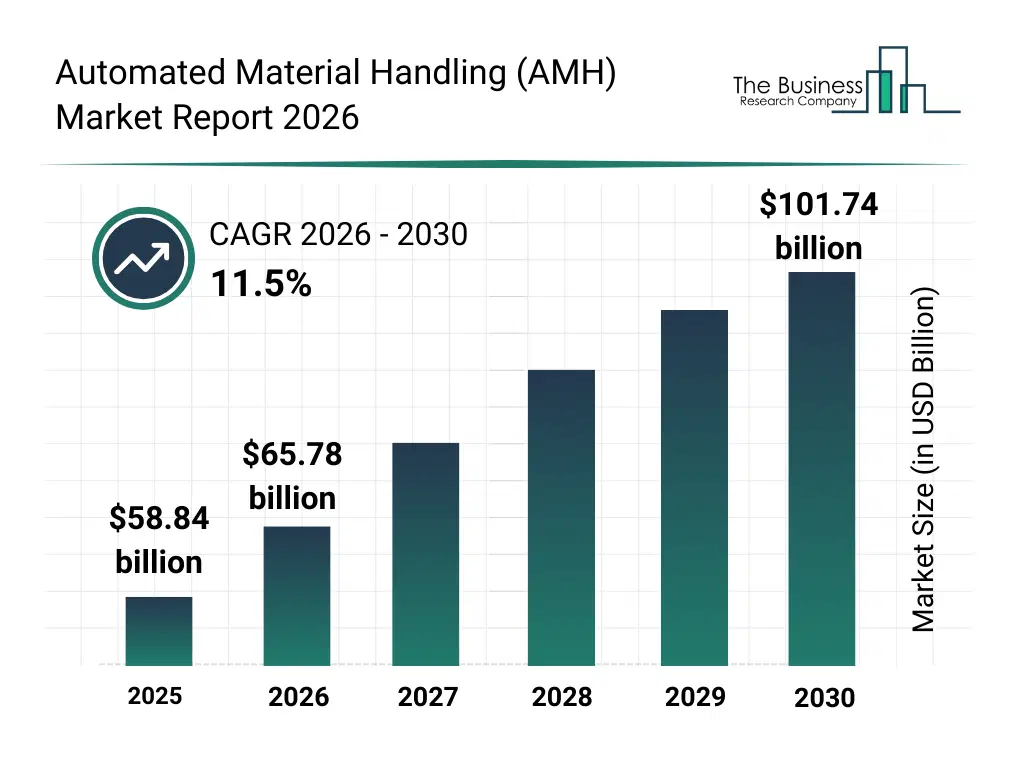
What Is The Automated Material Handling (AMH) Market Size and Share 2026?
The automated material handling (AMH) market size has grown rapidly in recent years. It will grow from $58.84 billion in 2025 to $65.78 billion in 2026 at a compound annual growth rate (CAGR) of 11.8%. The growth in the historic period can be attributed to e-commerce growth, labor shortage challenges, warehouse modernization, manufacturing automation, supply chain optimization.What Is The Automated Material Handling (AMH) Market Growth Forecast?
The automated material handling (AMH) market size is expected to see rapid growth in the next few years. It will grow to $101.74 billion in 2030 at a compound annual growth rate (CAGR) of 11.5%. The growth in the forecast period can be attributed to smart factory adoption, growth of omnichannel retail, expansion of logistics hubs, AI driven warehouse management, demand for rapid order fulfillment. Major trends in the forecast period include adoption of autonomous guided vehicles, expansion of warehouse automation, integration of robotics with wms, growth of high speed sortation systems, rising demand for flexible material handling.Tariff Impact On Automated Material Handling (AMH) Market
Tariffs have increased costs of automated material handling hardware such as sensors, robotics components, and control systems. Warehouse and logistics automation segments are most affected, especially in asia pacific sourcing regions. This has raised system deployment costs. At the same time, tariffs are promoting local assembly and regional system integration.
Global Automated Material Handling (AMH) Market Segmentation
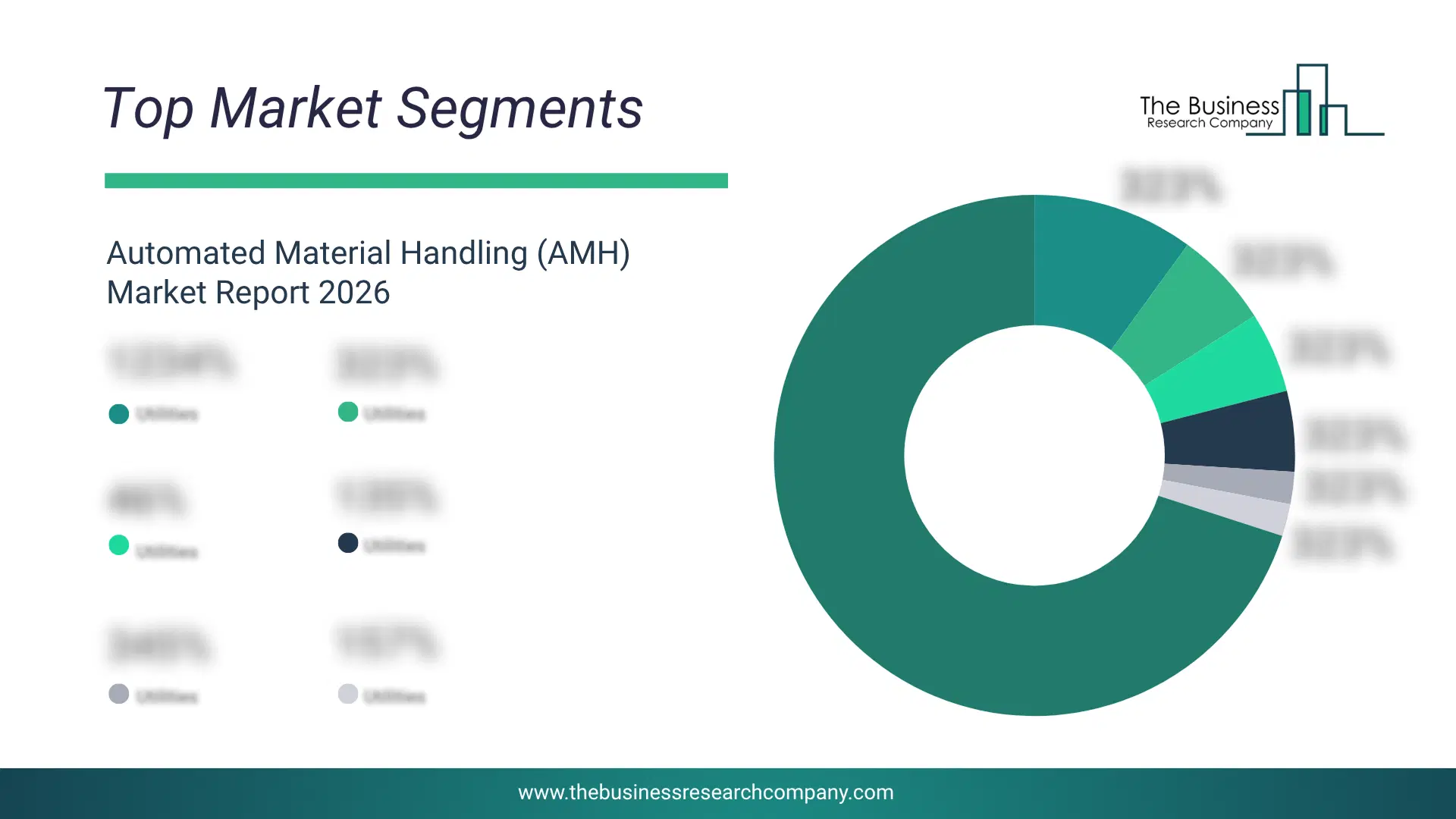
1) By Product Type: Hardware, Software, Services 2) By System Type: Unit Load Material Handling System, Bulk Load Material Handling System 3) By Function: Storage, Transportation, Assembly, Other Functions 4) By End-User: Airport, Automotive, Food And Beverages, Retail, Warehousing, And Distribution, Logistic Centers, General Manufacturing, Pharmaceuticals, Post and Parcel, Other End-Users Subsegments: 1) By Hardware: Automated Guided Vehicles (AGVs), Robotic Arms, Conveyor Systems, Sortation Systems, Palletizing Systems 2) By Software: Warehouse Management Systems (WMS), Inventory Management Software, Robotics Software, Fleet Management Software, Control Systems 3) By Services: Consulting Services, Installation and Integration Services, Maintenance and Support Services, Training Services, System Upgrades and Optimization ServicesWhat Is The Driver Of The Automated Material Handling (AMH) Market?
The growing need for automation in various industries is expected to propel the growth of the automated material handling market going forward. Automation in industries refers to using technology and systems to perform tasks and processes with minimal human intervention, enhancing efficiency, accuracy, and productivity. The growing need for automation in various industries is due to labor shortages, cost reduction, scalability, and data-driven industry decision-making. Automated material handling streamlines various operations by efficiently managing the movement, storage, and processing of materials, thereby reducing manual labor, minimizing errors, and enhancing overall productivity. For instance, in September 2024, according to the World Robotics Report published by the International Federation of Robotics, a Germany-based non-profit organization, approximately 4,281,585 industrial robots were operating in factories worldwide in 2023, marking a 10% increase from the previous year. Annual installations exceeded 541,302 units in 2023, with 70% of newly deployed robots in Asia, 17% in Europe, and 10% in the Americas, highlighting the global scale and regional concentration of automation growth. Therefore, the growing need for automation in various industries drives the automated material handling market.Key Players In The Global Automated Material Handling (AMH) Market
Major companies operating in the automated material handling (AMH) market are Mitsubishi Group, Honeywell International Inc., Toyota Industries Corporation, Murata Machinery Ltd., KION Group AG, Omron Corporation, Jungheinrich AG, FANUC Corporation, Crown Equipment Corporation, Daifuku Co. Ltd., Hyster-Yale Materials Handling Inc., KUKA AG, Dematic, SSI Schaefer Group, Vanderlande, SICK AG, BEUMER Group, Beckhoff Automation GmbH & Co. KG, Kardex Group, Swisslog AG , Bastian Solutions LLC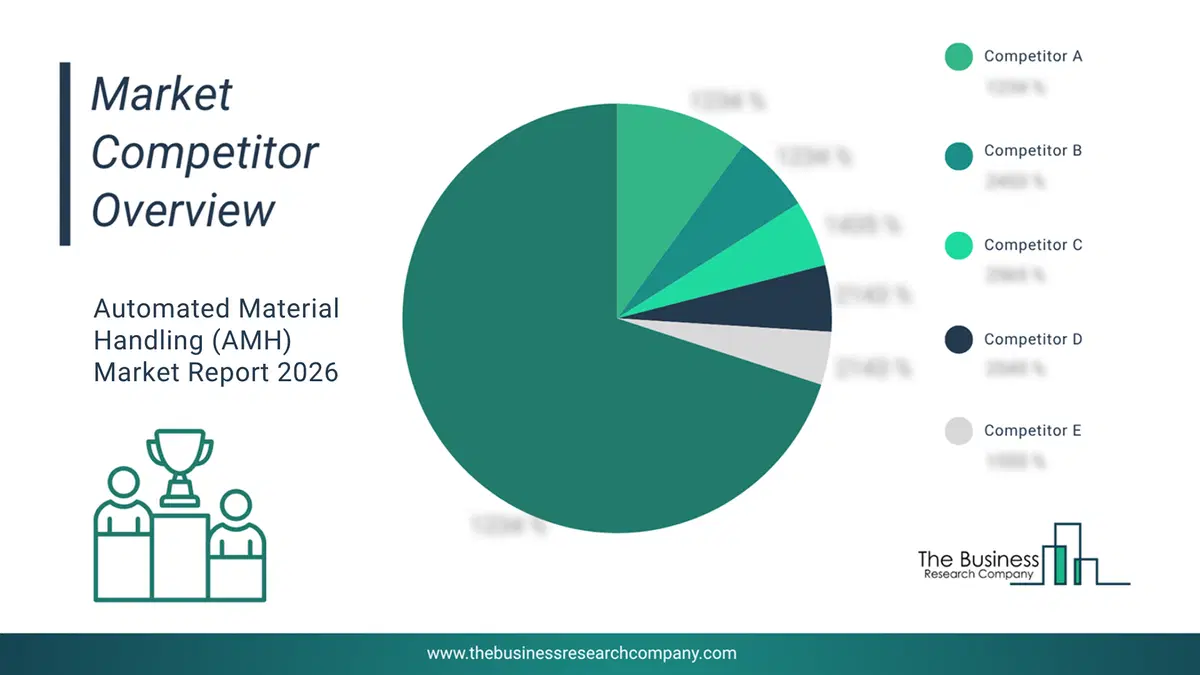
This chart is for illustrative purposes; the full report includes a detailed competitor analysis and comprehensive overview of the top 10 companies in the market.
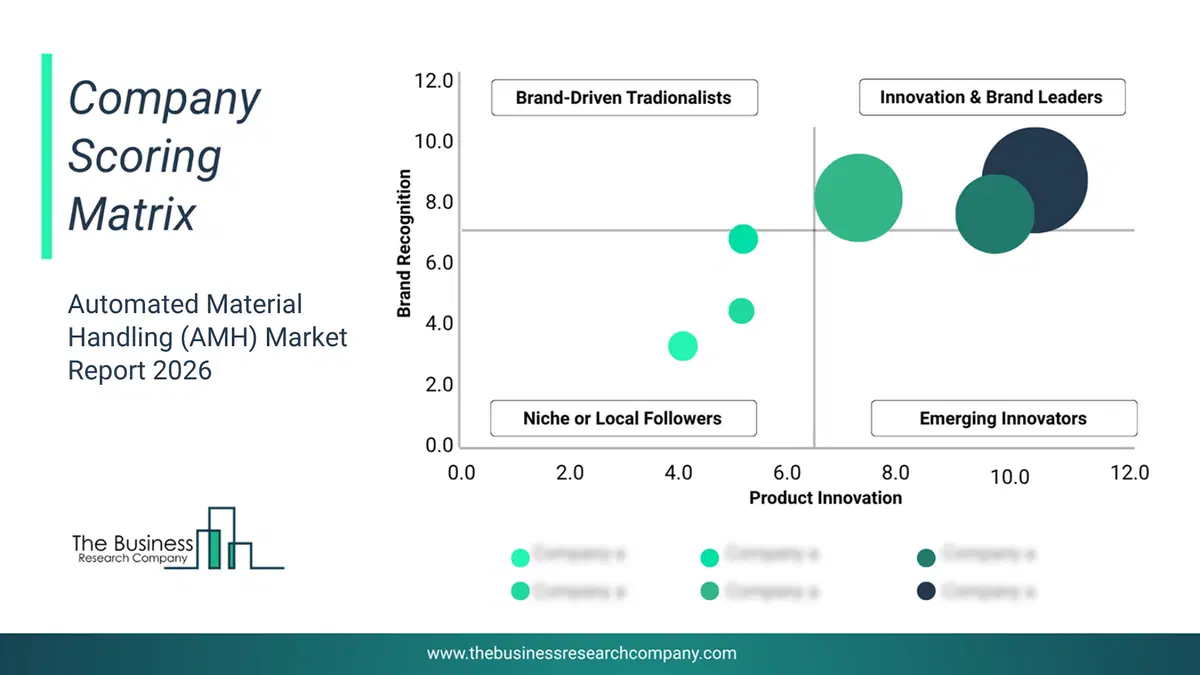
This chart maps companies by product innovation and brand strength, with bubble size indicating relative revenue, helping identify market leaders, challengers, and niche players. This is an illustrative chart; the full report provides a complete and accurate competitive analysis.
Global Automated Material Handling (AMH) Market Trends and Insights
Major companies operating in the automated material handling market are focusing on developing innovative solutions, such as freight movement systems, to meet the increasing demand for more efficient, flexible, and resilient supply chain operations. Freight Movement System, as a part of automated material handling that focuses specifically on transporting goods or materials within a warehouse, factory, or distribution center. This system integrates various automated technologies to improve material handling operations' efficiency, accuracy, and safety. For instance, in February 2024, ArcBest Corporation, a US-based transport company, launched ArcBest's Vaux Freight Movement System, an innovative suite of hardware and software that revolutionizes how freight is loaded, unloaded, and transferred in warehouses, on docks, and over the road. The Vaux Freight Movement System enables trailers to be unloaded in less than five minutes, with multiple forklifts swarming and processing the freight from all sides. This approach minimizes driver wait times, reduces damage claims, and enhances dock utilization.What Are Latest Mergers And Acquisitions In The Automated Material Handling (AMH) Market?
In January 2024, ABB Ltd., a Switzerland-based electrification and automation technology company, acquired Sevensense Robotics AG, for an undisclosed amount. With this acquisition, ABB aims to become a leader in next-generation mobile robotics by integrating Sevensense’s Visual SLAM-powered navigation technology into its AMR portfolio, enabling faster commissioning times, higher autonomy, and improved safety and efficiency in dynamic manufacturing, logistics, and intralogistics environments. Sevensense Robotics AG is a Swiss-based company that specializes in AI-enabled 3D-vision navigation systems for autonomous material-handling and service robots.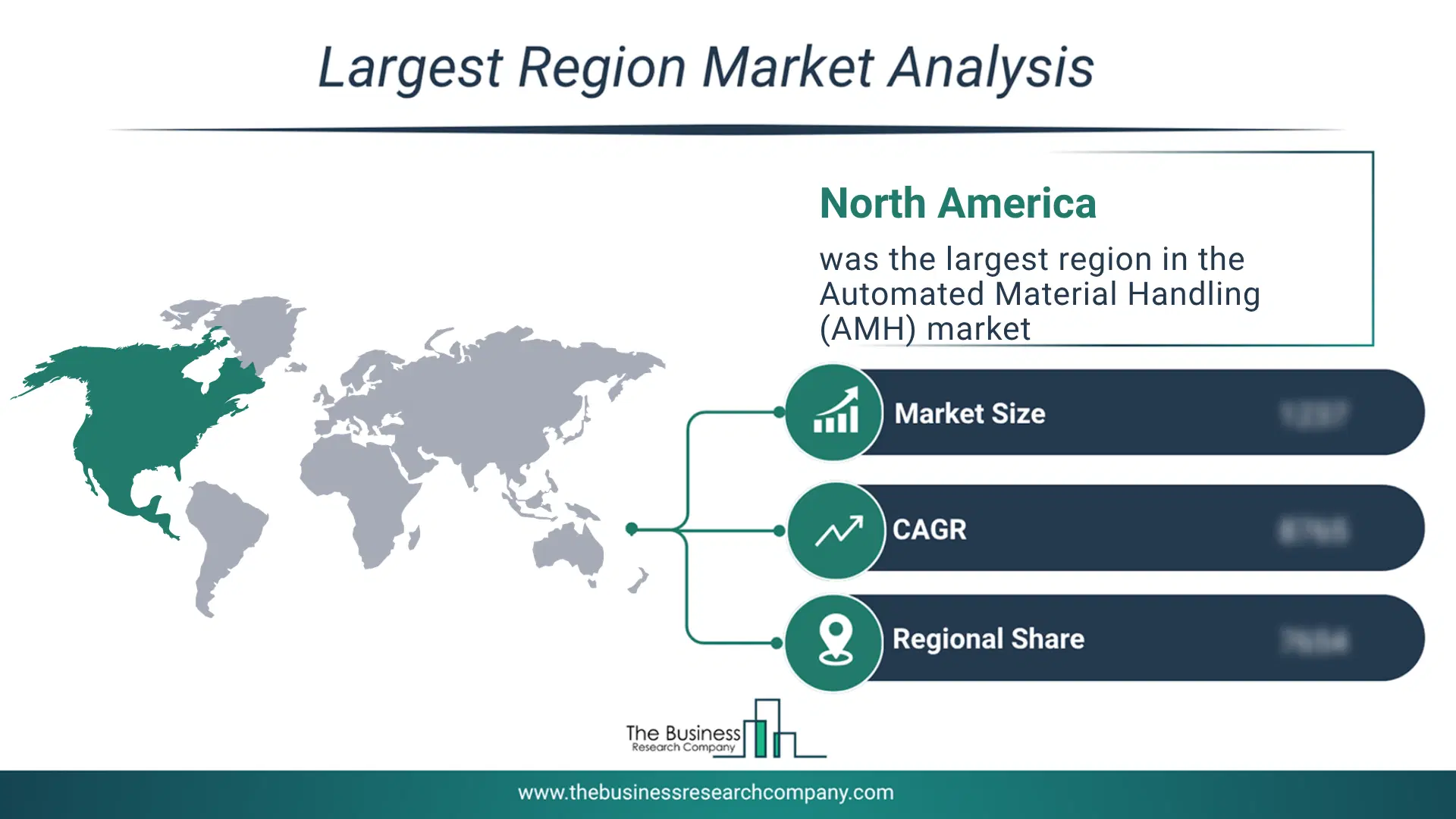
Regional Outlook
North America was the largest region in the automated material handling (AMH) market in 2025. Asia-Pacific is expected to be the fastest-growing region in the market going forward. The regions covered in this market report are Asia-Pacific, South East Asia, Western Europe, Eastern Europe, North America, South America, Middle East, Africa The countries covered in this market report are Australia, Brazil, China, France, Germany, India, Indonesia, Japan, Taiwan, Russia, South Korea, UK, USA, Canada, Italy, Spain.What Defines the Automated Material Handling (AMH) Market?
The automated material handling (AMH) market consists of revenues earned by entities by providing automated inventory management, and automated conveyor management. The market value includes the value of related goods sold by the service provider or included within the service offering. The automated material handling market also includes sales of conveyor systems and robotic picking systems. Values in this market are ‘factory gate’ values, that is the value of goods sold by the manufacturers or creators of the goods, whether to other entities (including downstream manufacturers, wholesalers, distributors, and retailers) or directly to end customers. The value of goods in this market includes related services sold by the creators of the goods.How is Market Value Defined and Measured?
The market value is defined as the revenues that enterprises gain from the sale of goods and/or services within the specified market and geography through sales, grants, or donations in terms of the currency (in USD unless otherwise specified). The revenues for a specified geography are consumption values that are revenues generated by organizations in the specified geography within the market, irrespective of where they are produced. It does not include revenues from resales along the supply chain, either further along the supply chain or as part of other products.
This chart presents market attractiveness based on a quantitative evaluation of growth, competition, strategic alignment, and risk, offering a clear view of opportunity areas for decision-making. This chart is for illustrative purposes; the full report contains the complete analysis.

This chart highlights the Total Addressable Market (TAM) by estimating the maximum revenue opportunity using an assumption-driven approach, supporting strategic planning and opportunity sizing across markets. The chart is illustrative; the full report provides a more comprehensive analysis.
What Key Data and Analysis Are Included in the Automated Material Handling (AMH) Market Report 2026?
The automated material handling (amh) market research report is one of a series of new reports from The Business Research Company that provides market statistics, including industry global market size, regional shares, competitors with the market share, detailed market segments, market trends and opportunities, and any further data you may need to thrive in the automated material handling (amh) industry. The market research report delivers a complete perspective of everything you need, with an in-depth analysis of the current and future state of the industry.Automated Material Handling AMH Market Report Forecast Analysis
| Report Attribute | Details |
|---|---|
| Market Size Value In 2026 | $65.78 billion |
| Revenue Forecast In 2030 | $101.74 billion |
| Base Year For Estimation | 2025 |
| Actual Estimates/Historical Data | 2020-2025 |
| Forecast Period | 2026 - 2030 |
| Market Representation | Revenue in USD Billion and CAGR from 2026 to 2030 |
| Segments Covered | Product Type, System Type, Function, End-User |
| Regional Scope | Asia-Pacific, Western Europe, Eastern Europe, North America, South America, Middle East, Africa |
| Key Companies Profiled | Mitsubishi Group, Honeywell International Inc., Toyota Industries Corporation, Murata Machinery Ltd., KION Group AG, Omron Corporation, Jungheinrich AG, FANUC Corporation, Crown Equipment Corporation, Daifuku Co. Ltd., Hyster-Yale Materials Handling Inc., KUKA AG, Dematic, SSI Schaefer Group, Vanderlande, SICK AG, BEUMER Group, Beckhoff Automation GmbH & Co. KG, Kardex Group, Swisslog AG , Bastian Solutions LLC |
| Customization Scope | Request for Customization |
| Pricing And Purchase Options | Explore Purchase Options |