
Automated Optometry Equipment Market Report 2026
Global Outlook – By Product Type (Autorefractors, Lensmeters, Phoropters, Tonometers, Retinal Cameras, Other Product Types), By Technology (Automated Technology, Semi-Automated Technology, Digital Technology), By Application (Vision Testing, Diagnosis Of Eye Diseases, Research And Clinical Studies), By End Users (Hospitals, Eye Clinics, Optometry Practices, Research Institutions, Other End Users) – Market Size, Trends, Strategies, and Forecast to 2030
Automated Optometry Equipment Market Overview
• Automated Optometry Equipment market size has reached to $3.24 billion in 2025 • Expected to grow to $5.07 billion in 2030 at a compound annual growth rate (CAGR) of 9.3% • Growth Driver: Surge In Prevalence Of Vision-Related Disorders Fueling The Growth Of The Market Due To Aging Population And Rising Economic Burden • Market Trend: Advancing Glaucoma Care With Automated Precision Therapy • North America was the largest region in 2025 and Asia-Pacific is the fastest growing region.What Is Covered Under Automated Optometry Equipment Market?
Automated optometry equipment refers to computerized and electronically controlled devices used in eye care to perform vision tests, measure refractive errors, assess eye pressure, and capture detailed images of ocular structures. These tools operate with minimal manual input and are designed to improve the accuracy, efficiency, and consistency of eye examinations. The main product types of the automated optometry equipment include autorefractors, lensmeters, phoropters, tonometers, retinal cameras, and others. Autorefractors refer to devices designed to automatically measure the refractive error of the eye, aiding in vision assessment and corrective lens prescription. It uses various technologies such as automated technology, semi-automated technology, digital technology, and micro-electro-mechanical systems-based technology. The application areas include vision testing, diagnosis of eye diseases, surgical procedures, orthokeratology, and research and clinical studies and are used by several end-users, including hospitals, eye clinics, optometry practices, research institutions, and others.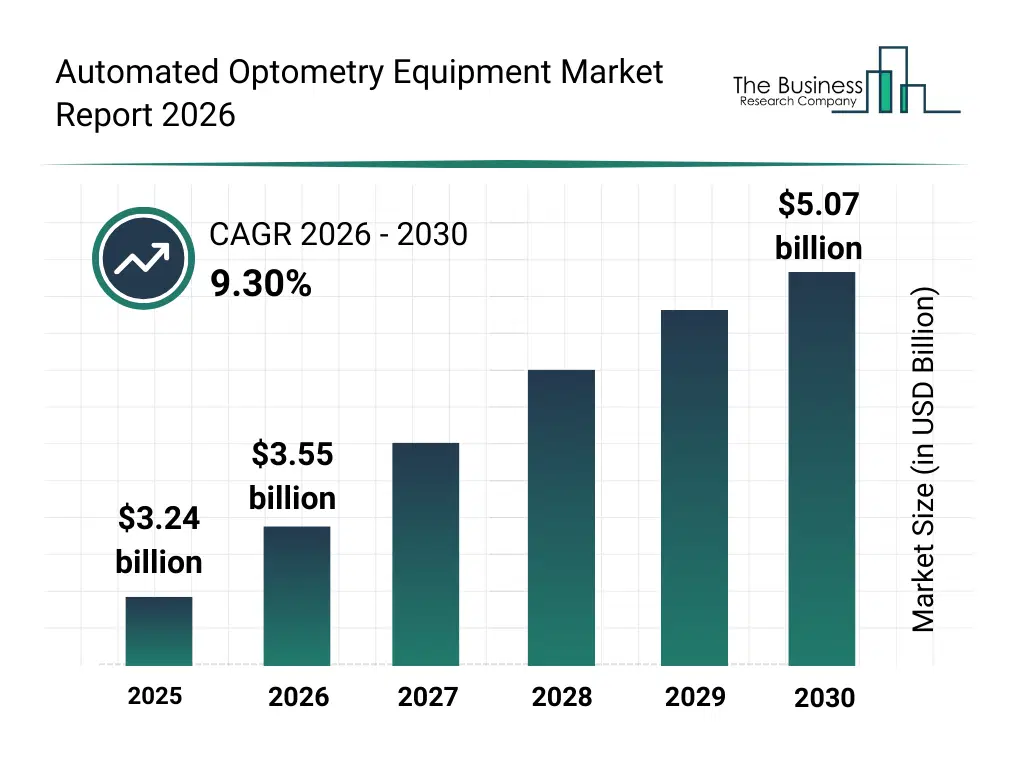
What Is The Automated Optometry Equipment Market Size and Share 2026?
The automated optometry equipment market size has grown strongly in recent years. It will grow from $3.24 billion in 2025 to $3.55 billion in 2026 at a compound annual growth rate (CAGR) of 9.6%. The growth in the historic period can be attributed to growing prevalence of vision impairment, shortage of trained optometrists, early adoption of automated refractors, expansion of optical retail chains, increasing demand for routine eye examinations.What Is The Automated Optometry Equipment Market Growth Forecast?
The automated optometry equipment market size is expected to see strong growth in the next few years. It will grow to $5.07 billion in 2030 at a compound annual growth rate (CAGR) of 9.3%. The growth in the forecast period can be attributed to integration of artificial intelligence in diagnostics, rising demand for tele-optometry services, increasing eye health awareness, technological advancements in imaging systems, expansion of screening programs in emerging markets. Major trends in the forecast period include increasing adoption of automated eye examination systems, growing demand for fast and accurate vision testing, rising use of ai-based refraction and screening tools, expansion of optometry services in retail and clinics, shift toward portable and compact diagnostic devices.
Global Automated Optometry Equipment Market Segmentation
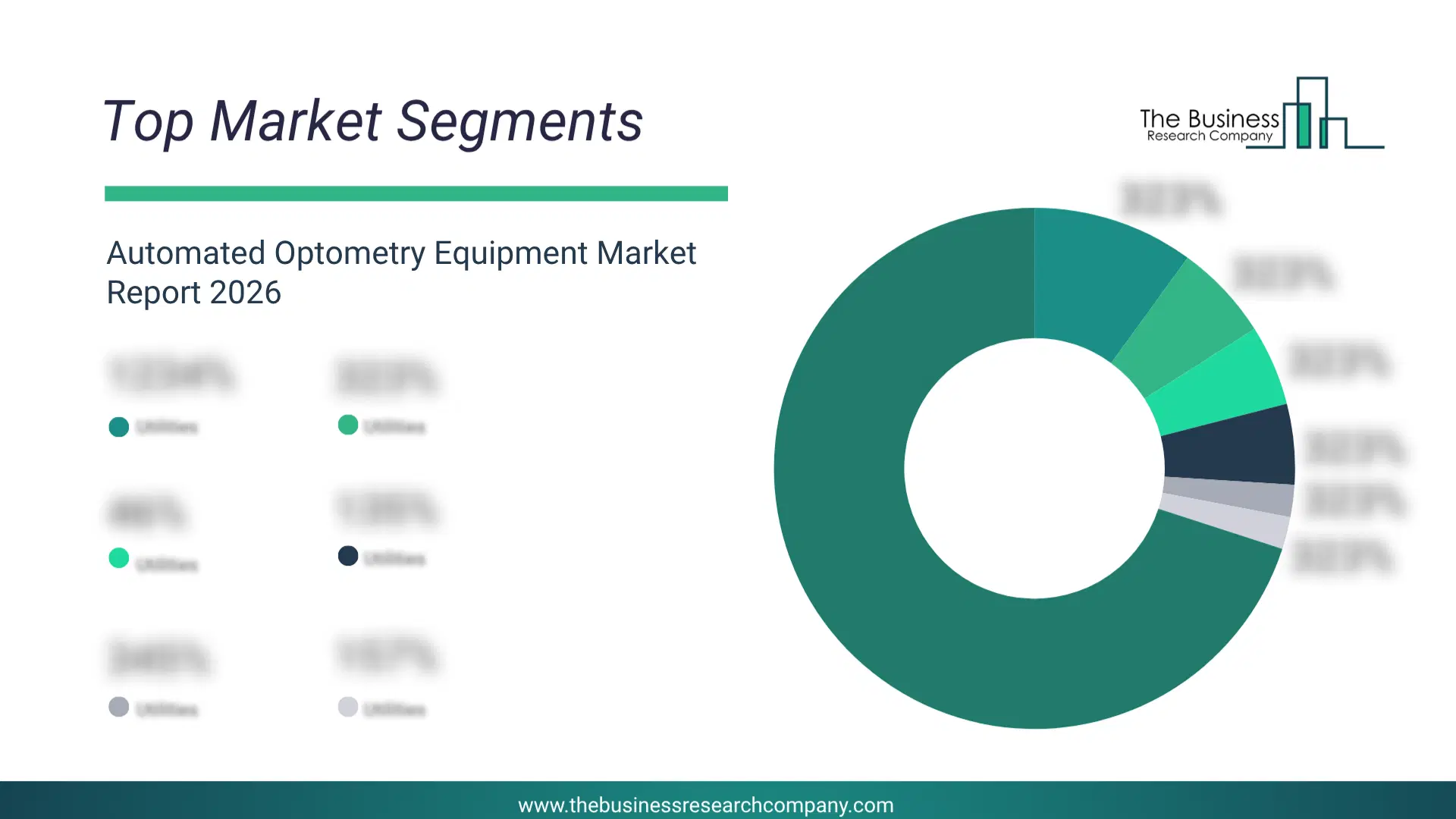
1) By Product Type: Autorefractors, Lensmeters, Phoropters, Tonometers, Retinal Cameras, Other Product Types 2) By Technology: Automated Technology, Semi-Automated Technology, Digital Technology 3) By Application: Vision Testing, Diagnosis Of Eye Diseases, Research And Clinical Studies 4) By End Users: Hospitals, Eye Clinics, Optometry Practices, Research Institutions, Other End Users Subsegments: 1) By Autorefractors: Desktop Automated Autorefractors, Handheld Automated Autorefractors, Wavefront-Based Autorefractors, Portable Digital Autorefractors 2) By Lensmeters: Digital Automated Lensmeters, Imaging-Based Lensmeters, Computer-Integrated Lensmeters 3) By Phoropters: Digital Phoropters, Fully Automated Phoropters, Computer-Controlled Phoropters 4) By Tonometers: Non-Contact Automated Tonometers, Digital Applanation Tonometers, Handheld Electronic Tonometers, Continuous Monitoring Tonometers 5) By Retinal Cameras: Digital Fundus Cameras, Scanning Laser Retinal Cameras, Ultra-Widefield Retinal Cameras, Handheld Digital Retinal Cameras 6) By Other Product Types: Automated Vision Screeners, Digital Slit Lamp Imaging Systems, Electronic Keratometers, Digital Pachymeters, Corneal Topography SystemsWhat Is The Driver Of The Automated Optometry Equipment Market?
The rising prevalence of vision-related disorders is expected to propel the growth of the automated optometry equipment market going forward. Vision-related disorders refer to medical conditions that impair the ability to see clearly, including problems with the eyes, optic nerve, or visual processing in the brain. The growing prevalence of vision-related disorders is due to the aging population, as older adults are more prone to conditions like cataracts, glaucoma, and age-related macular degeneration. Automated optometry equipment helps address the prevalence of vision-related disorders by enabling early detection, accurate diagnosis, and efficient monitoring, thereby improving patient outcomes and reducing the risk of severe vision loss. For instance, in June 2024, the Royal National Institute of Blind People, a UK-based organization, reported that there were 322,638 registered blind and partially sighted individuals, with 268,500 registered in England as of March 2023. Therefore, the rising prevalence of vision-related disorders is driving the growth of the automated optometry equipment industry.Key Players In The Global Automated Optometry Equipment Market
Major companies operating in the automated optometry equipment market are Canon Inc., Carl Zeiss Meditec Aktiengesellschaft, Topcon Corporation, NIDEK Co. Ltd., Alcon Inc., EssilorLuxottica, Hoya Corporation, OCULUS Optikgeräte GmbH, Huvitz Co. Ltd., Marco Ophthalmic Inc., Tomey Corporation, Medmont International Pty Ltd., Kowa Company Ltd., Plen Optika Ltd., Visionix Ltd., Keeler Ltd., HEINE Optotechnik GmbH & Co. KG, Forus Health Pvt. Ltd., Gulden Ophthalmic, Reichert Technologies, Optopol Technology, Costruzione Strumenti Oftalmici
This chart is for illustrative purposes; the full report includes a detailed competitor analysis and comprehensive overview of the top 10 companies in the market.
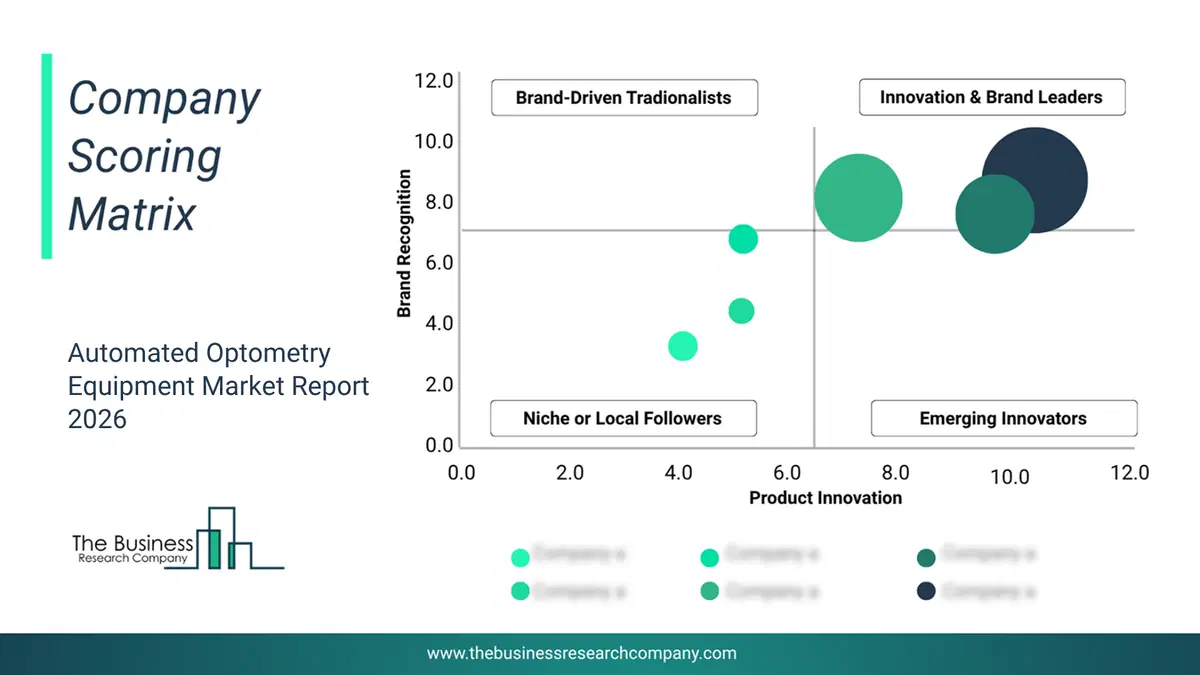
This chart maps companies by product innovation and brand strength, with bubble size indicating relative revenue, helping identify market leaders, challengers, and niche players. This is an illustrative chart; the full report provides a complete and accurate competitive analysis.
Global Automated Optometry Equipment Market Trends and Insights
Major companies operating in the automated optometry equipment market are focusing on developing innovative glaucoma treatments, such as direct selective laser trabeculoplasty, to enhance treatment accessibility, improve procedural efficiency, and deliver safer, more precise outcomes for patients. Direct selective laser trabeculoplasty is a type of laser treatment for glaucoma that uses a machine to send precise laser beams to a specific part of the eye, without needing special lenses or manual targeting. For instance, in February 2025, Alcon, a Switzerland-based pharmaceutical and medical device company, announced the full commercial launch of the Voyager Direct selective laser trabeculoplasty device in the United States. This marks the introduction of the first and only direct selective laser trabeculoplasty device available in the market. The system is designed with an automated workflow capable of delivering 120 precise laser pulses without the need for a gonio lens or manual alignment. Direct selective laser trabeculoplasty has demonstrated strong clinical benefits by effectively controlling intraocular pressure. In addition, the device offers a favorable safety profile, with minimal risk of adverse events, making it a significant advancement in glaucoma treatment.What Are Latest Mergers And Acquisitions In The Automated Optometry Equipment Market?
In July 2024, Alcon, a Switzerland-based pharmaceutical and medical device company, acquired BELKIN Vision for an undisclosed amount. Through this acquisition, Alcon expands its glaucoma portfolio by integrating Belkin Vision’s automated Direct Selective Laser Trabeculoplasty (DSLT) technology to streamline and enhance the efficiency of glaucoma treatment. BELKIN Vision is an Israel-based company that provides automated optometry equipment specifically focused on glaucoma treatment with their flagship product, the Eagle device.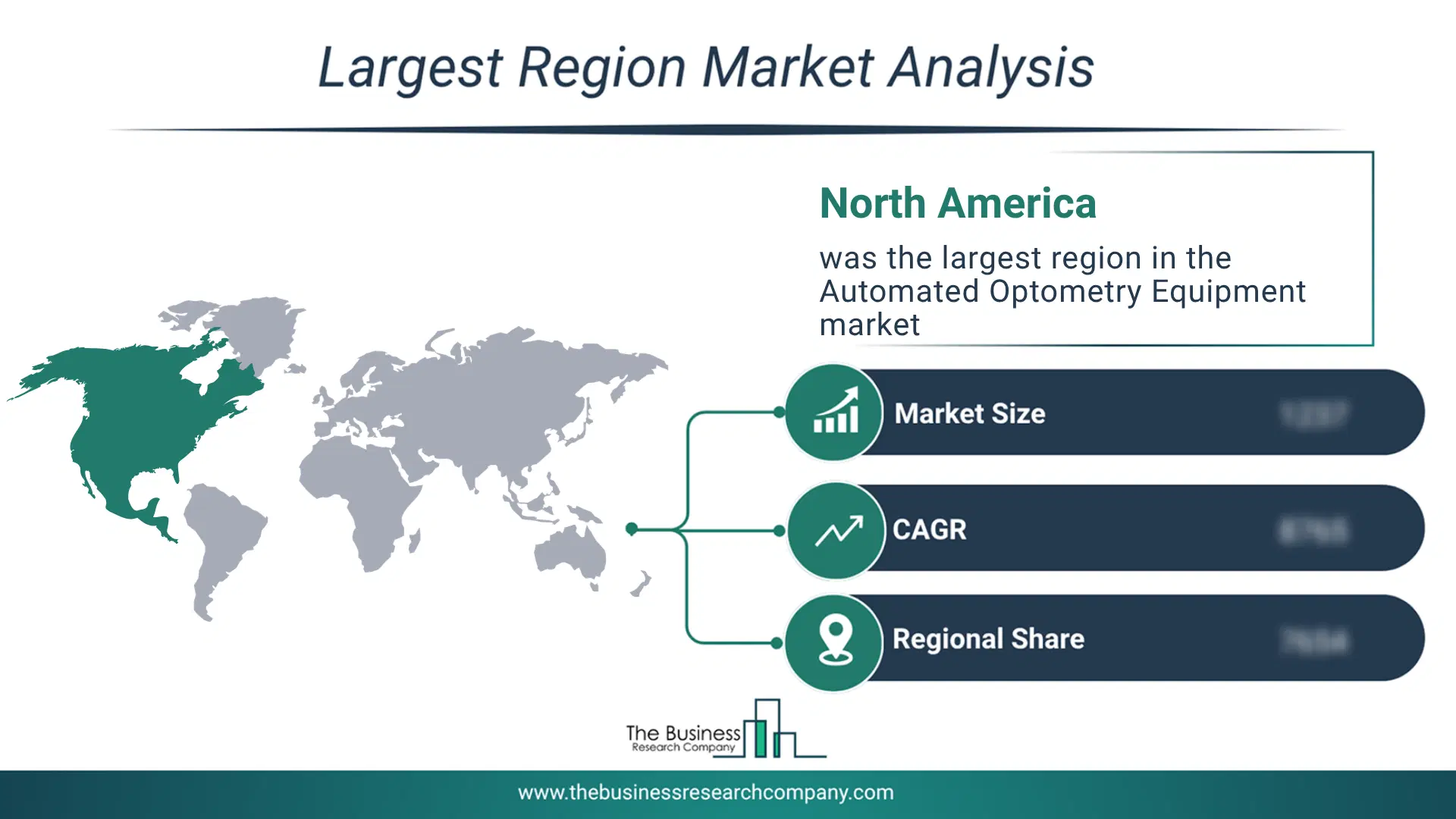
Regional Outlook
North America was the largest region in the automated optometry equipment market in 2025. Asia-Pacific is expected to be the fastest-growing region in the forecast period. The regions covered in this market report are Asia-Pacific, South East Asia, Western Europe, Eastern Europe, North America, South America, Middle East, Africa. The countries covered in this market report are Australia, Brazil, China, France, Germany, India, Indonesia, Japan, Taiwan, Russia, South Korea, UK, USA, Canada, Italy, SpainWhat Defines the Automated Optometry Equipment Market?
The automated optometry equipment market consists of revenues earned by entities by providing services such as installation, calibration, maintenance, repair, software updates, training, technical support, and remote diagnostics. The market value includes the value of related goods sold by the service provider or included within the service offering. The automated optometry equipment market also includes sales of fundus cameras, optical coherence tomography devices, slit lamps, keratometers, wavefront aberrometers, and perimeter analyzers. Values in this market are ‘factory gate’ values, that is the value of goods sold by the manufacturers or creators of the goods, whether to other entities (including downstream manufacturers, wholesalers, distributors and retailers) or directly to end customers. The value of goods in this market includes related services sold by the creators of the goods.How is Market Value Defined and Measured?
The market value is defined as the revenues that enterprises gain from the sale of goods and/or services within the specified market and geography through sales, grants, or donations in terms of the currency (in USD unless otherwise specified). The revenues for a specified geography are consumption values that are revenues generated by organizations in the specified geography within the market, irrespective of where they are produced. It does not include revenues from resales along the supply chain, either further along the supply chain or as part of other products.
This chart presents market attractiveness based on a quantitative evaluation of growth, competition, strategic alignment, and risk, offering a clear view of opportunity areas for decision-making. This chart is for illustrative purposes; the full report contains the complete analysis.

This chart highlights the Total Addressable Market (TAM) by estimating the maximum revenue opportunity using an assumption-driven approach, supporting strategic planning and opportunity sizing across markets. The chart is illustrative; the full report provides a more comprehensive analysis.
What Key Data and Analysis Are Included in the Automated Optometry Equipment Market Report 2026?
The automated optometry equipment market research report is one of a series of new reports from The Business Research Company that provides market statistics, including industry global market size, regional shares, competitors with the market share, detailed market segments, market trends and opportunities, and any further data you may need to thrive in the automated optometry equipment industry. The market research report delivers a complete perspective of everything you need, with an in-depth analysis of the current and future state of the industry.Automated Optometry Equipment Market Report Forecast Analysis
| Report Attribute | Details |
|---|---|
| Market Size Value In 2026 | $3.55 billion |
| Revenue Forecast In 2030 | $5.07 billion |
| Growth Rate | CAGR of 9.3% from 2026 to 2030 |
| Base Year For Estimation | 2025 |
| Actual Estimates/Historical Data | 2020-2025 |
| Forecast Period | 2026 - 2030 |
| Market Representation | Revenue in USD Billion and CAGR from 2026 to 2030 |
| Segments Covered | Product Type, Technology, Application, End Users |
| Regional Scope | Asia-Pacific, Western Europe, Eastern Europe, North America, South America, Middle East, Africa |
| Country Scope | The countries covered in the report are Australia, Brazil, China, France, Germany, India, Indonesia, Japan, Taiwan, Russia, South Korea, UK, USA, Canada, Italy, Spain. |
| Key Companies Profiled | Canon Inc., Carl Zeiss Meditec Aktiengesellschaft, Topcon Corporation, NIDEK Co. Ltd., Alcon Inc., EssilorLuxottica, Hoya Corporation, OCULUS Optikgeräte GmbH, Huvitz Co. Ltd., Marco Ophthalmic Inc., Tomey Corporation, Medmont International Pty Ltd., Kowa Company Ltd., Plen Optika Ltd., Visionix Ltd., Keeler Ltd., HEINE Optotechnik GmbH & Co. KG, Forus Health Pvt. Ltd., Gulden Ophthalmic, Reichert Technologies, Optopol Technology, Costruzione Strumenti Oftalmici |
| Customization Scope | Request for Customization |
| Pricing And Purchase Options | Explore Purchase Options |