

Automotive Event Data Recorder Market Report 2026
Global Outlook – By Component (Hardware, Event Data Recorder Unit, Sensors, Storage Devices, Power Supply Units, Software), By Vehicle (Passenger Vehicle, Commercial Vehicle, Electric Vehicle, Other Vehicles), By Application (Accident Analysis, Insurance Claims, Vehicle Safety Improvement, Driver Behavior Monitoring, Other Applications), By Sales Channel (Original Equipment Manufacturers (OEMs), Aftermarket), By End-User (Insurance Companies, Fleet Operators, Automobile Manufacturers, Law Enforcement Agencies) – Market Size, Trends, Strategies, and Forecast to 2030
Automotive Event Data Recorder Market Overview
• Automotive Event Data Recorder market size has reached to $2.77 billion in 2025 • Expected to grow to $3.76 billion in 2030 at a compound annual growth rate (CAGR) of 6.2% • Growth Driver: Surge In Traffic Accidents Driving Growth Due To Increased Vehicle Usage And Road Safety Concerns • Market Trend: Integration Of AI In Advanced Vehicle Safety Solutions • North America was the largest region in 2025 and Asia-Pacific is the fastest growing region.What Is Covered Under Automotive Event Data Recorder Market?
An automotive event data recorder (EDR) is a device installed in vehicles to record key data moments before, during, and after a crash. It captures information such as vehicle speed, brake use, seatbelt status, and airbag deployment. This data helps in crash investigations, safety research, and legal proceedings. EDRs function similarly to an airplane's black box and are increasingly common in modern vehicles. The main components of an automotive event data recorder include hardware, the event data recorder unit, sensors, storage devices, power supply units, and software. Hardware refers to the physical components, such as sensors, data recorders, storage units, and power supplies, used to capture, process, and store real-time vehicle data for incident analysis and safety enhancements. The system is used in various types of vehicles, including passenger vehicles, commercial vehicles, electric vehicles, and others. It serves multiple applications, such as accident analysis, insurance claims, vehicle safety improvement, and driver behavior monitoring. Sales channels include original equipment manufacturers (OEMs) and the aftermarket, while end-users include insurance companies, fleet operators, automobile manufacturers, law enforcement agencies, and others.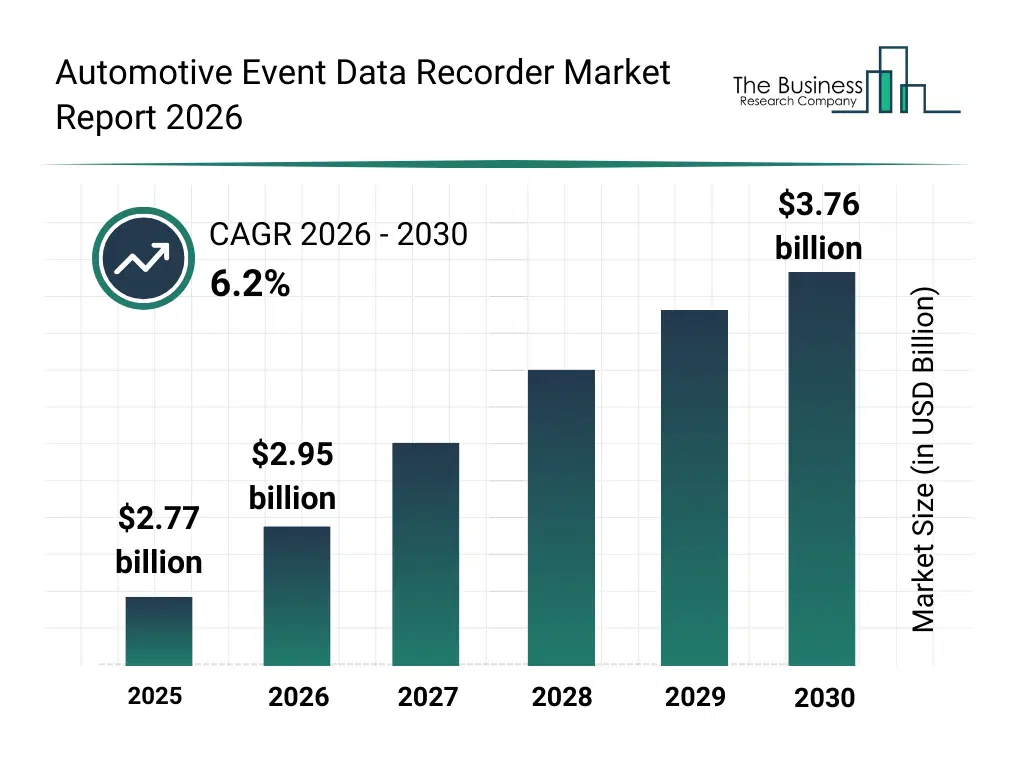
What Is The Automotive Event Data Recorder Market Size and Share 2026?
The automotive event data recorder market size has grown strongly in recent years. It will grow from $2.77 billion in 2025 to $2.95 billion in 2026 at a compound annual growth rate (CAGR) of 6.5%. The growth in the historic period can be attributed to vehicle safety investigations, early edr adoption, accident analysis requirements, regulatory compliance, automotive electronics growth.What Is The Automotive Event Data Recorder Market Growth Forecast?
The automotive event data recorder market size is expected to see strong growth in the next few years. It will grow to $3.76 billion in 2030 at a compound annual growth rate (CAGR) of 6.2%. The growth in the forecast period can be attributed to connected car expansion, autonomous vehicle testing, advanced safety analytics, insurance telematics growth, data-driven mobility. Major trends in the forecast period include increasing mandates for crash data recording, integration with connected vehicle platforms, adoption in electric and autonomous vehicles, growth in insurance analytics, demand for data transparency.
Global Automotive Event Data Recorder Market Segmentation
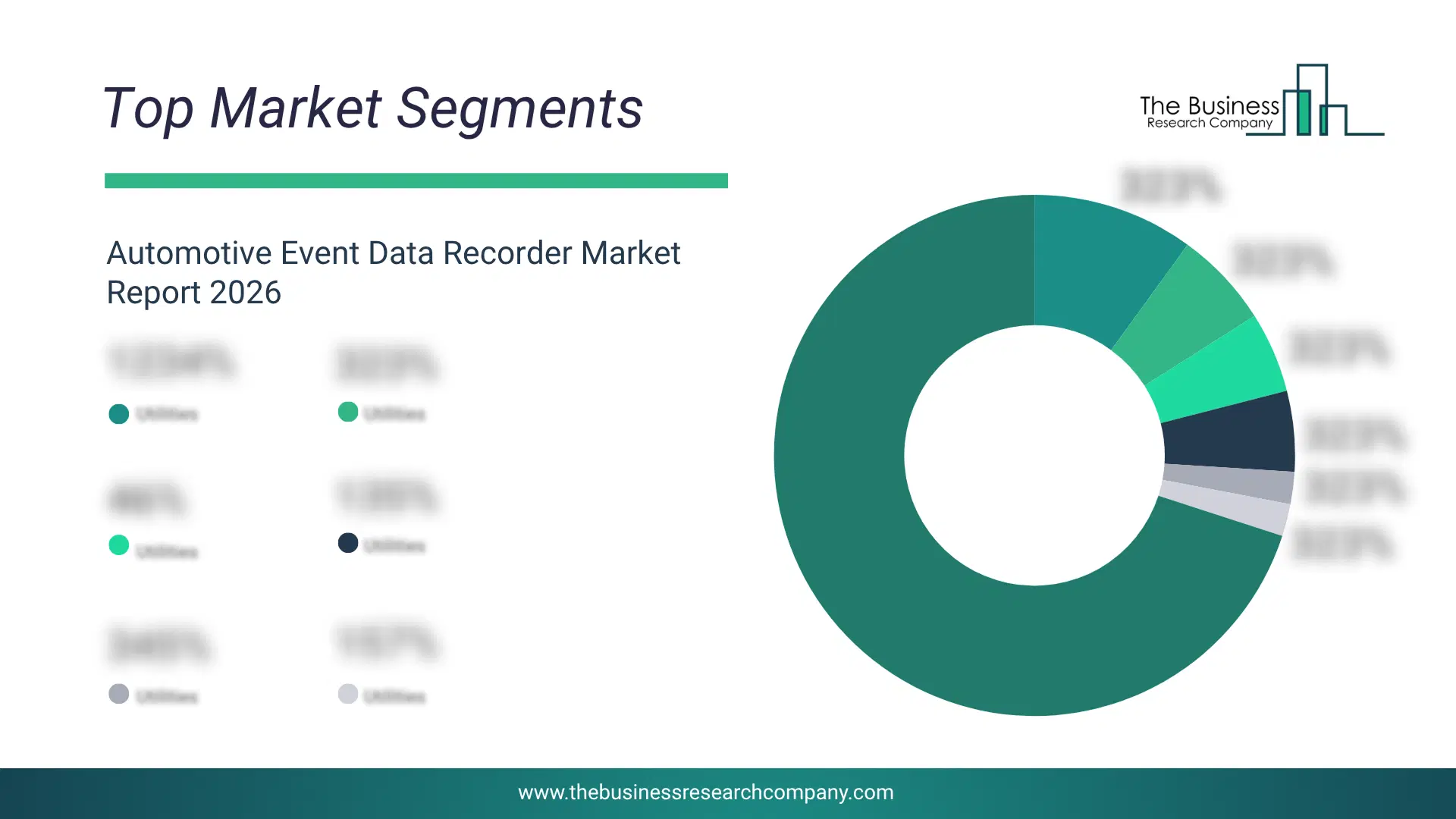
1) By Component: Hardware, Event Data Recorder Unit, Sensors, Storage Devices, Power Supply Units, Software 2) By Vehicle: Passenger Vehicle, Commercial Vehicle, Electric Vehicle, Other Vehicles 3) By Application: Accident Analysis, Insurance Claims, Vehicle Safety Improvement, Driver Behavior Monitoring, Other Applications 4) By Sales Channel: Original Equipment Manufacturers (OEMs), Aftermarket 5) By End-User: Insurance Companies, Fleet Operators, Automobile Manufacturers, Law Enforcement Agencies Subsegments: 1) By Hardware: Printed Circuit Boards (PCBs), Housings And Enclosures, Connectors And Cables, Mounting Brackets, Heat Sinks 2) By Event Data Recorder (EDR) Unit: Standalone Event Data Recorder (EDR) Units, Integrated Event Data Recorder (EDR) Modules, Front-End Crash Data Recorders, Original Equipment Manufacturer-Installed Event Data Recorders (EDRs) 3) By Sensors: Accelerometers, Gyroscopes, Impact Sensors, Speed Sensors, Global Positioning System Sensors 4) By Storage Devices: Hard Disk Drives (HDDs), Solid State Drives (SSDs), Embedded Flash Memory, External Removable Storage, Cloud-Connected Storage 5) By Power Supply Units: Battery Packs, Capacitors, Voltage Regulators, Power Management Integrated Circuits (PMICs), Vehicle Power Line Adapters 6) By Software: Data Acquisition Software, Data Encryption And Security Software, Event Triggering And Logging Software, Event Data Recorder (EDR) Data Analysis Tools, Firmware And System Management SoftwareWhat Are The Drivers Of The Automotive Event Data Recorder Market?
The rise in traffic accidents is expected to propel the growth of the automotive event data recorder market going forward. Traffic accidents refer to unexpected incidents on roads involving vehicles that result in damage, injury, or death. The rise in traffic accidents is primarily due to increasing vehicle usage, as higher numbers of vehicles on the road lead to greater traffic congestion, more frequent interactions between drivers, and a higher likelihood of collisions. Automotive event data recorder contributes to traffic accident analysis by recording key data before, during, and after a crash, enabling accurate reconstruction and enhancing road safety efforts. For instance, in January 2024, according to the Bureau of Infrastructure and Transport Research Economics (BITRE), an Australia-based government body, tragically, 1,266 people died on Australian roads in 2023, a 7.3% increase from 2022. Therefore, the rise in traffic accidents is driving the growth of the automotive event data recorder industry. The increasing electric vehicle production is expected to propel the growth of the automotive event data recorder market going forward. Electric vehicle production refers to the process of designing, manufacturing, and assembling battery-powered vehicles that use electric motors instead of internal combustion engines. The increasing electric vehicle production is primarily due to growing environmental concerns, as governments and consumers seek to reduce greenhouse gas emissions and air pollution by shifting from traditional fossil fuel-powered cars to cleaner, more sustainable electric alternatives. Automotive event data recorder enhances electric vehicle production by providing critical data insights that improve vehicle safety, performance, and compliance with regulatory standards, thereby accelerating innovation and consumer trust in electric mobility. For instance, in January 2024, according to Kelley Blue Book, a US-based Cox Automotive company, in 2023, a record 1.2 million car buyers in the United States chose electric vehicles, accounting for 7.6% of the total U.S. vehicle market, up from 5.9% in 2022. Therefore, the increasing electric vehicle production is driving the growth of the automotive event data recorder industry.Key Players In The Global Automotive Event Data Recorder Market
Major companies operating in the automotive event data recorder market report include Volkswagen Group, Toyota Motor Corporation, Mercedes-Benz, BMW Group, Hyundai Motor Company, Bosch GmbH, Kia Corporation, DENSO Corporation, ZF Friedrichshafen AG, Continental AG, Hyundai Mobis Co. Ltd., Volvo Car Corporation, Infineon Technologies AG, NXP Semiconductors, Harman International, Garmin Ltd., Sensata Technologies, Neusoft Corporation, Magneti Marelli, Alps Electric Co. Ltd.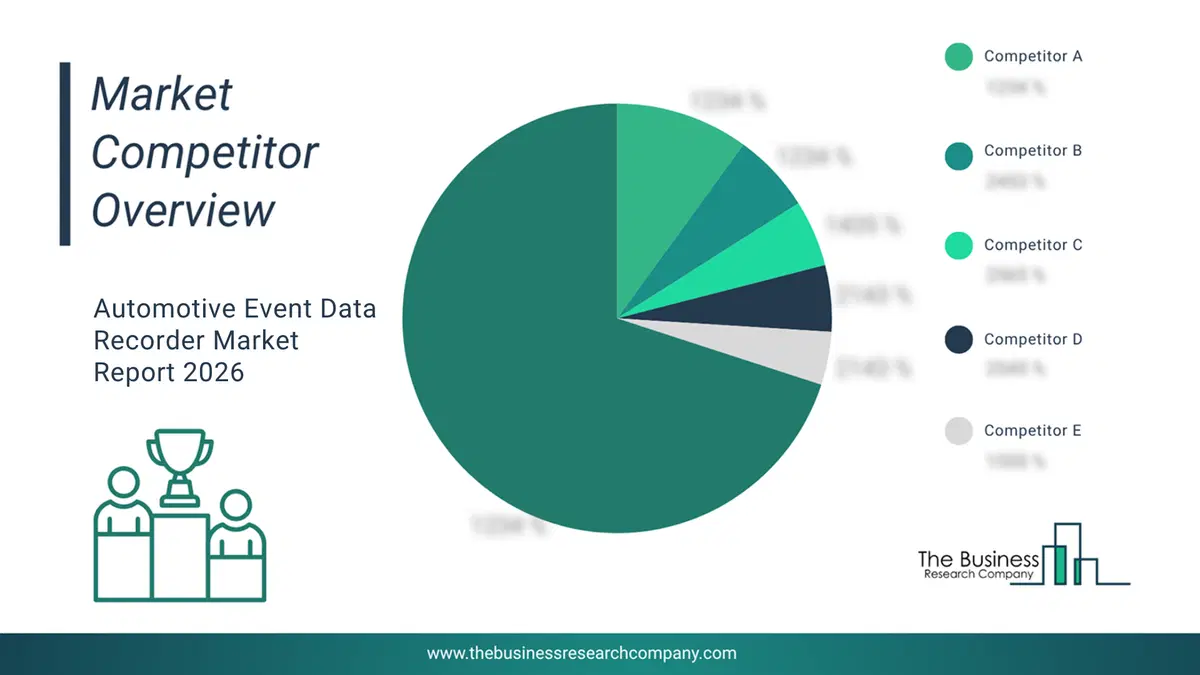
This chart is for illustrative purposes; the full report includes a detailed competitor analysis and comprehensive overview of the top 10 companies in the market.
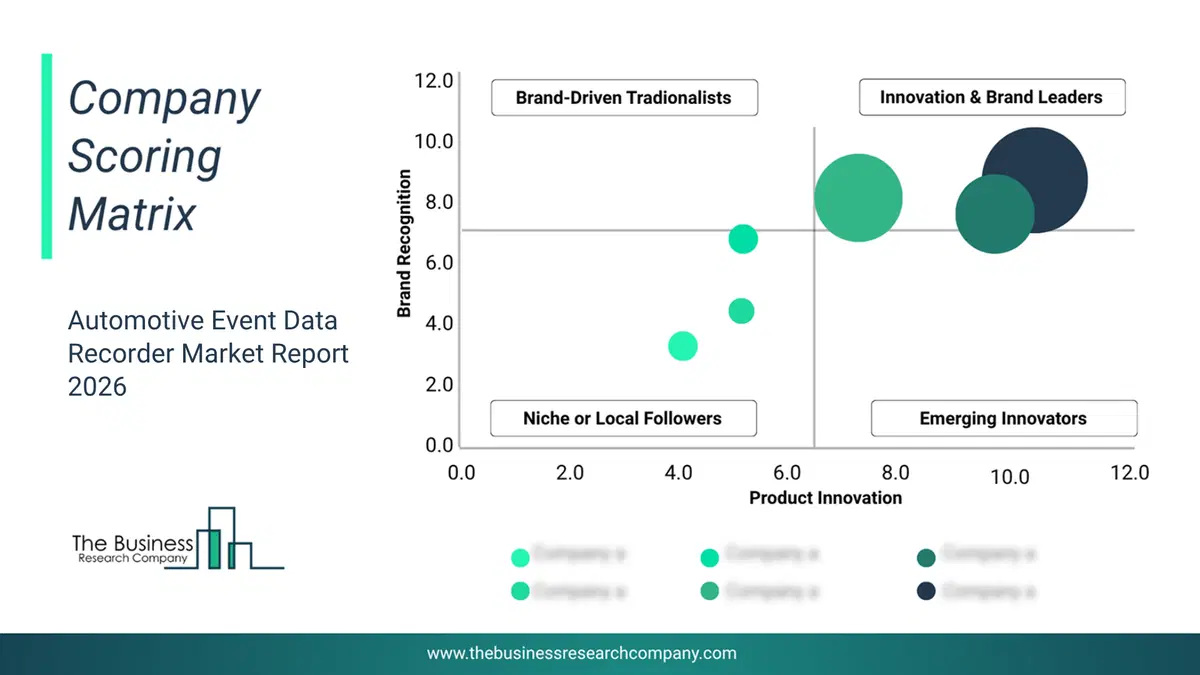
This chart maps companies by product innovation and brand strength, with bubble size indicating relative revenue, helping identify market leaders, challengers, and niche players. This is an illustrative chart; the full report provides a complete and accurate competitive analysis.
Global Automotive Event Data Recorder Market Trends and Insights
Major companies in the automotive event data recorder market are increasingly focusing on developing innovative solutions such as next-generation vehicle safety systems for both passenger cars and commercial trucks. Next-generation vehicle safety systems refer to advanced technologies integrated into vehicles to enhance driver and passenger safety through automated features, sensors, and real-time data processing. These systems help by reducing the risk of accidents, preventing collisions, and enhancing situational awareness through features such as automatic emergency braking, lane-keeping assist, and adaptive cruise control. For instance, in May 2024, Plus, a US-based autonomous trucking technology company, introduced PlusProtect, an AI-powered safety system designed to enhance next-generation vehicle safety. As part of its broader suite of advanced vehicle safety functionalities, plusprotect includes an optional, easily extractable event data recorder. The system features high-performance automatic emergency braking, enhanced lane departure warnings, traffic jam assist, and self-calibrating sensors. With capabilities such as over-the-air updates and predictive fuel optimization, PlusProtect offers scalable safety solutions aligned with evolving standards, supporting advanced driver assistance systems (ADAS) and paving the way for future vehicle automation.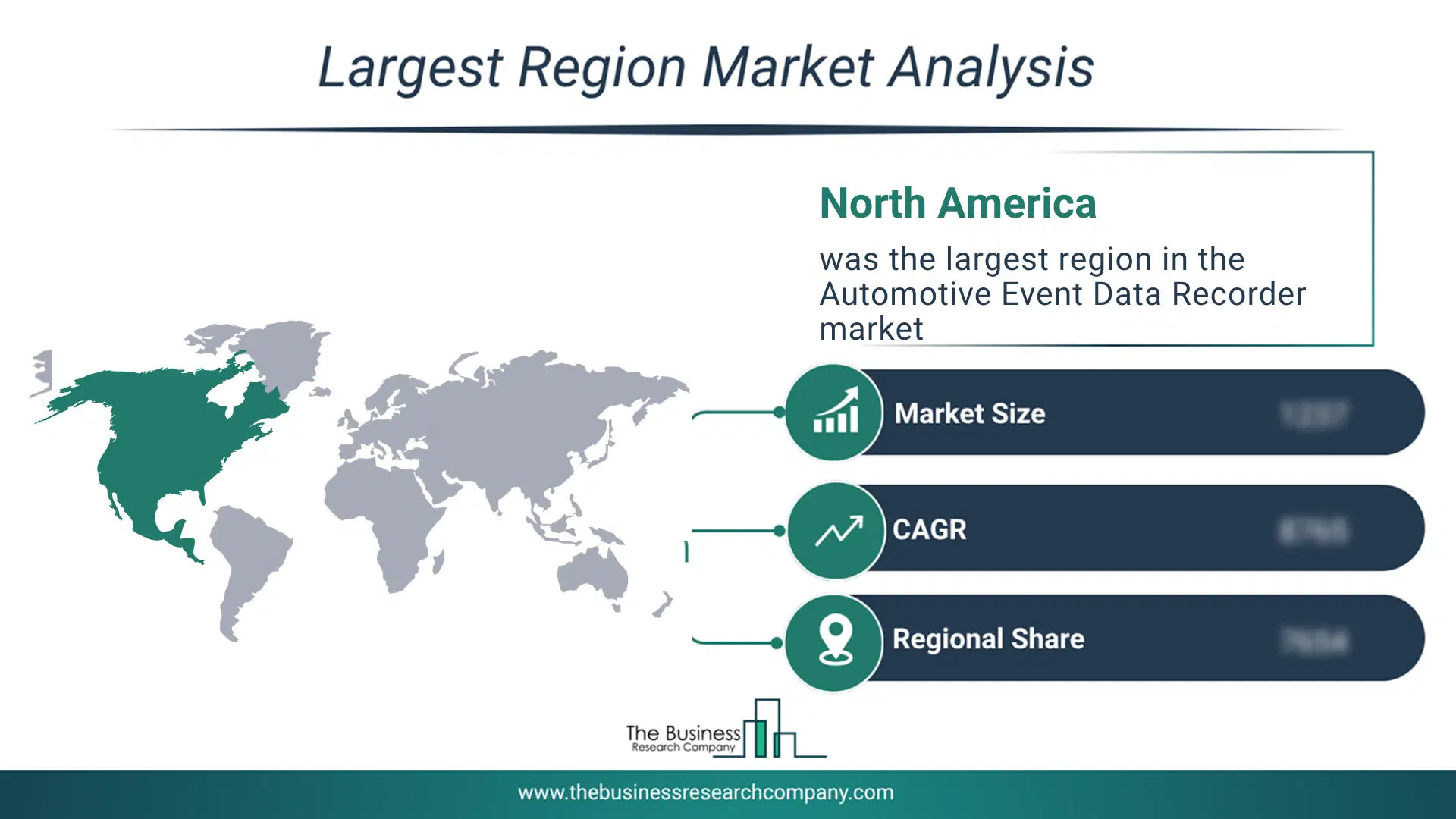
Regional Outlook
North America was the largest region in the automotive event data recorder market in 2025. Asia-Pacific is expected to be the fastest-growing region in the forecast period. The regions covered in this market report include Asia-Pacific, South East Asia, Western Europe, Eastern Europe, North America, South America, Middle East, Africa. The countries covered in this market report include Australia, Brazil, China, France, Germany, India, Indonesia, Japan, Taiwan, Russia, South Korea, UK, USA, Canada, Italy, SpainWhat Defines the Automotive Event Data Recorder Market?
The automotive event data recorder market consists of revenues earned by entities by providing services such as data collection, crash analysis, diagnostics, and reporting for accident investigations. The market value includes the value of related goods sold by the service provider or contained within the service offering. The automotive event data recorder market also consists of sales of black box data recorders, onboard diagnostic (OBD) devices, sensors, data storage units, and interface modules. Values in this market are ‘factory gate’ values, that is, the value of goods sold by the manufacturers or creators of the goods, whether to other entities (including downstream manufacturers, wholesalers, distributors, and retailers) or directly to end customers. The value of goods in this market includes related services sold by the creators of the goods.How is Market Value Defined and Measured?
The market value is defined as the revenues that enterprises gain from the sale of goods and/or services within the specified market and geography through sales, grants, or donations in terms of the currency (in USD unless otherwise specified). The revenues for a specified geography are consumption values that are revenues generated by organizations in the specified geography within the market, irrespective of where they are produced. It does not include revenues from resales along the supply chain, either further along the supply chain or as part of other products.
This chart presents market attractiveness based on a quantitative evaluation of growth, competition, strategic alignment, and risk, offering a clear view of opportunity areas for decision-making. This chart is for illustrative purposes; the full report contains the complete analysis.

This chart highlights the Total Addressable Market (TAM) by estimating the maximum revenue opportunity using an assumption-driven approach, supporting strategic planning and opportunity sizing across markets. The chart is illustrative; the full report provides a more comprehensive analysis.
What Key Data and Analysis Are Included in the Automotive Event Data Recorder Market Report 2026?
The automotive event data recorder market research report is one of a series of new reports from The Business Research Company that provides market statistics, including industry global market size, regional shares, competitors with the market share, detailed market segments, market trends and opportunities, and any further data you may need to thrive in the automotive event data recorder industry. The market research report delivers a complete perspective of everything you need, with an in-depth analysis of the current and future state of the industry.Automotive Event Data Recorder Market Report Forecast Analysis
| Report Attribute | Details |
|---|---|
| Market Size Value In 2026 | $2.95 billion |
| Revenue Forecast In 2030 | $3.76 billion |
| Growth Rate | CAGR of 6.5% from 2026 to 2030 |
| Base Year For Estimation | 2025 |
| Actual Estimates/Historical Data | 2020-2025 |
| Forecast Period | 2026 - 2030 - 2030 |
| Market Representation | Revenue in USD Billion and CAGR from 2026 to 2030 |
| Segments Covered | Component, Vehicle, Application, Sales Channel, End-User |
| Regional Scope | Asia-Pacific, Western Europe, Eastern Europe, North America, South America, Middle East, Africa |
| Country Scope | The countries covered in the report are Australia, Brazil, China, France, Germany, India, Indonesia, Japan, Taiwan, Russia, South Korea, UK, USA, Canada, Italy, Spain. |
| Key Companies Profiled | Volkswagen Group, Toyota Motor Corporation, Mercedes-Benz, BMW Group, Hyundai Motor Company, Bosch GmbH, Kia Corporation, DENSO Corporation, ZF Friedrichshafen AG, Continental AG, Hyundai Mobis Co. Ltd., Volvo Car Corporation, Infineon Technologies AG, NXP Semiconductors, Harman International, Garmin Ltd., Sensata Technologies, Neusoft Corporation, Magneti Marelli, Alps Electric Co. Ltd. |
| Customization Scope | Request for Customization |
| Pricing And Purchase Options | Explore Purchase Options |