
Autonomous Military Vehicle Market Report 2026
Global Outlook – By Component ( Hardware, Software, Services), By Product Type ( Semi-Autonomous Vehicles, Fully Autonomous Vehicles), By Platform Type ( Unmanned Aerial Vehicles (UAVs), Unmanned Ground Vehicles (UGVs), Unmanned Underwater Vehicles (UUVs), Unmanned Surface Vehicles (USVs)), By Application ( Intelligence, Surveillance, And Reconnaissance (ISR), Combat Operations, Logistics And Supply Chain Management, Explosive Ordnance Disposal (EOD), Search And Rescue Missions), By End-User ( Army, Navy, Air Force) – Market Size, Trends, Strategies, and Forecast to 2030
Autonomous Military Vehicle Market Overview
• Autonomous Military Vehicle market size has reached to $11.75 billion in 2025 • Expected to grow to $20.89 billion in 2030 at a compound annual growth rate (CAGR) of 12.2% • Growth Driver: Rising Defense Expenditure Driving The Market Due To Increasing Investment In Advanced Technologies And Reduced Human Risk • Market Trend: Advancements In Robotic Combat Vehicles (RCVs) Strengthen Autonomous Military Vehicle Capabilities In Modern Warfare • North America was the largest region in 2025 and Asia-Pacific is the fastest growing region.What Is Covered Under Autonomous Military Vehicle Market?
An autonomous military vehicle is a defense platform that uses sensors, artificial intelligence, and advanced control systems to operate and carry out missions without direct human control. These vehicles can perform tasks such as surveillance, reconnaissance, and combat operations, while often allowing remote monitoring or human override when required. The main components of autonomous military vehicle include hardware, software, and services. Hardware refers to the physical systems such as sensors, navigation modules, control units, and mobility platforms that enable autonomous operation in defense environments. They are categorized by product type including semi-autonomous vehicles and fully autonomous vehicles and by platform type including unmanned aerial vehicles (UAVs), unmanned ground vehicles (UGVs), unmanned underwater vehicles (UUVs), and unmanned surface vehicles (USVs). They find application in intelligence, surveillance, and reconnaissance (ISR), combat operations, logistics and supply chain management, explosive ordnance disposal (EOD), and search and rescue missions, serving end users including army, navy, and air force.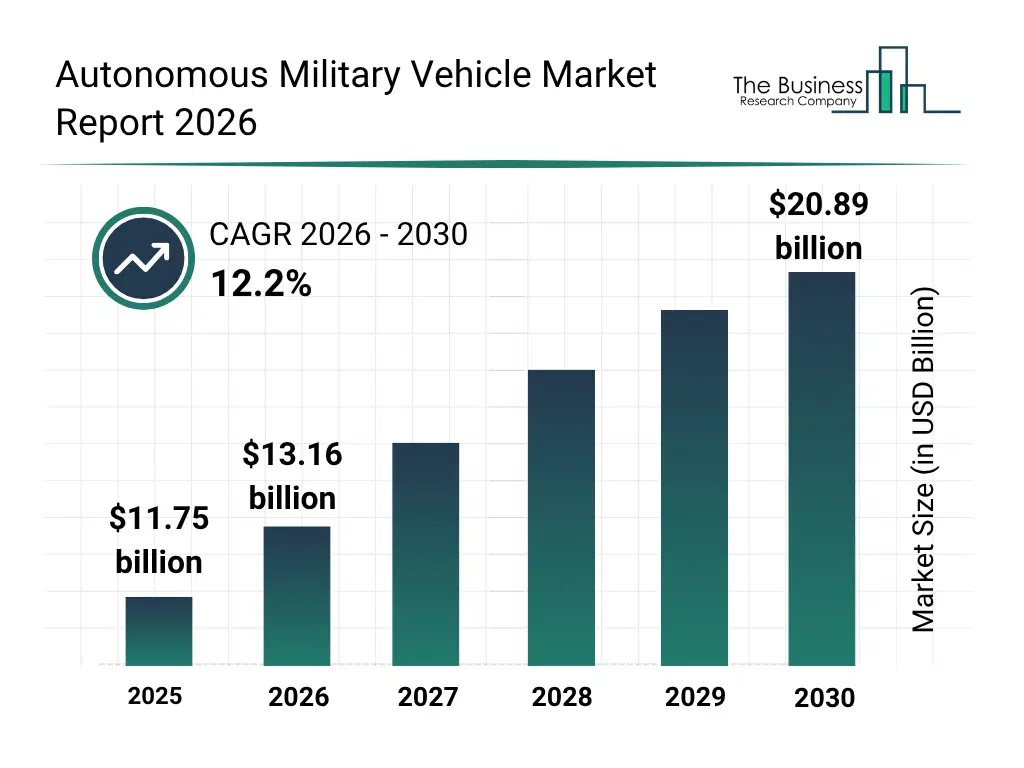
What Is The Autonomous Military Vehicle Market Size and Share 2026?
The autonomous military vehicle market size has grown rapidly in recent years. It will grow from $11.75 billion in 2025 to $13.16 billion in 2026 at a compound annual growth rate (CAGR) of 12.0%. The growth in the historic period can be attributed to rising defense modernization programs, increasing military expenditure on unmanned systems, growing demand for remote surveillance capabilities, expansion of border security operations, advancements in autonomous navigation technologies.What Is The Autonomous Military Vehicle Market Growth Forecast?
The autonomous military vehicle market size is expected to see rapid growth in the next few years. It will grow to $20.89 billion in 2030 at a compound annual growth rate (CAGR) of 12.2%. The growth in the forecast period can be attributed to increasing adoption of Ai-powered combat systems, rising investments in autonomous fleet management platforms, growing deployment of multi-domain unmanned operations, expansion of cybersecure communication networks for defense systems, increasing demand for autonomous logistics and supply chain support. Major trends in the forecast period include increasing deployment of Ai-enabled autonomous mission planning systems, growing adoption of swarm intelligence technologies in unmanned military operations, rising integration of secure cloud-based battlefield data management platforms, expansion of advanced sensor fusion systems for real-time autonomous navigation, increasing use of smart manufacturing technologies in autonomous military vehicle production.
Global Autonomous Military Vehicle Market Segmentation
1) By Component: Hardware, Software, Services 2) By Product Type: Semi-Autonomous Vehicles, Fully Autonomous Vehicles 3) By Platform Type: Unmanned Aerial Vehicles (UAVs), Unmanned Ground Vehicles (UGVs), Unmanned Underwater Vehicles (UUVs), Unmanned Surface Vehicles (USVs) 4) By Application: Intelligence, Surveillance, And Reconnaissance (ISR), Combat Operations, Logistics And Supply Chain Management, Explosive Ordnance Disposal (EOD), Search And Rescue Missions 5) By End-User: Army, Navy, Air Force Subsegments: 1) By Hardware: Sensors And Imaging Systems, Communication And Data Link Equipment, Navigation And Positioning Systems, Control Units And Processors, Propulsion And Power Systems, Payload And Mission Equipment, Structural And Chassis Components 2) By Software: Autonomy And Navigation Software, Mission Planning And Control Software, Data Processing And Analytics Software, Artificial Intelligence And Machine Learning Software, Cybersecurity And Encryption Software, Simulation And Training Software, Fleet Management Software 3) By Services: Maintenance And Repair Services, Training And Simulation Services, System Integration Services, Technical Support And Consulting Services, Upgrade And Modernization Services, Deployment And Operational Support ServicesWhat Is The Driver Of The Autonomous Military Vehicle Market?
The rising defense expenditure is expected to propel the growth of the autonomous military vehicle market going forward. Defense expenditure is the total amount a government spends on its military forces, including personnel, equipment, operations, and defense-related infrastructure and research. Defense expenditure is increasing due to rising geopolitical tensions, as countries invest more in military capabilities and advanced technologies to strengthen national security and deter potential threats from rival nations. Defense expenditure drives the adoption of autonomous military vehicles by enabling investment in advanced technologies, testing programs, and large-scale deployment, which strengthens mission effectiveness while minimizing human involvement in high-risk operations. For instance, in April 2024, according to the Stockholm International Peace Research Institute (SIPRI), a Sweden-based independent resource on global security, total global military expenditure reached $2,443 billion in 2023, reflecting a 6.8% increase in real terms compared to 2022. Therefore, the rising defense expenditure is driving the growth of the autonomous military vehicle industry.Key Players In The Global Autonomous Military Vehicle Market
Major companies operating in the autonomous military vehicle market are Boeing Defense Space & Security, Lockheed Martin Corporation, Northrop Grumman Corporation, General Dynamics Land Systems, BAE Systems plc, L3Harris Technologies Inc., Textron Inc., Oshkosh Corporation, Rheinmetall AG, Singapore Technologies Engineering Ltd, Hanwha Aerospace, Elbit Systems Ltd., Israel Aerospace Industries Ltd., Kongsberg Gruppen ASA, KNDS N.V., ASELSAN A.Ş., AeroVironment Inc., Anduril Industries, Hyundai Rotem Company, QinetiQ Group plc, Teledyne FLIR LLC, Diehl Defence GmbH & Co. KG, HDT Global, FNSS Savunma Sistemleri A.Ş., Forterra Inc., Kodiak Robotics Inc.Global Autonomous Military Vehicle Market Trends and Insights
Major companies operating in the autonomous military vehicle market are focusing on developing innovative solutions, such as robotic combat vehicles, to enhance battlefield mobility, enable remote and autonomous operations, and improve mission effectiveness while reducing risks to human soldiers. A robotic combat vehicle (RCV) is an unmanned or remotely controlled ground vehicle designed to carry out combat and reconnaissance missions while reducing risk to human soldiers. For instance, in September 2025, Milrem Robotics, an Estonia-based defense technology company, launched a HAVOC RCV, an 8×8 robotic combat vehicle built for high-mobility combat support with 110 km/h speeds, a 600 km range, and modular weapons such as remote turrets. It enables stealth and speed, paired with a unified autonomy system compatible across Milrem's lineup for lower costs. The HAVOC RCV is a tracked unmanned ground vehicle built for high mobility across challenging terrains and harsh battlefield conditions. It supports remote and semi-autonomous operations, reducing troop exposure to risks during missions. Its modular design enables integration of various weapon systems, sensors, and mission-specific payloads.What Are Latest Mergers And Acquisitions In The Autonomous Military Vehicle Market?
In July 2024, LIG Nex1, a South Korea-based defense technology company, acquired Ghost Robotics Corp. for $240 million. Through this acquisition, LIG Nex1 aims to strengthen its portfolio in autonomous ground robotics by integrating advanced unmanned ground vehicle technologies for defense and security applications. Ghost Robotics Corp. is a US-based robotics company that offers autonomous military vehicles.Regional Outlook
North America was the largest region in the autonomous military vehicle market in 2025. Asia-Pacific is expected to be the fastest-growing region in the forecast period.The regions covered in this market report are Asia-Pacific, South East Asia, Western Europe, Eastern Europe, North America, South America, Middle East, Africa. The countries covered in this market report are Australia, Brazil, China, France, Germany, India, Indonesia, Japan, Taiwan, Russia, South Korea, UK, USA, Canada, Italy, Spain.What Defines the Autonomous Military Vehicle Market?
The autonomous military vehicle market consists of revenues earned by entities by providing services such as border and perimeter security monitoring, electronic warfare and signal jamming support, and cyber defense and secure communication relay. The market value includes the value of related goods sold by the service provider or included within the service offering. The autonomous military vehicle market also includes sales of onboard mission computers, inertial measurement units, and AI processing units. Values in this market are ‘factory gate’ values, that is, the value of goods sold by the manufacturers or creators of the goods, whether to other entities (including downstream manufacturers, wholesalers, distributors, and retailers) or directly to end customers. The value of goods in this market includes related services sold by the creators of the goods.How is Market Value Defined and Measured?
The market value is defined as the revenues that enterprises gain from the sale of goods and/or services within the specified market and geography through sales, grants, or donations in terms of the currency (in USD unless otherwise specified). The revenues for a specified geography are consumption values that are revenues generated by organizations in the specified geography within the market, irrespective of where they are produced. It does not include revenues from resales along the supply chain, either further along the supply chain or as part of other products.What Key Data and Analysis Are Included in the Autonomous Military Vehicle Market Report 2026?
The autonomous military vehicle market research report is one of a series of new reports from The Business Research Company that provides autonomous military vehicle market statistics, including autonomous military vehicle industry global market size, regional shares, competitors with a autonomous military vehicle market share, detailed autonomous military vehicle market segments, market trends and opportunities, and any further data you may need to thrive in the autonomous military vehicle industry. This autonomous military vehicle market research report delivers a complete perspective of everything you need, with an in-depth analysis of the current and future scenario of the industry.Autonomous Military Vehicle Market Report Forecast Analysis
| Report Attribute | Details |
|---|---|
| Market Size Value In 2026 | $13.16 billion |
| Revenue Forecast In 2030 | $20.89 billion |
| Growth Rate | CAGR of 12.2% from 2026 to 2030 |
| Base Year For Estimation | 2025 |
| Actual Estimates/Historical Data | 2020-2025 |
| Forecast Period | 2026 - 2030 |
| Market Representation | Revenue in USD Billion and CAGR from 2026 to 2030 |
| Segments Covered | Component, Product Type, Platform Type, Application, End-User |
| Regional Scope | Asia-Pacific, Western Europe, Eastern Europe, North America, South America, Middle East, Africa |
| Country Scope | The countries covered in the autonomous military vehicle market report are Australia, Brazil, China, France, Germany, India, Indonesia, Japan, Taiwan, Russia, South Korea, UK, USA, Canada, Italy, Spain. |
| Key Companies Profiled | Boeing Defense Space & Security, Lockheed Martin Corporation, Northrop Grumman Corporation, General Dynamics Land Systems, BAE Systems plc, L3Harris Technologies Inc., Textron Inc., Oshkosh Corporation, Rheinmetall AG, Singapore Technologies Engineering Ltd, Hanwha Aerospace, Elbit Systems Ltd., Israel Aerospace Industries Ltd., Kongsberg Gruppen ASA, KNDS N.V., ASELSAN A.Ş., AeroVironment Inc., Anduril Industries, Hyundai Rotem Company, QinetiQ Group plc, Teledyne FLIR LLC, Diehl Defence GmbH & Co. KG, HDT Global, FNSS Savunma Sistemleri A.Ş., Forterra Inc., Kodiak Robotics Inc. |
| Customization Scope | Request for Customization |
| Pricing And Purchase Options | Explore Purchase Options |