
Military Vehicle Electrification Market Report 2026
Global Outlook – By Technology (Hybrid, Fully Electric), By Operation (Manned, Autonomous/Semi-Autonomous), By Platform (Combat Vehicles, Support Vehicles, Unmanned Armored Vehicles), By System (Power Generation, Cooling Systems, Energy Storage, Traction Drive Systems, Power Conversion) – Market Size, Trends, Strategies, and Forecast to 2030
Military Vehicle Electrification Market Overview
• Military Vehicle Electrification market size has reached to $8.01 billion in 2025 • Expected to grow to $15.86 billion in 2030 at a compound annual growth rate (CAGR) of 14.4% • Growth Driver: Rising Fuel Prices Fuel Growth Of Military Vehicle Electrification • Market Trend: Technological Advancements In Military Vehicle Electrification • North America was the largest region in 2025 and Asia-Pacific is the fastest growing region.What Is Covered Under Military Vehicle Electrification Market?
The military vehicle electrification are used for electrifying the military vehicles by replacing traditionally used fossil fuels with electricity to power light-duty vehicles, medium-and heavy-duty trucks, and others. The primary goal of military vehicle electrification is to reduce the emission of greenhouse gases. The main types of military vehicle electrification technologies are hybrid and fully electric. The hybrid military vehicle refers to a vehicle that can work with fuel and battery. These hybrid vehicles store energy during braking and decelerating by converting kinetic energy to electricity. The military vehicle can be operated manned, autonomous/ semi-autonomous. Electrification systems are used in combat, support, and unmanned armored vehicles in power generation, cooling systems, energy storage, traction drive systems, and power conversion.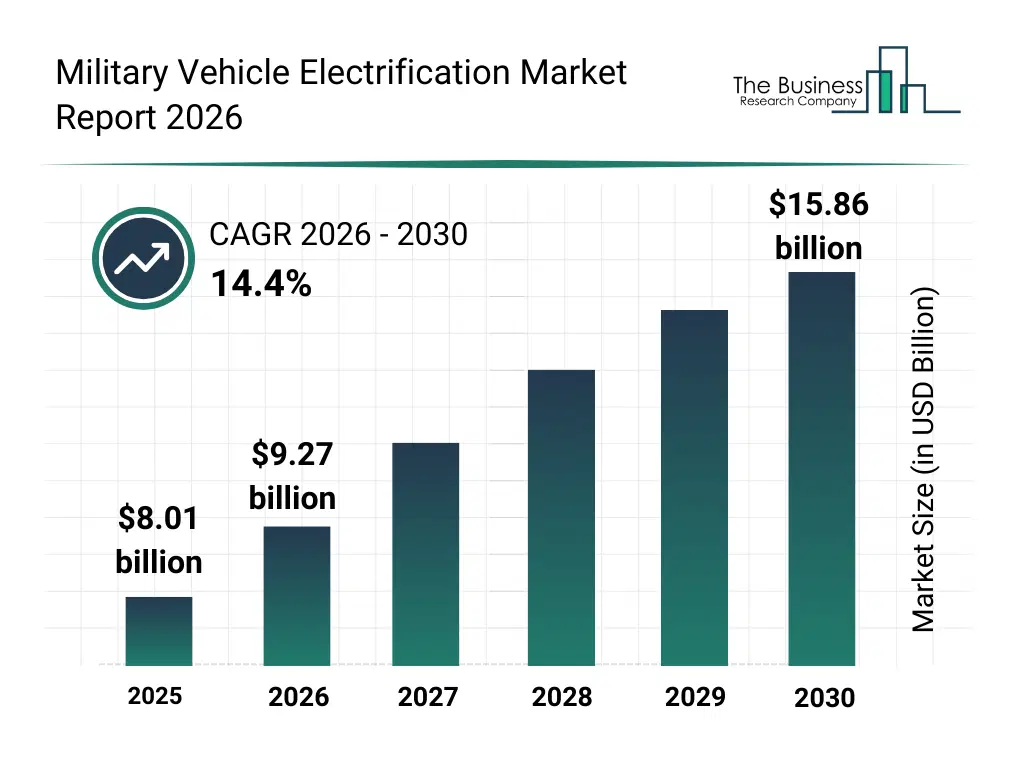
What Is The Military Vehicle Electrification Market Size and Share 2026?
The military vehicle electrification market size has grown rapidly in recent years. It will grow from $8.01 billion in 2025 to $9.27 billion in 2026 at a compound annual growth rate (CAGR) of 15.8%. The growth in the historic period can be attributed to initial modernization programs to improve onboard power generation for military vehicles, rising demand for reduced fuel dependency in tactical and logistic fleets, early integration of hybrid powertrains to enhance vehicle endurance, increased research in battery technologies suitable for harsh military environments, adoption of electrification solutions to support silent mobility and reduced acoustic signatures.What Is The Military Vehicle Electrification Market Growth Forecast?
The military vehicle electrification market size is expected to see rapid growth in the next few years. It will grow to $15.86 billion in 2030 at a compound annual growth rate (CAGR) of 14.4%. The growth in the forecast period can be attributed to growing requirement for high-power electric systems to enable advanced onboard sensors and directed-energy weapons, expansion of fully electric and hybrid platforms across light medium and heavy military vehicle categories, advancements in fast-charging and battlefield energy-storage infrastructure, increasing defense investment in low-emission technologies to meet sustainability mandates, development of modular electrification kits enabling retrofit of legacy military vehicles. Major trends in the forecast period include enhanced battery and energy storage systems, high-efficiency traction drive systems, onboard power management and optimization, modular hybrid and electric vehicle platforms, military-specific vehicle electrification standards.
Global Military Vehicle Electrification Market Segmentation
1) By Technology: Hybrid, Fully Electric 2) By Operation: Manned, Autonomous/Semi-Autonomous 3) By Platform: Combat Vehicles, Support Vehicles, Unmanned Armored Vehicles 4) By System: Power Generation, Cooling Systems, Energy Storage, Traction Drive Systems, Power Conversion Subsegments: 1) By Hybrid: Series Hybrid Systems, Parallel Hybrid Systems, Plug-in Hybrid Systems 2) By Fully Electric: Battery Electric Vehicles (BEVs), Fuel Cell Electric Vehicles (FCEVs)What Is Driver Of The Military Vehicle Electrification Market?
The rising fuel prices are anticipated to propel the growth of the military vehicle electrification market going forward. Fuel prices refer to the cost of various types of fuel, primarily gasoline and diesel, that consumers pay to fill up their vehicles or equipment. With rising fuel prices, traditional military vehicles become expensive to operate with internal combustion engines, so electrification for military vehicles provides an alternative to reduce fuel consumption and operating costs for military organizations. For instance, in February 2024, according to the Department for Energy Security and Net Zero (DESNZ), a UK-based government department, the median fuel cost was estimated to be $3,670 (£2,950), compared with the actual net fuel cost estimate of $2,735 (£2,200) in 2023. Therefore, the rising fuel prices drive the growth of the military vehicle electrification industry.Key Players In The Global Military Vehicle Electrification Market
Major companies operating in the military vehicle electrification market are BAE Systems plc, Arquus, Leonardo S.p.A., Textron Inc., General Motors Company, Oshkosh Corporation, Ballard Power Systems Inc., AM General LLC, Nikola Corporation, Alke S.r.l., Aselsan A.S., Epsilor Electric Fuel Ltd., Flensberg Fahrzeugbau Gesellschaft mbH, Kongsberg Gruppen, Lockheed Martin Corporation, Magna International Inc., Navistar International Corporation, Otokar Otomotiv ve Savunma Sanayi A.S., Rheinmetall AG, Ricardo plc, Siemens AG, Tata Motors Limited, RTX Corporation, Thales Group, UQM Technologies Inc., Visedo Oy, Wrightspeed Inc., XALT Energy LLC
This chart is for illustrative purposes; the full report includes a detailed competitor analysis and comprehensive overview of the top 10 companies in the market.
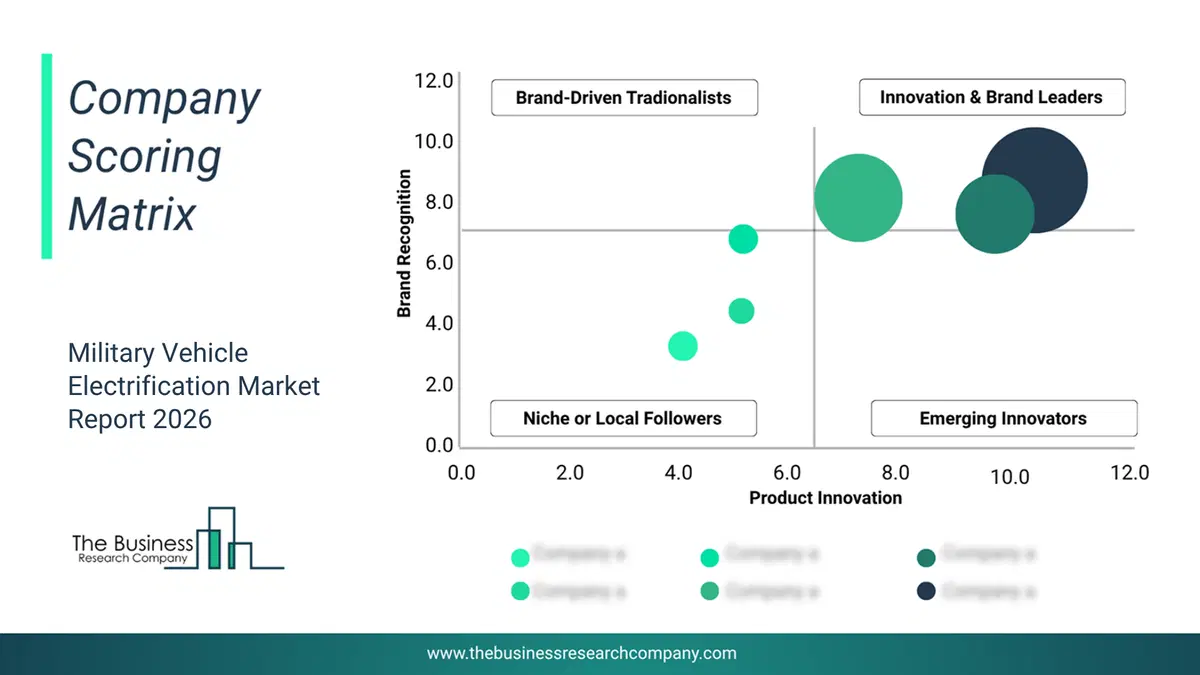
This chart maps companies by product innovation and brand strength, with bubble size indicating relative revenue, helping identify market leaders, challengers, and niche players. This is an illustrative chart; the full report provides a complete and accurate competitive analysis.
Global Military Vehicle Electrification Market Trends and Insights
Major companies operating in the military vehicle electrification market are focusing developing technological advancement such as infantry fighting vehicle, to provide both armored protection and enhanced mobility. An infantry fighting vehicle (IFV) is a heavily armed and armored combat vehicle designed to transport and support infantry in battle while offering firepower and protection against enemy forces. For instance, in February 2024, ST Engineering, a Singapore-based technology, defence and engineering company, launched the Hybrid-Electric 35-ton Armored Fighting Vehicle. The company's hybrid-electric drive kit, which can also be integrated into other platforms, offers extra power for digital capabilities like enhanced situational awareness and supports open architecture for AI-driven software integrations. The vehicle includes an AI-powered surveillance optical radar that leverages machine learning to detect and map target locations and distances, while manned-unmanned teaming enables efficient mission planning and execution.What Are Latest Mergers And Acquisitions In The Military Vehicle Electrification Market? Parker Hannifin Corporation Acquires Curtis Instruments, Inc. To Strengthen Electrification Capabilities
In September 2025, Parker Hannifin Corporation, a U.S.-based manufacturing company, acquired Curtis Instruments, Inc. for an undisclosed amount. With this acquisition, Parker aims to enhance its electrification capabilities by integrating Curtis’s advanced control systems into its existing product portfolio, accelerate the development of next-generation military and commercial electric vehicle solutions, and strengthen its position in high-performance electrification technologies. Curtis Instruments Inc. is a U.S.-based manufacturing company that offers military vehicle electrification.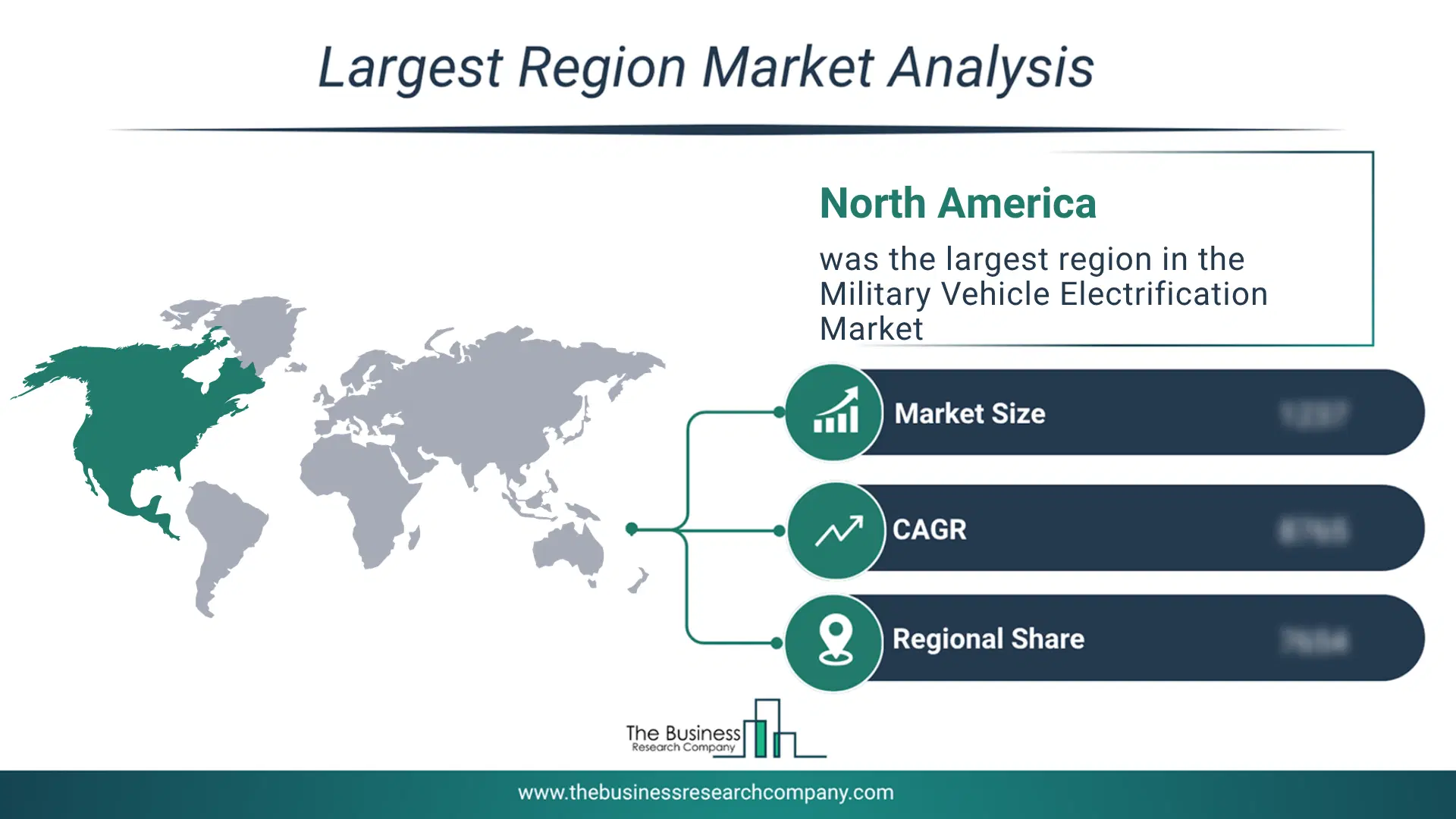
Regional Insights
North America was the largest region in the military vehicle electrification market in 2025. Asia-Pacific is expected to be the fastest-growing region in the forecast period. The regions covered in this market report are Asia-Pacific, South East Asia, Western Europe, Eastern Europe, North America, South America, Middle East, Africa. The countries covered in this market report are Australia, Brazil, China, France, Germany, India, Indonesia, Japan, Taiwan, Russia, South Korea, UK, USA, Canada, Italy, SpainWhat Defines the Military Vehicle Electrification Market?
The military vehicle electrification market consists of sales of military vehicle electrification that are used to increase onboard power and extend range and persistence. Values in this market are ‘factory gate’ values, that is the value of goods sold by the manufacturers or creators of the goods, whether to other entities (including downstream manufacturers, wholesalers, distributors, and retailers) or directly to end customers. The value of goods in this market includes related services sold by the creators of the goods.How is Market Value Defined and Measured?
The market value is defined as the revenues that enterprises gain from the sale of goods and/or services within the specified market and geography through sales, grants, or donations in terms of the currency (in USD unless otherwise specified). The revenues for a specified geography are consumption values that are revenues generated by organizations in the specified geography within the market, irrespective of where they are produced. It does not include revenues from resales along the supply chain, either further along the supply chain or as part of other products.
This chart presents market attractiveness based on a quantitative evaluation of growth, competition, strategic alignment, and risk, offering a clear view of opportunity areas for decision-making. This chart is for illustrative purposes; the full report contains the complete analysis.

This chart highlights the Total Addressable Market (TAM) by estimating the maximum revenue opportunity using an assumption-driven approach, supporting strategic planning and opportunity sizing across markets. The chart is illustrative; the full report provides a more comprehensive analysis.
What Key Data and Analysis Are Included in the Military Vehicle Electrification Market Report 2026?
The military vehicle electrification market research report is one of a series of new reports from The Business Research Company that provides market statistics, including industry global market size, regional shares, competitors with the market share, detailed market segments, market trends and opportunities, and any further data you may need to thrive in the military vehicle electrification industry. The market research report delivers a complete perspective of everything you need, with an in-depth analysis of the current and future state of the industry.Military Vehicle Electrification Market Report Forecast Analysis
| Report Attribute | Details |
|---|---|
| Market Size Value In 2026 | $9.27 billion |
| Revenue Forecast In 2030 | $15.86 billion |
| Growth Rate | CAGR of 14.4% from 2026 to 2030 |
| Base Year For Estimation | 2025 |
| Actual Estimates/Historical Data | 2020-2025 |
| Forecast Period | 2026 - 2030 |
| Market Representation | Revenue in USD Billion and CAGR from 2026 to 2030 |
| Segments Covered | Technology, Operation, Platform, System |
| Regional Scope | Asia-Pacific, Western Europe, Eastern Europe, North America, South America, Middle East, Africa |
| Country Scope | The countries covered in the military vehicle electrification market report are Australia, Brazil, China, France, Germany, India, Indonesia, Japan, Taiwan, Russia, South Korea, UK, USA, Canada, Italy, Spain |
| Key Companies Profiled | BAE Systems plc, Arquus, Leonardo S.p.A., Textron Inc., General Motors Company, Oshkosh Corporation, Ballard Power Systems Inc., AM General LLC, Nikola Corporation, Alke S.r.l., Aselsan A.S., Epsilor Electric Fuel Ltd., Flensberg Fahrzeugbau Gesellschaft mbH, Kongsberg Gruppen, Lockheed Martin Corporation, Magna International Inc., Navistar International Corporation, Otokar Otomotiv ve Savunma Sanayi A.S., Rheinmetall AG, Ricardo plc, Siemens AG, Tata Motors Limited, RTX Corporation, Thales Group, UQM Technologies Inc., Visedo Oy, Wrightspeed Inc., XALT Energy LLC |
| Customization Scope | Request for Customization |
| Pricing And Purchase Options | Explore Purchase Options |