
Autonomous Port Operations Systems Market Report 2026
Global Outlook – By Port Type (Seaports, Inland Ports, Dry Ports), By Autonomy (Fully Autonomous, Remotely Operated, Partially Autonomous), By Application (Terminal Planning And Operations, Cargo Storage, Inventory Management, Security And Security Controls, Other Applications), By End User (Line-Fit And Newbuild, Retrofit) – Market Size, Trends, Strategies, and Forecast to 2030
Autonomous Port Operations Systems Market Overview
• Autonomous Port Operations Systems market size has reached to $28.63 billion in 2025 • Expected to grow to $60.83 billion in 2030 at a compound annual growth rate (CAGR) of 16.2% • Growth Driver: Rising Marine Trade Volume Fueling The Growth Of The Market Due To Increasing Port Efficiency Demands • Market Trend: Adoption Of Advanced Modular Solutions Driven By The Need For Flexible And Efficient Port Logistics • Asia-Pacific was the largest region and fastest growing region.What Is Covered Under Autonomous Port Operations Systems Market?
Autonomous port operations systems refer to integrated, technology-driven solutions that leverage artificial intelligence, machine learning, robotics, and data analytics to enable the automated coordination, control, and execution of port activities with minimal human intervention, aiming to enhance operational efficiency, safety, and real-time decision-making across maritime logistics networks. These systems optimize cargo handling, streamline vessel traffic management, reduce turnaround times, improve resource utilization, and support predictive maintenance and environmental monitoring in port environments. The main port types of autonomous port operations systems include seaports, inland ports, and dry ports. Seaports are critical maritime hubs where autonomous port operations systems are implemented to streamline cargo handling, vessel management, and logistics through automation and intelligent technologies. These are characterized based on autonomy, such as fully autonomous, remotely operated, and partially autonomous, which are used in applications including terminal planning and operations, cargo storage, inventory management, security and security controls, and others. It is used for various end users, such as line-fit and new build and retrofit.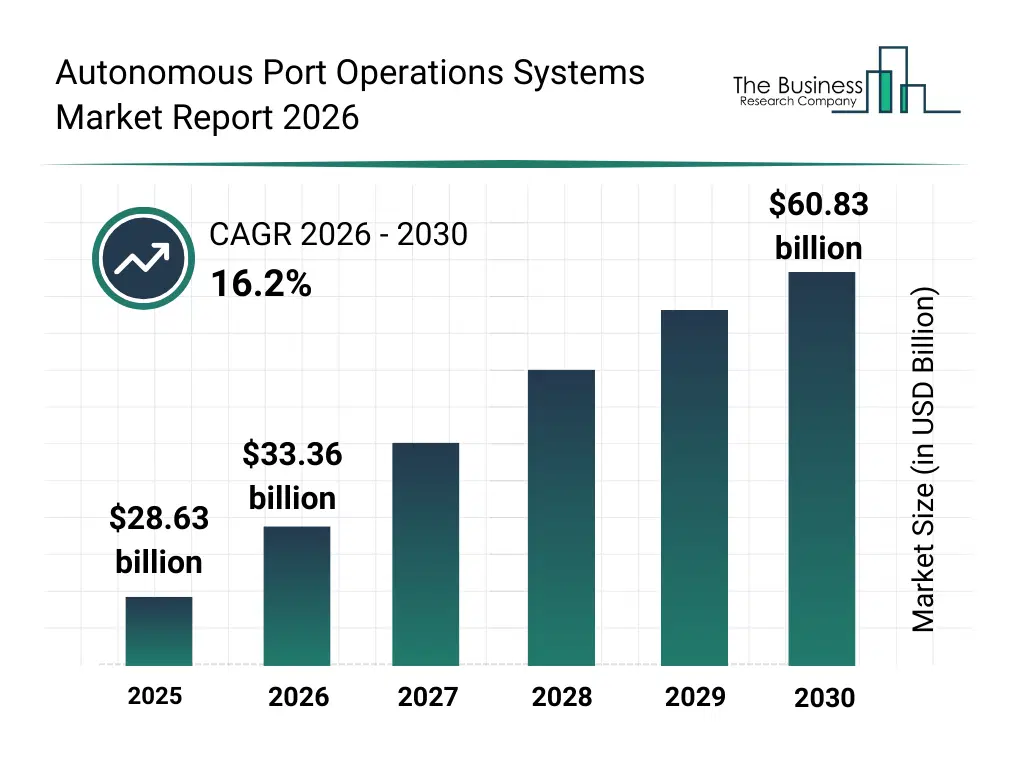
What Is The Autonomous Port Operations Systems Market Size and Share 2026?
The autonomous port operations systems market size has grown rapidly in recent years. It will grow from $28.63 billion in 2025 to $33.36 billion in 2026 at a compound annual growth rate (CAGR) of 16.5%. The growth in the historic period can be attributed to port modernization initiatives, growth in global trade volumes, early adoption of terminal automation, demand for operational efficiency, reduction of manual labor.What Is The Autonomous Port Operations Systems Market Growth Forecast?
The autonomous port operations systems market size is expected to see rapid growth in the next few years. It will grow to $60.83 billion in 2030 at a compound annual growth rate (CAGR) of 16.2%. The growth in the forecast period can be attributed to reduction in port congestion, smart port investments, demand for real-time logistics visibility, sustainability-driven port operations, integration of digital twins. Major trends in the forecast period include automation of container handling operations, deployment of AI-driven port control systems, integration of autonomous vehicles and cranes, expansion of remote port operations, focus on predictive maintenance.
Global Autonomous Port Operations Systems Market Segmentation
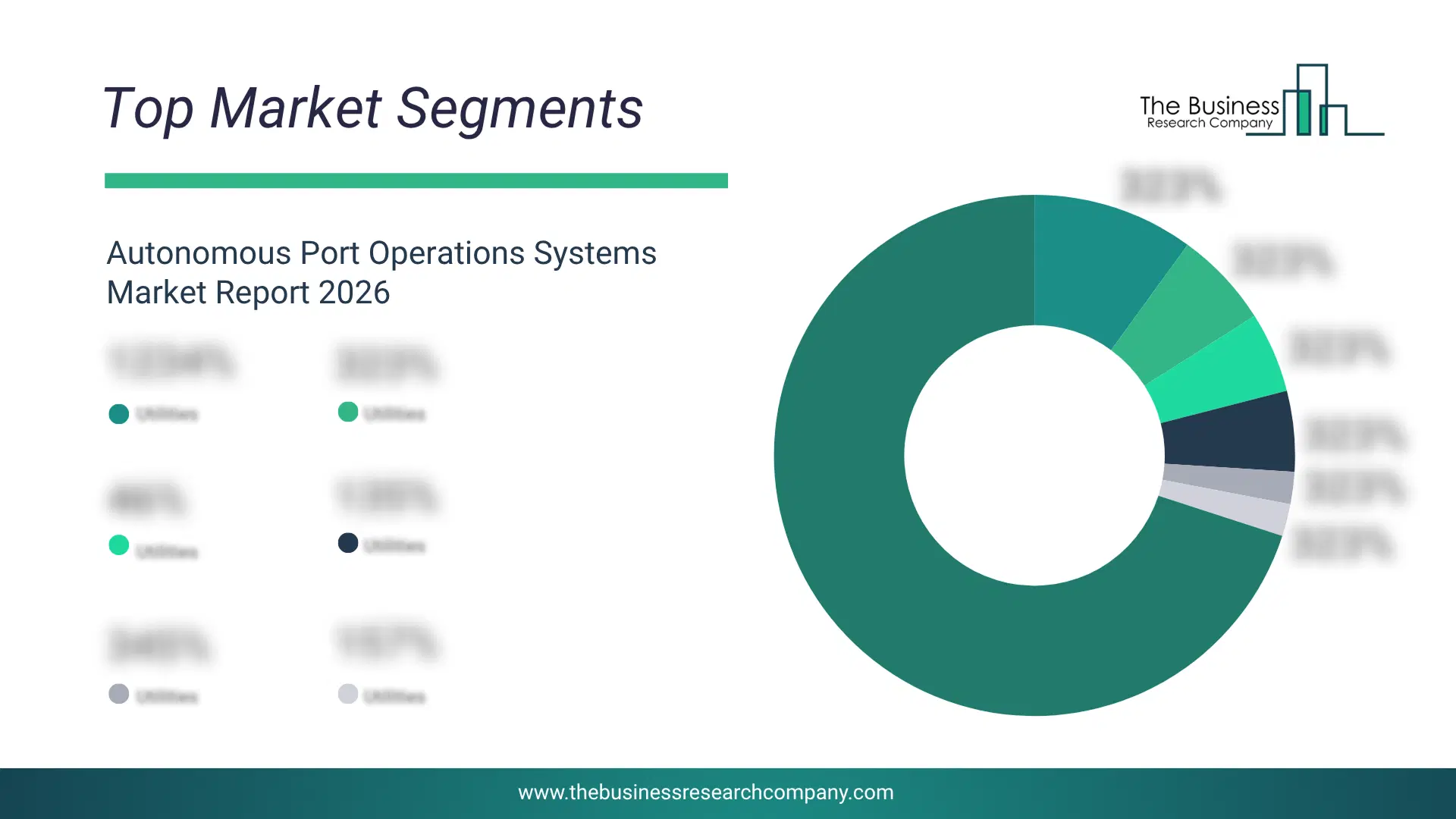
1) By Port Type: Seaports, Inland Ports, Dry Ports 2) By Autonomy: Fully Autonomous, Remotely Operated, Partially Autonomous 3) By Application: Terminal Planning And Operations, Cargo Storage, Inventory Management, Security And Security Controls, Other Applications 4) By End User: Line-Fit And Newbuild, Retrofit Subsegments: 1) By Seaports: Container Terminals, Bulk Cargo Terminals, Ro-Ro (Roll-On Or Roll-Off) Terminals, Liquid Cargo Terminals 2) By Inland Ports: Rail-Linked Intermodal Terminals, Barge Terminals, Inland Container Depots (ICDs), Logistics Hubs 3) By Dry Ports: Customs Clearance Facilities, Warehousing Centers, Intermodal Transfer Points, Freight Consolidation CentersWhat Is The Driver Of The Autonomous Port Operations Systems Market?
The rising marine trade volume is expected to fuel the growth of the autonomous port operations systems market in the coming years. Marine trade refers to the international exchange of goods and commodities through sea transport, utilizing ships to move cargo across global waterways. The rising marine trade volume is due to globalization, which dramatically increases the interconnectedness of economies around the world. Autonomous port operations systems improve the management of growing marine trade volumes by increasing efficiency, reducing human error, and streamlining logistics. These systems use advanced technologies to automate key port functions such as cargo handling, container tracking, and vessel berthing. For instance, in July 2025, according to the European Commission, a Belgium-based executive branch of the European Union (EU), the third quarter of 2024 saw 61.9% of the total amount of goods handled at major European Union ports come from inward movements, up 0.2% from the previous quarter and 0.3% from the same period the year before. Therefore, the rising volume of marine trade will boost the growth of the autonomous port operations systems industry.Key Players In The Global Autonomous Port Operations Systems Market
Major companies operating in the autonomous port operations systems market report include CMA CGM Terminals, ABB Ltd., Toshiba Corporation, Yara International, DP World, Nidec Industrial Solutions, Hangzhou Hikvision Digital Technology Co. Ltd., PSA International, Shanghai Zhenhua Heavy Industries Co. Ltd. (ZPMC), Konecranes, Trelleborg Marine and Infrastructure, SICK AG, Cargotec Corporation, China Merchants Port Holdings Co. Ltd., Hutchison Port Holdings Trust, TMEIC Corporation, Conductix-Wampfler GmBH, Siemens Logistics GmbH, CyberLogitec, Navis, Rocsys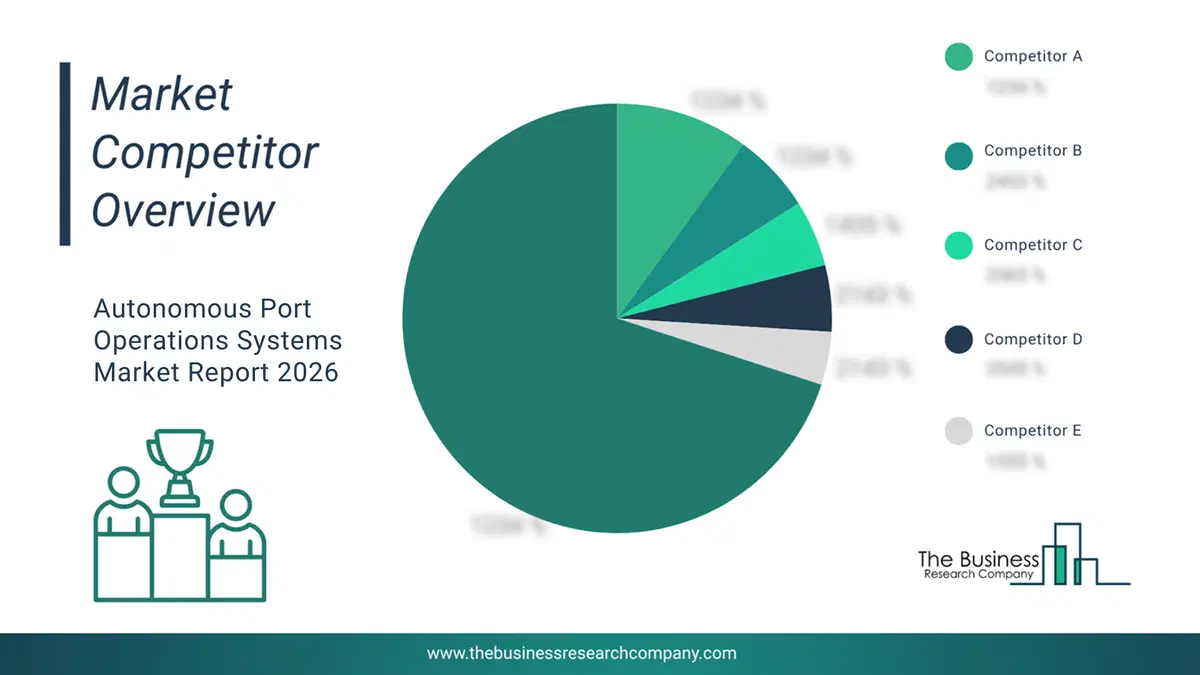
This chart is for illustrative purposes; the full report includes a detailed competitor analysis and comprehensive overview of the top 10 companies in the market.
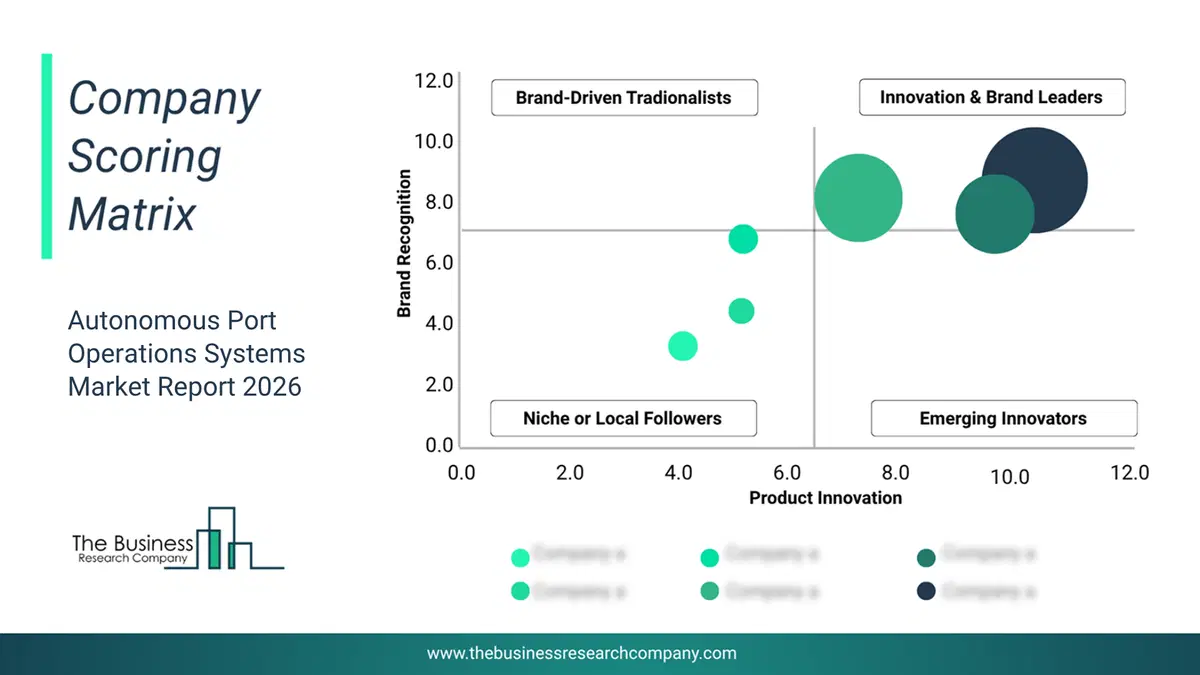
This chart maps companies by product innovation and brand strength, with bubble size indicating relative revenue, helping identify market leaders, challengers, and niche players. This is an illustrative chart; the full report provides a complete and accurate competitive analysis.
Global Autonomous Port Operations Systems Market Trends and Insights
Major companies operating in the autonomous port operations systems market are focusing on developing advanced solutions, such as modular and scalable logistics solutions, to enable faster implementation and integration with existing systems. Modular and scalable logistics solutions are flexible systems designed to adapt and expand according to changing operational needs, allowing efficient management of logistics processes as demand grows or shifts. For instance, in May 2025, the Port of Antwerp-Bruges, a Belgium-based port, launched an autonomous electric shuttle at the Medrepair Terminal to enhance container transportation. This shuttle stands out for its seamless integration into active port terminals, offering valuable operational data to support future scalability and commercial rollout. It reduces reliance on diesel-powered vehicles and manual labor when it is engineered for short-range transport between key port zones such as warehouses, stacks, and gates. Its modular, scalable design aligns with Logistics as a Service (LaaS) models, helping improve yard efficiency, cut turnaround times, and mitigate labor shortages. It operates autonomously along predefined routes and is equipped with sophisticated navigation software and high-resolution sensors while providing real-time operational oversight through a centralized human-machine interface (HMI).What Are Latest Mergers And Acquisitions In The Autonomous Port Operations Systems Market?
In November 2025, BTG Positioning Systems B.V., a UK-based maritime technology company, acquired GPR Inc., for an undisclosed amount. With this acquisition, BTG aims to advance port automation capabilities by integrating GPR’s port management and automation solutions into its service offerings, enhancing efficiency, safety, and operational intelligence for global ports. GPR Inc. is a UK-based maritime technology company that specializes in providing port automation, navigation, and operational management solutions.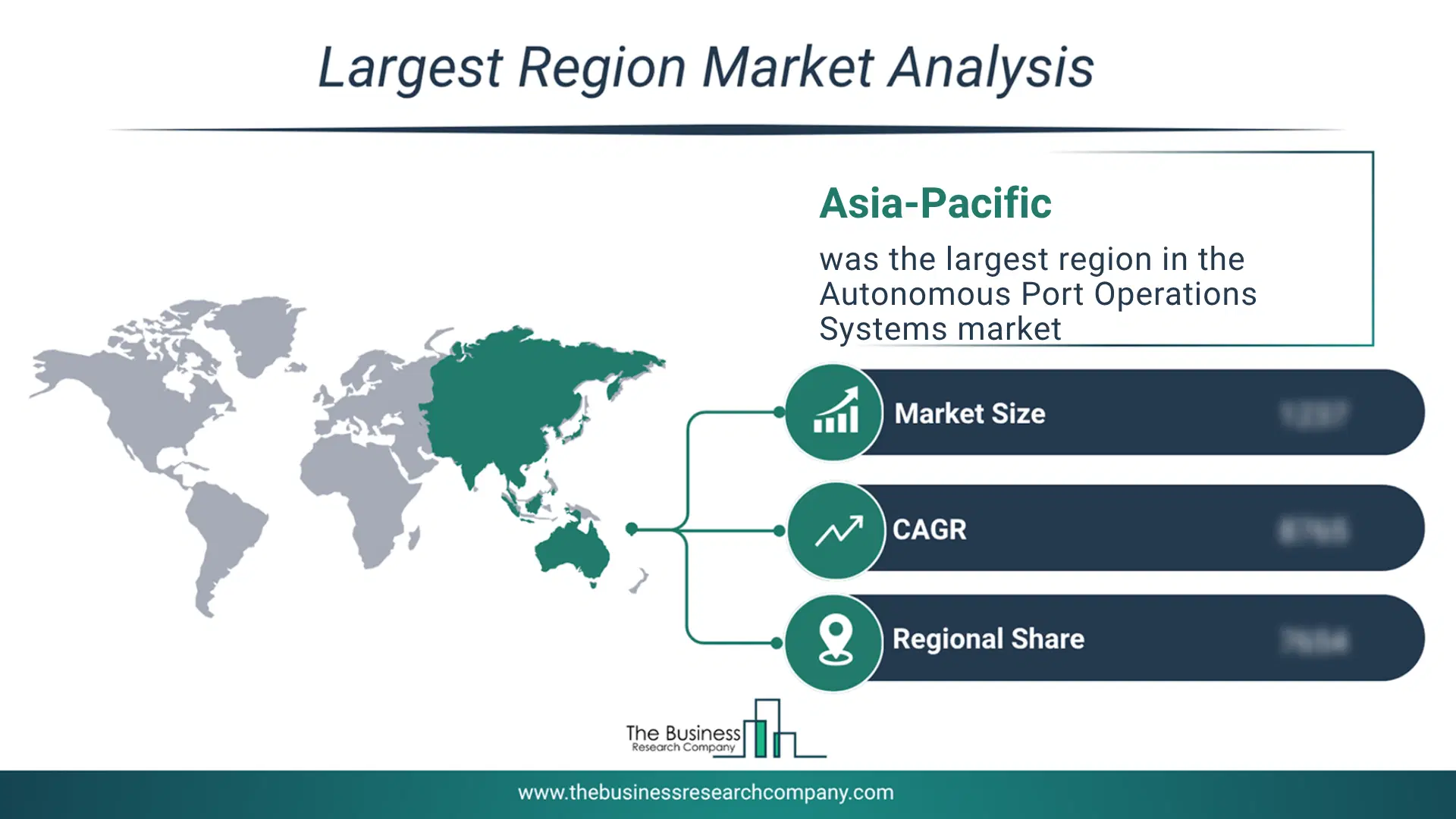
Regional Outlook
Asia-Pacific was the largest region in the autonomous port operations systems market in 2025. Asia-Pacific is expected to be the fastest-growing region in the forecast period. The regions covered in this market report include Asia-Pacific, South East Asia, Western Europe, Eastern Europe, North America, South America, Middle East, Africa. The countries covered in this market report include Australia, Brazil, China, France, Germany, India, Indonesia, Japan, Taiwan, Russia, South Korea, UK, USA, Canada, Italy, SpainWhat Defines the Autonomous Port Operations Systems Market?
The autonomous port operations systems market consists of revenues earned by entities by providing services such as predictive maintenance services, remote operation and monitoring services, AI-based analytics and optimization services, and digital twin modeling and simulation services. The market value includes the value of related goods sold by the service provider or included within the service offering. The autonomous port operations systems market also includes sales of automated guided vehicles (AGVs), autonomous straddle carriers, smart quay cranes, and IoT-enabled port sensors. Values in this market are ‘factory gate’ values, that is, the value of goods sold by the manufacturers or creators of the goods, whether to other entities (including downstream manufacturers, wholesalers, distributors, and retailers) or directly to end customers. The value of goods in this market includes related services sold by the creators of the goods.How is Market Value Defined and Measured?
The market value is defined as the revenues that enterprises gain from the sale of goods and/or services within the specified market and geography through sales, grants, or donations in terms of the currency (in USD unless otherwise specified). The revenues for a specified geography are consumption values that are revenues generated by organizations in the specified geography within the market, irrespective of where they are produced. It does not include revenues from resales along the supply chain, either further along the supply chain or as part of other products.
This chart presents market attractiveness based on a quantitative evaluation of growth, competition, strategic alignment, and risk, offering a clear view of opportunity areas for decision-making. This chart is for illustrative purposes; the full report contains the complete analysis.

This chart highlights the Total Addressable Market (TAM) by estimating the maximum revenue opportunity using an assumption-driven approach, supporting strategic planning and opportunity sizing across markets. The chart is illustrative; the full report provides a more comprehensive analysis.
What Key Data and Analysis Are Included in the Autonomous Port Operations Systems Market Report 2026?
The autonomous port operations systems market research report is one of a series of new reports from The Business Research Company that provides market statistics, including industry global market size, regional shares, competitors with the market share, detailed market segments, market trends and opportunities, and any further data you may need to thrive in the autonomous port operations systems industry. The market research report delivers a complete perspective of everything you need, with an in-depth analysis of the current and future state of the industry.Autonomous Port Operations Systems Market Report Forecast Analysis
| Report Attribute | Details |
|---|---|
| Market Size Value In 2026 | $33.36 billion |
| Revenue Forecast In 2030 | $60.83 billion |
| Growth Rate | CAGR of 16.5% from 2026 to 2030 |
| Base Year For Estimation | 2025 |
| Actual Estimates/Historical Data | 2020-2025 |
| Forecast Period | 2026 - 2030 - 2030 |
| Market Representation | Revenue in USD Billion and CAGR from 2026 to 2030 |
| Segments Covered | Port Type, Autonomy, Application, End User |
| Regional Scope | Asia-Pacific, Western Europe, Eastern Europe, North America, South America, Middle East, Africa |
| Country Scope | The countries covered in the report are Australia, Brazil, China, France, Germany, India, Indonesia, Japan, Taiwan, Russia, South Korea, UK, USA, Canada, Italy, Spain. |
| Key Companies Profiled | CMA CGM Terminals, ABB Ltd., Toshiba Corporation, Yara International, DP World, Nidec Industrial Solutions, Hangzhou Hikvision Digital Technology Co. Ltd., PSA International, Shanghai Zhenhua Heavy Industries Co. Ltd. (ZPMC), Konecranes, Trelleborg Marine and Infrastructure, SICK AG, Cargotec Corporation, China Merchants Port Holdings Co. Ltd., Hutchison Port Holdings Trust, TMEIC Corporation, Conductix-Wampfler GmBH, Siemens Logistics GmbH, CyberLogitec, Navis, Rocsys |
| Customization Scope | Request for Customization |
| Pricing And Purchase Options | Explore Purchase Options |