
Autonomous Transport Market Report 2026
Global Outlook – By Component (Hardware, Software, Services), By Vehicle Type (Passenger Cars, Commercial Trucks, Public Transit Shuttles, Delivery Robots, Unmanned Aerial Vehicles, Autonomous Rail Systems, Marine Vessels), By Technology (Artificial Intelligence (AI) Systems, Sensors (LiDAR, Radar, Ultrasonic), Machine Vision, Robotics, Advanced Control Systems, Vehicle Control Units And Hardware Components), By Propulsion Type (Electric, Hybrid, Internal Combustion Engine), By Application (Logistics And Freight, Ride Hailing And Robo Taxis, Industrial And Mining, Last Mile Delivery, Personal Mobility, Defense And Security) – Market Size, Trends, Strategies, and Forecast to 2030
Autonomous Transport Market Overview
• Autonomous Transport market size has reached to $55.39 billion in 2025 • Expected to grow to $73.26 billion in 2030 at a compound annual growth rate (CAGR) of 32.5% • Growth Driver: Rising E-commerce Volumes Fueling The Growth Of The Market Due To Increasing Demand For Scalable, Fast, And Cost-efficient Delivery Solutions • Market Trend: Advancements In AI-Driven Autonomous Navigation Enhancing Intelligent Mobility • North America was the largest region in 2025 and Asia-Pacific is the fastest growing region.What Is Covered Under Autonomous Transport Market?
Autonomous transport refers to vehicles and mobility systems that use advanced technologies to operate with minimal or no human intervention. Its purpose is to enhance transportation efficiency, safety, and convenience by reducing human error, optimizing traffic flow, and enabling smarter mobility solutions. The main components of autonomous transport include hardware, software and services. Hardware refers to the physical systems and components used in autonomous transport, including sensors, cameras, radar, LiDAR, control units, and onboard computing systems that enable self-driving operation. The vehicle types include passenger cars, commercial trucks, public transit shuttles, delivery robots, unmanned aerial vehicles, autonomous rail systems and marine vessels, and the technologies categories as artificial intelligence (AI) systems, sensors (LiDAR, radar and ultrasonic), machine vision, robotics, advanced control systems, and vehicle control units and hardware components. The propulsion types include electric, hybrid and internal combustion engine systems, and the key applications such as logistics and freight, ride hailing and robo taxis, industrial and mining, last mile delivery, personal mobility, and defence and security.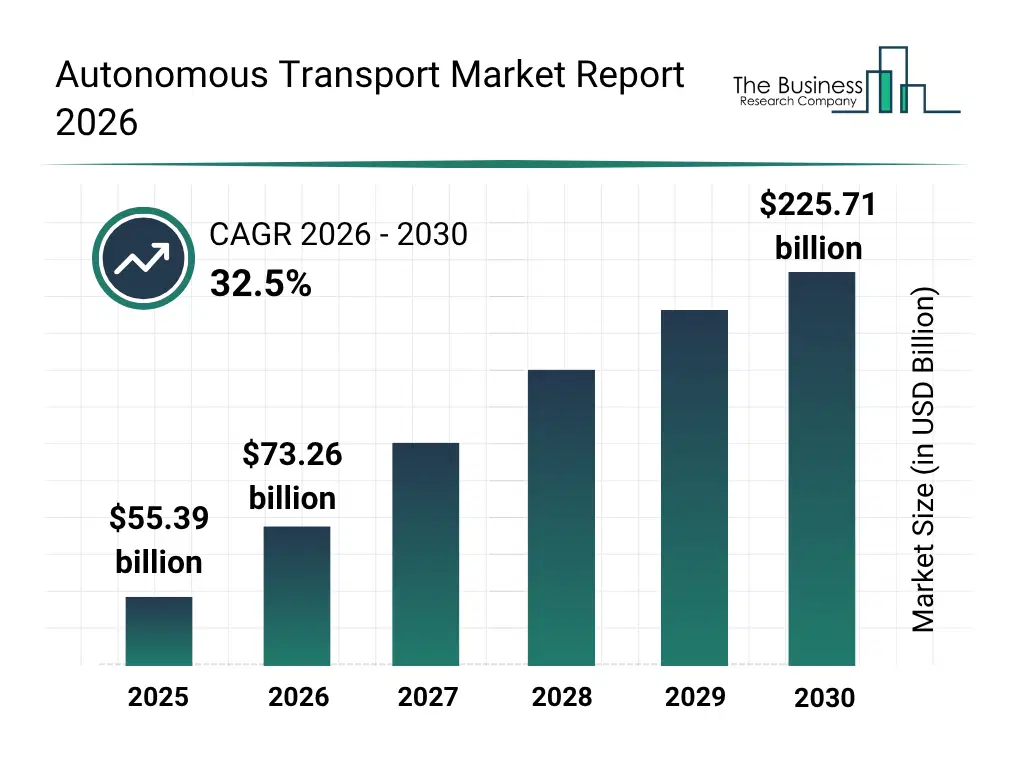
What Is The Autonomous Transport Market Size and Share 2026?
The autonomous transport market size has grown exponentially in recent years. It will grow from $55.39 billion in 2025 to $73.26 billion in 2026 at a compound annual growth rate (CAGR) of 32.3%. The growth in the historic period can be attributed to advancements in automotive electronics, growing demand for road safety improvements, rise of connected vehicle technologies, expansion of gps navigation systems, increasing investment in automotive r&d.What Is The Autonomous Transport Market Growth Forecast?
The autonomous transport market size is expected to see exponential growth in the next few years. It will grow to $225.71 billion by 2030 at a compound annual growth rate (CAGR) of 32.5%. The growth in the forecast period can be attributed to rapid commercialization of autonomous taxis and robo mobility, expansion of smart city infrastructure projects, increasing regulatory support for autonomous testing, growth of AI driven mobility ecosystems, rising demand for efficient logistics automation. Major trends in the forecast period include sensor fusion and real time decision making in vehicles, vehicle-to-everything (v2x) communication expansion, autonomous fleet management and remote monitoring systems, high definition mapping and localization advancements, safety redundancy and fail-safe autonomous control systems.
Global Autonomous Transport Market Segmentation
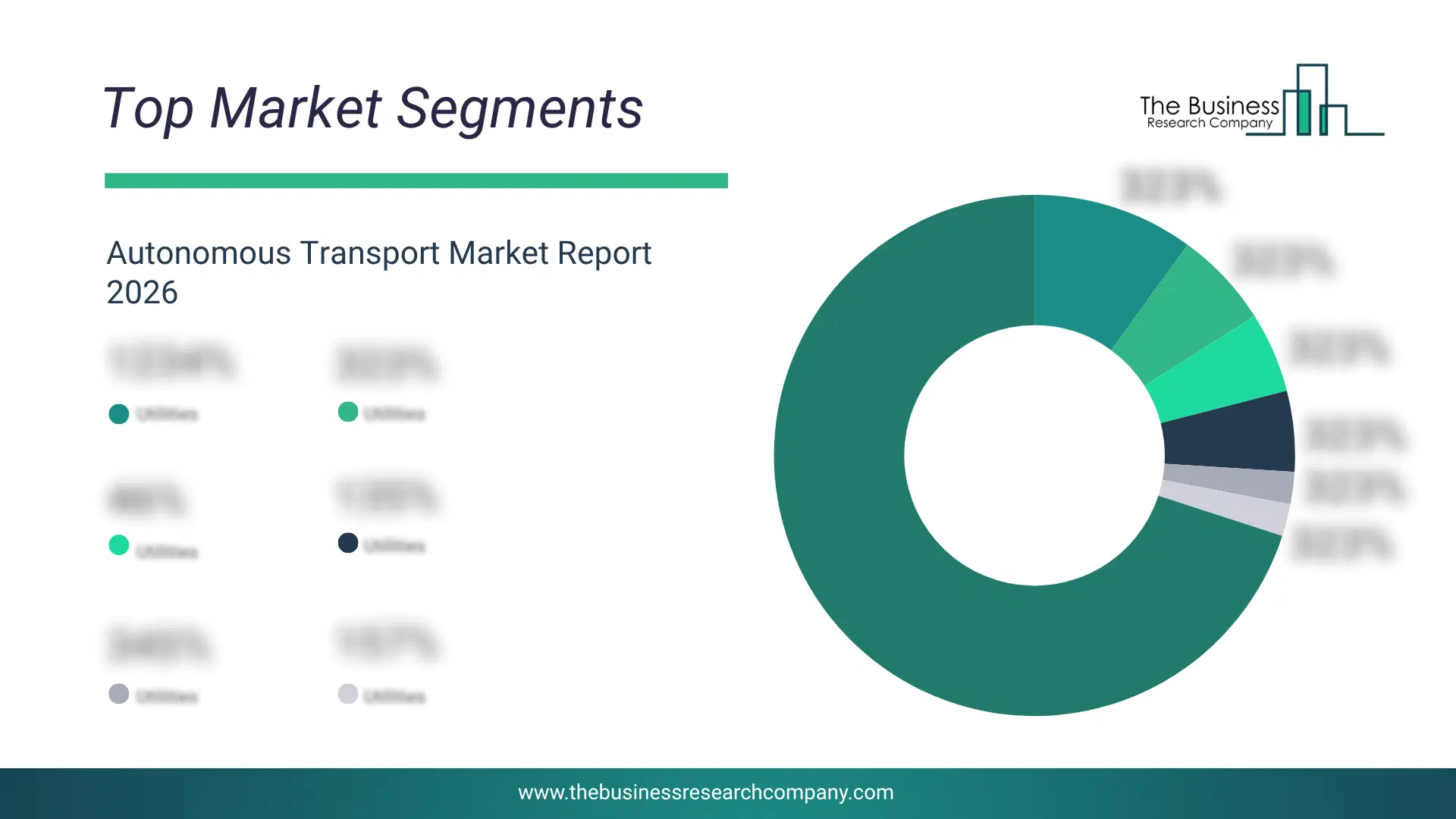
1) By Component: Hardware, Software, Services 2) By Vehicle Type: Passenger Cars, Commercial Trucks, Public Transit Shuttles, Delivery Robots, Unmanned Aerial Vehicles, Autonomous Rail Systems, Marine Vessels 3) By Technology: Artificial Intelligence (AI) Systems, Sensors (LiDAR, Radar, Ultrasonic), Machine Vision, Robotics, Advanced Control Systems, Vehicle Control Units And Hardware Components 4) By Propulsion Type: Electric, Hybrid, Internal Combustion Engine 5) By Application: Logistics And Freight, Ride Hailing And Robo Taxis, Industrial And Mining, Last Mile Delivery, Personal Mobility, Defense And Security Subsegments: 1) By Hardware: Sensors, Cameras, Radar Systems, Light Detection And Ranging (LiDAR) Systems, Global Positioning System Modules, Communication Devices, Onboard Computers, Control Units 2) By Software: Autonomous Driving Software, Navigation And Mapping Software, Fleet Management Software, Remote Monitoring Software, Simulation And Testing Software, Artificial Intelligence And Machine Learning Software, Safety And Security Software, Data Analytics Software 3) By Services: Integration And Deployment Services, Consulting Services, Maintenance And Support Services, Training And Education Services, Simulation And Testing Services, Data Management Services, Software Update Services, Remote Operation ServicesWhat Is The Driver Of The Autonomous Transport Market?
The rising e-commerce volumes are expected to propel the growth of the autonomous transport market going forward. E-commerce volumes refer to the total value and number of goods and services purchased through online platforms within a specific period, reflecting the scale of digital retail transactions. The rise in e-commerce volumes is due to the growing global online consumer base, which increases the frequency of digital purchases. Autonomous transport enables e-commerce companies to handle rising order volumes by automating delivery and logistics operations, improving speed, scalability, and cost efficiency while reducing reliance on human drivers. For instance, in March 2026, according to United States Census Bureau, a US-based government agency, total e-commerce sales for 2025 were estimated at $1,233.7 billion, reflecting a year-over-year growth of 5.4% compared to 2024. Therefore, the rising e-commerce volumes are driving the growth of the autonomous transport industry.Key Players In The Global Autonomous Transport Market
Major companies operating in the autonomous transport market are Waymo LLC; Motional AD LLC; Wayve Technologies Ltd; May Mobility Inc.; Beijing Momenta Technology Co. Ltd.; Shenzhen DeepRoute.ai Co. Ltd.; Oxa Autonomy Ltd; Einride AB; Gatik AI Inc.; EasyMile SAS; Kodiak Robotics Inc.; Pony AI Inc.; WeRide Corp.; Vay Technology GmbH; Waabi Innovation Inc.; AutoX Inc.; Beijing Trunk Technology Co. Ltd.; Beijing Baidu Netcom Science and Technology Co. Ltd.; PlusAI Inc.; Nevoya Inc.; Applied EV Pty Ltd; Aurora Innovation Inc.; Nuro Inc.; TuSimple Holdings Inc.; Via Transportation Inc.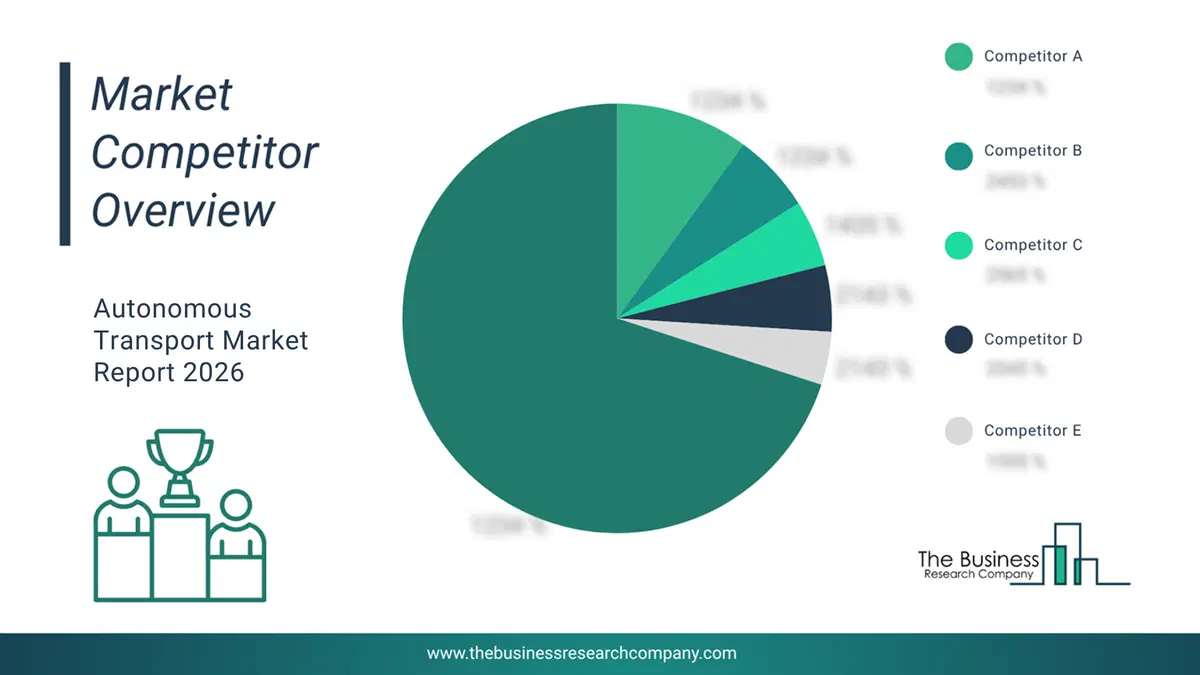
This chart is for illustrative purposes; the full report includes a detailed competitor analysis and comprehensive overview of the top 10 companies in the market.
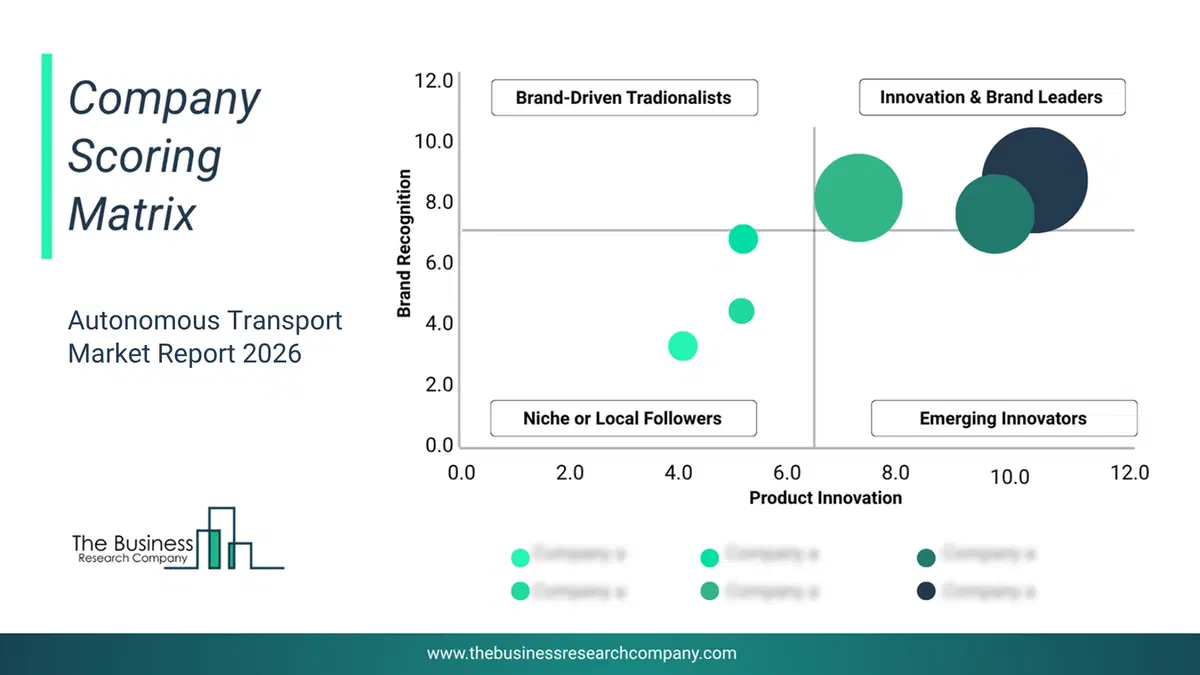
This chart maps companies by product innovation and brand strength, with bubble size indicating relative revenue, helping identify market leaders, challengers, and niche players. This is an illustrative chart; the full report provides a complete and accurate competitive analysis.
Global Autonomous Transport Market Trends and Insights
Major companies operating in the autonomous transport market are focusing on technological advancements in artificial intelligence for autonomous navigation, such as AI-based autonomous driving model suites to enable vehicles to perceive surroundings, reason about dynamic environments, and make real-time driving decisions with minimal human intervention. AI-based autonomous driving model suites refer to integrated artificial intelligence frameworks that combine perception models, reasoning engines, and decision-making algorithms to interpret sensor data, predict traffic behavior, and execute safe navigation maneuvers in complex road conditions. For instance, in January 2026, NVIDIA Corporation, a US-based technology company, launched the Alpamayo family of open AI models and simulation tools for autonomous vehicle development. This solution provides reasoning-based vision-language-action models for handling complex driving scenarios, integrated simulation tools for validating autonomous navigation performance, and open datasets designed to improve safety and scalability for level-4 autonomous deployment. Alpamayo also supports accelerated training and testing workflows, enabling developers to evaluate edge-case driving conditions and enhance real-world decision-making accuracy. By combining advanced AI reasoning with large-scale simulation and dataset capabilities, the platform strengthens the development of intelligent navigation systems for next-generation autonomous transport solutions.What Are Latest Mergers And Acquisitions In The Autonomous Transport Market?
In March 2023, Torc Robotics, a US-based autonomous driving technology company and subsidiary of Daimler Truck AG, acquired Algolux Inc. for an undisclosed amount. Through this acquisition, Torc Robotics enhances its Level 4 autonomous trucking platform by integrating advanced computer vision, deep learning, and computational imaging technologies, improving performance in low-light and adverse weather conditions while accelerating the commercialization of self-driving freight solutions. Algolux Inc. is a Canada-based company that develops computer vision and machine learning software for autonomous vehicles, with a core focus on perception systems, object detection, and AI-driven navigation in complex driving environments.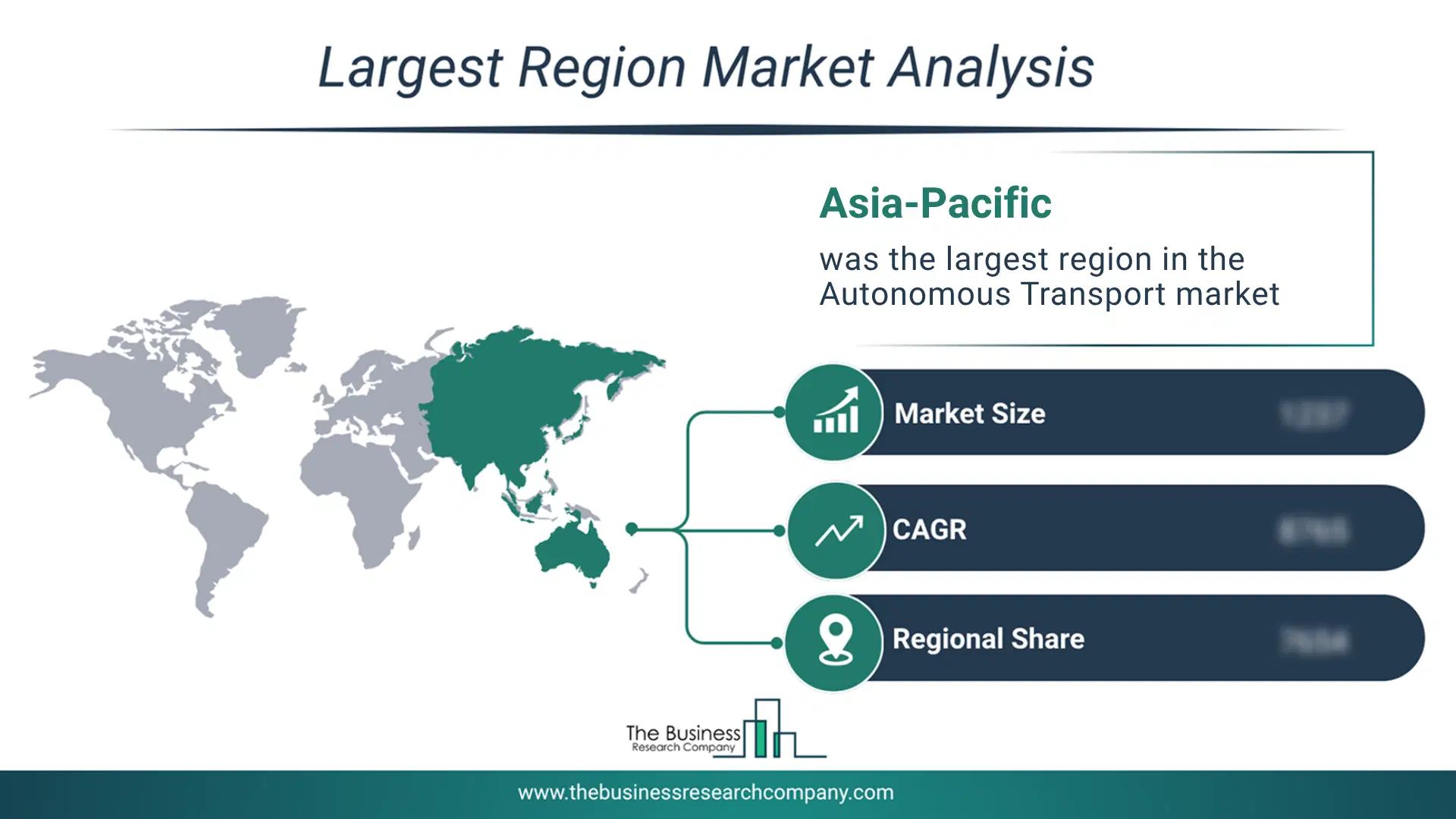
Regional Insights
North America was the largest region in the autonomous transport market in 2025. Asia-Pacific is expected to be the fastest-growing region in the forecast period. The regions covered in this market report are Asia-Pacific, South East Asia, Western Europe, Eastern Europe, North America, South America, Middle East, Africa. The countries covered in this market report are Australia, Brazil, China, France, Germany, India, Indonesia, Japan, Taiwan, Russia, South Korea, UK, USA, Canada, Italy, Spain.What Defines the Autonomous Transport Market?
The autonomous transport market consists of revenues earned by entities by providing services such as fleet management solutions, mapping and navigation services, testing and validation services, and maintenance and support services. The market value includes the value of related goods sold by the service provider or included within the service offering. The autonomous transport market also includes sales of autonomous cars, shuttles, trucks, drones, delivery robots, and related hardware components and control units. Values in this market are ‘factory gate’ values, that is, the value of goods sold by the manufacturers or creators of the goods, whether to other entities (including downstream manufacturers, integrators, and operators) or directly to end customers. The value of goods in this market includes related services sold by the creators of the goods.How is Market Value Defined and Measured?
The market value is defined as the revenues that enterprises gain from the sale of goods and/or services within the specified market and geography through sales, grants, or donations in terms of the currency (in USD unless otherwise specified). The revenues for a specified geography are consumption values that are revenues generated by organizations in the specified geography within the market, irrespective of where they are produced. It does not include revenues from resales along the supply chain, either further along the supply chain or as part of other products.
This chart presents market attractiveness based on a quantitative evaluation of growth, competition, strategic alignment, and risk, offering a clear view of opportunity areas for decision-making. This chart is for illustrative purposes; the full report contains the complete analysis.

This chart highlights the Total Addressable Market (TAM) by estimating the maximum revenue opportunity using an assumption-driven approach, supporting strategic planning and opportunity sizing across markets. The chart is illustrative; the full report provides a more comprehensive analysis.
What Key Data and Analysis Are Included in the Autonomous Transport Market Report 2026?
The autonomous transport market research report is one of a series of new reports from The Business Research Company that provides market statistics, including industry global market size, regional shares, competitors with the market share, detailed market segments, market trends and opportunities, and any further data you may need to thrive in the autonomous transport industry. The market research report delivers a complete perspective of everything you need, with an in-depth analysis of the current and future state of the industry.Autonomous Transport Market Report Forecast Analysis
| Report Attribute | Details |
|---|---|
| Market Size Value In 2026 | $73.26 billion |
| Revenue Forecast In 2030 | $225.71 billion |
| Growth Rate | CAGR of 32.50% from 2026 to 2030 |
| Base Year For Estimation | 2025 |
| Actual Estimates/Historical Data | 2020-2025 |
| Forecast Period | 2026 - 2030 - 2030 |
| Market Representation | Revenue in USD Billion and CAGR from 2026 to 2030 |
| Segments Covered | Component, Vehicle Type, Technology, Propulsion Type, Application |
| Regional Scope | Asia-Pacific, Western Europe, Eastern Europe, North America, South America, Middle East, Africa |
| Country Scope | The countries covered in the report are Australia, Brazil, China, France, Germany, India, Indonesia, Japan, Taiwan, Russia, South Korea, UK, USA, Canada, Italy, Spain. |
| Key Companies Profiled | Waymo LLC; Motional AD LLC; Wayve Technologies Ltd; May Mobility Inc.; Beijing Momenta Technology Co. Ltd.; Shenzhen DeepRoute.ai Co. Ltd.; Oxa Autonomy Ltd; Einride AB; Gatik AI Inc.; EasyMile SAS; Kodiak Robotics Inc.; Pony AI Inc.; WeRide Corp.; Vay Technology GmbH; Waabi Innovation Inc.; AutoX Inc.; Beijing Trunk Technology Co. Ltd.; Beijing Baidu Netcom Science and Technology Co. Ltd.; PlusAI Inc.; Nevoya Inc.; Applied EV Pty Ltd; Aurora Innovation Inc.; Nuro Inc.; TuSimple Holdings Inc.; Via Transportation Inc. |
| Customization Scope | Request for Customization |
| Pricing And Purchase Options | Explore Purchase Options |