
Unmanned Aerial Vehicles (UAV) Payload And Subsystems Market Report 2026
Global Outlook – By Type (Camera And Sensors, Weaponry, Radar And Communications, Other Types), By Platform Type (Fixed-Wing Unmanned Aerial Vehicles (UAVs), Rotary Wing Unmanned Aerial Vehicles (UAVs), Hybrid Unmanned Aerial Vehicles (UAVs)), By Subsystem Type (Propulsion And Power, Flight Control Systems (FCS), Navigation And Guidance, Communications And Datalinks, Launch And Recovery Systems), By Applications (Military, Mining, Agriculture, Civil, Commercial, Photography And Film Production, Firefighting And Disaster Management), By End User (Commercial, Government, Research And Development) – Market Size, Trends, Strategies, and Forecast to 2030
Unmanned Aerial Vehicles (UAV) Payload And Subsystems Market Overview
• Unmanned Aerial Vehicles (UAV) Payload And Subsystems market size has reached to $9.81 billion in 2025 • Expected to grow to $16.59 billion in 2030 at a compound annual growth rate (CAGR) of 11% • Growth Driver: Increasing Demand For Drone Applications Fueling The Growth Of The Market Due To Expansion Of Logistics And Delivery Services • Market Trend: Ultra-Compact Spherical ISR Payload Enhancing UAV Operational Efficiency And Advanced Surveillance Capabilities • North America was the largest region in 2025 and Asia-Pacific is the fastest growing region.Market Gains By 2030 – Top Opportunities By Segment
Market Gain identifies the most promising market opportunities by highlighting the segments or products expected to generate the highest incremental revenue growth over the next five years.
What Is Covered Under Unmanned Aerial Vehicles (UAV) Payload And Subsystems Market?
Unmanned aerial vehicle (UAV) payload and subsystems refer to the collection of components and integrated systems that a UAV carries and depends on to carry out its mission, encompassing everything necessary for its operation and performance. These subsystems include critical elements such as control, navigation, propulsion, and power management systems, all of which work in a coordinated manner to ensure the unmanned aerial vehicle (UAV) operates efficiently, reliably, and safely throughout its flight. The main types of unmanned aerial vehicle (UAV) payloads and subsystems are cameras and sensors, weaponry, radar and communications, and others. Cameras and sensors are devices on an unmanned aerial vehicle (UAV) that capture visual, thermal, or other types of data from the environment. These include various platform types, including fixed-wing unmanned aerial vehicles (UAVs), rotary-wing unmanned aerial vehicles (UAVs), hybrid unmanned aerial vehicles (UAVs), and with subsystems, including propulsion and power, flight control systems (FCS), navigation and guidance, communications and data links, and launch and recovery systems. These find applications in military, mining, agriculture, civil, and commercial sectors, serving end users such as the commercial, government, and research and development.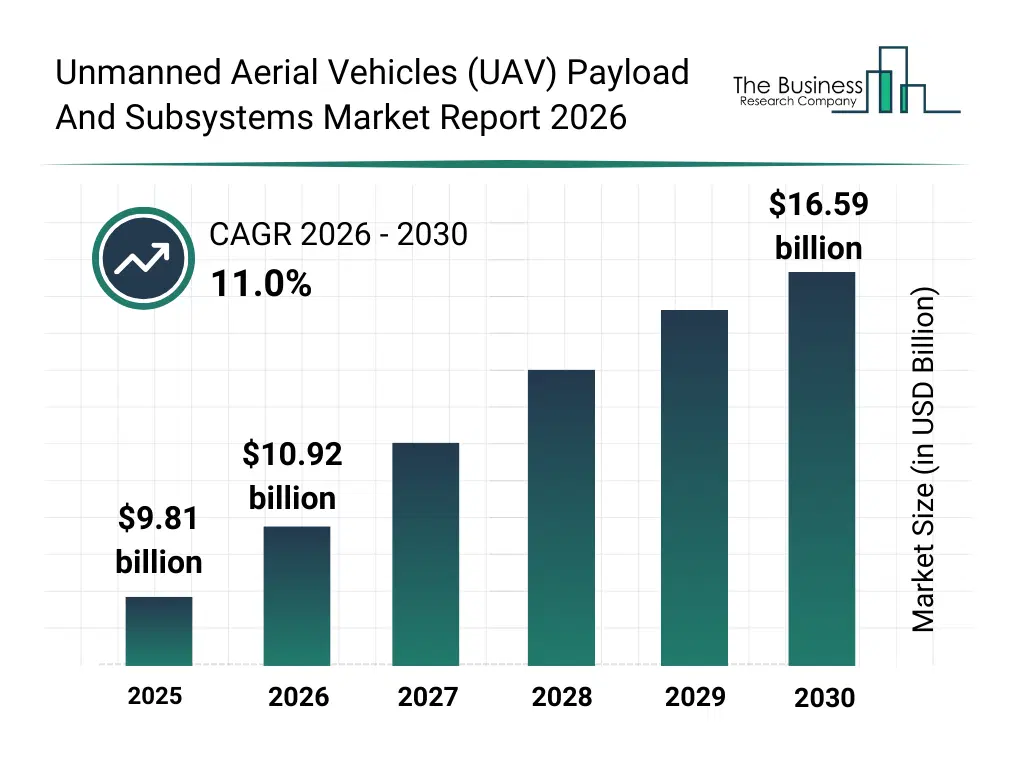
What Is The Unmanned Aerial Vehicles (UAV) Payload And Subsystems Market Size and Share 2026?
The unmanned aerial vehicles (UAV) payload and subsystems market size has grown rapidly in recent years. It will grow from $9.81 billion in 2025 to $10.92 billion in 2026 at a compound annual growth rate (CAGR) of 11.3%. The growth in the historic period can be attributed to development of integrated navigation systems, improvements in propulsion units, early adoption of flight control modules, expansion of ground control stations, increasing use of communication datalinks in UAV operations.What Is The Unmanned Aerial Vehicles (UAV) Payload And Subsystems Market Growth Forecast?
The unmanned aerial vehicles (UAV) payload and subsystems market size is expected to see rapid growth in the next few years. It will grow to $16.59 billion in 2030 at a compound annual growth rate (CAGR) of 11.0%. The growth in the forecast period can be attributed to integration of AI-powered payload management, advancement in autonomous propulsion and power systems, expansion of modular flight control technologies, growth in uav communication network services, adoption of multi-functional payloads for varied missions. Major trends in the forecast period include increased demand for lightweight and miniaturized uav subsystems, advancements in high-efficiency propulsion and power management units, growth in integrated multi-sensor payload configurations, rising adoption of long-range communication datalinks, expansion of ruggedized subsystems for extreme operating environments.
Global Unmanned Aerial Vehicles (UAV) Payload And Subsystems Market Segmentation
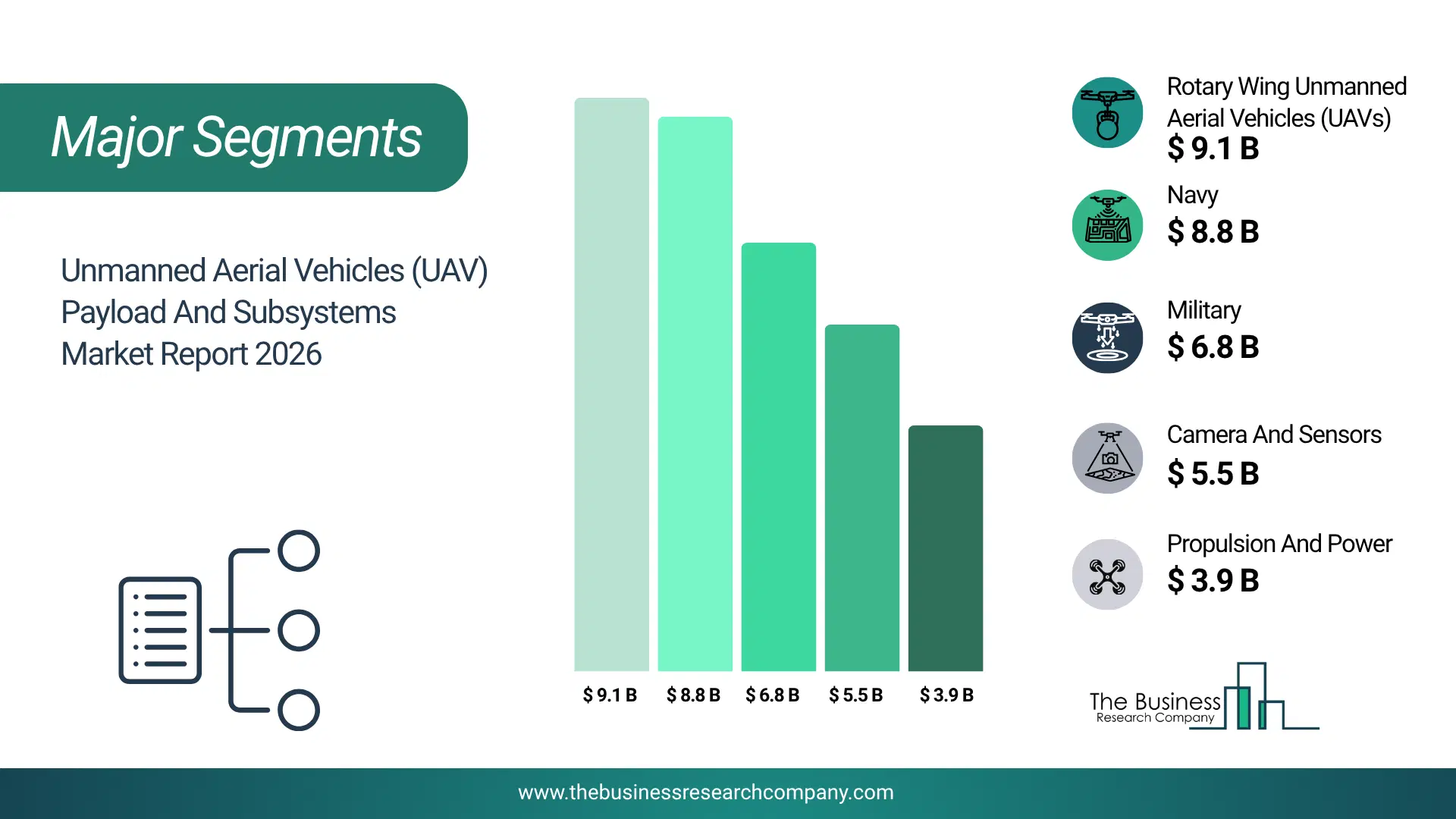
1) By Type: Camera And Sensors, Weaponry, Radar And Communications, Other Types 2) By Platform Type: Fixed-Wing Unmanned Aerial Vehicles (UAVs), Rotary Wing Unmanned Aerial Vehicles (UAVs), Hybrid Unmanned Aerial Vehicles (UAVs) 3) By Subsystem Type: Propulsion And Power, Flight Control Systems (FCS), Navigation And Guidance, Communications And Datalinks, Launch And Recovery Systems 4) By Applications: Military, Mining, Agriculture, Civil, Commercial, Photography And Film Production, Firefighting And Disaster Management 5) By End User: Commercial, Government, Research And Development Subsegments: 1) By Camera And Sensors: Electro-Optical Cameras, Infrared Cameras, Light Detection And Ranging Sensor, Multispectral Cameras, Hyperspectral Cameras, Laser Sensors 2) By Weaponry: missiles, Bombs, Rockets, Guns, Grenades, Torpedoes 3) By Radar And Communications: Synthetic Aperture Radar, Doppler Radar, Satellite Communication Systems, Radio Frequency Communication Systems, Signal Intelligence Systems 4) By Other Types: Electronic Warfare Systems, Navigation Systems, Autonomous Flight Control Systems, Payload Delivery Mechanisms The top segments in the unmanned aerial vehicles (uav) payload and subsystems market will be: • Government will reach $8847.87 Million by 2030. • Rotary Wing Unmanned Aerial Vehicles (UAVs) will reach $9126.29 Million by 2030. • Military will reach $6855.96 Million by 2030. • Camera And Sensors will reach $5521.64 Million by 2030. • Propulsion And Power will reach $3957.77 Million by 2030.What Is Driver Of The Unmanned Aerial Vehicles (UAV) Payload And Subsystems Market?
The increasing demand for drone applications is expected to propel the growth of the unmanned aerial vehicle (UAV) payload and subsystems market going forward. Drone applications refer to the various practical uses of unmanned aerial vehicles (UAVs) across industries for tasks such as surveying, monitoring, delivery, and surveillance. The demand for drone applications is increasing due to the expansion of logistics and delivery services, as they enable faster, cost-effective, and last-mile delivery solutions. Unmanned aerial vehicle (UAV) payloads and subsystems enhance drone applications by providing specialized sensors, cameras, and delivery mechanisms, making them suitable for diverse tasks such as surveillance, mapping, and logistics. They improve operational efficiency by enabling precise data collection and reliable performance, advancing the effectiveness of drone missions. For instance, in March 2024, according to the State Council of the People's Republic of China, a China-based government agency, nearly 1.27 million unmanned aerial vehicles (UAVs) were registered nationwide in 2023, marking a 32.2% increase compared to 2022. Therefore, the increasing demand for drone applications is driving the growth of the unmanned aerial vehicle (UAV) payload and subsystems market.
Infographic Chart Showing Key Market Drivers Analysis And Restraints For Unmanned Aerial Vehicles (Uav) Payload And Subsystems Market
The chart presents an impact analysis of key drivers and restraints, quantifying their relative influence on the market's growth rate and helping assess the balance between growth enablers and limiting factors. This chart offers a high-level perspective; the full report contains more detailed insights.
How Will The Drivers Impact Growth In The Global Unmanned Aerial Vehicles (UAV) Payload And Subsystems Market?
• High Demand for Security and Surveillance Applications (Medium) – During the forecast period, the high demand for security and surveillance applications will become a key driver of growth in the unmanned aerial vehicles (uav) payload and subsystems market by 2030. as security and surveillance missions require high-resolution imaging, night-time visibility, wide-area coverage, and real-time data transmission, operators increasingly rely on uav-mounted eo/ir sensors, radar payloads, laser rangefinders, and secure communication systems. the emphasis on all-weather, day-night operations and extended mission endurance will further accelerate the adoption of lightweight, power-efficient payloads and integrated subsystems that enable continuous surveillance without compromising flight performance. as a result, high demand for security and surveillance applications is anticipated to contributing to a 1.5% annual growth in the market. • Increasing Defense Spending (Medium) – During the forecast period, the increasing defense spending will emerge as a major factor driving the expansion of the unmanned aerial vehicles (uav) payload and subsystems market by 2030. defense modernization programs increasingly focus on enhancing uav mission effectiveness through upgraded sensor payloads, secure datalinks, precision weapon systems, and resilient navigation and guidance subsystems. greater defense spending also supports investments in ruggedized, modular, and interoperable payload architectures that can be deployed across multiple uav platforms, driving sustained demand for mission-critical onboard systems tailored to military operational requirements. consequently, the increasing defense spending is projected to contributing to a 1.0% annual growth in the market. • Rising Demand for Commercial Drones (Low) – During the forecast period, the rising demand for commercial drones will serve as a key growth catalyst for the unmanned aerial vehicles (uav) payload and subsystems market by 2030. as commercial operators seek to deploy drones for diverse and repeatable missions, demand is increasing for versatile payloads, including high-resolution cameras, thermal sensors, communication modules, and onboard processing systems. the need for cost-effective, modular, and easy-to-integrate payload solutions will further encourage adoption of standardized payload interfaces and lightweight subsystems that enable rapid mission reconfiguration and scalable commercial drone operations. therefore, this rising demand for commercial drones is projected to supporting to a 0.8% annual growth in the market. • Increasing Focus on Precision Agriculture (Low) – During the forecast period, the increasing focus on precision agriculture will propel the growth of the unmanned aerial vehicles (UAV) payload and subsystems market. For specialized UAV payloads and subsystems designed for crop monitoring, field mapping, and resource optimization. Agricultural UAV missions rely heavily on multispectral and hyperspectral sensors, thermal imaging payloads, and precise navigation systems to assess crop health, irrigation efficiency, and soil conditions. As farmers and agribusinesses seek to improve productivity while reducing input costs, the use of UAV-based sensing platforms equipped with advanced payloads and reliable onboard subsystems will continue to expand, supporting more frequent and data-driven agricultural operations. The increasing focus on precision agriculture growth contribution during the forecast period in 2025 is 0.5%.How Will The Restraints Impact Growth In The Global Unmanned Aerial Vehicles (UAV) Payload And Subsystems Market?
• High Initial Development and Production Costs (Medium) – During the forecast period, high initial development and production costs is restricting the growth of the unmanned aerial vehicles (uav) payload and subsystems market during the forecast period. developing flight-grade payloads and subsystems requires significant investment in research, testing, ruggedization, and certification to ensure reliable performance under vibration, temperature extremes, and contested environments. low production volumes, platform-specific customization, and specialized components further elevate per-unit costs, limiting affordability and slowing adoption. these cost pressures reduce the pace at which new payload technologies are introduced and restrict market participation to well-capitalized players. growth affected by the high initial development and production costs during the forecast period in 2025 is -1.1%. • Payload Capacity Limitations (Medium) – During the forecast period, payload capacity limitations are restricting the growth of the unmanned aerial vehicles (uav) payload and subsystems market during the forecast period. small and medium-sized uavs, which represent a large share of operational fleets, offer limited payload margins, restricting the integration of heavier sensors, multi-function payloads, or combined subsystem configurations. this limitation forces manufacturers to prioritize trade-offs between capability, endurance, and mission flexibility, slowing adoption of advanced payload technologies that require higher power or larger form factors. as a result, certain high-performance payloads face limited addressable markets. growth affected by the payload capacity limitations during the forecast period in 2025 is -0.8%. • Impact of Trade War and Tariff (Low) – During the forecast period, the impact of the trade war and tariffs is restricting the growth of the unmanned aerial vehicles (uav) payload and subsystems market during the forecast period. tariffs on electronics, sensors, precision components, and raw materials raise manufacturing costs and reduce price competitiveness in international markets. trade-related uncertainties also complicate sourcing strategies and long-term investment planning for payload manufacturers, particularly those reliant on cross-border supply networks. these factors limit economies of scale, increase pricing pressure, and slow global expansion of uav payload and subsystem offerings. growth affected by the impact of the trade war and tariffs during the forecast period in 2025 is -0.2%.Key Players In The Global Unmanned Aerial Vehicles (UAV) Payload And Subsystems Market
Major companies operating in the unmanned aerial vehicles (UAV) payload and subsystems market are Raytheon Technologies, The Boeing Company, Lockheed Martin Corporation, Airbus Defence and Space GmbH, Northrop Grumman Corporation, BAE Systems plc, Safran Group, Thales S.A., L3Harries Technologies Inc., Textron Systems, Elbit Systems Ltd., Teledyne Technologies, Israel Aerospace Industries Ltd., Saab AB, General Atomics Aeronautical Systems Inc., Kratos Defense & Security Solutions Inc., AeroVironment Inc., Insitu Inc., Denel Aerospace Systems, Alpha Unmanned Systems, Avy B.V.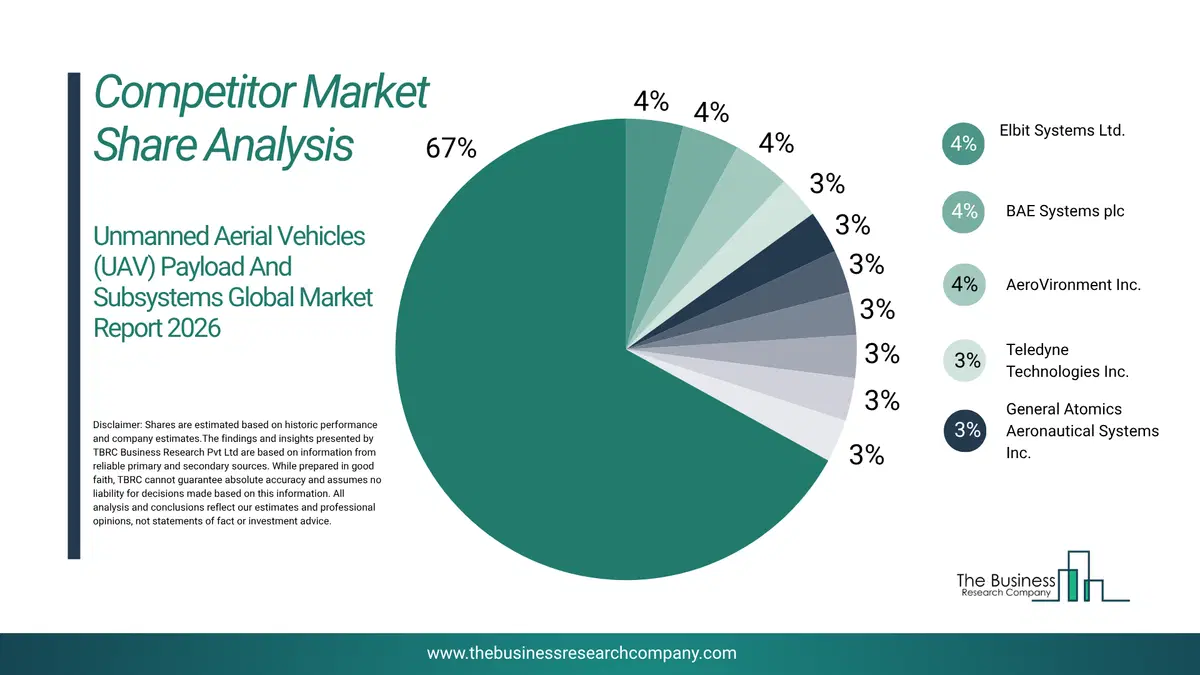
This chart is for illustrative purposes; the full report includes a detailed competitor analysis and comprehensive overview of the top 10 companies in the market.
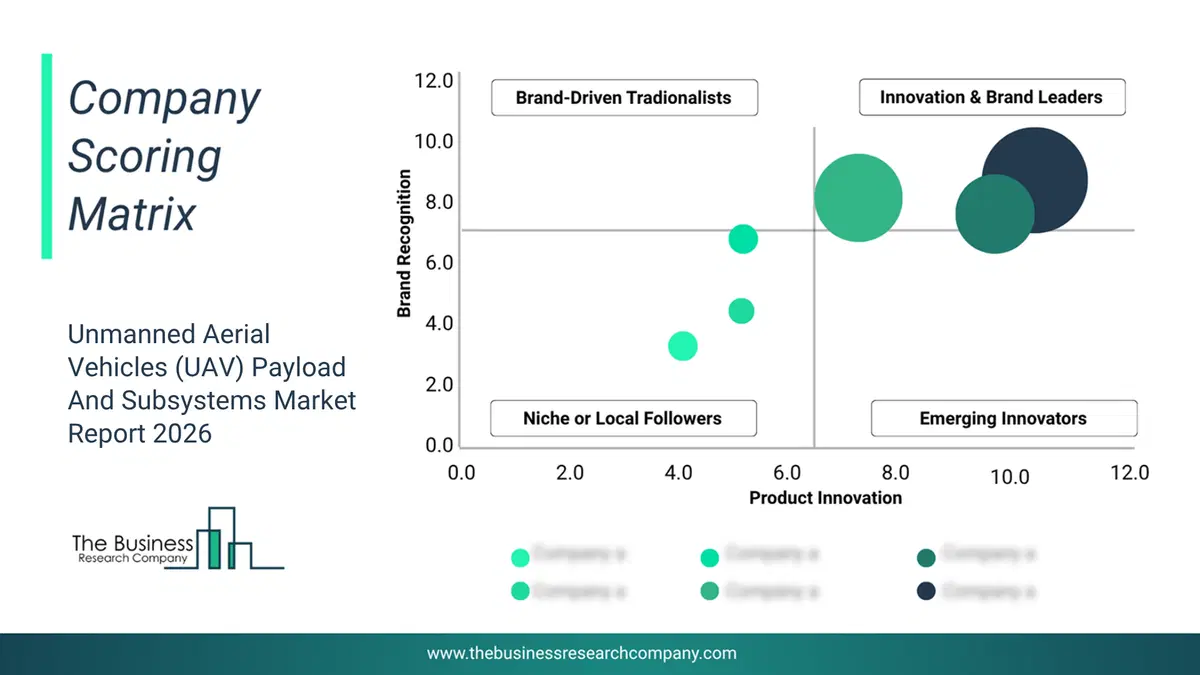
This chart maps companies by product innovation and brand strength, with bubble size indicating relative revenue, helping identify market leaders, challengers, and niche players. This is an illustrative chart; the full report provides a complete and accurate competitive analysis.
Global Unmanned Aerial Vehicles (UAV) Payload And Subsystems Market Trends and Insights
Major companies operating in the unmanned aerial vehicle (UAV) payload and subsystem market are focusing on developing advanced products, such as ultra-compact spherical ISR payload systems, to enhance operational efficiency and expand the capabilities of UAVs across various sectors. An ultra-compact spherical intelligence, surveillance, and reconnaissance (ISR) payload system is a small, lightweight, and rugged sensor package for UAVs that provides 360-degree intelligence, surveillance, and reconnaissance capabilities without compromising flight performance. For instance, in August 2025, Gremsy Co. Ltd., a Vietnam-based manufacturer of gimbals and payload systems, launched the LYNX, an ultra-compact spherical ISR payload designed for unmanned aerial vehicles (UAVs). This new payload is Gremsy’s smallest and most compact ISR system, combining a rugged and minimalist design with advanced capabilities. It offers extended flight time, precise and stable data capture, and high reliability, making it ideal for critical operations such as drone first responder missions, public safety, and surveillance. The LYNX represents a significant innovation in UAV payload technology by delivering powerful intelligence, surveillance, and reconnaissance performance in a micro-sized form factor.What Are Latest Mergers And Acquisitions In The Unmanned Aerial Vehicles (UAV) Payload And Subsystems Market? BAE Systems Acquires Malloy Aeronautics To Expand Heavy-Lift UAV Capabilities
In February 2024, BAE Systems plc, a UK-based defense and aerospace technology company, acquired Malloy Aeronautics Ltd. for an undisclosed amount. With this acquisition, BAE Systems aims to expand its uncrewed aerial systems portfolio by integrating Malloy’s electric heavy-lift drones, including the T-650, into FalconWorks to enable rapid, sustainable, and scalable autonomous operations. Malloy Aeronautics Ltd. is a UK-based aerospace technology company that develops unmanned aerial vehicles (UAVs) with advanced payloads and subsystems.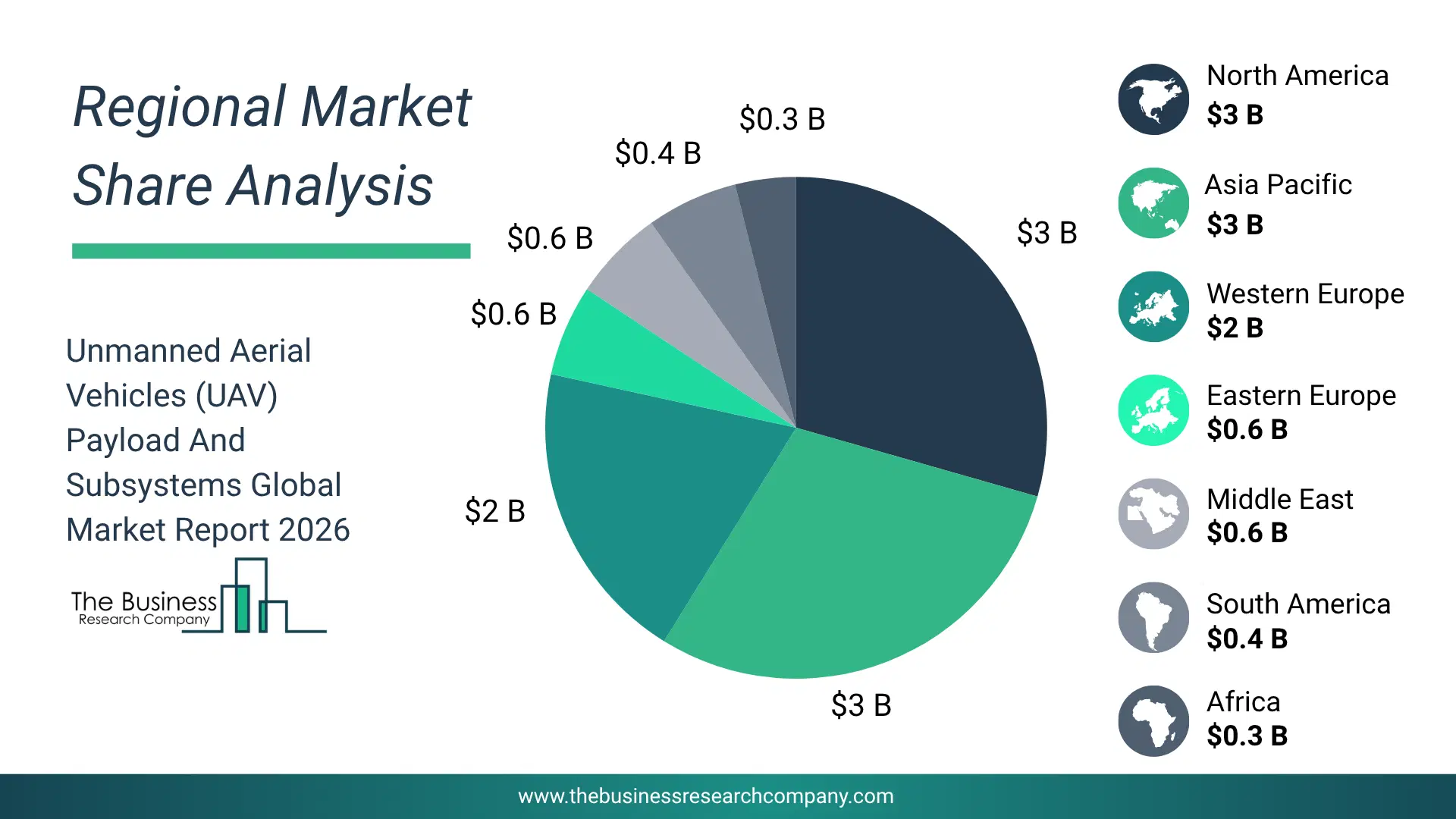
Regional Insights
North America was the largest region in the unmanned aerial vehicle (UAV) payload and subsystems market in 2025. Asia-Pacific is expected to be the fastest-growing region in the forecast period. The regions covered in this market report are Asia-Pacific, South East Asia, Western Europe, Eastern Europe, North America, South America, Middle East, Africa. The countries covered in this market report are Australia, Brazil, China, France, Germany, India, Indonesia, Japan, Taiwan, Russia, South Korea, UK, USA, Canada, Italy, SpainWhat Defines the Unmanned Aerial Vehicles (UAV) Payload And Subsystems Market?
The unmanned aerial vehicle (UAV) payload and subsystems market consists of sales of navigation systems, propulsion units, flight control modules, ground control stations, and communication datalinks. Values in this market are ‘factory gate’ values, that is, the value of goods sold by the manufacturers or creators of the goods, whether to other entities (including downstream manufacturers, wholesalers, distributors, and retailers) or directly to end customers. The value of goods in this market includes related services sold by the creators of the goods.How is Market Value Defined and Measured?
The market value is defined as the revenues that enterprises gain from the sale of goods and/or services within the specified market and geography through sales, grants, or donations in terms of the currency (in USD unless otherwise specified). The revenues for a specified geography are consumption values that are revenues generated by organizations in the specified geography within the market, irrespective of where they are produced. It does not include revenues from resales along the supply chain, either further along the supply chain or as part of other products.
This chart presents market attractiveness based on a quantitative evaluation of growth, competition, strategic alignment, and risk, offering a clear view of opportunity areas for decision-making. This chart is for illustrative purposes; the full report contains the complete analysis.

This chart highlights the Total Addressable Market (TAM) by estimating the maximum revenue opportunity using an assumption-driven approach, supporting strategic planning and opportunity sizing across markets. The chart is illustrative; the full report provides a more comprehensive analysis.
What Key Data and Analysis Are Included in the Unmanned Aerial Vehicles (UAV) Payload And Subsystems Market Report 2026?
The unmanned aerial vehicles (uav) payload and subsystems market research report is one of a series of new reports from The Business Research Company that provides market statistics, including industry global market size, regional shares, competitors with the market share, detailed market segments, market trends and opportunities, and any further data you may need to thrive in the unmanned aerial vehicles (uav) payload and subsystems industry. The market research report delivers a complete perspective of everything you need, with an in-depth analysis of the current and future state of the industry.Unmanned Aerial Vehicles (UAV) Payload And Subsystems Market Report Forecast Analysis
| Report Attribute | Details |
|---|---|
| Market Size Value In 2026 | $10.92 billion |
| Revenue Forecast In 2030 | $16.59 billion |
| Growth Rate | CAGR of 11.3% from 2026 to 2030 |
| Base Year For Estimation | 2025 |
| Actual Estimates/Historical Data | 2020-2025 |
| Forecast Period | 2026 - 2030 - 2035 |
| Market Representation | Revenue in USD Billion and CAGR from 2026 to 2030 |
| Segments Covered | Type, Platform Type, Subsystem Type, Applications, End User |
| Regional Scope | Asia-Pacific, Western Europe, Eastern Europe, North America, South America, Middle East, Africa |
| Country Scope | The countries covered in the report are Australia, Brazil, China, France, Germany, India, Indonesia, Japan, Taiwan, Russia, South Korea, UK, USA, Canada, Italy, Spain. |
| Key Companies Profiled | Raytheon Technologies, The Boeing Company, Lockheed Martin Corporation, Airbus Defence and Space GmbH, Northrop Grumman Corporation, BAE Systems plc, Safran Group, Thales S.A., L3Harries Technologies Inc., Textron Systems, Elbit Systems Ltd., Teledyne Technologies, Israel Aerospace Industries Ltd., Saab AB, General Atomics Aeronautical Systems Inc., Kratos Defense & Security Solutions Inc., AeroVironment Inc., Insitu Inc., Denel Aerospace Systems, Alpha Unmanned Systems, Avy B.V. |
| Customization Scope | Request for Customization |
| Pricing And Purchase Options | Explore Purchase Options |