
Baby Powder Market Report 2026
Global Outlook – By Product (Talc-Based, Talc-Free), By Distribution Channel (Online, Offline), By End User (Infant, Toddler) – Market Size, Trends, Strategies, and Forecast to 2030
Baby Powder Market Overview
• Baby Powder market size has reached to $1.67 billion in 2025 • Expected to grow to $2.75 billion in 2030 at a compound annual growth rate (CAGR) of 10.5% • Growth Driver: Rising Number Of Nuclear Families Boosts The Baby Powder Market • Market Trend: Innovative Hypoallergenic Formulations Set New Standard For Infant Skin Care • Asia-Pacific was the largest region in 2025 and Europe is the fastest growing region.What Is Covered Under Baby Powder Market?
Baby powder refers to a fine powder composed mainly of talc or corn starch that is sprinkled or rubbed on the skin to absorb moisture and relieve chafing. It is a light powder that helps to dry or smooth the skin. The baby powder is used for preventing diaper rashes on a baby’s skin. The main types of baby powder market products are talc-based and talc-free. The talc-based product is used to prevent rashes and irritation around an infant’s bottom and genitals. Talc-based products refer to baby powder that uses talc as its primary ingredient. Talc refers to a mineral in clay mined from underground deposits. It’s the softest mineral, which makes it useful in the making of products like cosmetics and baby powders. It is distributed through online and offline channels and is used by infants and toddlers.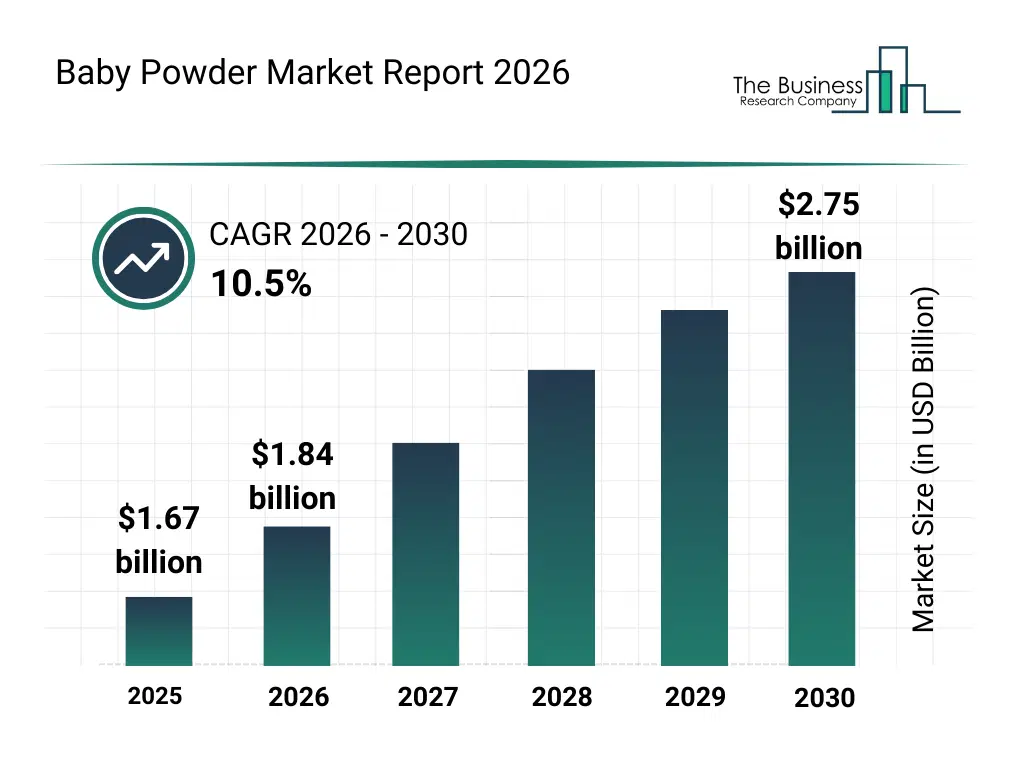
What Is The Baby Powder Market Size and Share 2026?
The baby powder market size has grown rapidly in recent years. It will grow from $1.67 billion in 2025 to $1.84 billion in 2026 at a compound annual growth rate (CAGR) of 10.6%. The growth in the historic period can be attributed to rising awareness of infant skin health, growth of personal hygiene product consumption, expansion of baby care product portfolios, availability of talc-based formulations, increasing retail penetration.What Is The Baby Powder Market Growth Forecast?
The baby powder market size is expected to see rapid growth in the next few years. It will grow to $2.75 billion in 2030 at a compound annual growth rate (CAGR) of 10.5%. The growth in the forecast period can be attributed to increasing adoption of talc-free alternatives, rising consumer preference for clean-label products, expansion of premium baby hygiene products, growing regulatory scrutiny on ingredients, increasing focus on plant-based formulations. Major trends in the forecast period include increasing shift toward talc-free baby powders, rising demand for natural and organic ingredients, growing focus on dermatologically safe products, expansion of cornstarch-based formulations, enhanced transparency in ingredient labeling.
Global Baby Powder Market Segmentation
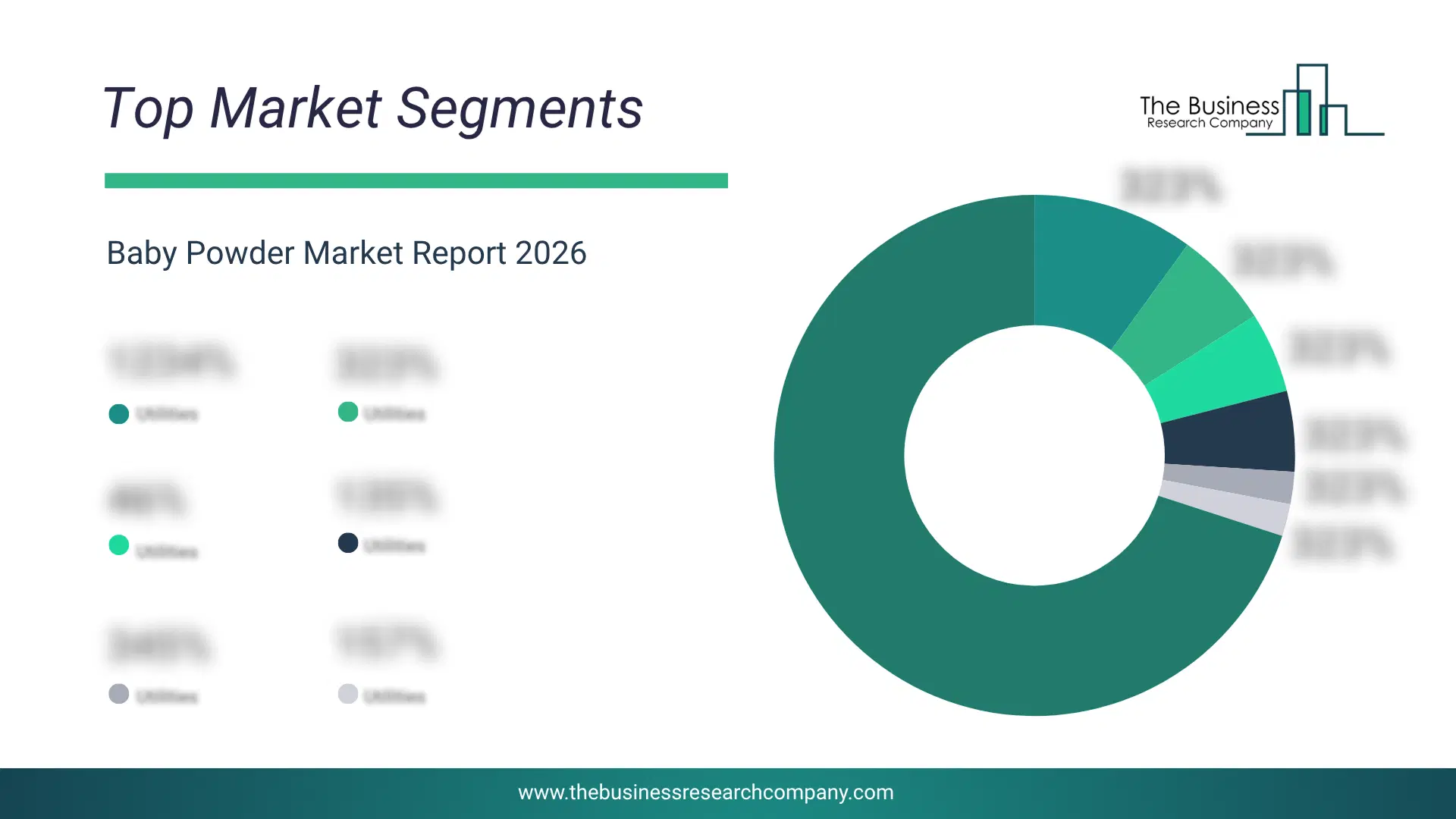
1) By Product: Talc-Based, Talc-Free 2) By Distribution Channel: Online, Offline 3) By End User: Infant, Toddler Subsegments: 1) By Talc-Based: Talc Powder, Talc with Additional Ingredients 2) By Talc-Free: Cornstarch-Based Powder, Arrowroot Powder, Rice Powder, Other Natural PowdersWhat Is The Driver Of The Baby Powder Market?
The increase in the number of nuclear families is expected to propel the growth of the baby powder market going forward. A nuclear family is a family unit that consists of two generations living together in a single household, which includes a married or cohabiting couple (the parents) and their dependent children. Baby powder is used as a common product to maintain a baby's hygiene, absorb moisture, and prevent diaper rash in nuclear families. For instance, in November 2024, according to the Census Bureau, a US-based government agency, in 2024, almost three-quarters (74%) of family households were married-couple households. Therefore, the increase in the number of nuclear families is driving the growth of the baby powder industry.Key Players In The Global Baby Powder Market
Major companies operating in the baby powder market are Johnson & Johnson, Pigeon Corporation, Prestige Brands Holdings Inc., Burt's Bees, Mothercare, PZ Cussons, Himalaya Drug Company Pvt Ltd, Sebapharma GmbH & Co. KG, Kimberly-Clark Corporation, Mee Mee, Chattem Inc., GLÜKi Organics, Beiersdorf AG, Church & Dwight Co. Inc., Goodbaby International Holdings Limited, Gerber Products Company, Naterra International Inc., Unilever plc, Chicco, Artsana USA Inc., Bathtime Kids, Libero, Lion Corporation, Mamaearth, Mann & Schröder GmbH, Dabur Ltd, Oriflame Cosmetics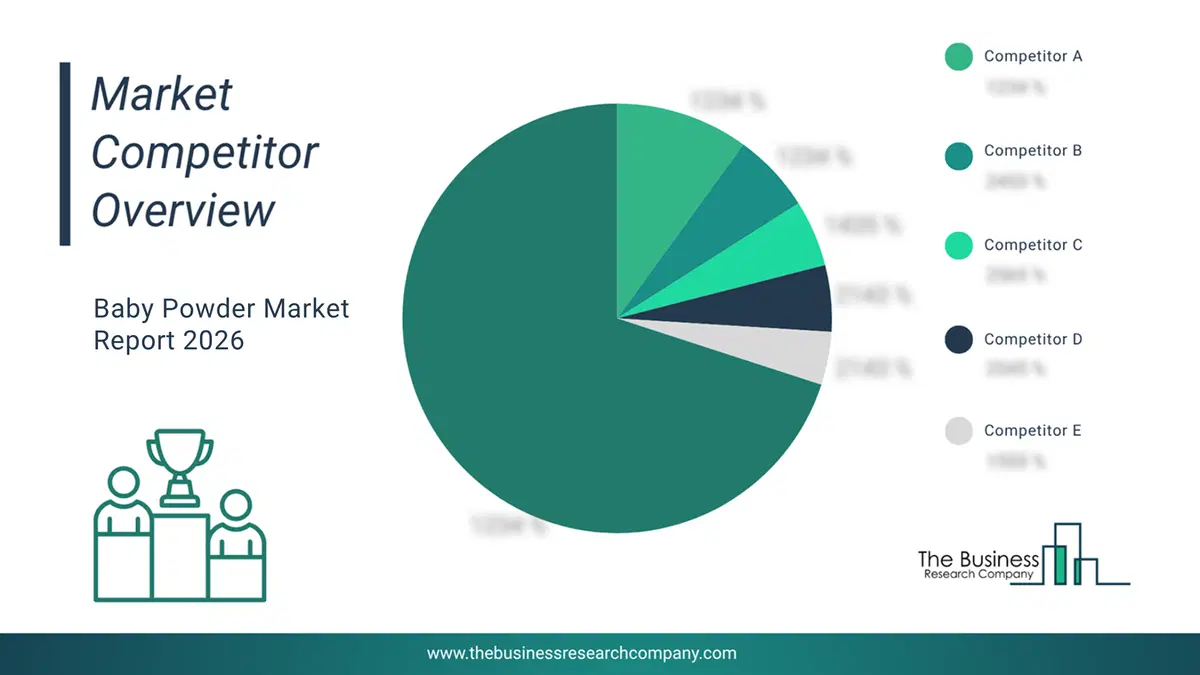
This chart is for illustrative purposes; the full report includes a detailed competitor analysis and comprehensive overview of the top 10 companies in the market.
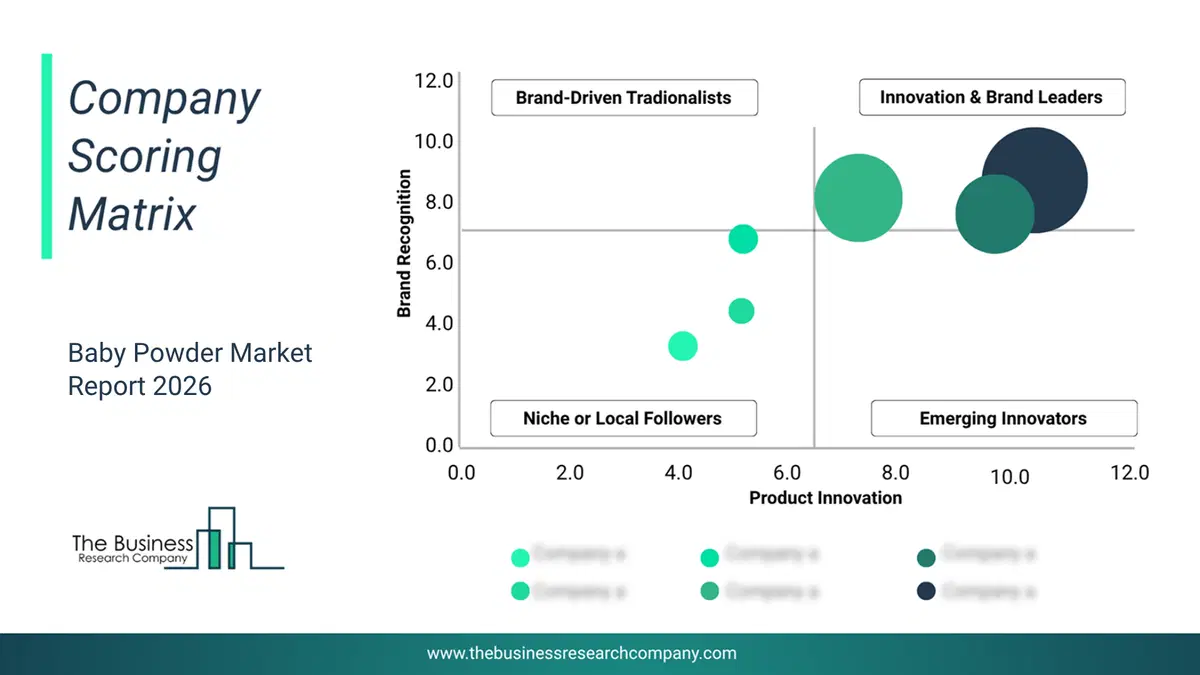
This chart maps companies by product innovation and brand strength, with bubble size indicating relative revenue, helping identify market leaders, challengers, and niche players. This is an illustrative chart; the full report provides a complete and accurate competitive analysis.
Global Baby Powder Market Trends and Insights
Major companies in the baby powder market are focusing on developing innovative solutions such as hypoallergenic formulations to ensure safer, gentler, and more skin-friendly products for infants. Hypoallergenic formulations are products specially designed to minimize the risk of causing allergic reactions. For instance, in October 2025, Remark HB Limited, an India-based health and beauty industry, launched Bangladesh's first 100% safe cornstarch baby powder. This product is formulated without talc or chemical additives, making it a natural and gentle alternative for babies' delicate skin. This powder quickly gained attention among parents and caregivers for its hypoallergenic and skin-friendly properties. The product underwent rigorous safety and quality testing in multiple laboratories to ensure it meets international standards for infant care. With this launch, Remark HB Limited aims to strengthen its presence in the Bangladesh baby care market while promoting safer, natural alternatives to traditional talc-based powders.What Are Latest Mergers And Acquisitions In The Baby Powder Market?
In November 2025, Kimberly-Clark Corporation, a US-based personal‑care and consumer‑goods manufacturer company, acquired Kenvue for $32 billion. With this acquisition, Kimberly‑Clark aims to expand and diversify its health and wellness footprint by combining its strong personal‑care portfolio with a leading consumer‑health business. Kenvue Inc. is a US-based consumer health company that provides baby powder, though it now exclusively sells a cornstarch-based version after discontinuing its talc-based product worldwide.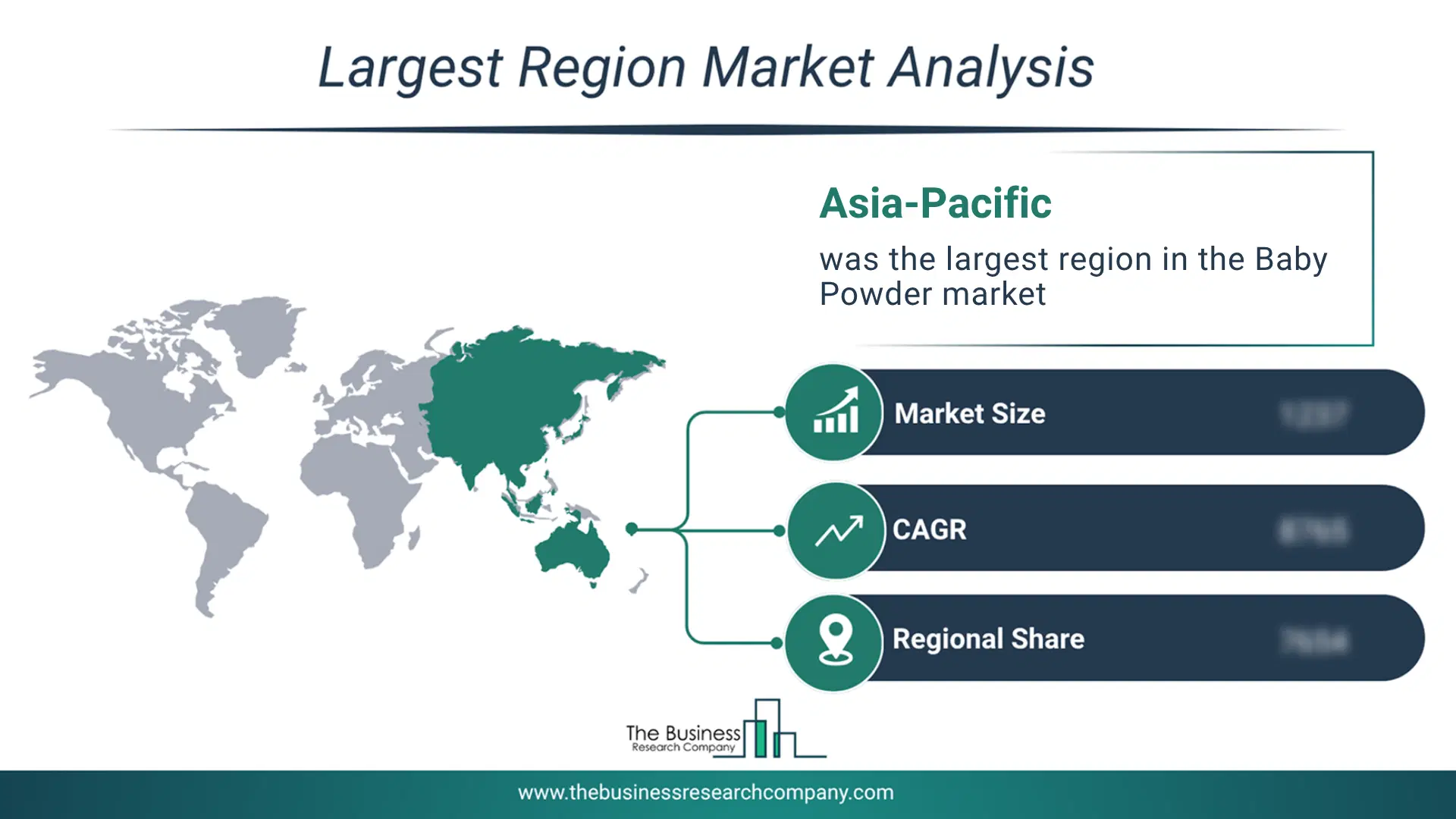
Regional Insights
Asia-Pacific was the largest region in the baby powder market in 2025. Asia-Pacific is expected to be the fastest-growing region in the forecast period. The regions covered in this market report are Asia-Pacific, South East Asia, Western Europe, Eastern Europe, North America, South America, Middle East, Africa The countries covered in this market report are Australia, Brazil, China, France, Germany, India, Indonesia, Japan, Taiwan, Russia, South Korea, UK, USA, Canada, Italy, SpainWhat Defines the Baby Powder Market?
The baby powder market consists of sales of cornstarch-based baby powder. Values in this market are ‘factory gate’ values, that is the value of goods sold by the manufacturers or creators of the goods, whether to other entities (including downstream manufacturers, wholesalers, distributors, and retailers) or directly to end customers. The value of goods in this market includes related services sold by the creators of the goods.How is Market Value Defined and Measured?
The market value is defined as the revenues that enterprises gain from the sale of goods and/or services within the specified market and geography through sales, grants, or donations in terms of the currency (in USD unless otherwise specified). The revenues for a specified geography are consumption values that are revenues generated by organizations in the specified geography within the market, irrespective of where they are produced. It does not include revenues from resales along the supply chain, either further along the supply chain or as part of other products.
This chart presents market attractiveness based on a quantitative evaluation of growth, competition, strategic alignment, and risk, offering a clear view of opportunity areas for decision-making. This chart is for illustrative purposes; the full report contains the complete analysis.

This chart highlights the Total Addressable Market (TAM) by estimating the maximum revenue opportunity using an assumption-driven approach, supporting strategic planning and opportunity sizing across markets. The chart is illustrative; the full report provides a more comprehensive analysis.
What Key Data and Analysis Are Included in the Baby Powder Market Report 2026?
The baby powder market research report is one of a series of new reports from The Business Research Company that provides market statistics, including industry global market size, regional shares, competitors with the market share, detailed market segments, market trends and opportunities, and any further data you may need to thrive in the baby powder industry. The market research report delivers a complete perspective of everything you need, with an in-depth analysis of the current and future state of the industry.Baby Powder Market Report Forecast Analysis
| Report Attribute | Details |
|---|---|
| Market Size Value In 2026 | $1.84 billion |
| Revenue Forecast In 2030 | $2.75 billion |
| Growth Rate | CAGR of 10.6% from 2026 to 2030 |
| Base Year For Estimation | 2025 |
| Actual Estimates/Historical Data | 2020-2025 |
| Forecast Period | 2026 - 2030 |
| Market Representation | Revenue in USD Billion and CAGR from 2026 to 2030 |
| Segments Covered | Product, Distribution Channel, End User |
| Regional Scope | Asia-Pacific, Western Europe, Eastern Europe, North America, South America, Middle East, Africa |
| Country Scope | The countries covered in this market report are Australia, Brazil, China, France, Germany, India, Indonesia, Japan, Taiwan, Russia, South Korea, UK, USA, Canada, Italy, Spain |
| Key Companies Profiled | Johnson & Johnson, Pigeon Corporation, Prestige Brands Holdings Inc., Burt's Bees, Mothercare, PZ Cussons, Himalaya Drug Company Pvt Ltd, Sebapharma GmbH & Co. KG, Kimberly-Clark Corporation, Mee Mee, Chattem Inc., GLÜKi Organics, Beiersdorf AG, Church & Dwight Co. Inc., Goodbaby International Holdings Limited, Gerber Products Company, Naterra International Inc., Unilever plc, Chicco, Artsana USA Inc., Bathtime Kids, Libero, Lion Corporation, Mamaearth, Mann & Schröder GmbH, Dabur Ltd, Oriflame Cosmetics |
| Customization Scope | Request for Customization |
| Pricing And Purchase Options | Explore Purchase Options |