
Blockchain In Energy Trading Market Report 2026
Global Outlook – By Component (Platform, Services), By Deployment Mode (On-Premises, Cloud), By Application (Peer-To-Peer Energy Trading, Grid Management, Renewable Energy Certificate Trading, Carbon Credit Trading, Electric Vehicle Charging And Billing, Wholesale Electricity Trading), By End-User (Residential, Commercial, Industrial, Utilities) – Market Size, Trends, Strategies, and Forecast to 2030
Blockchain In Energy Trading Market Overview
• Blockchain In Energy Trading market size has reached to $1.71 billion in 2025 • Expected to grow to $7.15 billion in 2030 at a compound annual growth rate (CAGR) of 33.2% • Growth Driver: Increasing Cybersecurity Threats Is Fueling The Growth Of The Market Due To The Rising Need For Secure And Tamper-resistant Transactions • Market Trend: Advancing Transparency And Efficiency In Global Energy Transactions Through Tokenized Oil-backed Digital Assets • North America was the largest region in 2025 and Asia-Pacific is the fastest growing region.Market Gains By 2030 – Top Opportunities By Segment
Market Gain identifies the most promising market opportunities by highlighting the segments or products expected to generate the highest incremental revenue growth over the next five years.
What Is Covered Under Blockchain In Energy Trading Market?
The blockchain in energy trading refers to the use of blockchain-based platforms to enable secure, transparent, and automated energy trading transactions. It includes digital solutions that support peer-to-peer energy exchange, smart contract execution, and real-time tracking of energy generation and consumption. The main components of blockchain in energy trading include platforms and services. Platforms refer to blockchain-based systems that enable secure, transparent, and decentralized recording, validation, and settlement of energy transactions across distributed energy networks. The solutions are deployed through on-premises and cloud modes depending on regulatory, security, and scalability requirements. The various applications involved are peer-to-peer energy trading, grid management, renewable energy certificate trading, carbon credit trading, electric vehicle charging and billing, and wholesale electricity trading. The end users of blockchain in energy trading solutions include residential, commercial, industrial, and utilities.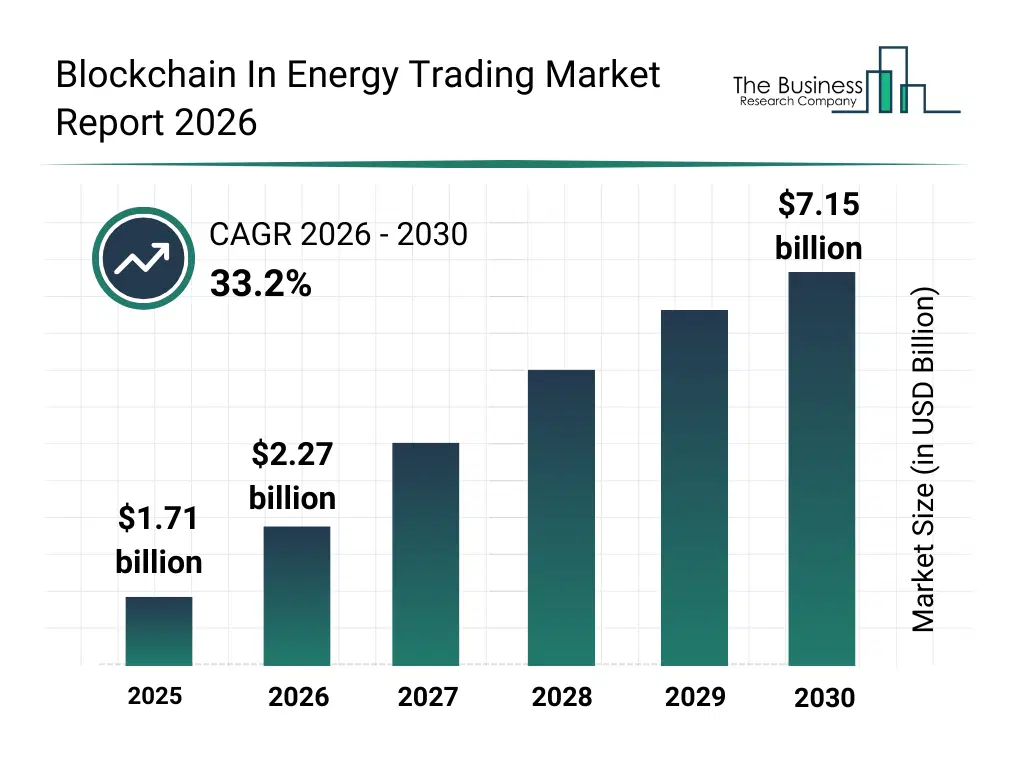
What Is The Blockchain In Energy Trading Market Size and Share 2026?
The blockchain in energy trading market size has grown exponentially in recent years. It will grow from $1.71 billion in 2025 to $2.27 billion in 2026 at a compound annual growth rate (CAGR) of 33.0%. The growth in the historic period can be attributed to renewable energy integration growth, early blockchain pilot projects, grid decentralization initiatives, transparency in energy markets, prosumer energy models.What Is The Blockchain In Energy Trading Market Growth Forecast?
The blockchain in energy trading market size is expected to see exponential growth in the next few years. It will grow to $7.15 billion in 2030 at a compound annual growth rate (CAGR) of 33.2%. The growth in the forecast period can be attributed to scaling distributed energy resources, regulatory acceptance of blockchain trading, EV charging transaction growth, carbon credit digitization, cross-border energy trading. Major trends in the forecast period include peer-to-peer energy trading platforms, smart contract-based energy settlement, tokenized renewable energy certificates, decentralized grid transaction management, real-time energy usage transparency.
Global Blockchain In Energy Trading Market Segmentation
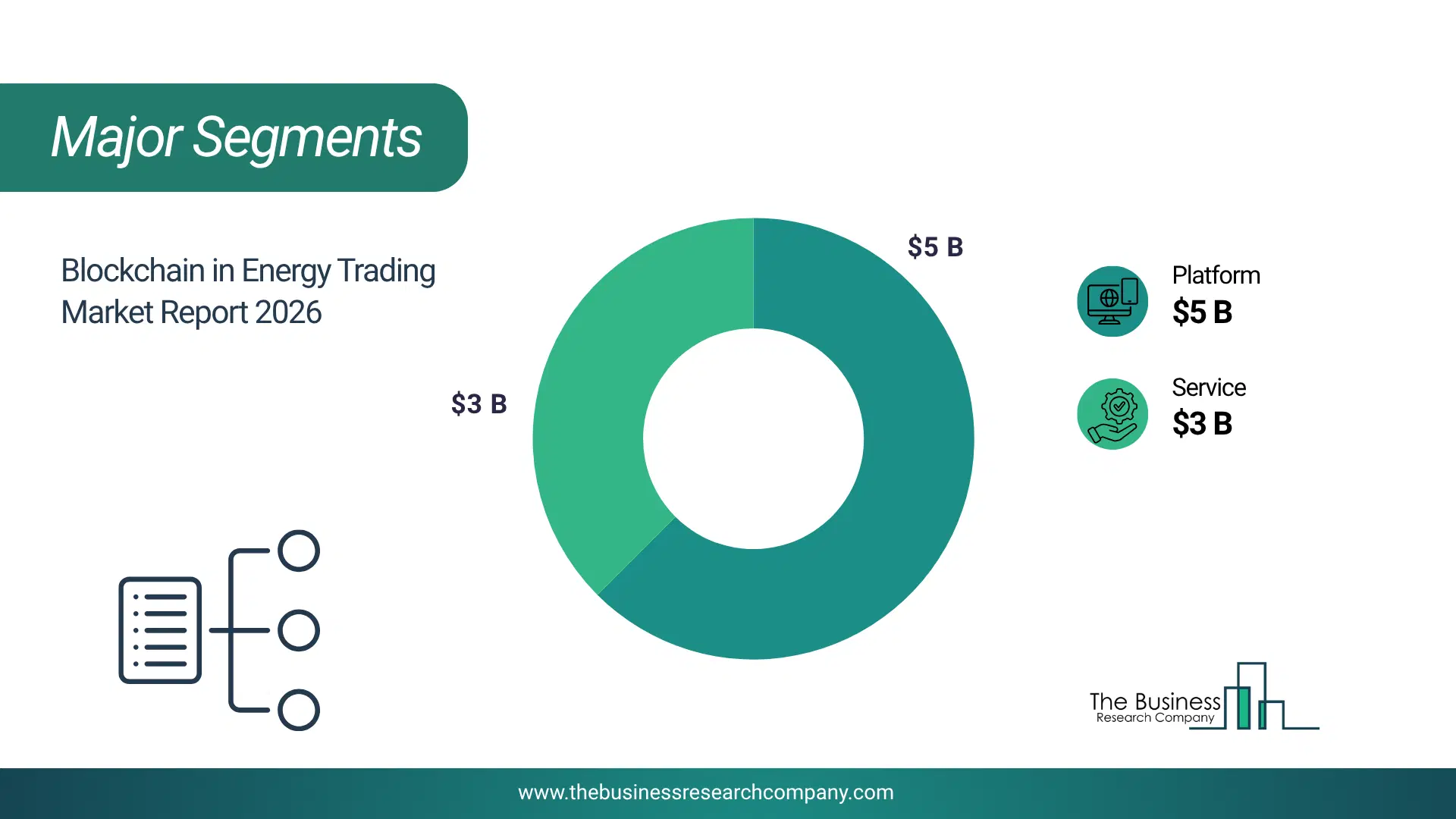
1) By Component: Platform, Services 2) By Deployment Mode: On-Premises, Cloud 3) By Application: Peer-To-Peer Energy Trading, Grid Management, Renewable Energy Certificate Trading, Carbon Credit Trading, Electric Vehicle Charging And Billing, Wholesale Electricity Trading 4) By End-User: Residential, Commercial, Industrial, Utilities Subsegments: 1) By Platform: Public Blockchain Platforms, Private Blockchain Platforms, Consortium Blockchain Platforms, Peer-To-Peer (P2P) Energy Trading Platforms, Smart Contract–Based Trading Platforms, Distributed Ledger Technology (DLT) Platforms, Energy Tokenization Platforms, Grid-Integrated Blockchain Platforms 2) By Services: Consulting And Strategy Services, System Integration And Deployment, Smart Contract Development Services, Maintenance And Support Services, Cybersecurity And Risk Management Services, Regulatory And Compliance Services, Managed Blockchain Services, Training And Technical Support Services The top segments in the blockchain in energy trading market will be: • Platform will reach $4.58 Billion by 2030. • Service will reach $2.69 Billion by 2030.What Is The Driver Of The Blockchain In Energy Trading Market?
The increasing cybersecurity threats are expected to propel the growth of the blockchain in energy trading market going forward. Cybersecurity threats refer to malicious activities aimed at compromising digital systems, networks, and data, leading to disruptions, data breaches, and operational risks across industries. The rise in cybersecurity threats is due to increasing digital connectivity and data exchange expanding the attack surface, making systems more vulnerable to unauthorized access and cyberattacks. Blockchain in energy trading supports cybersecurity threats by enabling tamper-resistant, transparent, and decentralized transaction records, reducing the risk of data manipulation, fraud, and unauthorized system access. For instance, in November 2023, according to the Anti-Phishing Working Group (APWG), a US-based non-profit organization dedicated to cybercrime prevention, 1,624,144 phishing attacks were recorded in the first quarter of 2023. This total exceeded the 888,585 attacks reported in the fourth quarter of 2022 and also surpassed the previous record of 1,270,883 attacks in the third quarter of 2022. Therefore, increasing cybersecurity threats are driving the growth of the blockchain in the energy trading market.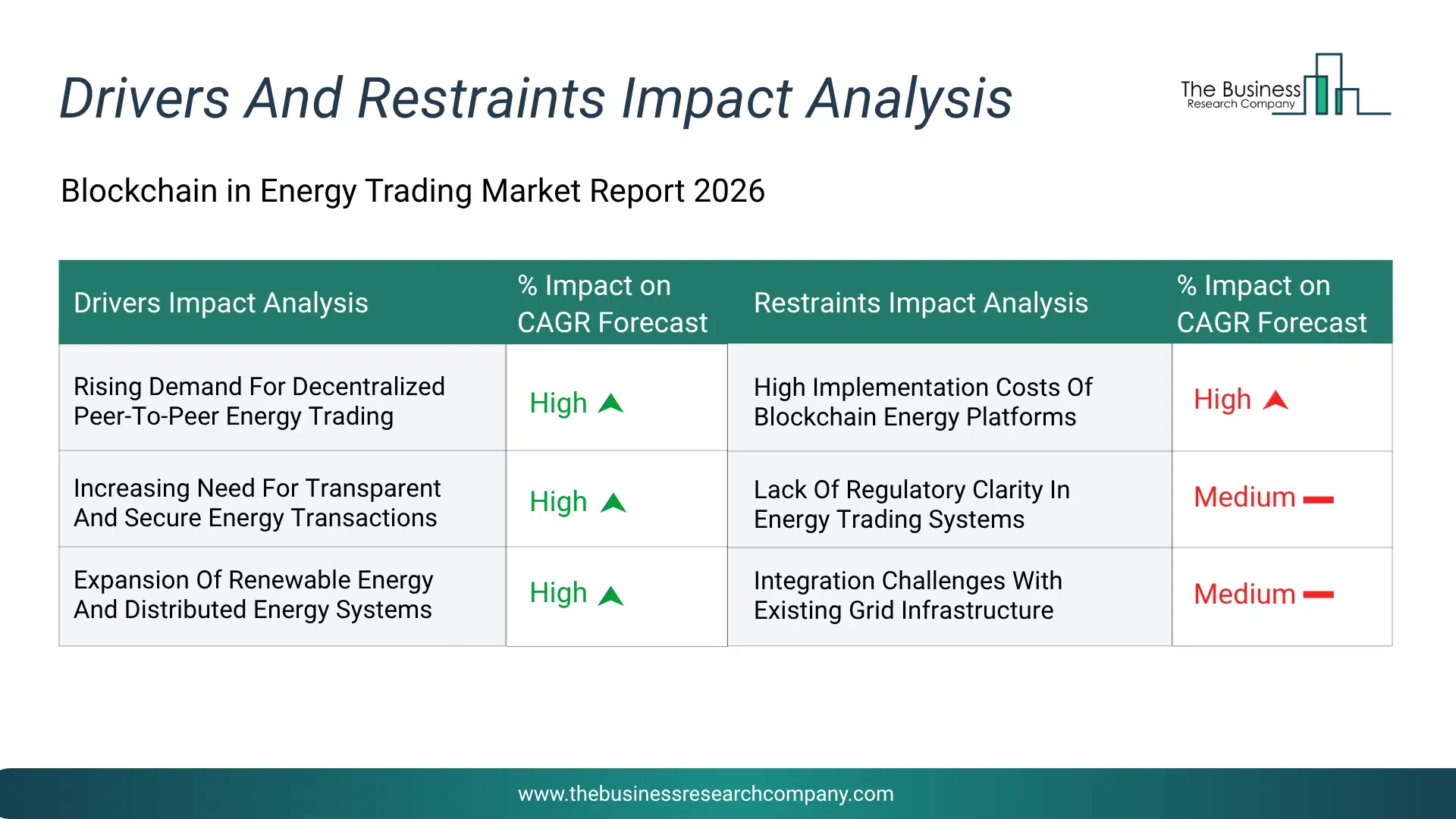
Infographic Chart Showing Key Market Drivers Analysis And Restraints For Blockchain In Energy Trading Market
The chart presents an impact analysis of key drivers and restraints, quantifying their relative influence on the market's growth rate and helping assess the balance between growth enablers and limiting factors. This chart offers a high-level perspective; the full report contains more detailed insights.
How Will The Drivers Impact Growth In The Global Blockchain in Energy Trading Market?
• Rising Demand For Decentralized Peer-To-Peer Energy Trading (High) – During the forecast period, the rising demand for decentralized peer-to-peer energy trading is expected to become a key growth driver for the blockchain in energy trading market by 2030. Consumers and prosumers are increasingly seeking the ability to directly trade excess electricity generated from distributed sources such as rooftop solar systems without relying on centralized intermediaries. Blockchain technology enables automated and trustless transactions through smart contracts, allowing participants to efficiently buy and sell energy in real time. This shift is encouraging the development of localized energy marketplaces and community-based trading platforms that enhance energy accessibility and flexibility. • Increasing Need For Transparent And Secure Energy Transactions (High) – During the forecast period, the increasing need for transparent and secure energy transactions is expected to emerge as a major factor driving the expansion of the blockchain in energy trading market by 2030. Traditional energy trading systems often face challenges related to data discrepancies, delayed settlements, and limited visibility across transaction chains. Blockchain introduces immutable ledgers and cryptographic security mechanisms that ensure transaction integrity, traceability, and auditability across multiple stakeholders. This is particularly critical for complex energy markets involving multiple intermediaries and cross-border exchanges. As energy companies prioritize trust, compliance, and operational efficiency, the adoption of blockchain-based transaction systems is expected to accelerate. • Expansion Of Renewable Energy And Distributed Energy Systems (High) – During the forecast period, the expansion of renewable energy and distributed energy systems is expected to act as a key growth catalyst for the blockchain in energy trading market by 2030. The growing integration of renewable sources such as solar, wind, and small-scale generation units is increasing the complexity of energy flows within power networks. Blockchain solutions enable efficient tracking, validation, and settlement of energy generated from diverse distributed sources, supporting better grid coordination and resource optimization. Additionally, the proliferation of microgrids and localized energy networks is creating new opportunities for decentralized transaction management.How Will The Restraints Impact Growth In The Global Blockchain in Energy Trading Market?
• High Implementation Costs Of Blockchain Energy Platforms (High) – During the forecast period, high implementation costs of blockchain energy platforms are restricting the growth of the blockchain in energy trading market. Significant investment required for platform development, infrastructure setup, cybersecurity measures, and ongoing maintenance is creating financial barriers for utilities and energy providers, thereby limiting widespread adoption especially among smaller market participants • Lack Of Regulatory Clarity In Energy Trading Systems (High) – During the forecast period, lack of regulatory clarity in energy trading systems is restricting the growth of the blockchain in energy trading market. Evolving policies and absence of standardized legal frameworks across regions are creating compliance uncertainties, delaying project approvals, and discouraging investments in blockchain-based energy trading solutions • Integration Challenges With Existing Grid Infrastructure (High) – During the forecast period, integration challenges with existing grid infrastructure are restricting the growth of the blockchain in energy trading market. Difficulties in aligning blockchain platforms with legacy energy systems, interoperability issues, and complexities in data synchronization are hindering seamless deployment and limiting operational efficiencyKey Players In The Global Blockchain In Energy Trading Market
Major companies operating in the blockchain in energy trading market are Shell plc, Siemens AG, Enel S.p.A., Acciona Energías Renovables S.A., Alliander Blockchain Lab, Iberdrola S.A., Vattenfall AB, UrbanChain, SolarCoin Foundation, TenneT Holding B.V., Pure Energy, PONTON GmbH, Power Ledger Pty Ltd, Energy Web Origin, Verv GmbH, Electron Limited, SunContract d.o.o., FlexiDAO S.L., Dione Protocol, Greeneum Network, WattTime Blockchain Solutions, Conjoule GmbH, and Grid Singularity GmbH.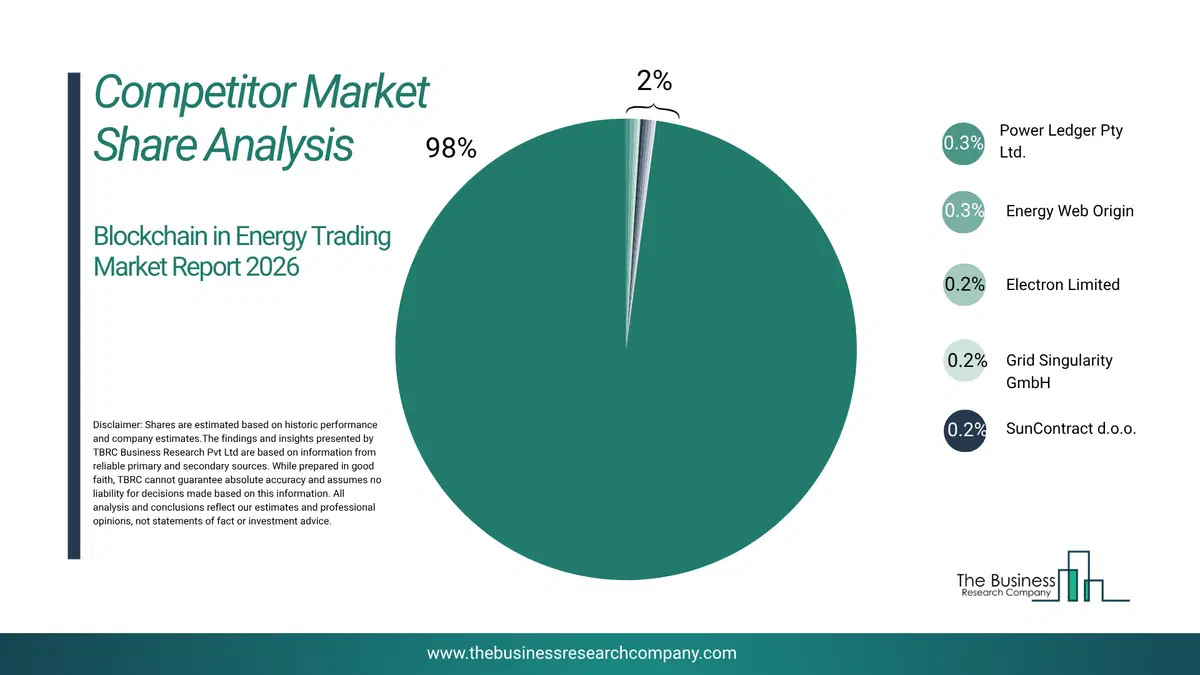
This chart is for illustrative purposes; the full report includes a detailed competitor analysis and comprehensive overview of the top 10 companies in the market.
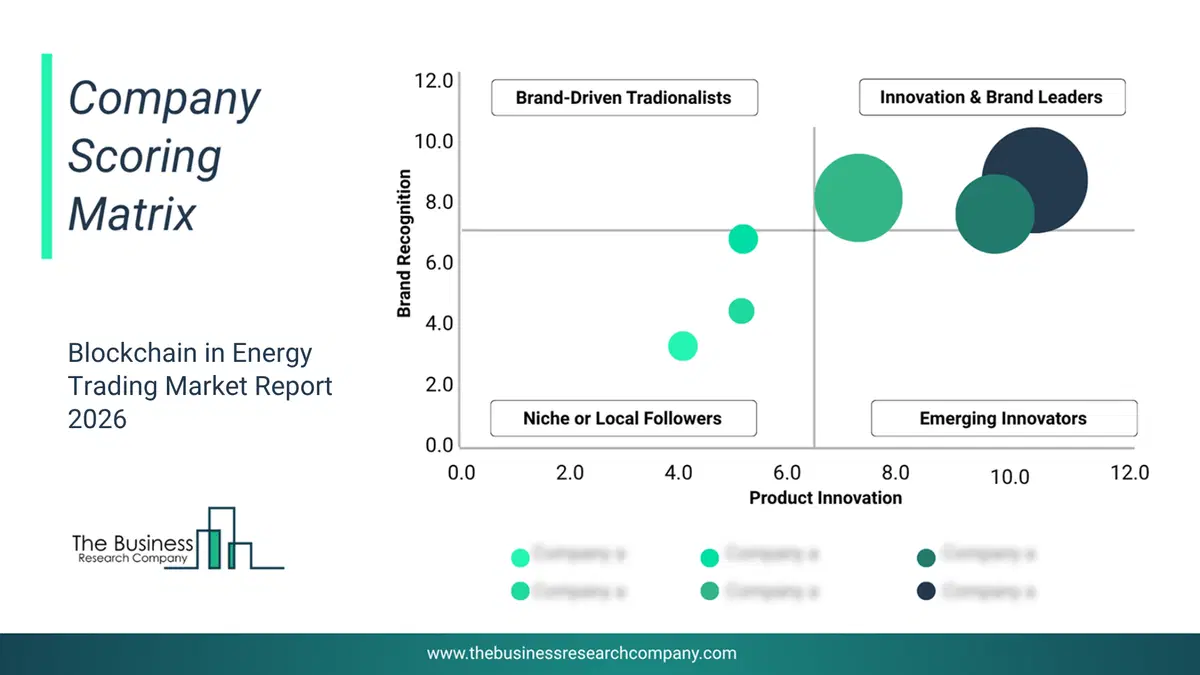
This chart maps companies by product innovation and brand strength, with bubble size indicating relative revenue, helping identify market leaders, challengers, and niche players. This is an illustrative chart; the full report provides a complete and accurate competitive analysis.
Global Blockchain In Energy Trading Market Trends and Insights
Major companies operating in the energy trading market are focusing on developing advanced solutions, such as tokenized oil-backed digital assets, to enhance transparency, liquidity, and efficiency in global energy transactions. Tokenized oil-backed digital assets refer to blockchain-based stablecoins collateralized by verified crude oil reserves, enabling secure, programmable, and near-instant settlement of energy trades. For instance, in 2025, the Gulf Energy Exchange (GEX), a Bahrain-based energy market operator, launched OIL1, the world’s first oil-backed stablecoin built on the Arc Layer-1 blockchain, pegged to both the US dollar and Gulf crude oil prices. Designed to assist traders and investors with broader access to energy commodities, the solution offers 24/7 on-chain trading, dual-peg stability, and regulatory compliance, facilitating efficient cross-border transactions and bridging traditional oil markets with blockchain-based finance.What Are Latest Mergers And Acquisitions In The Blockchain In Energy Trading Market?
In November 2024, the Hashgraph Association, a Switzerland-based non-profit organization focused on accelerating decentralized digital innovation, partnered with Blockchain for Energy to advance blockchain-powered carbon emissions tracking and energy data transparency using Hedera distributed ledger technology. Through this partnership, the Hashgraph Association and Blockchain for Energy aim to enhance transparent, traceable, and secure carbon emissions management using decentralized ledger technology, AI, and IoT to strengthen sustainability and regulatory compliance across the energy sector. Blockchain for Energy is a US-based company specialized in blockchain in energy trading, emissions management, and decentralized digital solutions for secure, transparent, and efficient energy transactions.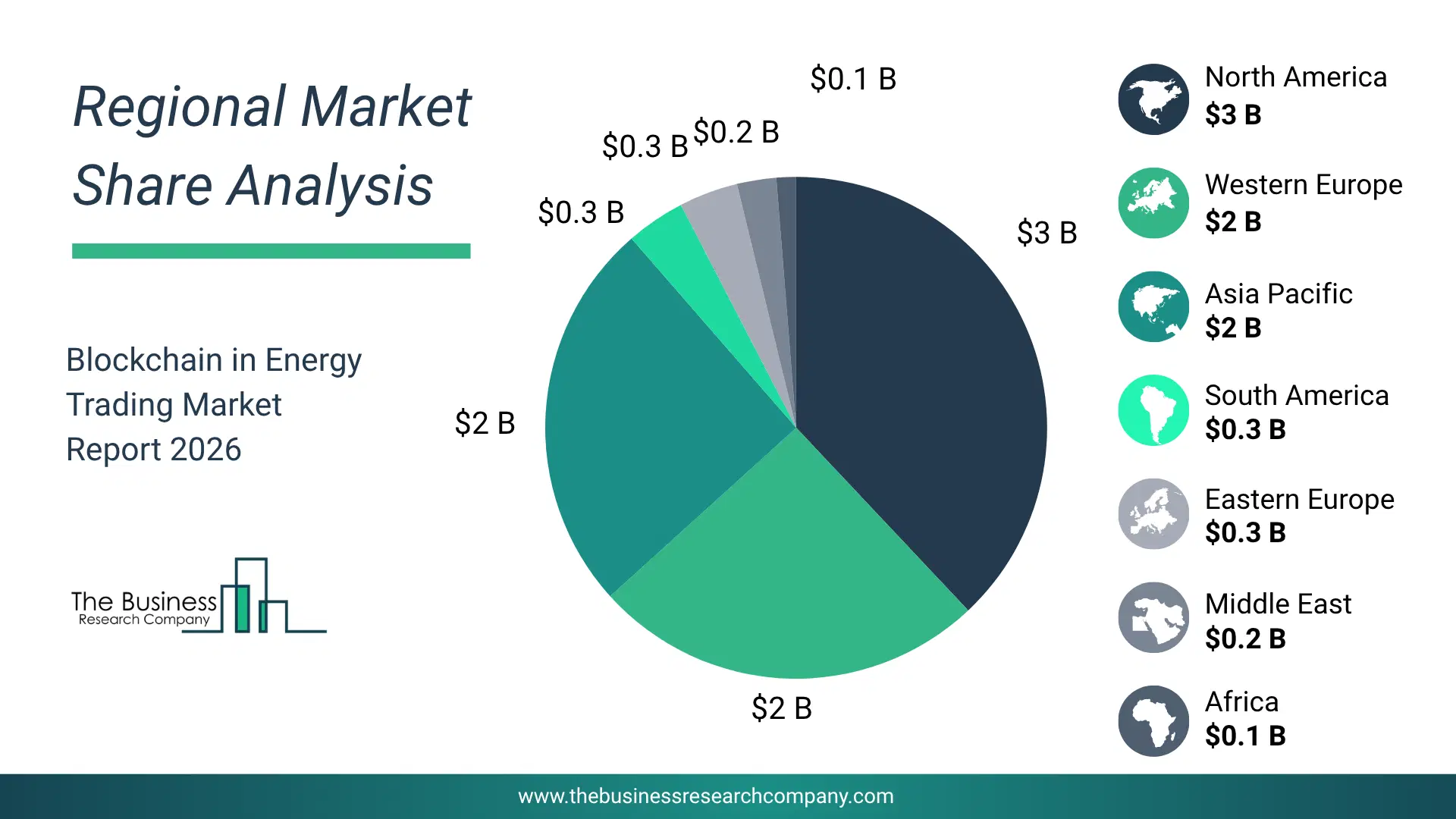
Regional Outlook
North America was the largest region in the blockchain in energy trading market in 2025. Asia-Pacific is expected to be the fastest-growing region in the forecast period. The regions covered in this market report are Asia-Pacific, South East Asia, Western Europe, Eastern Europe, North America, South America, Middle East, Africa. The countries covered in this market report are Australia, Brazil, China, France, Germany, India, Indonesia, Japan, Taiwan, Russia, South Korea, UK, USA, Canada, Italy, Spain.What Defines the Blockchain In Energy Trading Market?
The blockchain in energy trading market consists of revenues earned by entities by providing services such as transaction validation and settlement services, grid data management services, energy certificate tracking services, cybersecurity and compliance services, system maintenance and technical support. The market value includes the value of related goods sold by the service provider or included within the service offering. The blockchain in energy trading market also includes sales of smart meters, advanced metering infrastructure hardware, energy monitoring sensors, grid communication gateways, edge computing devices, energy management hardware controllers, servers for blockchain nodes, hardware security modules. Values in this market are ‘factory gate’ values, that is the value of goods sold by the manufacturers or creators of the goods, whether to other entities (including downstream manufacturers, wholesalers, distributors and retailers) or directly to end customers. The value of goods in this market includes related services sold by the creators of the goods.How is Market Value Defined and Measured?
The market value is defined as the revenues that enterprises gain from the sale of goods and/or services within the specified market and geography through sales, grants, or donations in terms of the currency (in USD unless otherwise specified). The revenues for a specified geography are consumption values that are revenues generated by organizations in the specified geography within the market, irrespective of where they are produced. It does not include revenues from resales along the supply chain, either further along the supply chain or as part of other products.
This chart presents market attractiveness based on a quantitative evaluation of growth, competition, strategic alignment, and risk, offering a clear view of opportunity areas for decision-making. This chart is for illustrative purposes; the full report contains the complete analysis.

This chart highlights the Total Addressable Market (TAM) by estimating the maximum revenue opportunity using an assumption-driven approach, supporting strategic planning and opportunity sizing across markets. The chart is illustrative; the full report provides a more comprehensive analysis.
What Key Data and Analysis Are Included in the Blockchain In Energy Trading Market Report 2026?
The blockchain in energy trading market research report is one of a series of new reports from The Business Research Company that provides market statistics, including industry global market size, regional shares, competitors with the market share, detailed market segments, market trends and opportunities, and any further data you may need to thrive in the blockchain in energy trading industry. The market research report delivers a complete perspective of everything you need, with an in-depth analysis of the current and future state of the industry.Blockchain In Energy Trading Market Report Forecast Analysis
| Report Attribute | Details |
|---|---|
| Market Size Value In 2026 | $2.27 billion |
| Revenue Forecast In 2030 | $7.15 billion |
| Growth Rate | CAGR of 33.0% from 2026 to 2030 |
| Base Year For Estimation | 2025 |
| Actual Estimates/Historical Data | 2020-2025 |
| Forecast Period | 2026 - 2030 |
| Market Representation | Revenue in USD Billion and CAGR from 2026 to 2030 |
| Segments Covered | Component, Deployment Mode, Application, End-User |
| Regional Scope | Asia-Pacific, Western Europe, Eastern Europe, North America, South America, Middle East, Africa |
| Country Scope | The countries covered in the report are Australia, Brazil, China, France, Germany, India, Indonesia, Japan, Taiwan, Russia, South Korea, UK, USA, Canada, Italy, Spain. |
| Key Companies Profiled | Shell plc, Siemens AG, Enel S.p.A., Acciona Energías Renovables S.A., Alliander Blockchain Lab, Iberdrola S.A., Vattenfall AB, UrbanChain, SolarCoin Foundation, TenneT Holding B.V., Pure Energy, PONTON GmbH, Power Ledger Pty Ltd, Energy Web Origin, Verv GmbH, Electron Limited, SunContract d.o.o., FlexiDAO S.L., Dione Protocol, Greeneum Network, WattTime Blockchain Solutions, Conjoule GmbH, and Grid Singularity GmbH. |
| Customization Scope | Request for Customization |
| Pricing And Purchase Options | Explore Purchase Options |