
Building-integrated Photovoltaics Market Report 2026
Global Outlook – By Product Type ( Polyscrystaline, Thin-Film, Other Product Types), By Application ( Roof, Facade, Glass, Other Applications), By End-User ( Residential, Commercial, Industrial) – Market Size, Trends, Strategies, and Forecast to 2030
Building-integrated Photovoltaics Market Overview
• Building-integrated Photovoltaics market size has reached to $25.13 billion in 2025 • Expected to grow to $68.12 billion in 2030 at a compound annual growth rate (CAGR) of 22% • Growth Driver: Cost-Saving Construction Initiatives Driving The Growth Of The Building-Integrated Photovoltaics Market • Market Trend: AntAI New Energy Launches Innovative BIPV Product • Asia-Pacific was the largest region in 2025.What Is Covered Under Building-integrated Photovoltaics Market?
The building-integrated photovoltaics refer to solar energy generating products that are perfectly integrated into the building envelope and are a part of building components such as facades, roofs, and windows. Building-integrated photovoltaics (BIPV) serve two main purposes; they act as the building structure's exterior layer while also generating power for on-site usage or export to the grid. This system can save money on materials and electricity, reduce pollution, and increase the architectural appeal of a building. BIPV systems are often introduced between the development phase of a building or deployed during a rebuild of an existing building when one of the wrap components is important to get replaced. The main product types of building-integrated photovoltaics are polycrystalline, thin-film, and others. Thin-film products typically consist of very thin layers of photovoltaically active material put on a glass substrate or a metal substrate using vacuum-deposition manufacturing techniques similar to those used in the architectural glass coating. The various applications include roof, facade, glass, and others used in residential, commercial, and industrial buildings.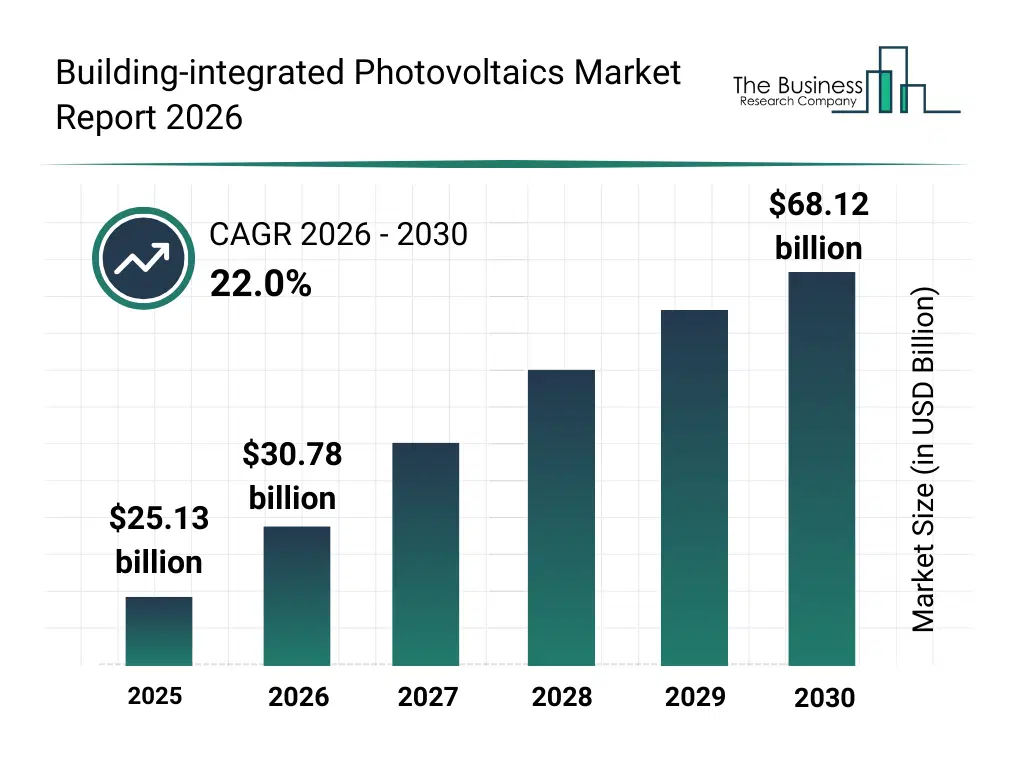
What Is The Building-integrated Photovoltaics Market Size 2026 And Growth Rate?
The building-integrated photovoltaics market size has grown exponentially in recent years. It will grow from $25.13 billion in 2025 to $30.78 billion in 2026 at a compound annual growth rate (CAGR) of 22.5%. The growth in the historic period can be attributed to rise in adoption of solar-integrated roofs, increasing deployment in facades and windows, use in residential construction projects, integration in commercial buildings, deployment in industrial buildings.What Is The Building-integrated Photovoltaics Market Growth Forecast?
The building-integrated photovoltaics market size is expected to see exponential growth in the next few years. It will grow to $68.12 billion in 2030 at a compound annual growth rate (CAGR) of 22.0%. The growth in the forecast period can be attributed to increase in high-efficiency thin-film and monocrystalline BIPV, rising adoption of AI-based solar monitoring, expansion in hybrid and organic photovoltaics, growth in smart building-integrated energy systems, increase in IoT-enabled energy management. Major trends in the forecast period include integration of bipv with smart building management systems, adoption of energy-efficient solar materials, implementation of IoT-enabled solar monitoring, expansion of multi-functional building facades, deployment of AI-optimized solar energy systems.
Global Building-integrated Photovoltaics Market Segmentation
1) By Product Type: Polyscrystaline, Thin-Film, Other Product Types 2) By Application: Roof, Facade, Glass, Other Applications 3) By End-User: Residential, Commercial, Industrial Subsegments: 1) By Polyscrystalline: Standard Polyscrystalline Panels, Advanced Polyscrystalline Modules 2) By Thin-Film: Amorphous Silicon (a-Si), Cadmium Telluride (CdTe), Copper Indium Gallium Selenide (CIGS) 3) By Other Product Types: Monocrystalline, Hybrid Photovoltaics, Organic Photovoltaics (OPV)What Is The Driver Of The Building-integrated Photovoltaics Market?
Rise in cost saving construction projects is expected to drive the growth of the building-integrated photovoltaics market going forward. The rise in cost-saving construction projects can be attributed to increased economic uncertainties, intense competition, technology-driven efficiencies, and the need for sustainability and responsible resource management in construction. Building-integrated photovoltaics (BIPV) reduce long-term energy costs by generating on-site renewable electricity, enhancing energy efficiency, and leveraging incentives while seamlessly integrating with the building's architecture. For instance, in August 2024, according to a report published by Upmetrics, a US-based non-profit organization, the construction industry of the USA is worth $1.8 trillion, while the global construction industry is valued at $8.9 trillion in 2023. Therefore, rise in cost saving construction projects will continue to contribute to drive the growth of the building-integrated photovoltaics industry in the forecast period.Key Players In The Global Building-integrated Photovoltaics Market
Major companies operating in the building-integrated photovoltaics market are First Solar Inc., Sharp Corporation, Yingli Solar, Solar Frontier, SunPower Corporation, Hanwha Solar, Panasonic Corporation, Canadian Solar Inc., Suntech Power Holdings Co. Ltd., Harsha Abakus Solar Private Limited, Ascent Solar Technologies Inc., Greatcell Energy Limited, Global Solar Energy Inc., Hanergy Holding Group Ltd., Onyx Solar Energy S.L., ISSOL SA, Solarcentury Holdings Limited, Trina Solar Limited, Hanwha Q CELLS Co. Ltd., GAF Energy LLC, RGS Energy, NanoFlex Power Corporation, Tesla Inc., Jinko Solar Holding Co. Ltd., LG Electronics Inc., SolarWorld Americas Inc., Mitsubishi Electric Corporation, REC Solar Holdings AS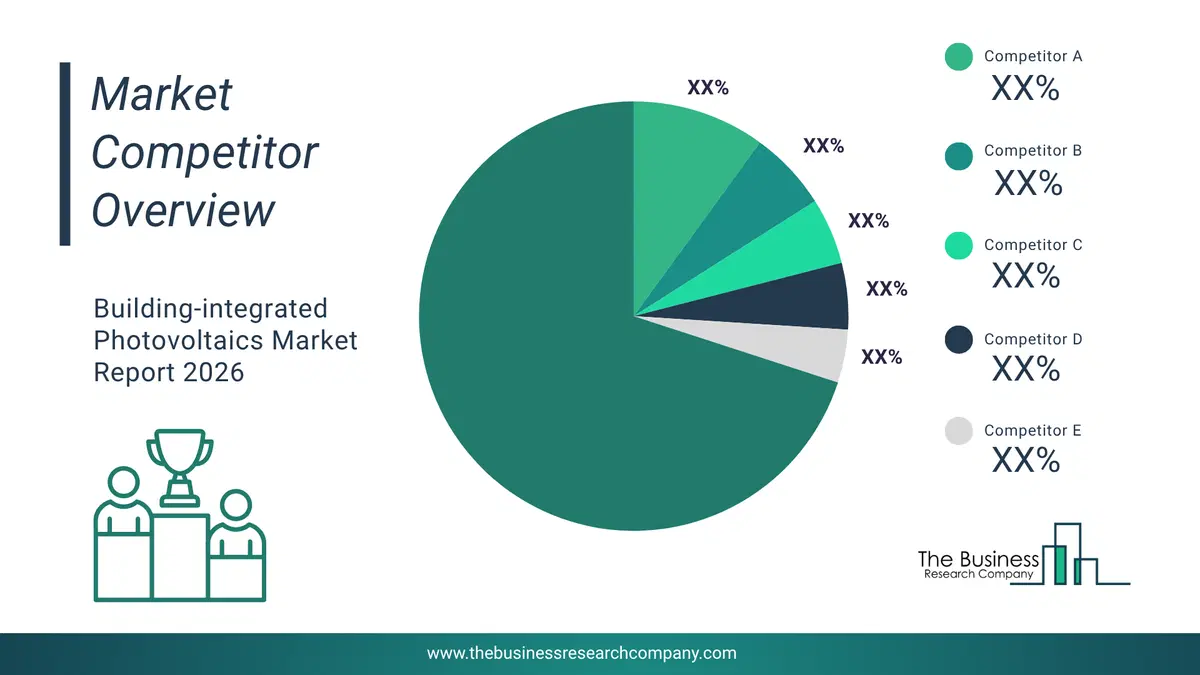
This chart is for illustrative purposes; the full report includes a detailed competitor analysis and comprehensive overview of the top 10 companies in the market.
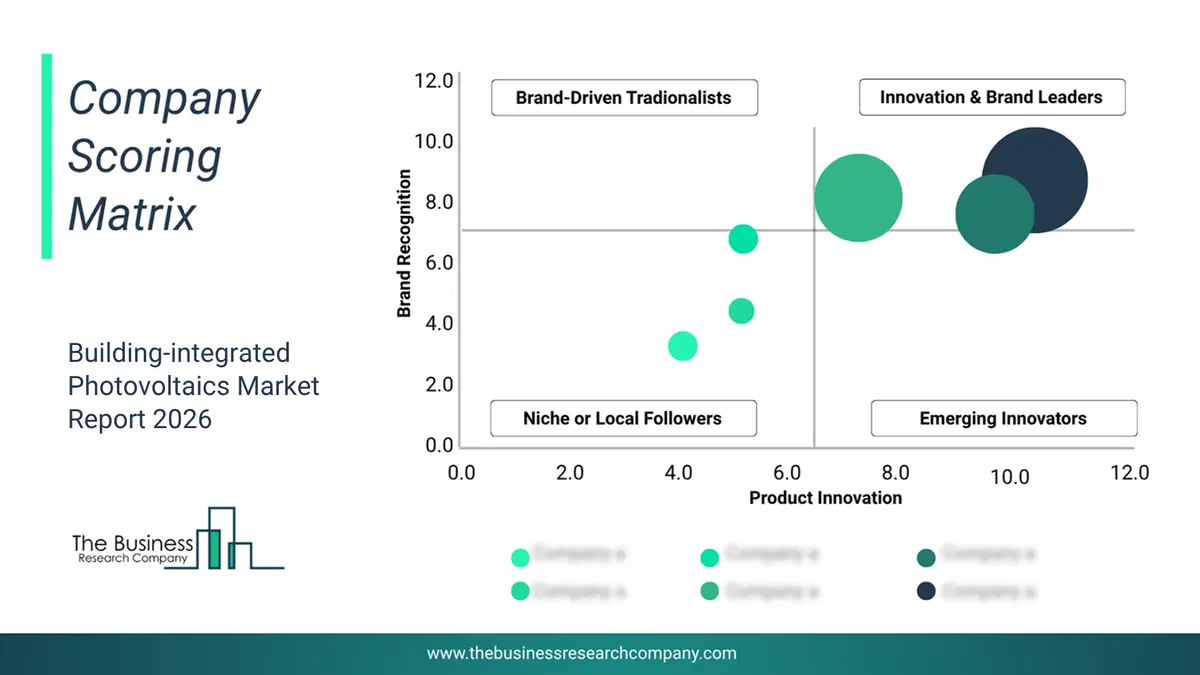
This chart maps companies by product innovation and brand strength, with bubble size indicating relative revenue, helping identify market leaders, challengers, and niche players. This is an illustrative chart; the full report provides a complete and accurate competitive analysis.
Global Building-integrated Photovoltaics Market Trends and Insights
Major companies operating in the building-integrated photovoltaics systems market are launching innovative ultra-lightweight BIPV such as Galaxy Series to gain a competitive edge in the market. The Galaxy Series represents an innovative BIPV (building-integrated photovoltaic) product, meticulously crafted for industrial and commercial use. Its distinctive attributes enable a broader adoption of solar roofing and increased solar energy capture. For instance, March 2023, GoodWe, a China-based manufacturer and smart energy solutions provider, launched Galaxy Series a new ultra-lightweight BIPV product. Featuring a frameless design, the Galaxy Series boasts an impressively low weight of just 6kg/㎡, rendering it ideal for roofs with limited load-bearing capabilities and subpar waterproofing. What truly distinguishes the Galaxy Series is its remarkable reliability, achieved through the use of 1.6mm ultra-thin glass. This ultra-thin glass not only enhances the product's resilience against hail and strong winds but also provides enduring safety and weather protection to buildings.What Are Latest Mergers And Acquisitions In The Building-integrated Photovoltaics Market?
In June 2025, Kameleon Solar, a Netherlands-based solar company, partnered with Nithin SAI Renewables Pvt. Ltd. to expand its BIPV solutions and accelerate adoption of integrated solar technologies in India. With this partnership aims to strengthen the deployment of building-integrated photovoltaics (BIPV), accelerate adoption of innovative solar technologies, and promote sustainable, clean energy solutions across the Indian market. Nithin SAI Renewables Pvt. Ltd. is an India-based manufacturing company that offers building-integrated photovoltaics.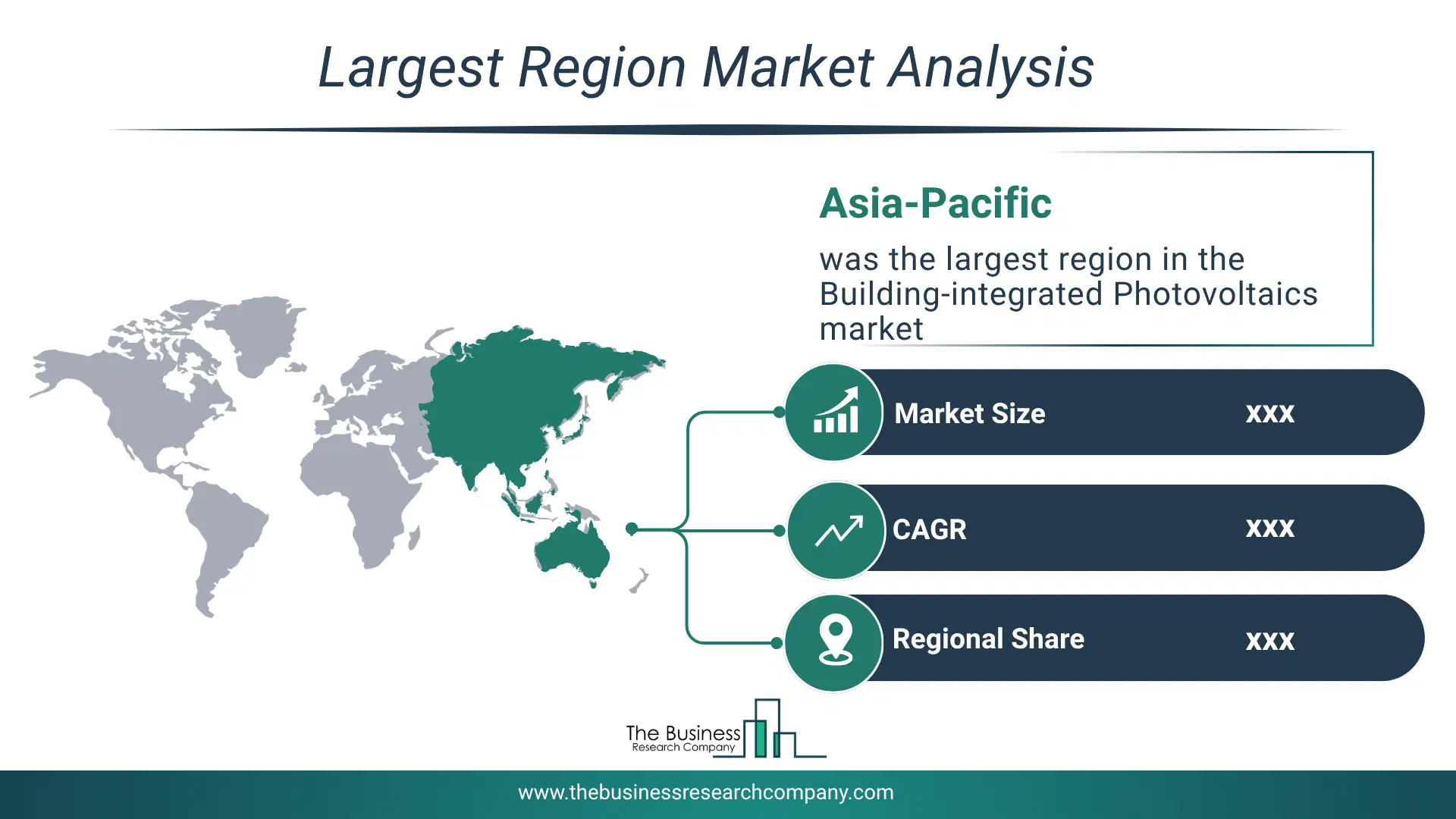
Regional Outlook
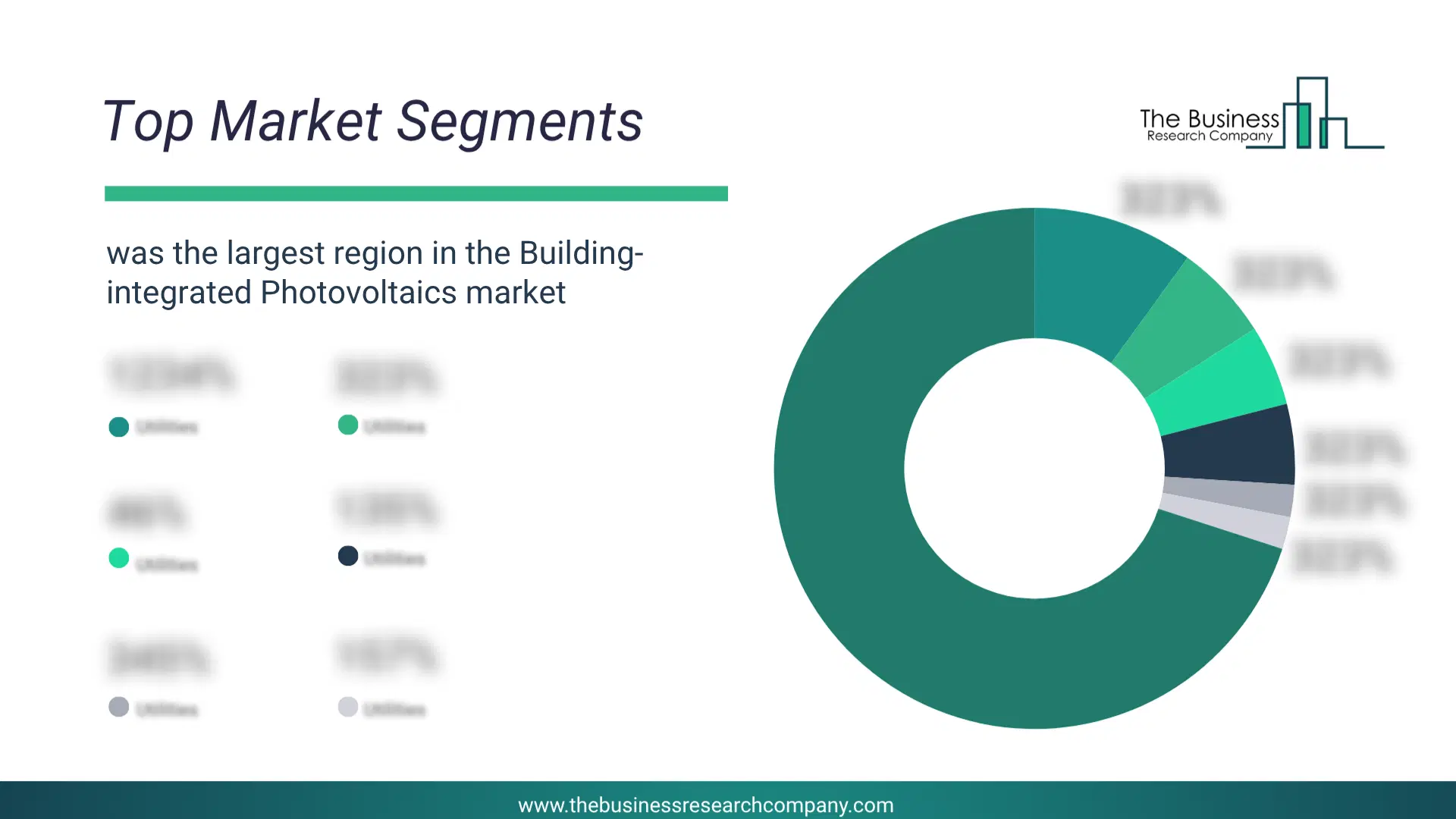
Asia-Pacific was the largest region in the building-integrated photovoltaics market in 2025. The regions covered in this market report are Asia-Pacific, South East Asia, Western Europe, Eastern Europe, North America, South America, Middle East, Africa. The countries covered in this market report are Australia, Brazil, China, France, Germany, India, Indonesia, Japan, Taiwan, Russia, South Korea, UK, USA, Canada, Italy, Spain.What Defines the Building-integrated Photovoltaics Market?
The building-integrated photovoltaics market consists of sales of photovoltaic foils, photovoltaic tiles, photovoltaic modules and solar cell glazings. Values in this market are ‘factory gate’ values, that is the value of goods sold by the manufacturers or creators of the goods, whether to other entities (including downstream manufacturers, wholesalers, distributors and retailers) or directly to end customers. The value of goods in this market includes related services sold by the creators of the goods.How is Market Value Defined and Measured?
The market value is defined as the revenues that enterprises gain from the sale of goods and/or services within the specified market and geography through sales, grants, or donations in terms of the currency (in USD unless otherwise specified). The revenues for a specified geography are consumption values that are revenues generated by organizations in the specified geography within the market, irrespective of where they are produced. It does not include revenues from resales along the supply chain, either further along the supply chain or as part of other products.
This chart presents market attractiveness based on a quantitative evaluation of growth, competition, strategic alignment, and risk, offering a clear view of opportunity areas for decision-making. This chart is for illustrative purposes; the full report contains the complete analysis.

This chart highlights the Total Addressable Market (TAM) by estimating the maximum revenue opportunity using an assumption-driven approach, supporting strategic planning and opportunity sizing across markets. The chart is illustrative; the full report provides a more comprehensive analysis.
What Key Data and Analysis Are Included in the Building-integrated Photovoltaics Market Report 2026?
The building-integrated photovoltaics market research report is one of a series of new reports from The Business Research Company that provides market statistics, including industry global market size, regional shares, competitors with the market share, detailed market segments, market trends and opportunities, and any further data you may need to thrive in the building-integrated photovoltaics industry. The market research report delivers a complete perspective of everything you need, with an in-depth analysis of the current and future state of the industry.Building-integrated Photovoltaics Market Report Forecast Analysis
| Report Attribute | Details |
|---|---|
| Market Size Value In 2026 | $30.78 billion |
| Revenue Forecast In 2030 | $68.12 billion |
| Growth Rate | CAGR of 22% from 2026 to 2030 |
| Base Year For Estimation | 2025 |
| Actual Estimates/Historical Data | 2020-2025 |
| Forecast Period | 2026 - 2030 |
| Market Representation | Revenue in USD Billion and CAGR from 2026 to 2030 |
| Segments Covered | Product Type, Application, End-User |
| Regional Scope | Asia-Pacific, Western Europe, Eastern Europe, North America, South America, Middle East, Africa |
| Country Scope | The countries covered in the report are Australia, Brazil, China, France, Germany, India, Indonesia, Japan, Taiwan, Russia, South Korea, UK, USA, Canada, Italy, Spain. |
| Key Companies Profiled | First Solar Inc., Sharp Corporation, Yingli Solar, Solar Frontier, SunPower Corporation, Hanwha Solar, Panasonic Corporation, Canadian Solar Inc., Suntech Power Holdings Co. Ltd., Harsha Abakus Solar Private Limited, Ascent Solar Technologies Inc., Greatcell Energy Limited, Global Solar Energy Inc., Hanergy Holding Group Ltd., Onyx Solar Energy S.L., ISSOL SA, Solarcentury Holdings Limited, Trina Solar Limited, Hanwha Q CELLS Co. Ltd., GAF Energy LLC, RGS Energy, NanoFlex Power Corporation, Tesla Inc., Jinko Solar Holding Co. Ltd., LG Electronics Inc., SolarWorld Americas Inc., Mitsubishi Electric Corporation, REC Solar Holdings AS |
| Customization Scope | Request for Customization |
| Pricing And Purchase Options | Explore Purchase Options |