

Ceramic Tiles Market 2026
By Type (Glazed Tiles, Unglazed Tiles, Porcelain Tiles), By Construction Type (New Construction, Renovation And Replacement), By Formulation (Dry Pressed, Extruded, Casting), By Application (Floor Tiles, Wall Tiles, Other Applications), And By Region, Opportunities And Strategies – Global Forecast To 2035
Ceramic Tiles Market Definition
Ceramic tiles refer to manufactured tile products composed primarily of clay, kaolin, feldspar and other minerals, which are processed through shaping, glazing or unglazed finishing, and firing to create durable, hard surface coverings. These tiles are used by a broad spectrum of end‑users, including residential homeowners, commercial building contractors, retail establishments, hospitality venues and infrastructure projects, whenever flooring, wall cladding or decorative surfacing is required. The ceramic tiles market consists of sales, by entities (organizations, sole traders, or partnerships), of products primarily made from clay and natural materials, used as durable and aesthetic coverings for floors and walls in residential, commercial, and architectural applications. Ceramic tiles are manufactured through grinding, compression, and firing processes, often enhanced with glazing for color and design versatility.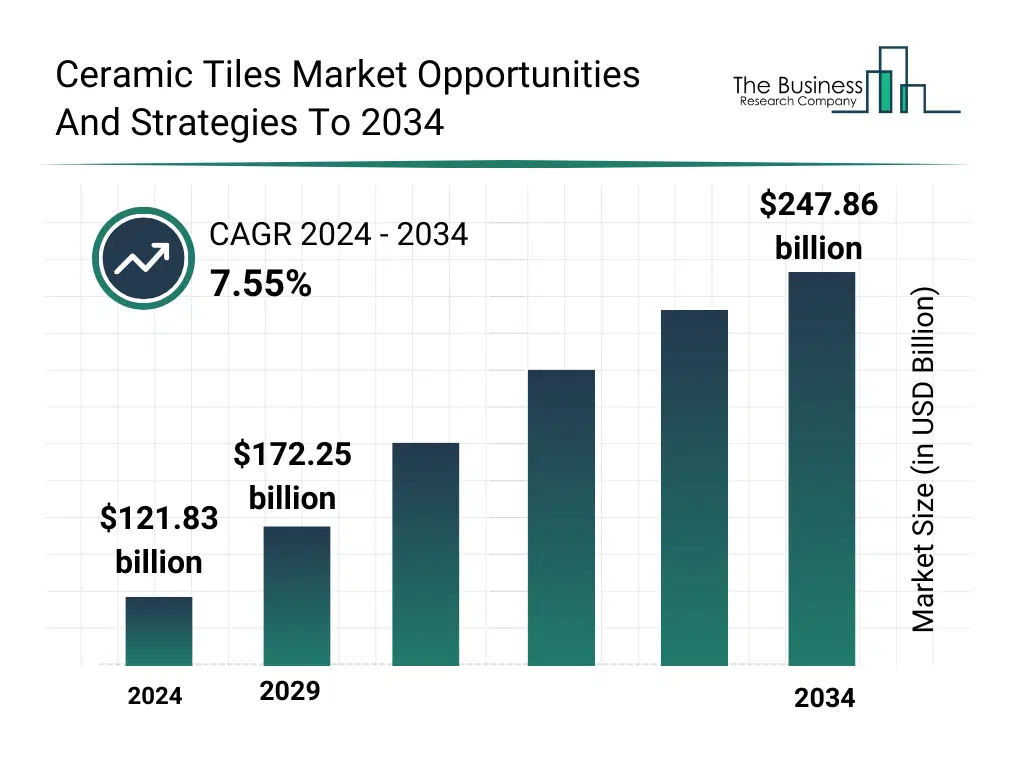
Ceramic Tiles Market Size
The global ceramic tiles market reached a value of nearly $121,825.15 million in 2024, having grown at a compound annual growth rate (CAGR) of 5.58% since 2019. The market is expected to grow from $121,825.15 million in 2024 to $172,251.80 million in 2029 at a rate of 7.17%. The market is then expected to grow at a CAGR of 7.55% from 2029 and reach $247,859.57 million in 2034. Growth in the historic period resulted from rise in infrastructure investments, growth in home improvement projects, government initiatives in housing and growth of high-rise and luxury housing projects. Factors that negatively affected growth in the historic period were fluctuating raw-material and competition from substitute materials. Going forward, government investment in smart cities and urban renewal projects, rising popularity of modular kitchens and bathrooms, adoption of prefabricated and modular construction and rising construction sector will drive the growth. Factors that could hinder the growth of the ceramic tiles market in the future include impact of trade war and tariff, stringent environmental/regulatory requirements and waste-management burdens.Ceramic Tiles Market Drivers
The key drivers of the ceramic tiles market include: Rising Construction Sector During the forecast period, the expansion of the construction sector is expected to drive significant growth in the ceramic tiles market. As building activity continues to rise across residential, commercial, and civil engineering projects, the need for durable, cost-efficient, and visually appealing finishing materials will intensify. Ceramic tiles—commonly used in housing developments, public infrastructure, and large-scale commercial spaces—are poised to benefit from this ongoing construction momentum. Increases in new housing completions, non-residential refurbishments, and engineering projects are generating steady demand for tiles, especially as builders and developers seek materials that combine longevity, low maintenance, and design versatility. Furthermore, growing construction investments are fueling demand for flooring and wall coverings in urban development and modernization initiatives. Consequently, the expansion of the global construction industry will be a key driver of growth in the ceramic tiles market. The rising construction sector growth contribution during the forecast period in 2024 is 1.50%.Ceramic Tiles Market Restraints
The key restraints on the ceramic tiles market include: Stringent Environmental/Regulatory Requirements During the forecast period, stringent environmental and regulatory standards are expected to constrain the growth of the ceramic tiles market. With governments worldwide tightening regulations on embodied carbon, energy use, and emissions linked to building materials, ceramic tile manufacturers are under mounting pressure to reform traditional production methods that depend on energy-intensive firing processes and raw material extraction. Meeting these evolving sustainability requirements often necessitates substantial investments in cleaner technologies, alternative energy sources, life-cycle assessments, and advanced product certifications—factors that increase operational costs and reduce production flexibility. In regions enforcing strict carbon-intensity benchmarks, manufacturers may face barriers to entry or diminished competitiveness if they fail to comply. Moreover, these environmental regulations are increasingly shaping procurement preferences in construction, prompting developers to prioritize low-emission materials and scrutinize suppliers’ sustainability credentials. Consequently, tightening environmental and regulatory frameworks are anticipated to limit the expansion potential of the ceramic tiles market during the forecast period. Growth affected by stringent environmental/regulatory requirements production during the forecast period in 2024 is -2.29%.Ceramic Tiles Market Trends
Major trends shaping the ceramic tiles market include: Expansion Of High-Recycled-Content Floor Tiles Companies in the ceramic tiles market are focusing on the launch of floor-tile ranges made with extremely high recycled-content materials in order to meet growing sustainability expectations and regulatory pressures. These innovations emphasize lower carbon footprints, reduced water usage, and high-quality design appeal, while also offering formats that cater to both premium residential and commercial segments. For instance, in February 2025, Topps Tiles plc, the UK’s leading tile specialist, introduced the Mas floor-tile collection manufactured by Alusid Ltd. The range comprises between 95 % and 98.5 % recycled industrial waste, and according to a third-party verified Environmental Product Declaration (EPD) it reduces carbon emissions by 51 % and water use by 44 % compared to standard tiles produced in Spain. By utilizing cutting-edge recycling-based production processes and strong design credentials, the company aims to deliver floor tiles that combine aesthetics, performance and sustainability to meet the evolving needs of both retail consumers and large-scale specifiers. Eco-Friendly Innovations Driving Sustainability In Tile Production Major companies in the ceramic tiles market are focusing on eco-friendly innovations to reduce the environmental footprint of tile production while meeting growing demand for sustainable building materials. By adopting low-energy manufacturing processes and using recycled or waste-based raw materials, producers are cutting emissions and conserving resources. These sustainable practices enhance brand value and attract environmentally conscious consumers and developers. Additionally, green innovations align with global regulations promoting sustainable construction. As a result, they are driving long-term growth and competitiveness in the ceramic tiles market. For instance, in July 2025, FRONT (formerly StoneCycling) and UK-based Alusid have joined forces to launch Skip Tile, a ceramic tile that skips a major polluting element of traditional tile production. Using a low-energy dry granulation method, the tile dramatically reduces environmental impact with 44% less water use, 51% less CO₂ emissions and 95% made from waste-based materials.Opportunities And Recommendations In The Ceramic Tiles Market
Opportunities – The top opportunities in the ceramic tiles market segmented by type will arise in the porcelain tiles segment, which will gain $26,542.59 million of global annual sales by 2029. The top opportunities in the ceramic tiles market segmented by construction type will arise in the new construction segment, which will gain $33,619.74 million of global annual sales by 2029. The top opportunities in the ceramic tiles market segmented by formulation will arise in the dry pressed segment, which will gain $39,204.23 million of global annual sales by 2029. The top opportunities in the ceramic tiles market segmented by application will arise in the floor tiles segment, which will gain $30,802.43 million of global annual sales by 2029. The ceramic tiles market size will gain the most in China at $20,178.76 million. Recommendations- To take advantage of the opportunities, The Business Research Company recommends the ceramic tiles companies to focus on scaling high recycled content floor tile portfolios, focus on accelerating ecofriendly production innovation, focus on preparing for hydrogen-based kiln manufacturing, focus on scaling advanced inkjet printhead integration, focus on scaling automation and advanced manufacturing, focus on accelerating expansion in the glazed tiles segment, expand in emerging markets, continue to focus on developed markets, provide competitively priced offerings, continue to use b2b promotions, participate in trade shows and events, focus on capturing growth in renovation and replacement demand, focus on capturing growth in renovation and replacement demand.
Ceramic Tiles Market Segmentation
The ceramic tiles market is segmented by type, by construction type, by formulation, and by application.By Type –
The ceramic tiles market is segmented by type into:
- a) Glazed Tiles
- b) Unglazed Tiles
- c) Porcelain Tiles
By Contruction Type –
The ceramic tiles market is segmented by contruction type into:
- a) New Construction
- b) Renovation And Replacement
By Formulation –
The ceramic tiles market is segmented by formulation into:
- a) Dry Pressed
- b) Extruded
- c) Casting
By Application –
The ceramic tiles market is segmented by application into:
- a) Floor Tiles
- b) Wall Tiles
- c) Other Applications
By Geography - The ceramic tiles market is segmented by geography into:
- • China
- • India
- • Japan
- • Australia
- • Indonesia
- • South Korea
- • Bangladesh
- • Thailand
- • Vietnam
- • Malaysia
- • Singapore
- • Phillipines
- • Hong kong
- • New Zealand
- • USA
- • Canada
- • Mexico
- • Brazil
- • Argentina
- • Chile
- • Colombiia
- • Peru
- • France
- • Germany
- • UK
- • Italy
- • Spain
- • Austria
- • Belgium
- • Denmark
- • Finland
- • Ireland
- • Netherland
- • Norway
- • Portugal
- • Sweden
- • Switzerland
- • Russia
- • Czech Republic
- • Poland
- • Romania
- • Ukraine
- • Saudi Arabia
- • Israel
- • Iran
- • Turkey
- • UAE o Africa
- • Egypt
- • Nigeria
- • South Africa
-
o Asia Pacific