
Circular Economy Trade Finance Market Report 2026
Global Outlook – By Type (Trade Finance Credit, Guarantees And Letters Of Credit, Leasing And Asset Financing, Supply Chain Financing), By Deployment Mode (On-Premises, Cloud-Based), By Application (Manufacturing, Retail, Energy, Automotive, Consumer Goods, Other Applications), By End User (Financial Institutions, Corporates And Industry Players) – Market Size, Trends, Strategies, and Forecast to 2030
Circular Economy Trade Finance Market Overview
• Circular Economy Trade Finance market size has reached to $14.02 billion in 2025 • Expected to grow to $29.92 billion in 2030 at a compound annual growth rate (CAGR) of 16.3% • Growth Driver: Growth In Global Trade Fueling The Expansion Of The Market Due To Rising Cross-Border Economic Activities • Market Trend: Introduction Of Harmonized Guidelines To Strengthen Sustainable Investment Frameworks • Europe was the largest region in 2025 and Asia-Pacific is the fastest growing region.Market Gains By 2030 – Top Opportunities By Segment
Market Gain identifies the most promising market opportunities by highlighting the segments or products expected to generate the highest incremental revenue growth over the next five years.
What Is Covered Under Circular Economy Trade Finance Market?
Circular economy trade finance is a financing approach that supports trade by enabling sustainable and resource-efficient economic activities. It focuses on promoting the reuse, recycling, and recovery of materials within supply chains, aiming to minimize waste and environmental impact. This approach integrates financial processes with circular economy principles to encourage longer product lifespans and sustainable trade practices. The main types of circular economy trade finances include trade finance credit, guarantees and letters of credit, leasing and asset financing, and supply chain financing. Trade finance credit refers to short-term financing facilities specifically designed to support transactions within circular economy models. It is deployed through on-premises and cloud-based modes for various applications, including manufacturing, retail, energy, automotive, consumer goods, and others. It is used by several end users, such as financial institutions, corporates, and industry players.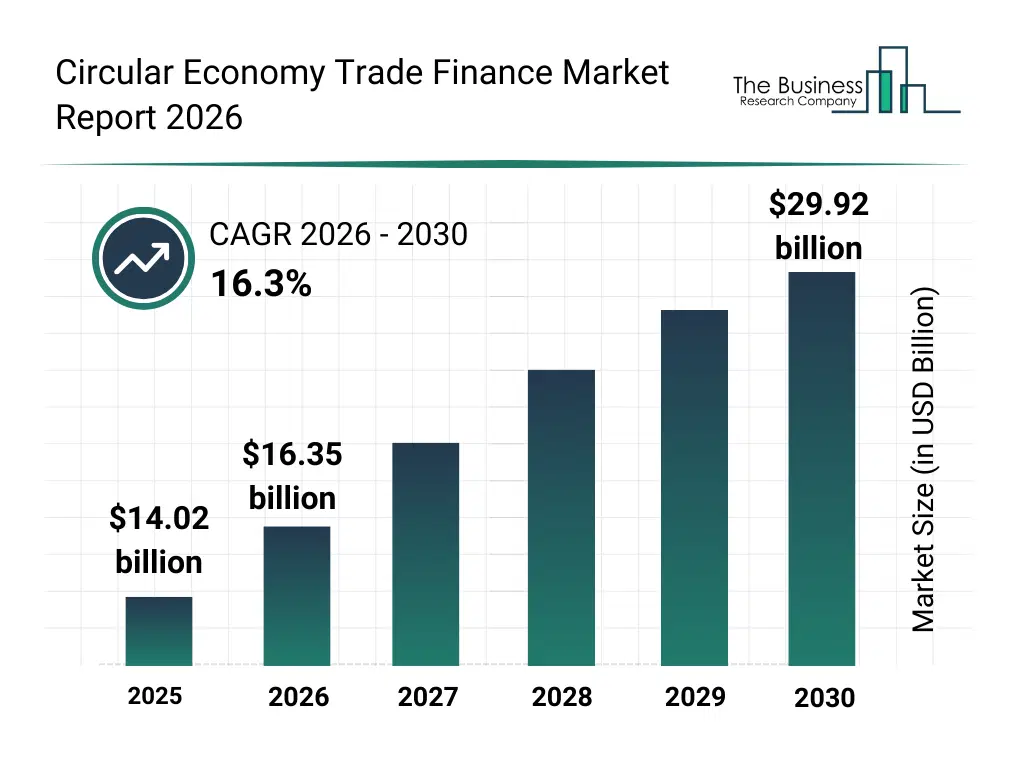
What Is The Circular Economy Trade Finance Market Size and Share 2026?
The circular economy trade finance market size has grown rapidly in recent years. It will grow from $14.02 billion in 2025 to $16.35 billion in 2026 at a compound annual growth rate (CAGR) of 16.6%. The growth in the historic period can be attributed to growth of sustainable supply chain initiatives, rising adoption of trade finance digitization, increasing focus on resource efficiency, expansion of leasing and asset financing models, development of circular economy policies.What Is The Circular Economy Trade Finance Market Growth Forecast?
The circular economy trade finance market size is expected to see rapid growth in the next few years. It will grow to $29.92 billion in 2030 at a compound annual growth rate (CAGR) of 16.3%. The growth in the forecast period can be attributed to increasing demand for sustainable trade finance products, rising regulatory support for circular business models, expansion of blockchain-enabled trade finance, growing focus on lifecycle-based financing, increasing collaboration between banks and corporates. Major trends in the forecast period include increasing adoption of circular supply chain financing models, rising use of green trade finance instruments, growing integration of digital trade finance platforms, expansion of asset-backed circular financing solutions, enhanced focus on traceability and resource efficiency.
Global Circular Economy Trade Finance Market Segmentation
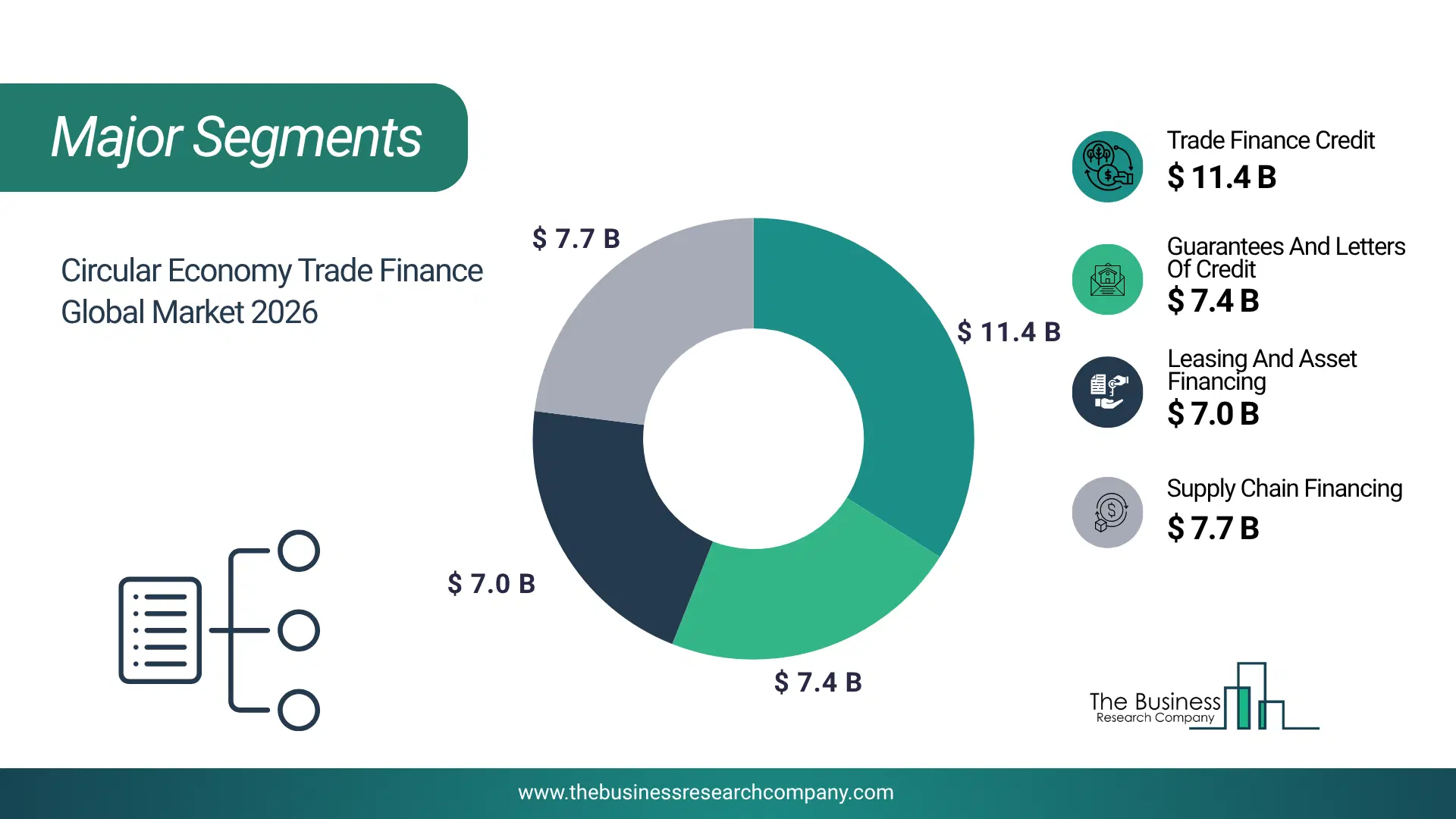
1) By Type: Trade Finance Credit, Guarantees And Letters Of Credit, Leasing And Asset Financing, Supply Chain Financing 2) By Deployment Mode: On-Premises, Cloud-Based 3) By Application: Manufacturing, Retail, Energy, Automotive, Consumer Goods, Other Applications 4) By End User: Financial Institutions, Corporates And Industry Players Subsegments: 1) By Trade Finance Credit: Short-Term Credit, Medium-Term Credit, Long-Term Credit 2) By Guarantees And Letters Of Credit: Performance Guarantees, Bid Bonds, Advance Payment Guarantees, Letters Of Credit 3) By Leasing And Asset Financing: Operating Lease, Finance Lease, Sale And Leaseback, Equipment Financing 4) By Supply Chain Financing: Invoice Financing, Factoring, Reverse Factoring, Dynamic Discounting, Inventory Financing The top segments in the circular economy trade finance market will be: • Trade Finance Credit will reach $11.4 billion by 2030. • Guarantees And Letters Of Credit will reach $7.36 billion by 2030. • Leasing And Asset Financing will reach $7.04 billion by 2030. • Supply Chain Financing will reach $7.68 billion by 2030.What Is The Driver Of The Circular Economy Trade Finance Market?
The global trade growth is expected to propel the growth of the circular economy trade finance market going forward. Trade is the process of buying, selling, or exchanging goods and services between individuals or entities. Trade is rising due to globalization, which has expanded market access and enabled businesses to connect with consumers and suppliers across the world more efficiently. Circular economy trade finance is beneficial for trade activities as it provides funding mechanisms that support resource reuse and recycling, reducing costs and enhancing sustainability across supply chains. For instance, in March 2025, United Nations Conference on Trade and Development, a Switzerland-based intergovernmental body, global trade reached an all-time high of $33 trillion in 2024, marking a 3.7% increase, equivalent to a growth of $1.2 trillion. Therefore, the global trade growth is driving the growth of the circular economy trade finance industry.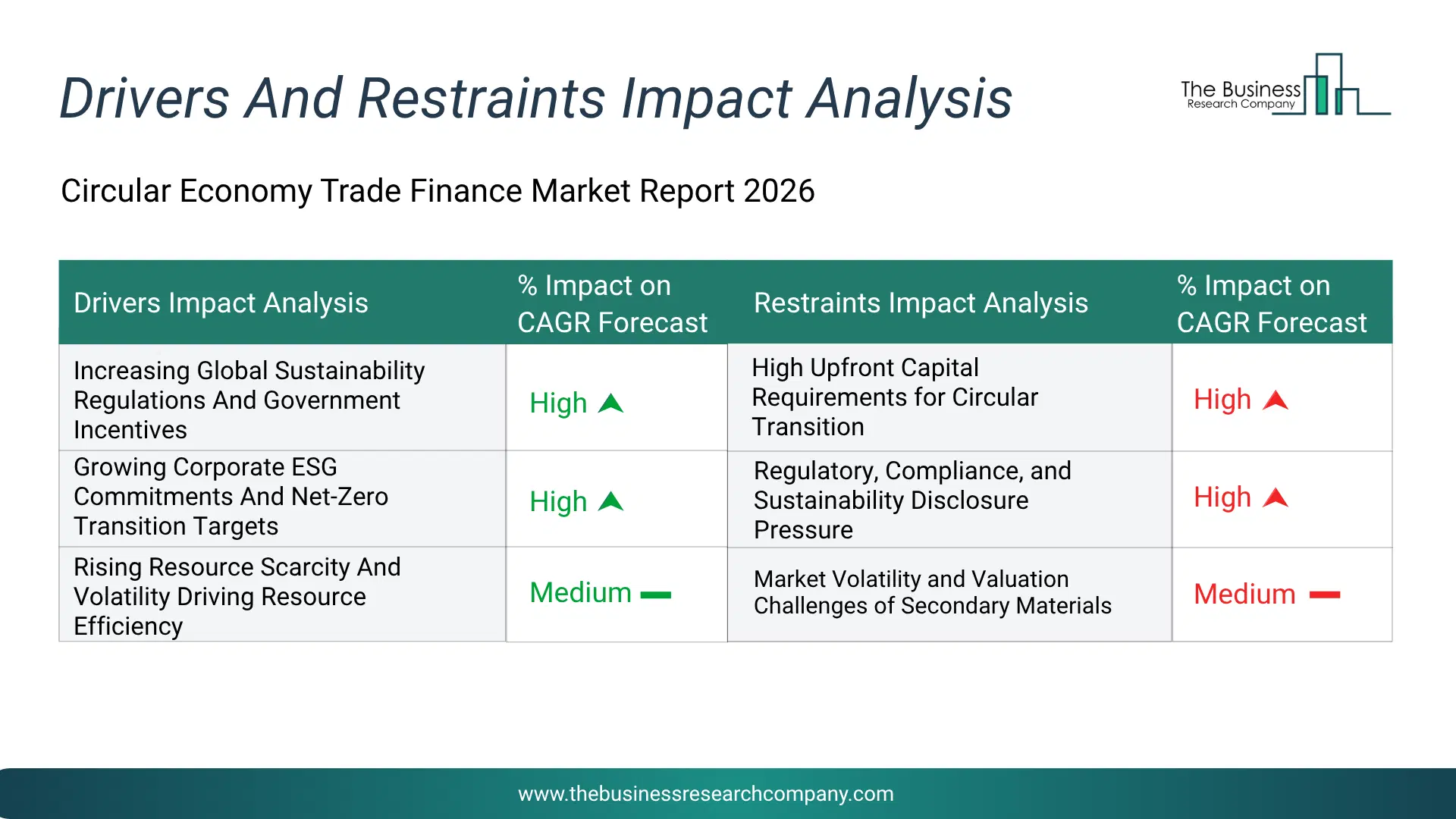
Infographic Chart Showing Key Market Drivers Analysis And Restraints For Circular Economy Trade Finance Market
The chart presents an impact analysis of key drivers and restraints, quantifying their relative influence on the market's growth rate and helping assess the balance between growth enablers and limiting factors. This chart offers a high-level perspective; the full report contains more detailed insights.
How Will The Drivers Impact Growth In The Global Circular Economy Trade Finance Market?
• Increasing Global Sustainability Regulations And Government Incentives (High) – During the forecast period, the increasing global sustainability regulations and government incentives are expected to become a key growth driver for the circular economy trade finance market by 2030. Rising global sustainability regulations and supportive government incentives are significantly encouraging the adoption of circular trade practices among businesses. Stricter policies on emissions control, waste management, and resource efficiency are compelling companies to redesign supply chains with greater emphasis on recycling, reuse, and low -carbon operations, thereby increasing the demand for specialized trade financing. Government initiatives such as tax incentives, subsidies, and green financing programs further reduce financial barriers and enhance the viability of circular trade projects. Financial institutions are responding by developing tailored solutions such as green letters of credit and sustainability -linked financing products. This regulatory backing and policy -driven support accelerate capital flows into circular trade initiatives and sustainable cross -border commerce. • Growing Corporate ESG Commitments And Net-Zero Transition Targets (High) – During the forecast period, the growing corporate esg commitments and net-zero transition targets are expected to emerge as a major factor driving the expansion of the circular economy trade finance market by 2030. Increasing corporate commitments to environmental, social, and governance (esg) standards and net-zero transition goals are encouraging organizations to integrate sustainability across their global supply chains. To achieve emission reduction and resource optimization targets, companies are increasingly adopting recycled materials, product refurbishment, and closed-loop trade models, all of which require dedicated financing mechanisms. Circular economy trade finance supports these initiatives by enabling funding for sustainable procurement, low-carbon logistics, and reverse supply chain operations while maintaining liquidity. At the same time, financial institutions are aligning trade finance solutions with esg frameworks to ensure transparent and responsible transactions. This alignment strengthens capital allocation toward circular trade activities and supports long-term decarbonization objectives. • Rising Resource Scarcity And Volatility Driving Resource Efficiency (Medium) – During the forecast period, the rising resource scarcity and volatility driving resource efficiency is expected to act as a key growth catalyst for the circular economy trade finance market by 2030. Increasing scarcity of critical raw materials and fluctuations in commodity prices are encouraging industries to prioritize resource efficiency and circular supply chains. Companies are increasingly focusing on recycling, reuse, and recovery of materials to reduce dependence on limited resources and manage cost volatility. Governments and industries are also promoting investments in recycling infrastructure, material recovery technologies, and sustainable supply chain strategies to ensure long-term resource security. Circular economy trade finance plays a crucial role by enabling funding for cross-border trade of recycled materials, refurbished goods, and secondary raw materials. This growing emphasis on efficient resource utilization is driving financial innovation and strengthening circular trade ecosystems.How Will The Restraints Impact Growth In The Global Circular Economy Trade Finance Market?
• High Upfront Capital Requirements for Circular Transition (High) – During the forecast period, the high upfront capital requirements act as a major restraint for circular economy trade finance because transitioning from linear to circular models demands significant initial investments in new technologies, reverse logistics, and redesigned supply chains. Many businesses, especially small and medium enterprises, struggle to secure trade finance when payback periods are long and returns are uncertain. Financial institutions often perceive circular projects as higher risk due to limited performance history and complex cash-flow structures. This increases borrowing costs and restricts access to credit facilities such as letters of credit or invoice financing. As a result, high initial capital intensity slows adoption of circular practices and limits the overall growth of circular economy trade finance markets. • Regulatory, Compliance, and Sustainability Disclosure Pressure (High) – During the forecast period, the regulatory, compliance, and sustainability disclosure pressures act as a restraint for circular economy trade finance by increasing administrative complexity and operational costs for financial institutions and businesses. Strict reporting standards and evolving esg regulations require extensive data collection, verification, and auditing, which many small and medium enterprises struggle to manage. Differences in regulatory frameworks across countries further complicate cross-border circular trade financing. The risk of penalties or reputational damage due to non-compliance makes lenders more cautious in funding circular projects. As a result, approval timelines lengthen and access to trade finance becomes more limited despite strong sustainability objectives. • Market Volatility and Valuation Challenges of Secondary Materials (Medium) – During the forecast period, the market volatility and valuation challenges of secondary materials restrain circular economy trade finance by increasing uncertainty around asset prices and revenue predictability. Fluctuating demand and inconsistent quality of recycled materials make it difficult for lenders to assess collateral value with confidence. This uncertainty raises credit risk, leading financial institutions to tighten lending criteria or charge higher financing costs. Inaccurate or unstable valuations also complicate trade documentation and insurance coverage for circular goods. As a result, access to affordable and timely trade finance is limited, slowing the scaling of circular supply chains.Key Players In The Global Circular Economy Trade Finance Market
Major companies operating in the circular economy trade finance market are Bank of America Corporation, Citigroup Inc., JPMorgan Chase & Co., Wells Fargo & Company, BNP Paribas S.A., MUFG Bank Ltd., HSBC Holdings Plc, Deutsche Bank AG, ING Groep N.V., The Goldman Sachs Group Inc., UBS Group AG, State Bank of India, Commonwealth Bank of Australia, Mizuho Financial Group Inc., Barclays PLC, Crédit Agricole S.A., Société Générale S.A., Intesa Sanpaolo S.p.A., UniCredit S.p.A., Standard Chartered Plc, ABN AMRO Bank N.V.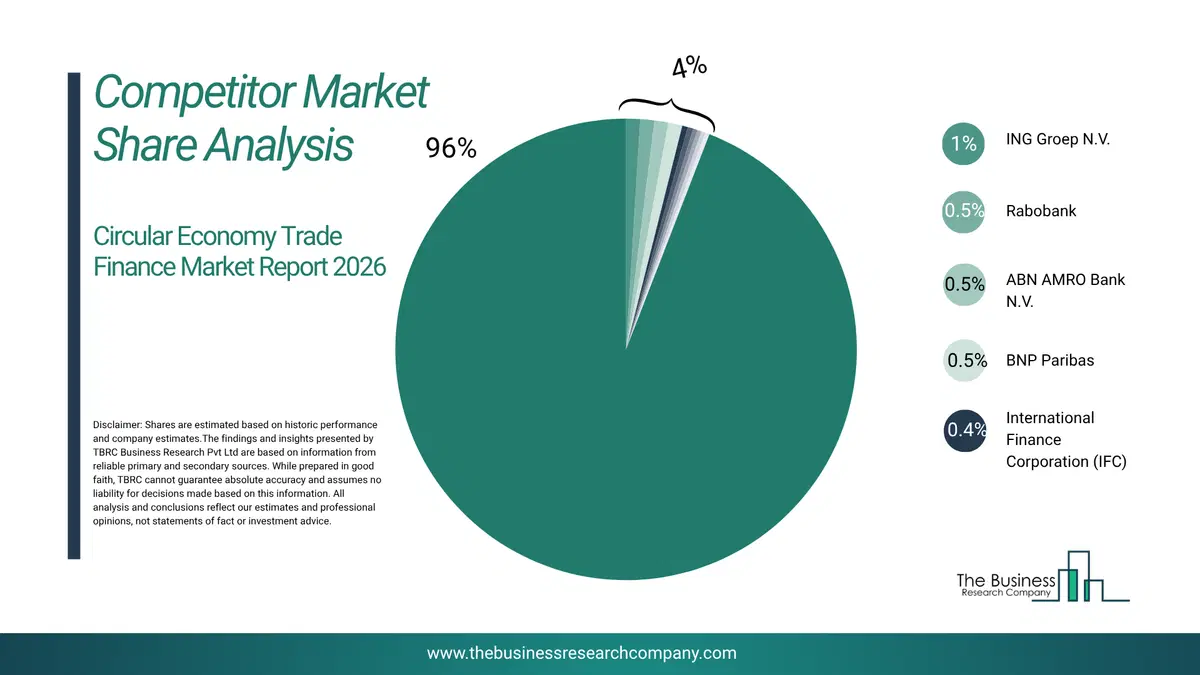
This chart is for illustrative purposes; the full report includes a detailed competitor analysis and comprehensive overview of the top 10 companies in the market.
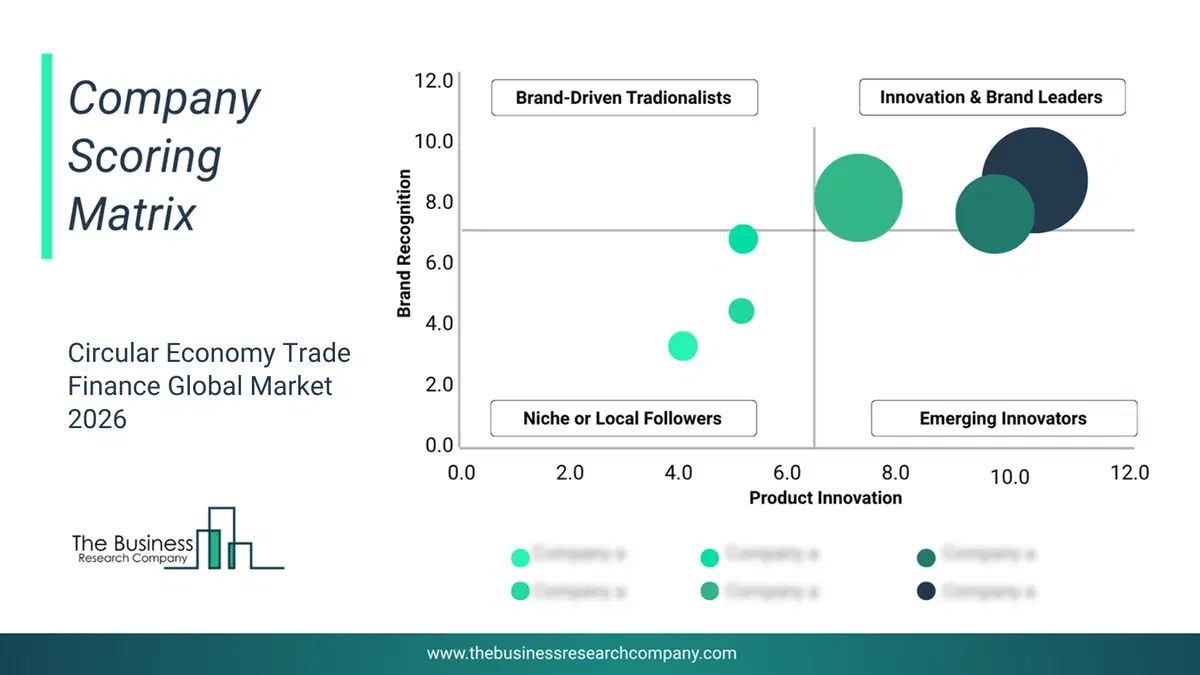
This chart maps companies by product innovation and brand strength, with bubble size indicating relative revenue, helping identify market leaders, challengers, and niche players. This is an illustrative chart; the full report provides a complete and accurate competitive analysis.
Global Circular Economy Trade Finance Market Trends and Insights
Major companies operating in the circular economy trade finance market are focusing on developing advanced approaches, such as sustainable finance taxonomies, to help direct investments toward projects that generate measurable environmental and social benefits. Sustainable finance taxonomies are frameworks that classify economic activities according to how they contribute to environmental, social, and governance sustainability goals. For instance, in May 2025, the International Finance Corporation (IFC), a US-based international financial institution, launched the Harmonized Circular Economy Finance Guidelines. The guidelines support investors, financial organizations, and private firms in recognizing and evaluating opportunities to direct funding toward circular economy initiatives. They establish clear criteria for qualifying activities and transactions, encouraging global harmonization and market alignment. Building upon frameworks such as biodiversity, blue finance, and green bond taxonomies, they expand the scope of eligible assets and stimulate private investment in sustainable growth. Distinctively, these guidelines are the first to outline and measure eligible transaction amounts while aligning with the EU Categorization System and ICMA Green Bond Principles.What Are Latest Mergers And Acquisitions In The Circular Economy Trade Finance Market?
In September 2025, Bank of Baroda (BoB), an India-based public bank, partnered with Small Industries Development Bank of India (SIDBI) to launch the BoB Earth Circular Economy Scheme (MSE Spice) within its Green and Sustainable product category. The partnership enables micro and small enterprises (MSEs) to implement sustainable practices in line with India’s climate and sustainability targets. It also boosts Bank of Baroda’s green finance offerings while reinforcing SIDBI’s commitment to providing inclusive and sustainable credit for MSMEs. Small Industries Development Bank of India (SIDBI) is an India-based financial institution.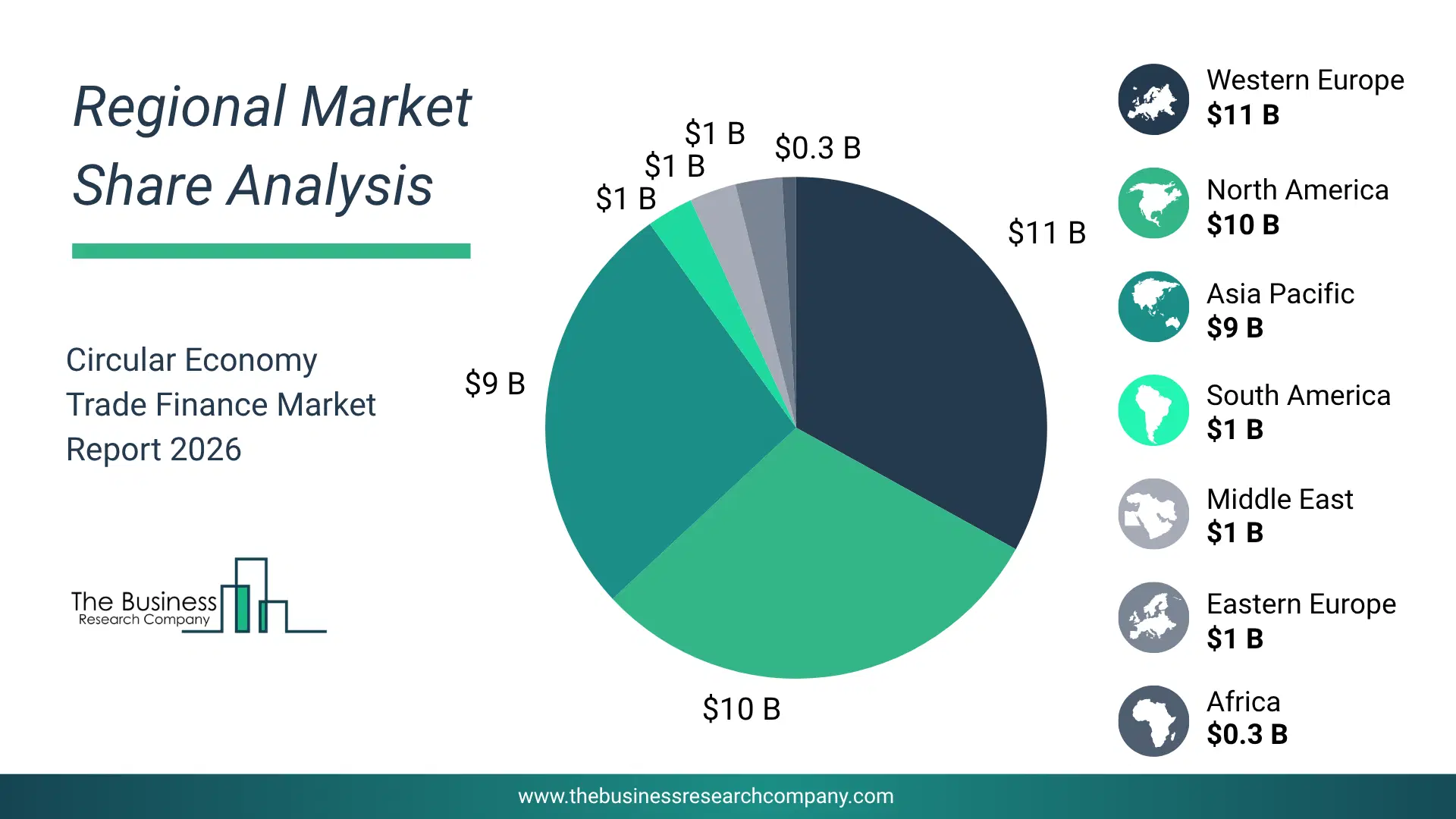
Regional Outlook
Europe was the largest region in the circular economy trade finance market in 2025. Asia-Pacific is expected to be the fastest-growing region in the forecast period. The regions covered in this market report are Asia-Pacific, South East Asia, Western Europe, Eastern Europe, North America, South America, Middle East, Africa. The countries covered in this market report are Australia, Brazil, China, France, Germany, India, Indonesia, Japan, Taiwan, Russia, South Korea, UK, USA, Canada, Italy, Spain.What Defines the Circular Economy Trade Finance Market?
The circular economy trade finance market includes revenues earned by entities by providing services such as green trade credit facilities, circular procurement funding, eco-friendly export-import financing, and carbon footprint-linked financing. The market value includes the value of related goods sold by the service provider or included within the service offering. Only goods and services traded between entities or sold to end consumers are included.How is Market Value Defined and Measured?
The market value is defined as the revenues that enterprises gain from the sale of goods and/or services within the specified market and geography through sales, grants, or donations in terms of the currency (in USD unless otherwise specified). The revenues for a specified geography are consumption values that are revenues generated by organizations in the specified geography within the market, irrespective of where they are produced. It does not include revenues from resales along the supply chain, either further along the supply chain or as part of other products.
This chart presents market attractiveness based on a quantitative evaluation of growth, competition, strategic alignment, and risk, offering a clear view of opportunity areas for decision-making. This chart is for illustrative purposes; the full report contains the complete analysis.

This chart highlights the Total Addressable Market (TAM) by estimating the maximum revenue opportunity using an assumption-driven approach, supporting strategic planning and opportunity sizing across markets. The chart is illustrative; the full report provides a more comprehensive analysis.
What Key Data and Analysis Are Included in the Circular Economy Trade Finance Market Report 2026?
The circular economy trade finance market research report is one of a series of new reports from The Business Research Company that provides market statistics, including Market Report 2026?global market size, regional shares, competitors with the market share, detailed market segments, market trends and opportunities, and any further data you may need to thrive in the circular economy trade finance Market Report 2026? The market research report delivers a complete perspective of everything you need, with an in-depth analysis of the current and future state of the Market Report 2026?Circular Economy Trade Finance Market Report Forecast Analysis
| Report Attribute | Details |
|---|---|
| Market Size Value In 2026 | $16.35 billion |
| Revenue Forecast In 2030 | $29.92 billion |
| Growth Rate | CAGR of 16.6% from 2026 to 2030 |
| Base Year For Estimation | 2025 |
| Actual Estimates/Historical Data | 2020-2025 |
| Forecast Period | 2026 - 2030 |
| Market Representation | Revenue in USD Billion and CAGR from 2026 to 2030 |
| Segments Covered | Type, Deployment Mode, Application, End User |
| Regional Scope | Asia-Pacific, Western Europe, Eastern Europe, North America, South America, Middle East, Africa |
| Country Scope | The countries covered in the report are Australia, Brazil, China, France, Germany, India, Indonesia, Japan, Taiwan, Russia, South Korea, UK, USA, Canada, Italy, Spain. |
| Key Companies Profiled | Bank of America Corporation, Citigroup Inc., JPMorgan Chase & Co., Wells Fargo & Company, BNP Paribas S.A., MUFG Bank Ltd., HSBC Holdings Plc, Deutsche Bank AG, ING Groep N.V., The Goldman Sachs Group Inc., UBS Group AG, State Bank of India, Commonwealth Bank of Australia, Mizuho Financial Group Inc., Barclays PLC, Crédit Agricole S.A., Société Générale S.A., Intesa Sanpaolo S.p.A., UniCredit S.p.A., Standard Chartered Plc, ABN AMRO Bank N.V. |
| Customization Scope | Request for Customization |
| Pricing And Purchase Options | Explore Purchase Options |