

Construction Cybersecurity Market Report 2026
Global Outlook – By Type (Network Security, Endpoint Security, Cloud Security, Identity And Access Management), By Component (Solution, Services), By Enterprise Size (Large Enterprises, Small And Medium Enterprises (SME)), By Application (Smart Building Protection, Project Data Safety, Remote Operations, BIM System Protection, Industrial Internet Of Things (IoT)), By End-User Industry (Residential Construction, Commercial Construction, Industrial Construction) – Market Size, Trends, Strategies, and Forecast to 2030
Construction Cybersecurity Market Overview
• Construction Cybersecurity market size has reached to $7.07 billion in 2025 • Expected to grow to $18.41 billion in 2030 at a compound annual growth rate (CAGR) of 21% • Growth Driver: The Rising Ransomware And Phishing Attacks Are Expected To Drive Market Growth Due To Digital Vulnerabilities • Market Trend: AI-Driven Platforms Reshape Cybersecurity In Modern Intelligent Building Environments • North America was the largest region in 2025 and Asia-Pacific is the fastest growing region.What Is Covered Under Construction Cybersecurity Market?
Construction cybersecurity refers to the comprehensive strategies and technologies used to protect digital assets, systems, and communication networks within the construction industry from cyber threats such as hacking, ransomware, data breaches, and unauthorized access. It encompasses the protection of project management software, building information modeling (BIM) systems, connected construction equipment, and sensitive project data to ensure the integrity, confidentiality, and availability of information throughout the construction lifecycle. The main types of construction cybersecurity are network security, endpoint security, cloud security, and identity and access management. Network security refers to the protection of interconnected systems, devices, and data flows across construction sites and offices from unauthorized access, disruptions, or cyber threats. It includes various components, such as solutions and services, and is used by different enterprise sizes, including large enterprises and small and medium enterprises (SMEs). It finds applications in smart building protection, project data safety, remote operations, BIM system protection, and industrial internet of things (IoT), serving a range of end-users, including industry residential construction, commercial construction, and industrial construction.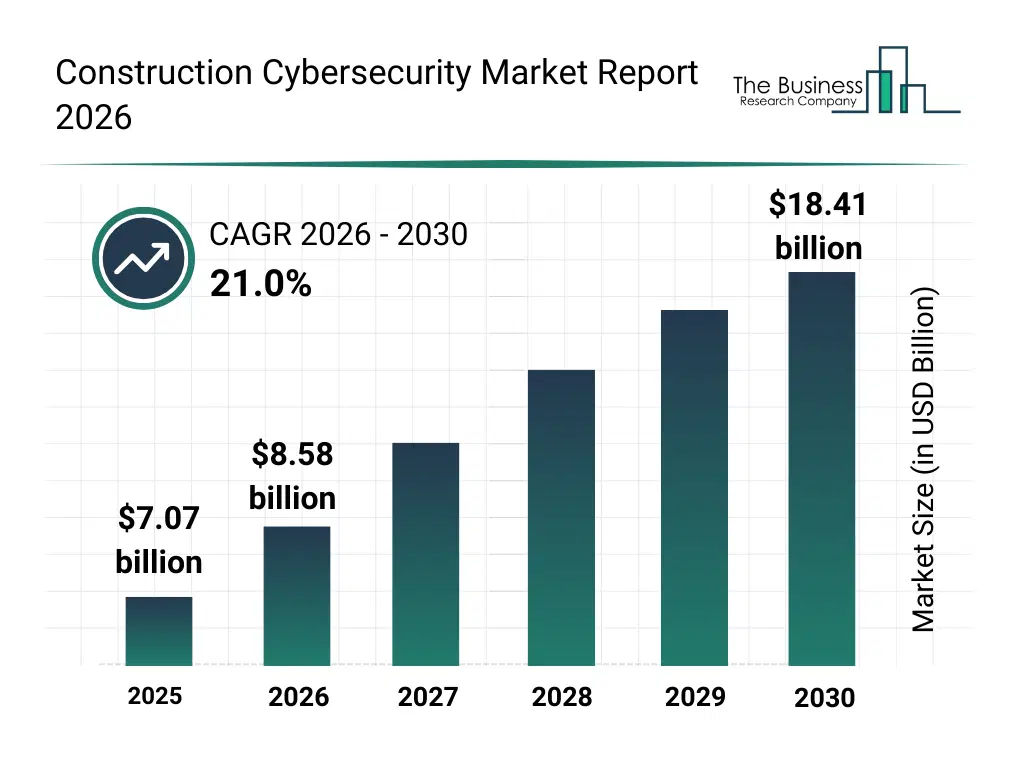
What Is The Construction Cybersecurity Market Size and Share 2026?
The construction cybersecurity market size has grown exponentially in recent years. It will grow from $7.07 billion in 2025 to $8.58 billion in 2026 at a compound annual growth rate (CAGR) of 21.3%. The growth in the historic period can be attributed to increasing digitization of construction workflows, rising integration of connected construction equipment, growing use of cloud-based construction tools, expansion of BIM-driven project environments, reliance on imported cybersecurity appliances.What Is The Construction Cybersecurity Market Growth Forecast?
The construction cybersecurity market size is expected to see exponential growth in the next few years. It will grow to $18.41 billion in 2030 at a compound annual growth rate (CAGR) of 21.0%. The growth in the forecast period can be attributed to increasing adoption of AI-driven cybersecurity tools, expansion of IoT protection requirements, growth in localized cybersecurity hardware manufacturing, rising need for integrated cyber-physical protection, increasing demand for advanced construction data governance. Major trends in the forecast period include integration of AI-powered threat detection, expansion of cloud-native cybersecurity platforms, growth of iot security for connected construction sites, advancement of industrial cyber-physical security integration, adoption of blockchain for secure project data management.
Global Construction Cybersecurity Market Segmentation
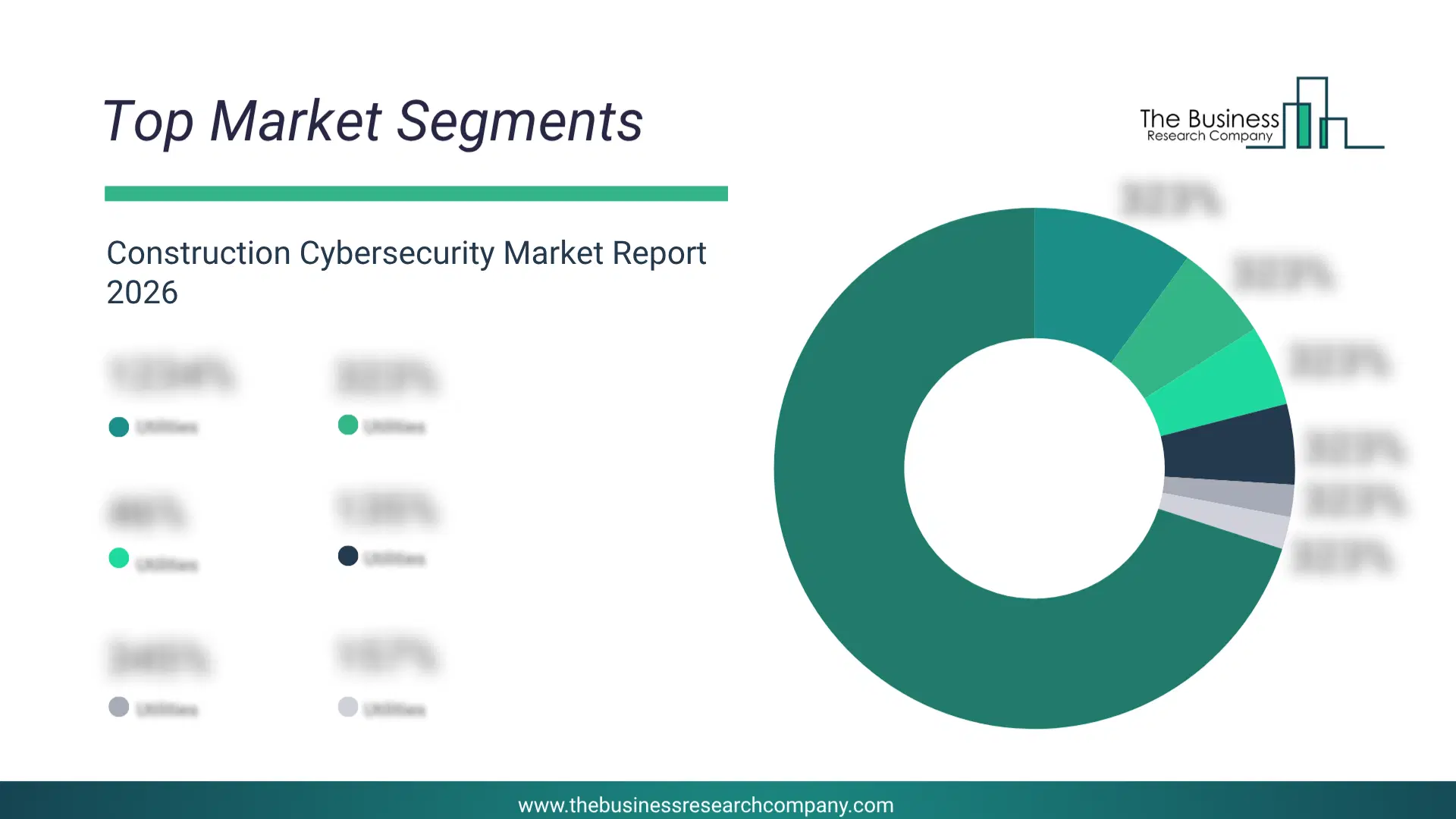
1) By Type: Network Security, Endpoint Security, Cloud Security, Identity And Access Management 2) By Component: Solution, Services 3) By Enterprise Size: Large Enterprises, Small And Medium Enterprises (SME) 4) By Application: Smart Building Protection, Project Data Safety, Remote Operations, BIM System Protection, Industrial Internet Of Things (IoT) 5) By End-User Industry: Residential Construction, Commercial Construction, Industrial Construction Subsegments: 1) By Network Security: Firewalls, Intrusion Detection And Prevention Systems (IDPS), Virtual Private Networks (VPNs), Network Access Control (NAC) 2) By Endpoint Security: Endpoint Detection And Response (EDR), Mobile Device Security, Antivirus Or Antimalware, Application Control 3) By Cloud Security: Cloud Access Security Brokers (CASB), Secure Web Gateways, Cloud Workload Protection Platforms (CWPP), Cloud Security Posture Management (CSPM) 4) By Identity and Access Management (IAM): Multi-Factor Authentication (MFA), Privileged Access Management (PAM), Single Sign-On (SSO), Identity Governance and Administration (IGA)What Is The Driver Of The Construction Cybersecurity Market?
The rising incidents of ransomware and phishing attacks are expected to propel the growth of the construction cybersecurity market going forward. Ransomware and phishing attacks refer to malicious cyber threats where ransomware encrypts data for ransom, while phishing tricks individuals into revealing sensitive information through deceptive messages. Incidents of ransomware and phishing attacks are rising significantly as cybercriminals are using increasingly sophisticated social engineering techniques that manipulate human behavior, making it easier to trick individuals into clicking malicious links or divulging sensitive information. Construction cybersecurity plays a critical role in mitigating ransomware and phishing threats by implementing robust protective measures, monitoring digital infrastructures, and enhancing organizational resilience against unauthorized access and data compromise. For instance, in June 2025, according to Ascendant Technologies Inc., a US-based IT service company, cybersecurity threats in the construction sector have surged by 23% over the past year, with phishing, ransomware, and data breaches driving risks that could push industry losses to $1.2 trillion by 2025. Therefore, the rising incidents of ransomware and phishing attacks are driving the growth of the construction cybersecurity industry.Key Players In The Global Construction Cybersecurity Market
Major companies operating in the construction cybersecurity market are Siemens AG, International Business Machines Corporation (IBM), Cisco Systems Inc., Honeywell International Inc., Johnson Controls International plc, Palo Alto Networks Inc., Hexagon AB, Fortinet Inc., Trimble Inc., Check Point Software Technologies Ltd., Trend Micro Incorporated, CrowdStrike Holdings Inc., Deltek Inc., Procore Technologies Inc., Rapid7 Inc., Tenable Holdings Inc., Arctic Wolf Networks Inc., Optiv Security Inc., eSentire Inc., Dragos Inc., Ntiva Inc., Pentera Security Ltd., Eventura Limited, BlueArmor LLC, Rhebo GmbH.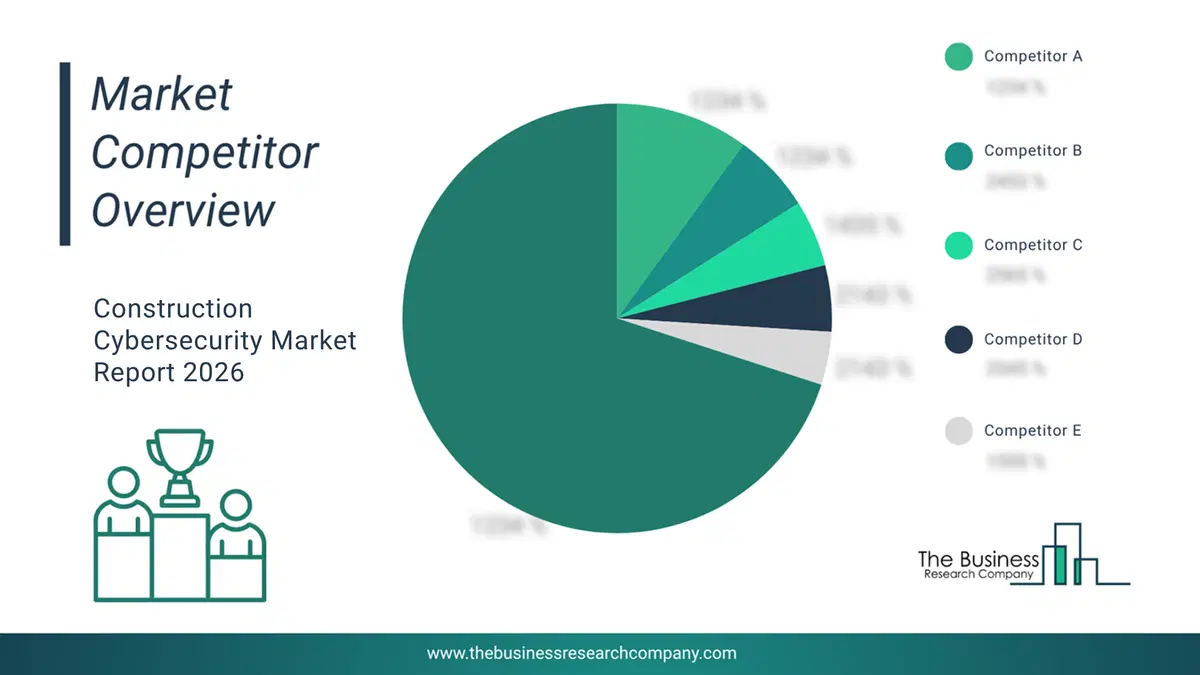
This chart is for illustrative purposes; the full report includes a detailed competitor analysis and comprehensive overview of the top 10 companies in the market.
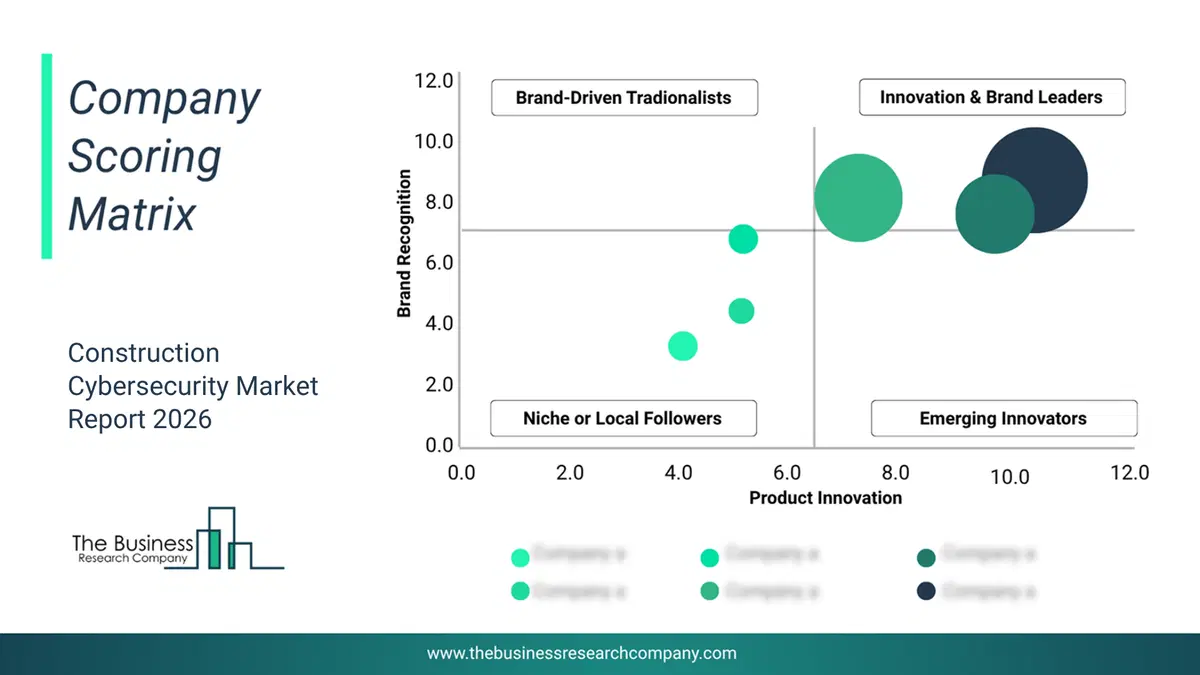
This chart maps companies by product innovation and brand strength, with bubble size indicating relative revenue, helping identify market leaders, challengers, and niche players. This is an illustrative chart; the full report provides a complete and accurate competitive analysis.
Global Construction Cybersecurity Market Trends and Insights
Major companies operating in the construction cybersecurity market are focusing on developing innovative solutions, such as AI-enabled intelligent building platforms, to enhance operational visibility, security, and efficiency across modern building environments. An AI-enabled intelligent building platform is a digital interface that uses artificial intelligence to unify building systems, enabling real-time analytics, remote monitoring, predictive maintenance, and advanced cybersecurity controls. For instance, in June 2025, Honeywell International Inc., a US-based technology and manufacturing company, launched Connected Solutions, an AI-powered building management platform that integrates critical building software, systems, and devices into a single interface to enable more efficient operations. The platform, built on Honeywell Forge, offers an AI-enabled installation process completed in hours, providing facility managers and operators with real-time data, remote monitoring, predictive maintenance prompts, advanced encryption for cybersecurity, and energy management tools to support decarbonization.What Are Latest Mergers And Acquisitions In The Construction Cybersecurity Market?
In November 2023, Rockwell Automation, a US-based industrial automation and information company, acquired Verve Industrial Protection for $183 million. Through this acquisition, Rockwell aims to integrate Verve’s asset inventory and vulnerability management platform into its Lifecycle Services, providing a unified, robust cybersecurity solution that strengthens the resilience and security of industrial and construction-related infrastructure. Verve Industrial Protection is a US-based industrial cybersecurity company, providing solutions for securing industrial control systems (ICS) and critical infrastructure, including construction environments.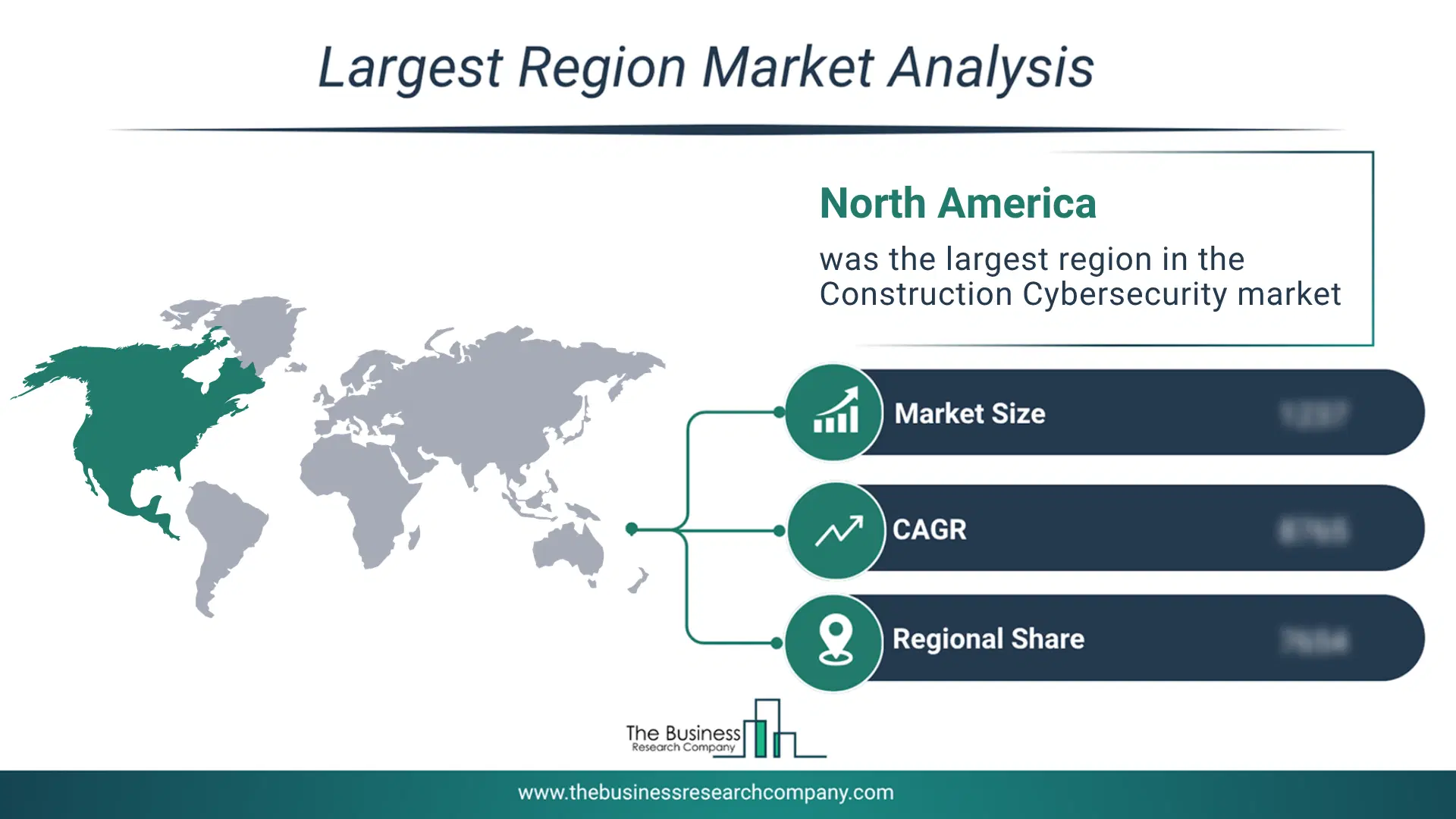
Regional Insights
North America was the largest region in the construction cybersecurity market in 2025. Asia-Pacific is expected to be the fastest-growing region in the forecast period. The regions covered in this market report are Asia-Pacific, South East Asia, Western Europe, Eastern Europe, North America, South America, Middle East, Africa. The countries covered in this market report are Australia, Brazil, China, France, Germany, India, Indonesia, Japan, Taiwan, Russia, South Korea, UK, USA, Canada, Italy, Spain.What Defines the Construction Cybersecurity Market?
The construction cybersecurity market consists of revenues earned by entities by providing services, such as security consulting services, risk and compliance assessment, security system integration, incident response and recovery services, managed security services, and vulnerability assessment and penetration testing. The market value includes the value of related goods sold by the service provider or included within the service offering. The construction cybersecurity market also includes sales of products including cyber-physical systems (CPS) security tools, security information and event management (SIEM) solutions, threat detection appliances, industrial firewall appliances, access control hardware, and hardware security modules (HSMs). Values in this market are ‘factory gate’ values, that is, the value of goods sold by the manufacturers or creators of the goods, whether to other entities (including downstream manufacturers, wholesalers, distributors, and retailers) or directly to end customers. The value of goods in this market includes related services sold by the creators of the goods.How is Market Value Defined and Measured?
The market value is defined as the revenues that enterprises gain from the sale of goods and/or services within the specified market and geography through sales, grants, or donations in terms of the currency (in USD unless otherwise specified). The revenues for a specified geography are consumption values that are revenues generated by organizations in the specified geography within the market, irrespective of where they are produced. It does not include revenues from resales along the supply chain, either further along the supply chain or as part of other products.
This chart presents market attractiveness based on a quantitative evaluation of growth, competition, strategic alignment, and risk, offering a clear view of opportunity areas for decision-making. This chart is for illustrative purposes; the full report contains the complete analysis.

This chart highlights the Total Addressable Market (TAM) by estimating the maximum revenue opportunity using an assumption-driven approach, supporting strategic planning and opportunity sizing across markets. The chart is illustrative; the full report provides a more comprehensive analysis.
What Key Data and Analysis Are Included in theConstruction Cybersecurity Market Report 2026?
The construction cybersecurity market research report is one of a series of new reports from The Business Research Company that provides market statistics, including industry global market size, regional shares, competitors with the market share, detailed market segments, market trends and opportunities, and any further data you may need to thrive in the construction cybersecurity industry. The market research report delivers a complete perspective of everything you need, with an in-depth analysis of the current and future state of the industry.Construction Cybersecurity Market Report Forecast Analysis
| Report Attribute | Details |
|---|---|
| Market Size Value In 2026 | $8.58 billion |
| Revenue Forecast In 2030 | $18.41 billion |
| Growth Rate | CAGR of 21.3% from 2026 to 2030 |
| Base Year For Estimation | 2025 |
| Actual Estimates/Historical Data | 2020-2025 |
| Forecast Period | 2026 - 2030 |
| Market Representation | Revenue in USD Billion and CAGR from 2026 to 2030 |
| Segments Covered | Type, Component, Enterprise Size, Application, End-User Industry |
| Regional Scope | Asia-Pacific, Western Europe, Eastern Europe, North America, South America, Middle East, Africa |
| Country Scope | The countries covered in this market report are Australia, Brazil, China, France, Germany, India, Indonesia, Japan, Taiwan, Russia, South Korea, UK, USA, Canada, Italy, Spain |
| Key Companies Profiled | Siemens AG, International Business Machines Corporation (IBM), Cisco Systems Inc., Honeywell International Inc., Johnson Controls International plc, Palo Alto Networks Inc., Hexagon AB, Fortinet Inc., Trimble Inc., Check Point Software Technologies Ltd., Trend Micro Incorporated, CrowdStrike Holdings Inc., Deltek Inc., Procore Technologies Inc., Rapid7 Inc., Tenable Holdings Inc., Arctic Wolf Networks Inc., Optiv Security Inc., eSentire Inc., Dragos Inc., Ntiva Inc., Pentera Security Ltd., Eventura Limited, BlueArmor LLC, Rhebo GmbH. |
| Customization Scope | Request for Customization |
| Pricing And Purchase Options | Explore Purchase Options |