

Consumer Metaverse Market Report 2026
Global Outlook – By Component (Hardware, Software, Services), By Technology (Blockchain, Virtual Reality, Augmented Reality, Mixed Reality, Other Technologies), By Application (Gaming, Social Media, Virtual Shopping, Education, Real Estate, Other Applications), By End-User (Individual Consumers, Enterprises) – Market Size, Trends, Strategies, and Forecast to 2030
Consumer Metaverse Market Overview
• Consumer Metaverse market size has reached to $133.4 billion in 2025 • Expected to grow to $502.06 billion in 2030 at a compound annual growth rate (CAGR) of 30.2% • Growth Driver: Remote Work Drives Market Growth Through Immersive Collaboration Tools And Advanced Digital Communication Solutions • Market Trend: Innovative Virtual Platforms Shaping The Future Of The Market • North America was the largest region in 2025 and Asia-Pacific is the fastest growing region.What Is Covered Under Consumer Metaverse Market?
Consumer metaverse refers to a virtual, interactive environment or digital universe where consumers can engage with brands, products, and services through immersive technologies like virtual reality (VR), augmented reality (AR), and 3D simulations. It is used for enhancing shopping experiences, social engagement, and personalized content delivery, allowing consumers to explore and purchase products in a highly interactive and customizable way. The main components in the consumer metaverse are hardware, software, and services. Hardware in the consumer metaverse refers to physical devices like VR headsets, AR glasses, haptic suits, and advanced sensors that enable users to interact with immersive virtual environments and experiences. It has technology such as blockchain, virtual reality, augmented reality, mixed reality, and others. The applications of this metaverse are gaming, social media, virtual shopping, education, real estate, and others having end users such as individual consumers and enterprises.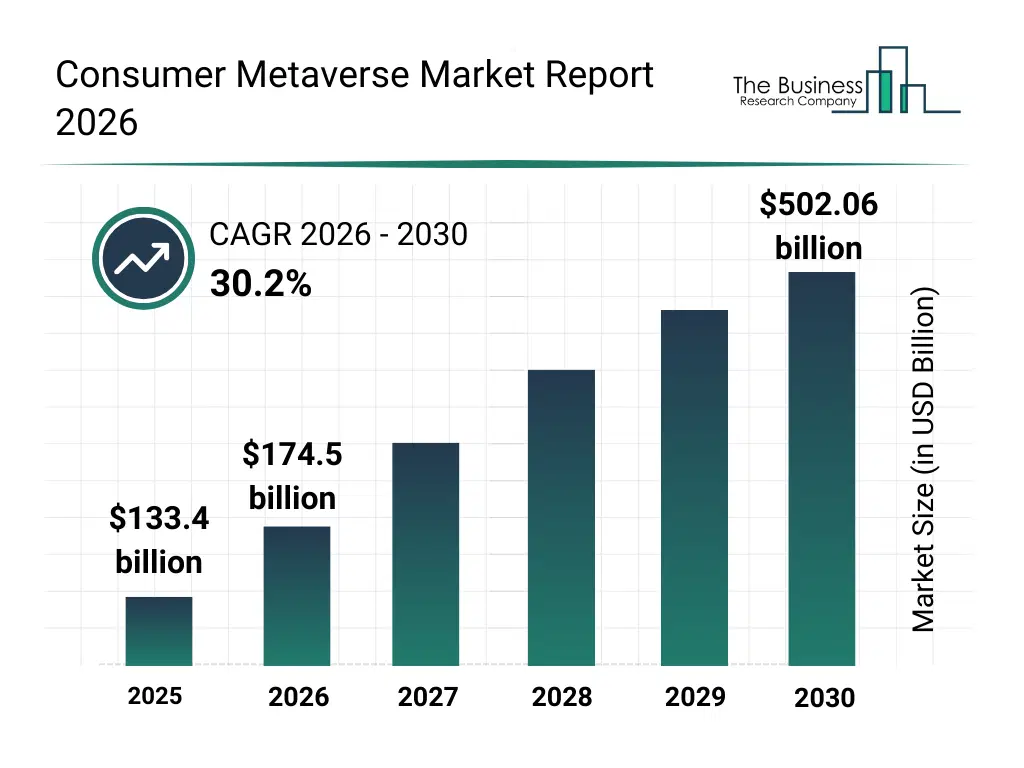
What Is The Consumer Metaverse Market Size and Share 2026?
The consumer metaverse market size has grown exponentially in recent years. It will grow from $133.4 billion in 2025 to $174.5 billion in 2026 at a compound annual growth rate (CAGR) of 30.8%. The growth in the historic period can be attributed to growth of online gaming, rise of social media platforms, early vr adoption, demand for digital experiences, expansion of e-commerce.What Is The Consumer Metaverse Market Growth Forecast?
The consumer metaverse market size is expected to see exponential growth in the next few years. It will grow to $502.06 billion in 2030 at a compound annual growth rate (CAGR) of 30.2%. The growth in the forecast period can be attributed to advancement of immersive hardware, growth of virtual economies, increasing brand participation, integration of AI personalization, adoption of digital ownership models. Major trends in the forecast period include virtual shopping environments, avatar-based digital identity systems, immersive social interaction platforms, blockchain-based digital assets, cross-platform metaverse experiences.
Global Consumer Metaverse Market Segmentation
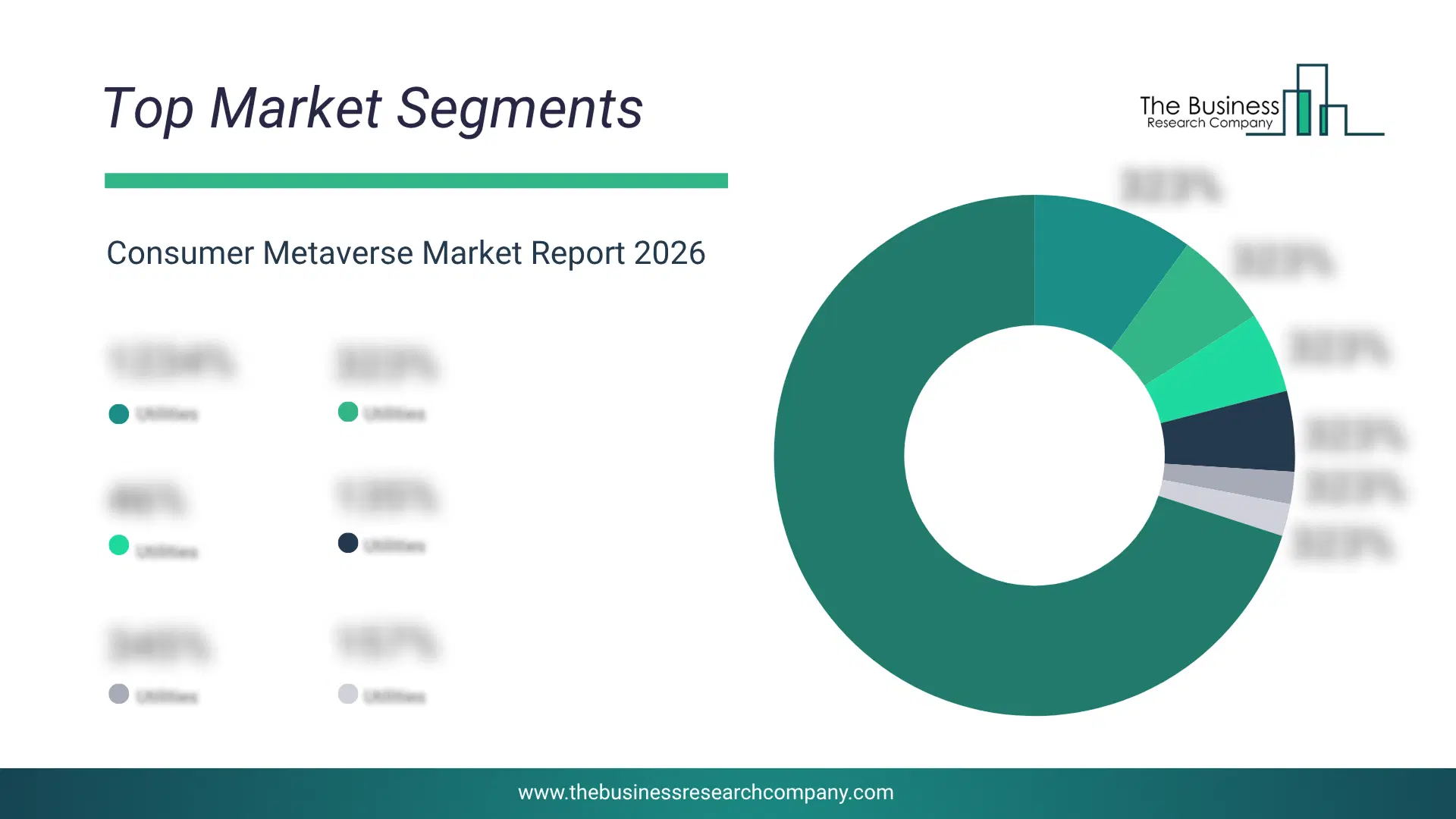
1) By Component: Hardware, Software, Services 2) By Technology: Blockchain, Virtual Reality, Augmented Reality, Mixed Reality, Other Technologies 3) By Application: Gaming, Social Media, Virtual Shopping, Education, Real Estate, Other Applications 4) By End-User: Individual Consumers, Enterprises Subsegments: 1) By Hardware: Augmented Reality Or Virtual Reality Headsets, Haptic Devices, Smart Glasses, Motion Tracking Devices 2) By Software: Virtual World Platforms, Metaverse Development Tools, Digital Twin Software, Avatar Creation Software 3) By Services: Consulting Services, Integration And Deployment Services, Support And Maintenance ServicesWhat Is The Driver Of The Consumer Metaverse Market?
The expansion of remote work is expected to drive the expansion of the consumer metaverse market moving forward. Remote work refers to the practice of performing job responsibilities outside a traditional office setting, often from home or other remote locations, utilizing digital tools and technology. The expansion of remote work is fueled by technological advancements in digital communication, widespread internet connectivity, shifting employee preferences toward flexible work environments, rising adoption of cloud-based platforms, enhanced productivity tracking tools, and businesses seeking to reduce operational costs while broadening access to global talent pools. The consumer metaverse enhances remote work by offering immersive virtual environments that enable interactive collaboration, team building, and networking experiences, simulating in-person interactions. For instance, in September 2024, according to the Bureau of Labor Statistics (BLS), a US-based federal agency, in August 2023, 19.5% of workers teleworked or worked from home for pay, with telework rates consistently ranging between 17.9% and 20.0% from October 2022 to August 2023. Therefore, the expansion of remote work is fueling the growth of the consumer metaverse industry.Key Players In The Global Consumer Metaverse Market
Major companies operating in the consumer metaverse market are Google LLC, Microsoft Corporation, Meta Platforms Inc., Tencent Holdings Ltd., Nvidia Corporation, Epic Games Inc., Snap Inc., Roblox Corporation, The Sandbox, HTC Corporation, Axie Infinity, Linden Lab, Animoca Brands Corporation Ltd., Decentraland, Illuvium, Landvault, Enjin, Wilder World, Star Atlas, Cryptovoxels, Blocktopia, Somnium Space Ltd.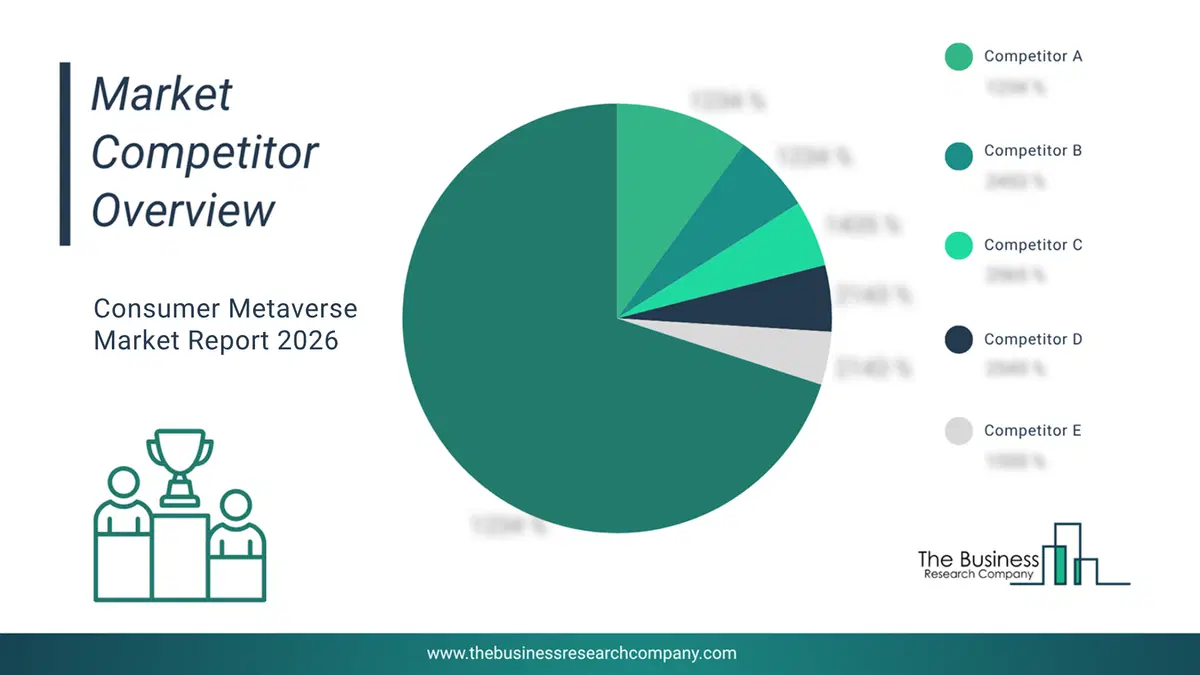
This chart is for illustrative purposes; the full report includes a detailed competitor analysis and comprehensive overview of the top 10 companies in the market.
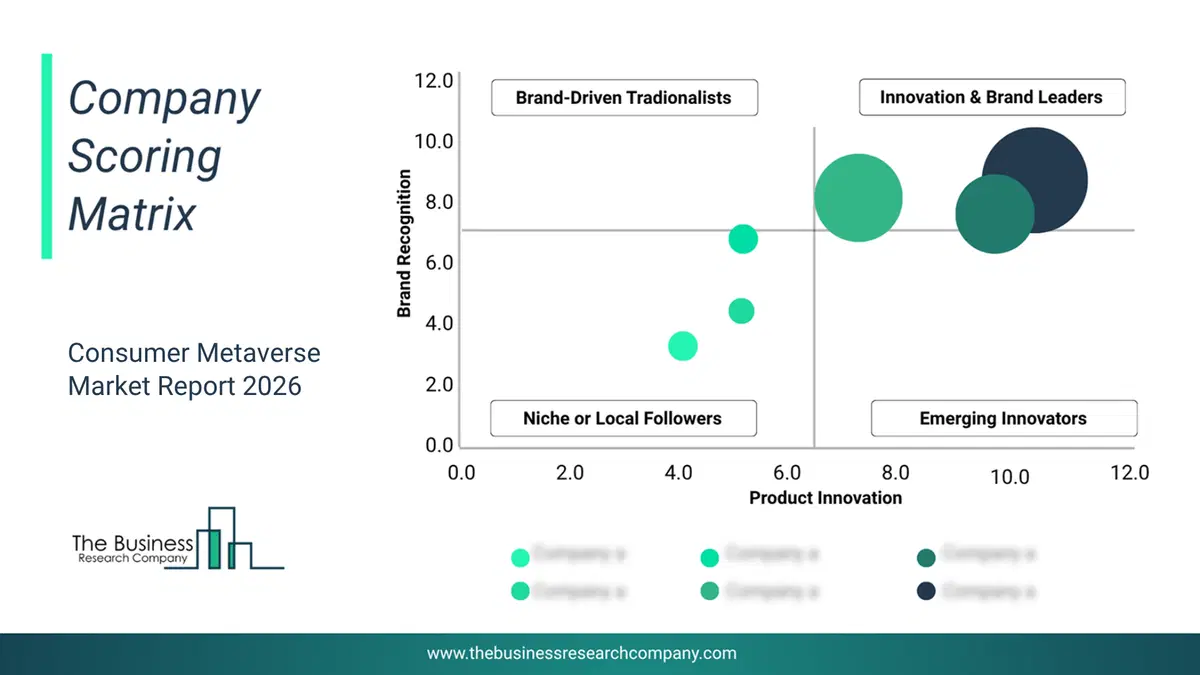
This chart maps companies by product innovation and brand strength, with bubble size indicating relative revenue, helping identify market leaders, challengers, and niche players. This is an illustrative chart; the full report provides a complete and accurate competitive analysis.
Global Consumer Metaverse Market Trends and Insights
Major companies operating in the consumer metaverse market are focused on developing innovative solutions, such as virtual platforms, to streamline and enhance the consumer experience. Virtual platforms refer to technology-driven spaces designed to facilitate immersive and interactive experiences online, where users can engage in activities such as socializing, shopping, gaming, and working. For instance, in January 2023, MG Motor India, an India-based automobile corporation, launched MGVerse metaverse platform. The platform allows users to explore MG's vehicle lineup in a virtual showroom, providing 360-degree views and detailed specifications through augmented reality (AR) and virtual reality (VR) integrations. Customers can personalize their vehicles with various customization options, including color choices and accessory additions, all in a lifelike digital environment. The metaverse experience includes AI-powered virtual assistants that offer real-time information, answer queries, and guide users through the purchasing journey.What Are Latest Mergers And Acquisitions In The Consumer Metaverse Market?
In October 2024, Infinite Reality, a US-based provider of AI-powered immersive experiences, spatial computing, extended reality (XR) solutions, and metaverse platforms, acquired Zappar for $45 million. With this acquisition, Infinite Reality seeks to enhance its XR technology portfolio and accelerate the creation of scalable, accessible immersive commerce and media experiences. Zappar is a UK-based provider of XR software and hardware tools, offering a full suite including a web based XR platform (Zapworks), browser 3D web tooling (Mattercraft), a no-code 3D experience designer, an affordable mixed-reality headset (Zapbox), and accessibility solutions.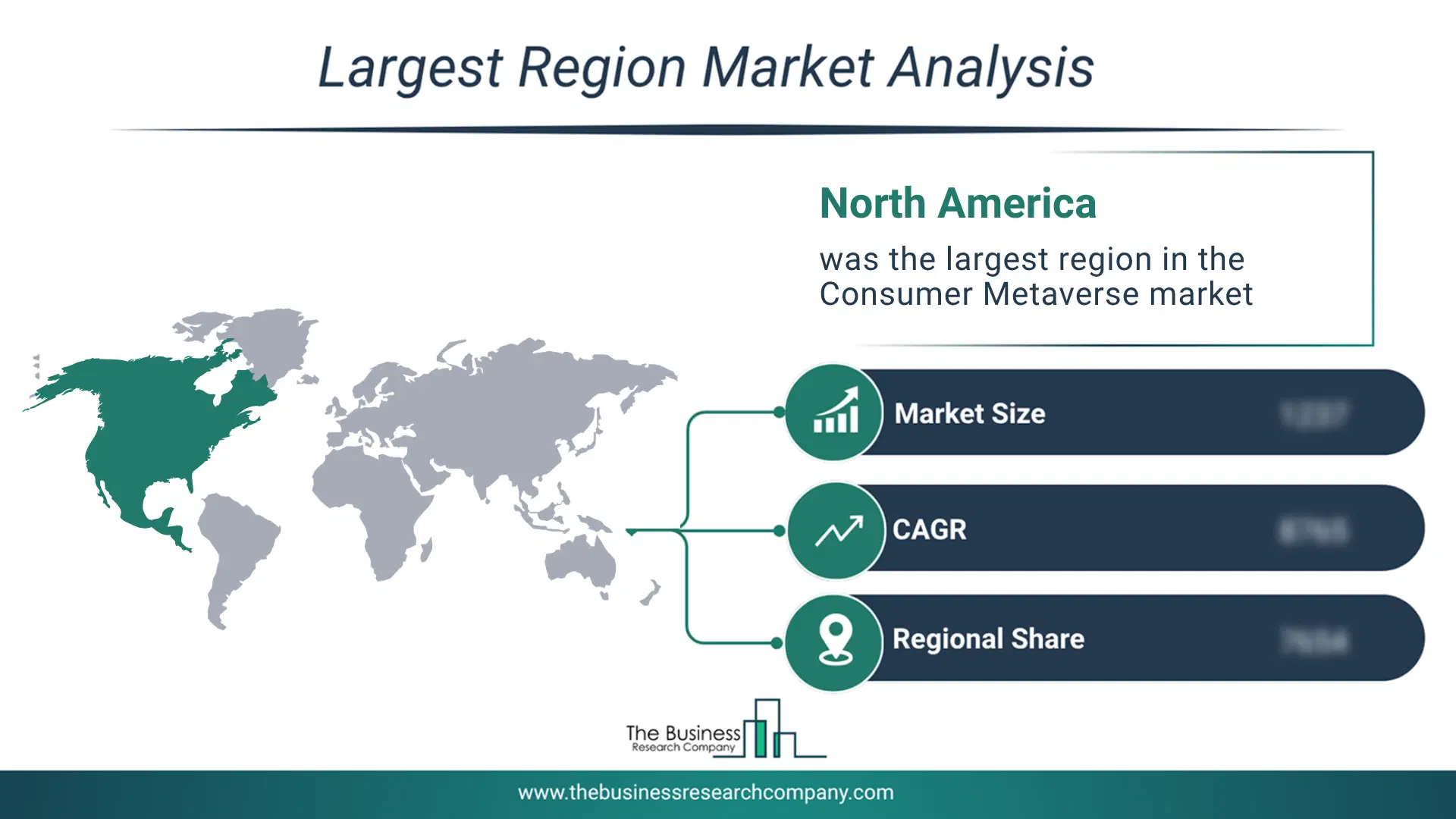
Regional Insights
North America was the largest region in the consumer metaverse market in 2025. Asia-Pacific is expected to be the fastest-growing region in the forecast period. The regions covered in this market report are Asia-Pacific, South East Asia, Western Europe, Eastern Europe, North America, South America, Middle East, Africa. The countries covered in this market report are Australia, Brazil, China, France, Germany, India, Indonesia, Japan, Taiwan, Russia, South Korea, UK, USA, Canada, Italy, Spain.What Defines the Consumer Metaverse Market?
The consumer metaverse market consists of revenues earned by entities by providing services such as immersive virtual experiences, digital goods, entertainment, and social interactions within virtual environments. The market value includes the value of related goods sold by the service provider or included within the service offering. The consumer metaverse market includes sales of virtual tools, digital assets, immersive technology components, and smart integration tools. Values in this market are ‘factory gate’ values, that is, the value of goods sold by the manufacturers or creators of the goods, whether to other entities (including downstream manufacturers, wholesalers, distributors, and retailers) or directly to end customers. The value of goods in this market includes related services sold by the creators of the goods.How is Market Value Defined and Measured?
The market value is defined as the revenues that enterprises gain from the sale of goods and/or services within the specified market and geography through sales, grants, or donations in terms of the currency (in USD unless otherwise specified). The revenues for a specified geography are consumption values that are revenues generated by organizations in the specified geography within the market, irrespective of where they are produced. It does not include revenues from resales along the supply chain, either further along the supply chain or as part of other products.
This chart presents market attractiveness based on a quantitative evaluation of growth, competition, strategic alignment, and risk, offering a clear view of opportunity areas for decision-making. This chart is for illustrative purposes; the full report contains the complete analysis.

This chart highlights the Total Addressable Market (TAM) by estimating the maximum revenue opportunity using an assumption-driven approach, supporting strategic planning and opportunity sizing across markets. The chart is illustrative; the full report provides a more comprehensive analysis.
What Key Data and Analysis Are Included in the Consumer Metaverse Market Report 2026?
The consumer metaverse market research report is one of a series of new reports from The Business Research Company that provides market statistics, including industry global market size, regional shares, competitors with the market share, detailed market segments, market trends and opportunities, and any further data you may need to thrive in the consumer metaverse industry. The market research report delivers a complete perspective of everything you need, with an in-depth analysis of the current and future state of the industry.Consumer Metaverse Market Report Forecast Analysis
| Report Attribute | Details |
|---|---|
| Market Size Value In 2026 | $174.5 billion |
| Revenue Forecast In 2030 | $502.06 billion |
| Growth Rate | CAGR of 30.2% from 2026 to 2030 |
| Base Year For Estimation | 2025 |
| Actual Estimates/Historical Data | 2020-2025 |
| Forecast Period | 2026 - 2030 |
| Market Representation | Revenue in USD Billion and CAGR from 2026 to 2030 |
| Segments Covered | Component, Technology, Application, End-User |
| Regional Scope | Asia-Pacific, Western Europe, Eastern Europe, North America, South America, Middle East, Africa |
| Country Scope | The Countries Covered In This Market Report Are Australia, Brazil, China, France, Germany, India, Indonesia, Japan, Taiwan, Russia, South Korea, Uk, Usa, Canada, Italy, Spain. |
| Key Companies Profiled | Google LLC, Microsoft Corporation, Meta Platforms Inc., Tencent Holdings Ltd., Nvidia Corporation, Epic Games Inc., Snap Inc., Roblox Corporation, The Sandbox, HTC Corporation, Axie Infinity, Linden Lab, Animoca Brands Corporation Ltd., Decentraland, Illuvium, Landvault, Enjin, Wilder World, Star Atlas, Cryptovoxels, Blocktopia, Somnium Space Ltd. |
| Customization Scope | Request for Customization |
| Pricing And Purchase Options | Explore Purchase Options |