
Cosmetic Chemicals Market Report 2026
Global Outlook – By Product Type (Surfactants, Emollients And Moisturizers, Colorants And Pigments, Preservatives, Emulsifying And Thickening Agents), By Application (Perfumes And Fragrances, Hair Care And Skincare, Color Cosmetic Chemicals, Other Applications), By End-Use Industry (Skin Care Products, Hair Care Products, Color Cosmetics, Fragrances & Perfumes, Oral Care, Personal Hygiene Products, Other End-Use Categories) – Market Size, Trends, Strategies, and Forecast to 2030
Cosmetic Chemicals Market Overview
• Cosmetic Chemicals market size has reached to $20.96 billion in 2025 • Expected to grow to $28.8 billion in 2030 at a compound annual growth rate (CAGR) of 6.5% • Growth Driver: Rising Demand For Hair And Skin Care Products Drives Growth In The Cosmetic Chemicals Market • Market Trend: Introducing Sustainably Sourced Cosmetic Ingredient For Radiant Skin • North America was the largest region in 2025 and Asia-Pacific is the fastest growing region.What Is Covered Under Cosmetic Chemicals Market?
Cosmetic chemicals are a blend of chemical compounds obtained from synthetic sources as well as natural sources. They are the main ingredients used for the formulation of personal care or cosmetic products. The product types involved in cosmetic chemicals are surfactants, emollients and moisturizers, colorants and pigments, preservatives, and emulsifying and thickening agents. A fragrance is defined as a combination of organic compounds that produces a distinct smell order. The various applications involved are perfumes and fragrances, hair care and skincare, color cosmetic chemicals, and others.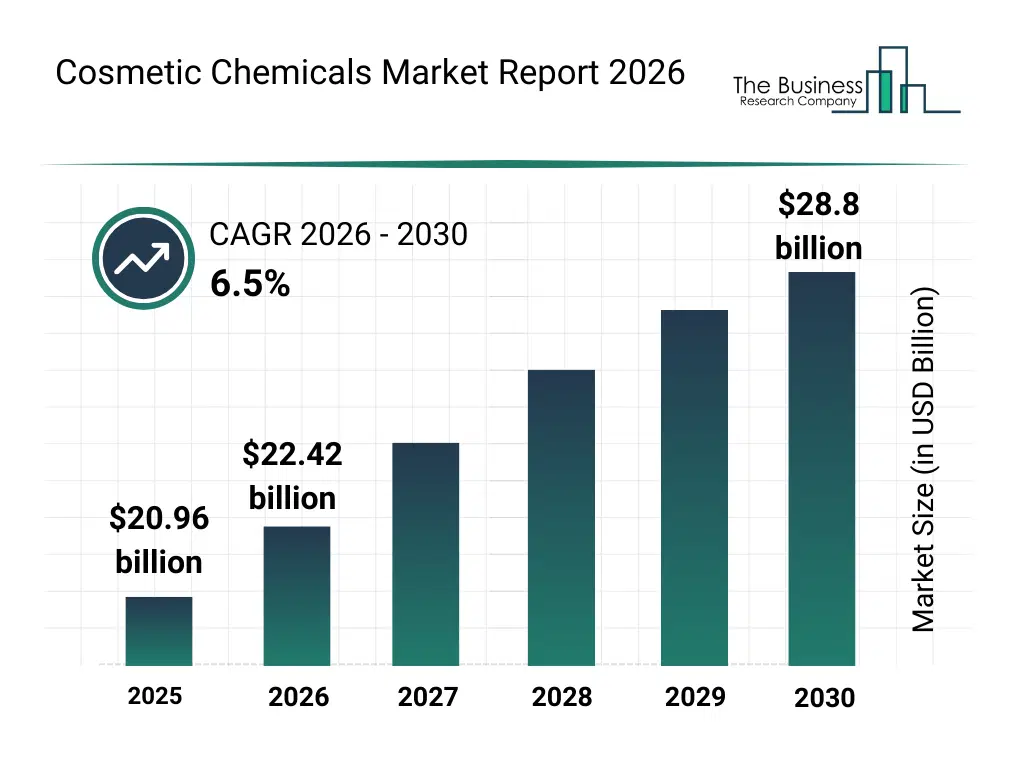
What Is The Cosmetic Chemicals Market Size and Share 2026?
The cosmetic chemicals market size has grown strongly in recent years. It will grow from $20.96 billion in 2025 to $22.42 billion in 2026 at a compound annual growth rate (CAGR) of 7.0%. The growth in the historic period can be attributed to growth of personal care product consumption, expansion of global cosmetics industry, rising consumer awareness of ingredient safety, increasing use of synthetic surfactants and emollients, availability of diverse chemical formulations.What Is The Cosmetic Chemicals Market Growth Forecast?
The cosmetic chemicals market size is expected to see strong growth in the next few years. It will grow to $28.8 billion in 2030 at a compound annual growth rate (CAGR) of 6.5%. The growth in the forecast period can be attributed to increasing demand for sustainable beauty products, rising investments in green chemistry, expansion of premium skincare and haircare segments, growing focus on regulatory-compliant formulations, increasing adoption of customized cosmetic solutions. Major trends in the forecast period include increasing demand for natural and bio-based ingredients, rising use of multifunctional cosmetic chemicals, growing adoption of clean label formulations, expansion of advanced emulsifiers and preservatives, enhanced focus on skin-compatible ingredients.
Global Cosmetic Chemicals Market Segmentation
1) By Product Type: Surfactants, Emollients And Moisturizers, Colorants And Pigments, Preservatives, Emulsifying And Thickening Agents 2) By Application: Perfumes And Fragrances, Hair Care And Skincare, Color Cosmetic Chemicals, Other Applications 3) By End-Use Industry: Skin Care Products, Hair Care Products, Color Cosmetics, Fragrances & Perfumes, Oral Care, Personal Hygiene Products, Other End-Use Categories Subsegments: 1) By Surfactants: Anionic Surfactants, Cationic Surfactants, Non-Ionic Surfactants, Amphoteric Surfactants 2) By Emollients And Moisturizers: Natural Emollients, Synthetic Emollients, Humectants 3) By Colorants And Pigments: Organic Colorants, Inorganic Pigments, Natural Colorants 4) By Preservatives: Parabens, Phenoxyethanol, Natural Preservatives 5) By Emulsifying And Thickening Agents: Natural Emulsifiers, Synthetic Emulsifiers, Thickening PolymersWhat Is The Driver Of The Cosmetic Chemicals Market?
The increasing popularity of hair and skin care products is expected to propel the growth of the cosmetic chemicals market going forward. A skin care product means a cosmetic preparation, which may be an antiseptic, tonic, lotion, cream, or otherwise, for massaging, cleansing, stimulating, manipulating, performing non-invasive hair removal, beautifying, or similar work on the body of any person. Hair and skin care products are items created to beautify, protect, and change the appearance of bodies' external features. Cosmetic chemicals are major ingredients used in hair and skin care products. For instance, in 2024, according to the Cosmetic, Toiletry and Perfumery Association Limited (CTPA), a UK-based trade association, beauty sectors increased to £10.3 billion (USD 13.2 billion), up 8.4% year-on-year. Further, with skincare sales up +12.2%, driven by strong performance in prestige and healthcare skincare, closely followed by color cosmetics growing +10.4% year-on-year and fragrance seeing a +8.6% increase in value, with mass fragrance performing particularly well. Therefore, the increasing popularity of hair and skin care products will continue to drive the growth of the cosmetic chemicals industry.Key Players In The Global Cosmetic Chemicals Market
Major companies operating in the cosmetic chemicals market are Dow Chemical Company, Givaudan SA, Ashland Global Holdings Inc., Eastman Chemical Company, Lonza Group Limited, BASF SE, Lanxess AG, P&G Chemicals, Solvay SA, Evonik Industries AG, Bayer AG, Croda International PLC, Stephan Company, Symrise AG, Cargill Inc., Lubrizol Corporation, Cobiosa, Genomatica Inc., Pharmacos, Wacker Chemie AG, Synthomer PLC, Celanese Corporation, Arkema Inc., ARLANXEO Holding BV, Apcotex Industries Limited, Asahi Kasei Corporation, KCC Corporation, Bluestar Silicones USA Corp., Clariant AG, Huntsman Corporation, Momentive Performance Materials Inc., Nippon Shokubai Co. Ltd., OMNOVA Solutions Inc., Shin-Etsu Chemical Co. Ltd.
This chart is for illustrative purposes; the full report includes a detailed competitor analysis and comprehensive overview of the top 10 companies in the market.
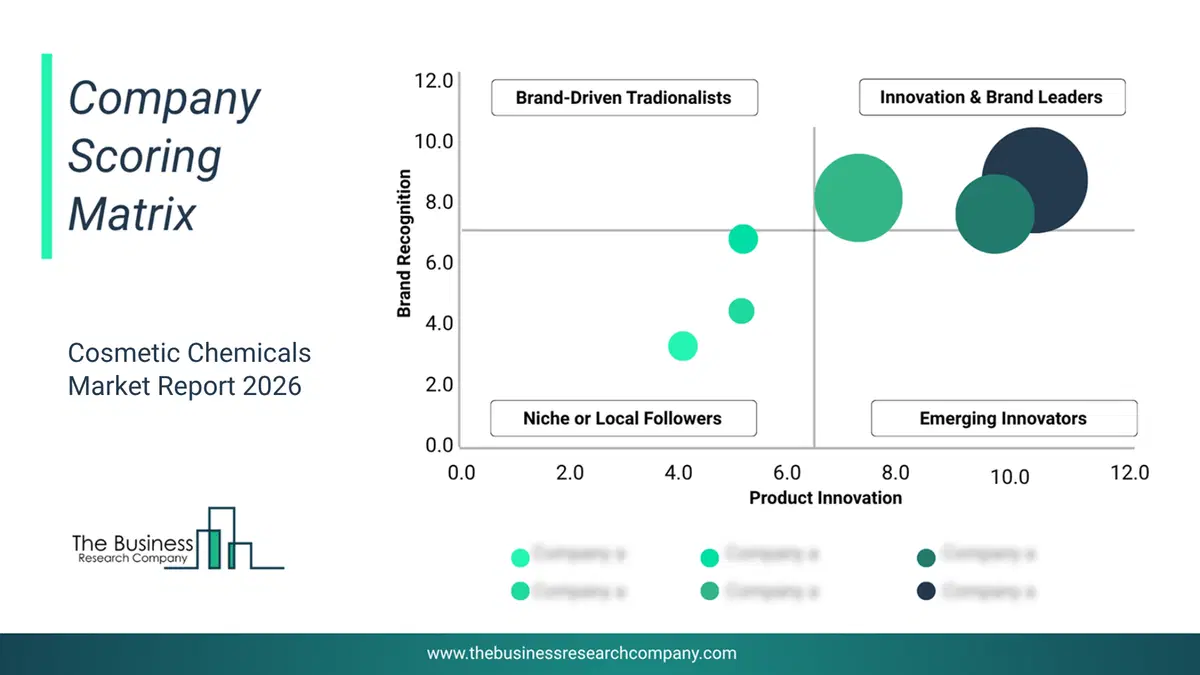
This chart maps companies by product innovation and brand strength, with bubble size indicating relative revenue, helping identify market leaders, challengers, and niche players. This is an illustrative chart; the full report provides a complete and accurate competitive analysis.
Global Cosmetic Chemicals Market Trends and Insights
Major companies operating in the cosmetic chemicals market are focused on introducing advanced solutions, such as sustainably sourced cosmetic ingredients, to drive their revenues in the market. Sustainably sourced cosmetic ingredients refer to raw materials used in cosmetic formulations that are derived from renewable resources and are produced in an environmentally responsible manner. For instance, in September 2023, BASF Personal Care, a Germany-based producer of ingredients for cosmetics, launched Epispot, a new sustainably sourced cosmetic ingredient. Epispot is an extract from the French plant Epilobium angustifolium, which is responsibly sourced. It can be used for various purposes, such as face serums, cleansers, and cosmetic formulations. By addressing the underlying reasons for an imbalance that impacts microbiota, lipids, and the skin's defense mechanism, Epispot minimizes shine, enhances the look of facial pores, and supports a healthy complexion. In keeping with the #NoFilter skincare trend, the new ingredient satisfies consumers' demand for a natural, ideal look without using digital beauty filters.What Are Latest Mergers And Acquisitions In The Cosmetic Chemicals Market?
In April 2023, Givaudan, a Switzerland-based multinational manufacturer of flavors, fragrances, and active cosmetic ingredients, acquired Amyris Inc. for an undisclosed amount. Through this acquisition, Givaudan aims to enhance its offerings in sustainable and bio-based ingredients, aligning with the growing consumer demand for environmentally friendly products in the cosmetics and personal care sectors. Amyris Inc. is a US-based biotechnology company that provides cosmetic chemicals.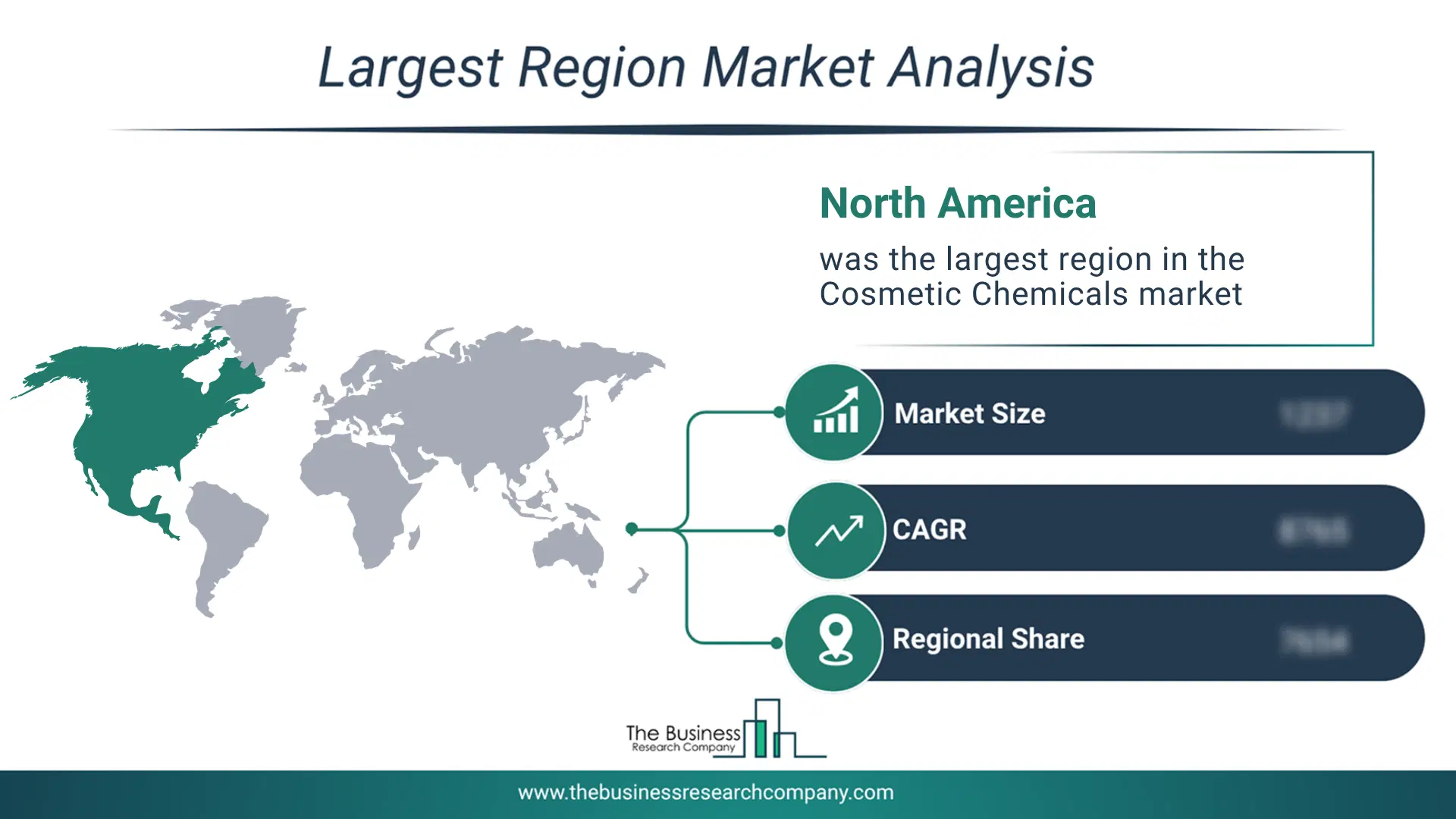
Regional Insights
North America was the largest region in the cosmetic chemicals market in 2025. Asia-Pacific is expected to be the fastest-growing region in the global cosmetic chemicals market during the forecast period. The regions covered in this market report are Asia-Pacific, South East Asia, Western Europe, Eastern Europe, North America, South America, Middle East, Africa The countries covered in this market report are Australia, Brazil, China, France, Germany, India, Indonesia, Japan, Taiwan, Russia, South Korea, UK, USA, Canada, Italy, SpainWhat Defines the Cosmetic Chemicals Market?
The cosmetic chemicals market consists of sales of glycerin, wax, and oil. Values in this market are ‘factory gate’ values, that is the value of goods sold by the manufacturers or creators of the goods, whether to other entities (including downstream manufacturers, wholesalers, distributors, and retailers) or directly to end customers. The value of goods in this market includes related services sold by the creators of the goods.How is Market Value Defined and Measured?
The market value is defined as the revenues that enterprises gain from the sale of goods and/or services within the specified market and geography through sales, grants, or donations in terms of the currency (in USD unless otherwise specified). The revenues for a specified geography are consumption values that are revenues generated by organizations in the specified geography within the market, irrespective of where they are produced. It does not include revenues from resales along the supply chain, either further along the supply chain or as part of other products.
This chart presents market attractiveness based on a quantitative evaluation of growth, competition, strategic alignment, and risk, offering a clear view of opportunity areas for decision-making. This chart is for illustrative purposes; the full report contains the complete analysis.

This chart highlights the Total Addressable Market (TAM) by estimating the maximum revenue opportunity using an assumption-driven approach, supporting strategic planning and opportunity sizing across markets. The chart is illustrative; the full report provides a more comprehensive analysis.
What Key Data and Analysis Are Included in the Cosmetic Chemicals Market Report 2026?
The cosmetic chemicals market research report is one of a series of new reports from The Business Research Company that provides market statistics, including industry global market size, regional shares, competitors with the market share, detailed market segments, market trends and opportunities, and any further data you may need to thrive in the cosmetic chemicals industry. The market research report delivers a complete perspective of everything you need, with an in-depth analysis of the current and future state of the industry.Cosmetic Chemicals Market Report Forecast Analysis
| Report Attribute | Details |
|---|---|
| Market Size Value In 2026 | $22.42 billion |
| Revenue Forecast In 2030 | $28.8 billion |
| Growth Rate | CAGR of 7.0% from 2026 to 2030 |
| Base Year For Estimation | 2025 |
| Actual Estimates/Historical Data | 2020-2025 |
| Forecast Period | 2026 - 2030 |
| Market Representation | Revenue in USD Billion and CAGR from 2026 to 2030 |
| Segments Covered | Product Type, Application, End-Use Industry |
| Regional Scope | Asia-Pacific, Western Europe, Eastern Europe, North America, South America, Middle East, Africa |
| Country Scope | The countries covered in this market report are Australia, Brazil, China, France, Germany, India, Indonesia, Japan, Taiwan, Russia, South Korea, UK, USA, Canada, Italy, Spain |
| Key Companies Profiled | Dow Chemical Company, Givaudan SA, Ashland Global Holdings Inc., Eastman Chemical Company, Lonza Group Limited, BASF SE, Lanxess AG, P&G Chemicals, Solvay SA, Evonik Industries AG, Bayer AG, Croda International PLC, Stephan Company, Symrise AG, Cargill Inc., Lubrizol Corporation, Cobiosa, Genomatica Inc., Pharmacos, Wacker Chemie AG, Synthomer PLC, Celanese Corporation, Arkema Inc., ARLANXEO Holding BV, Apcotex Industries Limited, Asahi Kasei Corporation, KCC Corporation, Bluestar Silicones USA Corp., Clariant AG, Huntsman Corporation, Momentive Performance Materials Inc., Nippon Shokubai Co. Ltd., OMNOVA Solutions Inc., Shin-Etsu Chemical Co. Ltd. |
| Customization Scope | Request for Customization |
| Pricing And Purchase Options | Explore Purchase Options |