
Crosslinking Agent Market Report 2026
Global Outlook – By Crosslinker Type (Epoxy Crosslinkers, Amine Crosslinkers, Peroxide Crosslinkers, Isocyanate Crosslinkers, Silane Crosslinkers), By Chemistry (Amine, Amino, Amide, Aziridine, Carbodiimide, Isocyanate, Other Chemistries), By End-Use Industry (Automotive, Construction, Packaging, Electronics, Medical) – Market Size, Trends, Strategies, and Forecast to 2030
Crosslinking Agent Market Overview
• Crosslinking Agent market size has reached to $8.67 billion in 2025 • Expected to grow to $12.23 billion in 2030 at a compound annual growth rate (CAGR) of 7.1% • Growth Driver: Rising Automotive Production Driving Demand For The Market Due To Increasing Need For Durable And Efficient Vehicle Materials • Market Trend: The Evolving Role Of Polyamide-Based Technology • North America was the largest region in 2025 and Asia-Pacific is the fastest growing region.What Is Covered Under Crosslinking Agent Market?
A crosslinking agent refers to a chemical substance used to connect two or more polymer chains by forming covalent bonds between them. These agents are commonly used in a wide range of rubber vulcanization, hydrogels, adhesives, coatings, and biomedical materials. Depending on the desired properties and application, crosslinking can be achieved through chemical, thermal, or radiation-induced methods. The main types of crosslinking agents are epoxy crosslinkers, amine crosslinkers, peroxide crosslinkers, isocyanate crosslinkers, and silane crosslinkers. Epoxy crosslinkers are chemical agents that react with epoxy resins to form a three-dimensional, hardened polymer network, enhancing the strength, chemical resistance, and durability of the final material. They utilize various chemistries such as amine, amino, amide, aziridine, carbodiimide, isocyanate, and others. These are used in a wide range of applications, including decorative and industrial coatings. The key end-use industries include automotive, construction, packaging, electronics, and medical.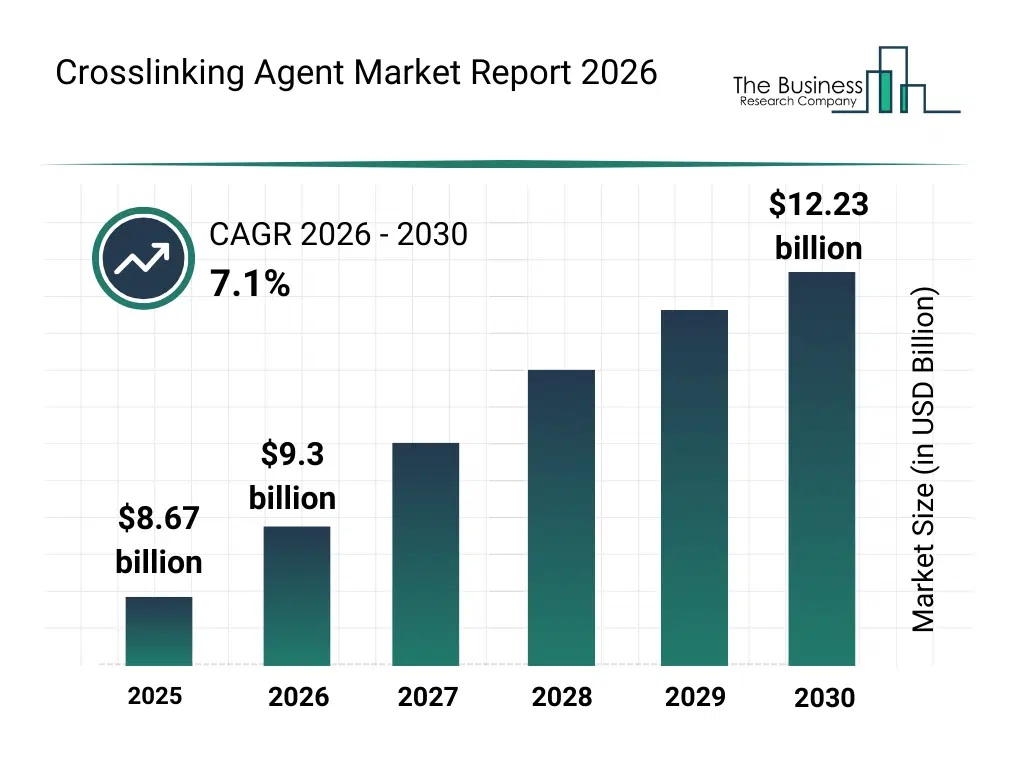
What Is The Crosslinking Agent Market Size and Share 2026?
The crosslinking agent market size has grown strongly in recent years. It will grow from $8.67 billion in 2025 to $9.3 billion in 2026 at a compound annual growth rate (CAGR) of 7.4%. The growth in the historic period can be attributed to growth of polymer processing, demand for durable rubber products, expansion of industrial coatings, use in adhesive formulations, development of synthetic materials.What Is The Crosslinking Agent Market Growth Forecast?
The crosslinking agent market size is expected to see strong growth in the next few years. It will grow to $12.23 billion in 2030 at a compound annual growth rate (CAGR) of 7.1%. The growth in the forecast period can be attributed to demand for lightweight materials, growth in electric vehicles, expansion of specialty polymers, increased use in electronics, innovation in bio based crosslinkers. Major trends in the forecast period include rising demand for high performance polymers, growing use in advanced coatings, expansion of rubber vulcanization applications, increasing adoption in adhesives and sealants, focus on controlled polymer network formation.
Global Crosslinking Agent Market Segmentation
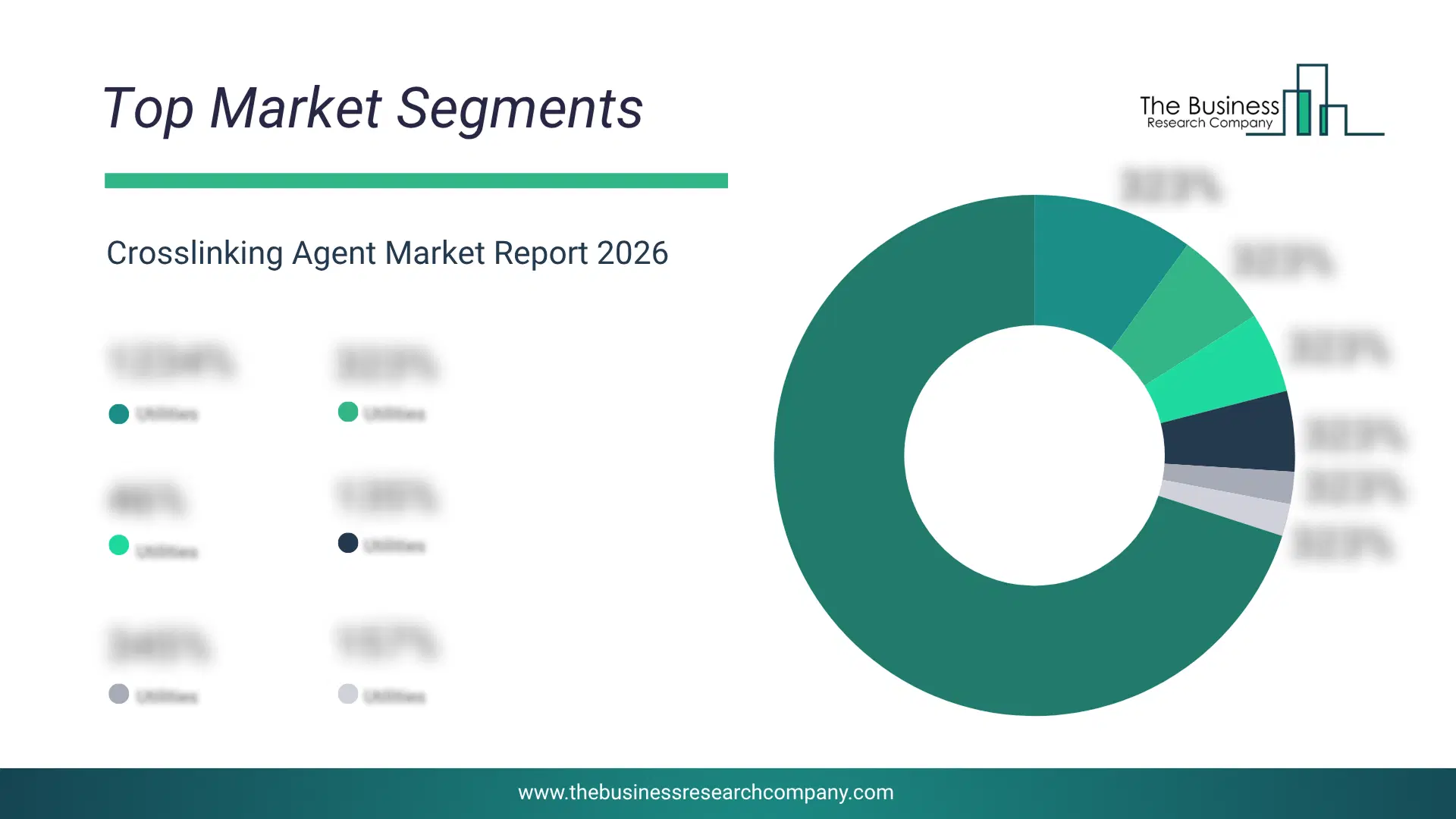
1) By Crosslinker Type: Epoxy Crosslinkers, Amine Crosslinkers, Peroxide Crosslinkers, Isocyanate Crosslinkers, Silane Crosslinkers 2) By Chemistry: Amine, Amino, Amide, Aziridine, Carbodiimide, Isocyanate, Other Chemistries 3) By End-Use Industry: Automotive, Construction, Packaging, Electronics, Medical Subsegments: 1) By Epoxy Crosslinkers: Aliphatic Epoxy, Aromatic Epoxy, Cycloaliphatic Epoxy, Glycidyl Ether Epoxy, Epoxy Phenol Novolac (EPN) 2) By Amine Crosslinkers: Aliphatic Amines, Cycloaliphatic Amines, Aromatic Amines, Polyetheramines, Amidoamines 3) By Peroxide Crosslinkers: Dicumyl Peroxide (DCP), Benzoyl Peroxide (BPO), Tert-Butyl Peroxide, Peroxy Ketals, Hydroperoxides 4) By Isocyanate Crosslinkers: Monomeric Diisocyanates (MDI), Polymeric Isocyanates, Blocked Isocyanates, Aliphatic Isocyanates, Aromatic Isocyanates 5) By Silane Crosslinkers: Vinyl Silanes, Epoxy Silanes, Amino Silanes, Methacryloxy Silanes, Sulfur SilanesWhat Is The Driver Of The Crosslinking Agent Market?
The rising automotive production is expected to drive the growth in the crosslinking agent market going forward. Automotive production refers to the complete process of manufacturing motor vehicles, including the design, assembly, and testing of components such as engines, chassis, body parts, electronics, and interiors. The automotive production is increasing primarily due to rising global demand for vehicles driven by economic growth and urbanization, which boosts consumer purchasing power and the need for personal transportation. Crosslinking agents are beneficial in automotive production to enhance the durability, chemical resistance, and heat resistance of coatings, adhesives, and composite materials, resulting in stronger, longer-lasting, and more fuel-efficient vehicles. For instance, in October 2025, according to a report published by ICAEW, a UK-based professional membership organization, worldwide motor vehicle production reached 93,546,599 units, up from 85,016,728 units in 2022. Therefore, the rising automotive production is driving the growth of the crosslinking agent industry.Key Players In The Global Crosslinking Agent Market
Major companies operating in the crosslinking agent market are BASF SE, The Dow Chemical Company, Mitsubishi Chemical Corporation, Sumitomo Chemical Co. Ltd., Toray Industries Inc., Evonik Industries AG, Covestro AG, INEOS Group Holdings S.A., Arkema S.A., LANXESS AG, Huntsman Corporation, DIC Corporation, H.B. Fuller Company, Aditya Birla Management Corporation Pvt. Ltd., EMS-CHEMIE HOLDING AG, Allnex Holdings S.à r.l., Ashland LLC, Momentive Performance Materials Inc., Perstorp Holding AB, Hexion Inc.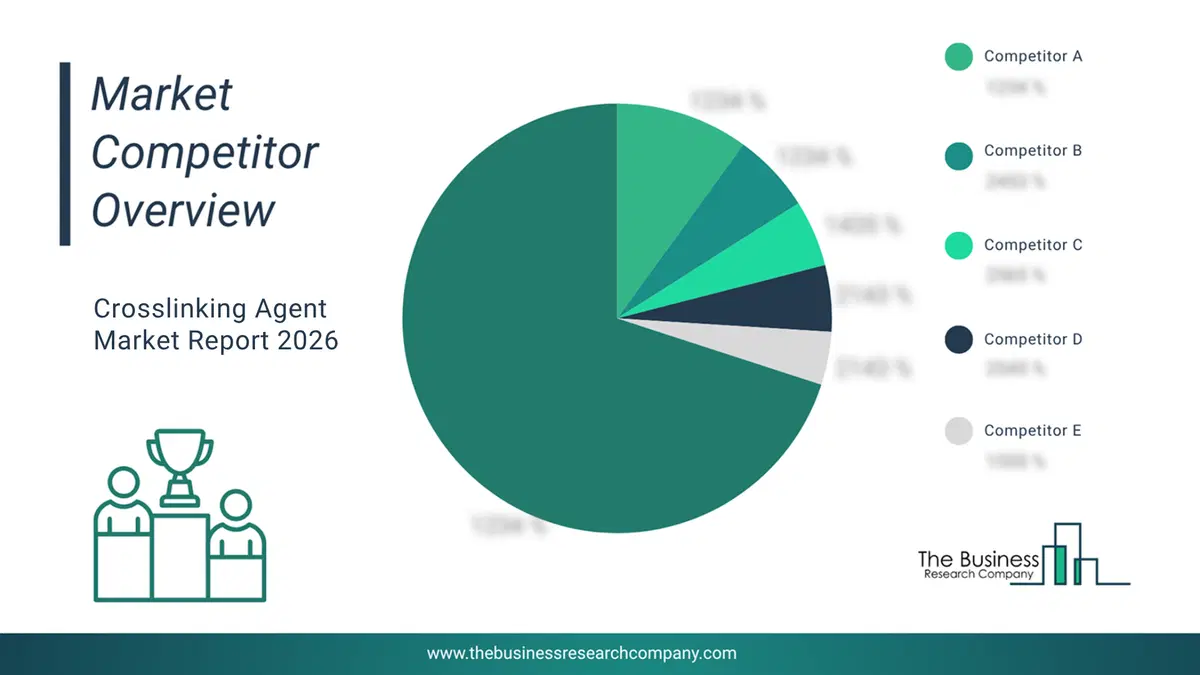
This chart is for illustrative purposes; the full report includes a detailed competitor analysis and comprehensive overview of the top 10 companies in the market.
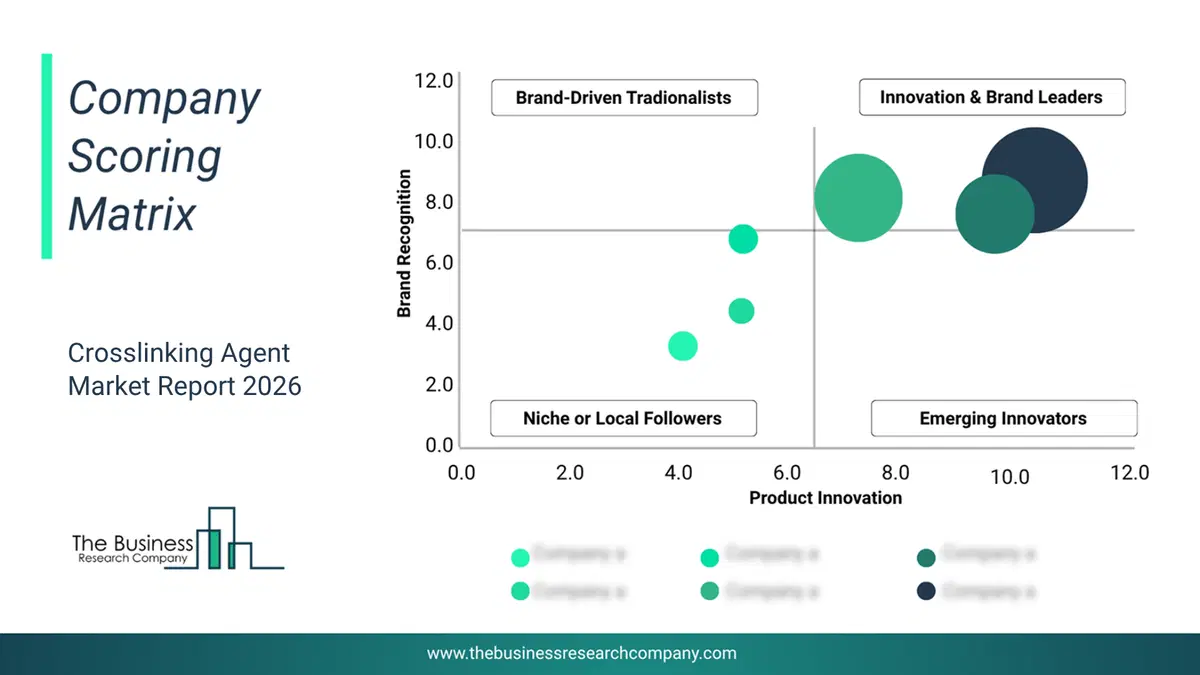
This chart maps companies by product innovation and brand strength, with bubble size indicating relative revenue, helping identify market leaders, challengers, and niche players. This is an illustrative chart; the full report provides a complete and accurate competitive analysis.
Global Crosslinking Agent Market Trends and Insights
Major companies operating in the crosslinking agent market are focusing on technological advancements, such as polyamide-based technology, to enhance flexibility, mechanical strength, environmental safety, and curing efficiency in epoxy systems for demanding applications such as civil engineering and industrial flooring. Polyamide-based technology uses polyamide materials in products such as epoxy curing agents to make them more flexible, stronger, and better at resisting chemicals. For instance, in September 2024, Evonik Industries AG, a Germany-based chemicals company, announced Ancamide 2853 and Ancamide 2865, two new polyamide-based, nonylphenol-free epoxy curing agents. These products function as polyamide-based crosslinking agents designed to cure standard diluted epoxy resins without requiring additional polyurethane modifiers. It offers high flexibility, mechanical strength, fast curing, and up to 40% bio-based content, making it ideal for civil engineering and flooring applications. This announcement aims to enhance sustainability, safety, and performance in epoxy systems by offering eco-friendly, fast-curing, and highly flexible polyamide-based curing agents tailored for demanding applications such as civil engineering and industrial flooring.What Are Latest Mergers And Acquisitions In The Crosslinking Agent Market?
In May 2024, Arkema S.A., a France-based specialty materials company, acquired the flexible packaging laminating adhesives business of Dow Inc. for an undisclosed amount. With this acquisition, Arkema aims to expand its portfolio of high-performance adhesives and strengthen its position in the global flexible packaging market by integrating Dow’s advanced laminating adhesive technologies into its Bostik division. Dow Inc. is a US-based materials science company that offers a wide range of chemical and specialty material solutions, including laminating adhesives used in flexible packaging applications.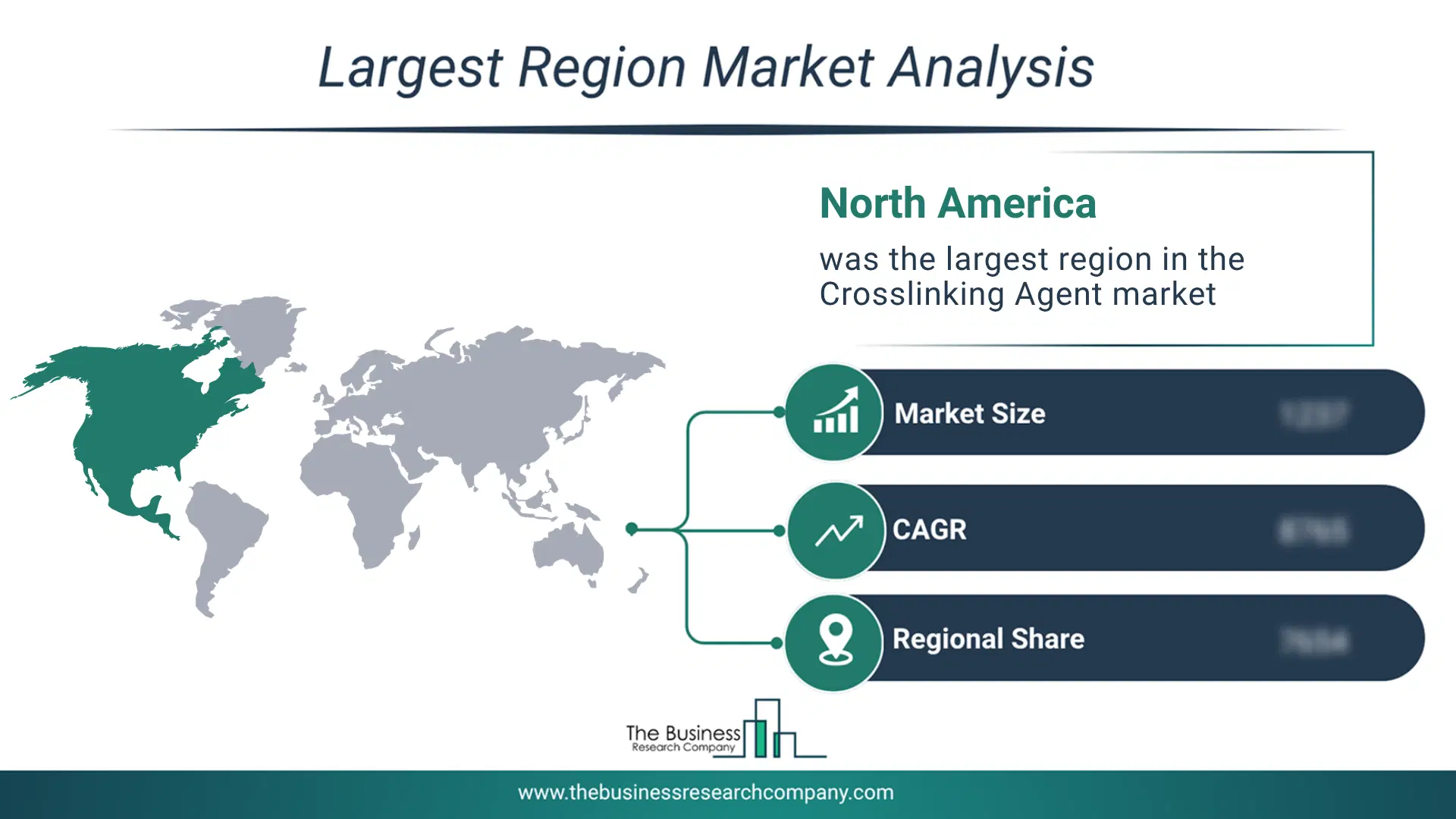
Regional Insights
North America was the largest region in the crosslinking agents market in 2025. Asia-Pacific is expected to be the fastest-growing region in the forecast period. The regions covered in this market report are Asia-Pacific, South East Asia, Western Europe, Eastern Europe, North America, South America, Middle East, Africa The countries covered in this market report are Australia, Brazil, China, France, Germany, India, Indonesia, Japan, Taiwan, Russia, South Korea, UK, USA, Canada, Italy, SpainWhat Defines the Crosslinking Agent Market?
The crosslinking agent market consists of sales of peroxides, sulfur, isocyanates, aziridines, and carbodiimides. Values in this market are ‘factory gate’ values, that is, the value of goods sold by the manufacturers or creators of the goods, whether to other entities (including downstream manufacturers, wholesalers, distributors, and retailers) or directly to end customers. The value of goods in this market includes related services sold by the creators of the goods.How is Market Value Defined and Measured?
The market value is defined as the revenues that enterprises gain from the sale of goods and/or services within the specified market and geography through sales, grants, or donations in terms of the currency (in USD unless otherwise specified). The revenues for a specified geography are consumption values that are revenues generated by organizations in the specified geography within the market, irrespective of where they are produced. It does not include revenues from resales along the supply chain, either further along the supply chain or as part of other products.
This chart presents market attractiveness based on a quantitative evaluation of growth, competition, strategic alignment, and risk, offering a clear view of opportunity areas for decision-making. This chart is for illustrative purposes; the full report contains the complete analysis.

This chart highlights the Total Addressable Market (TAM) by estimating the maximum revenue opportunity using an assumption-driven approach, supporting strategic planning and opportunity sizing across markets. The chart is illustrative; the full report provides a more comprehensive analysis.
What Key Data and Analysis Are Included in the Crosslinking Agent Market Report 2026?
The crosslinking agent market research report is one of a series of new reports from The Business Research Company that provides market statistics, including industry global market size, regional shares, competitors with the market share, detailed market segments, market trends and opportunities, and any further data you may need to thrive in the crosslinking agent industry. The market research report delivers a complete perspective of everything you need, with an in-depth analysis of the current and future state of the industry.Crosslinking Agent Market Report Forecast Analysis
| Report Attribute | Details |
|---|---|
| Market Size Value In 2026 | $9.3 billion |
| Revenue Forecast In 2030 | $12.23 billion |
| Growth Rate | CAGR of 7.4% from 2026 to 2030 |
| Base Year For Estimation | 2025 |
| Actual Estimates/Historical Data | 2020-2025 |
| Forecast Period | 2026 - 2030 |
| Market Representation | Revenue in USD Billion and CAGR from 2026 to 2030 |
| Segments Covered | Crosslinker Type, Chemistry, End-Use Industry |
| Regional Scope | Asia-Pacific, Western Europe, Eastern Europe, North America, South America, Middle East, Africa |
| Country Scope | The countries covered in this market report are Australia, Brazil, China, France, Germany, India, Indonesia, Japan, Taiwan, Russia, South Korea, UK, USA, Canada, Italy, Spain |
| Key Companies Profiled | BASF SE, The Dow Chemical Company, Mitsubishi Chemical Corporation, Sumitomo Chemical Co. Ltd., Toray Industries Inc., Evonik Industries AG, Covestro AG, INEOS Group Holdings S.A., Arkema S.A., LANXESS AG, Huntsman Corporation, DIC Corporation, H.B. Fuller Company, Aditya Birla Management Corporation Pvt. Ltd., EMS-CHEMIE HOLDING AG, Allnex Holdings S.à r.l., Ashland LLC, Momentive Performance Materials Inc., Perstorp Holding AB, Hexion Inc. |
| Customization Scope | Request for Customization |
| Pricing And Purchase Options | Explore Purchase Options |