
Cruise Tourism Market Report 2026
Global Outlook – By Type (River Cruise; Ocean Cruise; Expedition Cruise; Theme Cruise; Adventure Cruise; Other Types), By Duration (1 To 3 Days; 4 To 6 Days; 7 Days; 8 To 13 Days; 14 Days; 15 To 20 Days; More Than 21 Days), By Passenger Age (Less Than 12 Years; 13-19 Years; 20-29 Years; 40-49 Years; Above 60 Years), By Tourist (Independent Traveler; Tour Group; Package Traveler) – Market Size, Trends, Strategies, and Forecast to 2035
Cruise Tourism Market Overview
• Cruise Tourism market size has reached to $7.8 billion in 2025 • Expected to grow to $12.24 billion in 2030 at a compound annual growth rate (CAGR) of 9.4% • Growth Driver: Tourism Industry Expansion Fuels Growth In Cruise Tourism Market • Market Trend: Advanced Booking Web Portals Transforming The Market • North America was the largest region in 2025 and Asia-Pacific is the fastest growing region.What Is Covered Under Cruise Tourism Market?
Cruise tourism involves traveling on a cruise ship to various destinations, often including onboard amenities and entertainment. It combines transportation with leisure, offering passengers a floating resort experience. This form of tourism offers a seamless vacation experience with the added benefit of visiting multiple locations in a single trip, often including both on-board amenities and shore excursions. Cruise tourism is popular for its luxury, convenience, and the opportunity to explore diverse destinations in a single journey. The main types of cruise tourism are river cruises, ocean cruises, expedition cruises, theme cruises, adventure cruises, and others. A river cruise involves a voyage on a river, typically aboard a smaller, more intimate ship that travels through inland waterways, offering scenic views and access to riverside destinations. Cruise durations range from 1-3 days, 4-6 days, 7 days, 8 to 13 days, 14 days, 15-20 days, and more than 21 days. Passengers include various age groups such as those under 12 years, 13-19 years, 20-29 years, 40-49 years, and above 60 years. Tourists may be independent travelers, tour group members, or package travelers.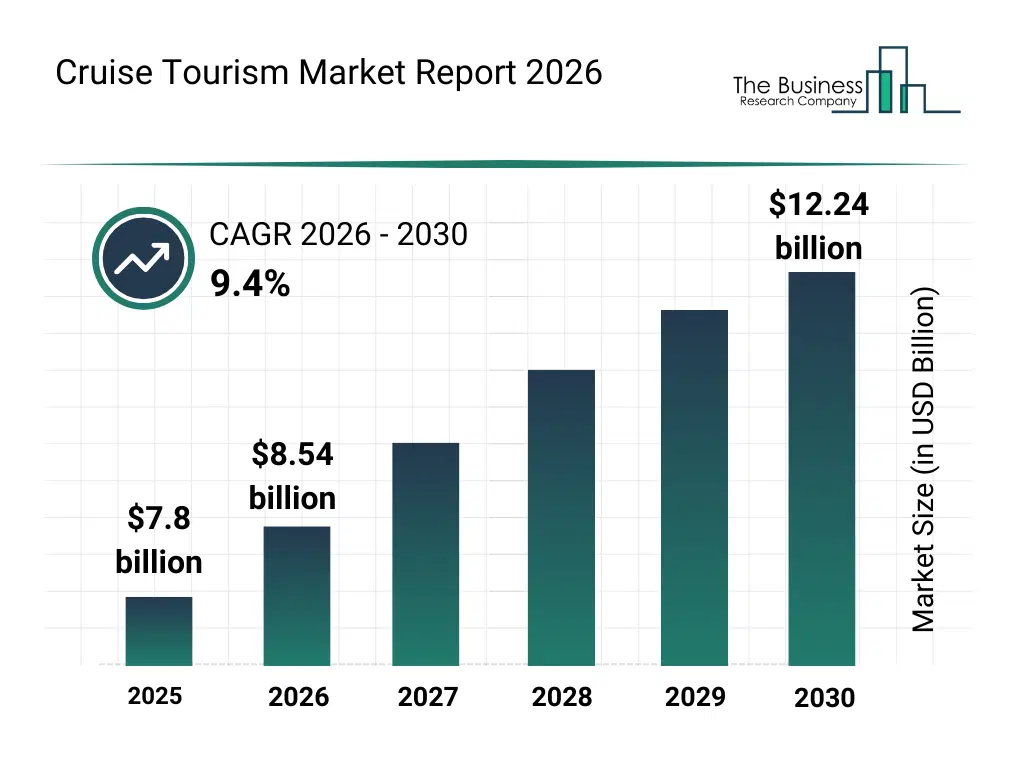
What Is The Cruise Tourism Market Size and Share 2026?
The cruise tourism market size has grown strongly in recent years. It will grow from $7.8 billion in 2025 to $8.54 billion in 2026 at a compound annual growth rate (CAGR) of 9.5%. The growth in the historic period can be attributed to expansion of global tourism activities, rising disposable incomes, growth of luxury travel demand, increasing cruise fleet sizes, development of port infrastructure.What Is The Cruise Tourism Market Growth Forecast?
The cruise tourism market size is expected to see strong growth in the next few years. It will grow to $12.24 billion in 2030 at a compound annual growth rate (CAGR) of 9.4%. The growth in the forecast period can be attributed to increasing focus on low-emission cruise ships, rising demand for experiential travel, expansion of emerging cruise destinations, growing integration of digital guest engagement tools, increasing investments in next-generation cruise vessels. Major trends in the forecast period include growing demand for sustainable cruise operations, rising adoption of smart ship technologies, expansion of experiential and theme-based cruises, increased focus on health and safety protocols, enhanced use of digital booking and personalization platforms.
Global Cruise Tourism Market Segmentation
1) By Type: River Cruise, Ocean Cruise, Expedition Cruise, Theme Cruise, Adventure Cruise, Other Types 2) By Duration: 1 To 3 Days, 4 To 6 Days, 7 Days, 8 To 13 Days, 14 Days, 15 To 20 Days, More Than 21 Days 3) By Passenger Age: Less Than 12 Years, 13-19 Years, 20-29 Years, 40-49 Years, Above 60 Years 4) By Tourist: Independent Traveler, Tour Group, Package Traveler Subsegments: 1) By River Cruise: Luxury River Cruises, Boutique River Cruises, Small Ship River Cruises, Family-Oriented River Cruises, Themed River Cruises (Wine, Culinary) 2) By Ocean Cruise: Luxury Ocean Cruises, Premium Ocean Cruises, Contemporary Ocean Cruises, Themed Ocean Cruises (Music, Wellness), Expedition Ocean Cruises 3) By Expedition Cruise: Arctic And Antarctic Expeditions, Polar Cruises, Wildlife And Eco-Tourism Expeditions, Remote And Uncharted Area Cruises, Scientific And Educational Expeditions 4) By Theme Cruise: Music Cruises, Culinary Cruises, Wellness And Spa Cruises, Sports And Adventure Cruises, Cultural And Art Cruises 5) By Adventure Cruise: Adventure And Exploration Cruises, Trekking And Hiking Cruises, Diving And Snorkeling Cruises, Sailing And Yachting Expeditions, Active Lifestyle Cruises 6) By Other Types: Family Cruises, Luxury Yacht Cruises, Educational And Learning Cruises, River And Ocean Hybrid Cruises, Cruise And Resort PackagesWhat Is The Driver Of The Cruise Tourism Market?
The expansion of the tourism industry is expected to propel the growth of the cruise tourism market going forward. The tourism industry refers to the sector that encompasses travel, accommodation, and recreational services provided to individuals for leisure, business, or other purposes. A rise in the tourism industry typically reflects increased travel demand, economic growth, and improved consumer confidence. Cruise tourism significantly boosts global tourism by offering unique travel experiences and contributing to economic growth through port-related activities and expenditures. For instance, in May 2024, according to the Office for National Statistics, a UK-based national statistical institute, the UK saw a rise in overseas visitors, with 38.0 million trips compared in 2023 to 31.2 million in 2022. These visitors spent $39.99 billion (£31.1 billion), an increase of $5.91 billion (£4.6 billion) from the previous year. Conversely, UK residents took 86.2 million trips abroad, up from 71.0 million in 2022, and spent $93.07 billion (£72.4 billion) and $17.87 billion (£13.9 billion) more than the previous year. Therefore, the expansion of the tourism industry is driving the growth of the cruise tourism industry.Key Players In The Global Cruise Tourism Market
Major companies operating in the cruise tourism market are Royal Caribbean International, Princess Crusies Ltd., Costa Cruises, AIDA Cruises, Viking Ocean Cruises, Cunard Line, Seabourn Cruise Line, Hurtigruten, Genting Hong Kong Ltd., Fred. Olsen Cruise Lines, Windstar Cruises, Azamara Club Cruises, Celestyal Cruises, Compagnie du Ponant, Crystal Cruises, Oceania Cruises, AmaWaterways LLC, P&O Cruises, Pullmantur Cruises, Ambassador Cruise Holidays Ltd., Kerala Shipping, Regent Seven Seas Cruises, Silversea CruisesGlobal Cruise Tourism Market Trends and Insights
Major companies operating in the cruise tourism market are developing advanced solutions, such as booking web portals, to enhance booking efficiency and provide real-time access to inventory and fare information. A booking web portal is an online platform that allows travel agents and customers to search, book, and manage cruise itineraries with real-time access to inventory and pricing. For instance, in February 2024, Resorts World Cruises, a Singapore-based company, launched the RW CruiseBuddy platform in India, designed to empower travel partners with direct access to real-time inventory and fare details. This cutting-edge tool is set to transform how travel partners book and manage cruise itineraries. The user-friendly web portal offers a convenient and seamless experience, simplifying booking management and providing up-to-date information.What Are Latest Mergers And Acquisitions In The Cruise Tourism Market?
In November 2023, BC Tours, a US-based company specializing in the provision of tourist services for cruises, acquired Ibercruises for an undisclosed amount. The acquisition of Ibercruises enables BC Tours to strengthen and solidify its leadership in cruise services across Portugal and the Azores. This strategic move aligns with BC Tours' expansion plan to broaden its service portfolio and penetrate new global cruise destinations and markets. Ibercruises is a Portugal-based travel agency specializing in providing handling services for cruise lines.Regional Outlook
North America was the largest region in the cruise tourism market in 2025. Asia-Pacific is expected to be the fastest-growing region in the forecast period. The regions covered in this market report are Asia-Pacific, South East Asia, Western Europe, Eastern Europe, North America, South America, Middle East, Africa. The countries covered in this market report are Australia; Brazil; China; France; Germany; India; Indonesia; Japan; Taiwan; Russia; South Korea; UK; USA; Canada; Italy; Spain.What Defines the Cruise Tourism Market?
The cruise tourism market includes revenues earned by entities by providing services such as accommodation, dining, entertainment, and various recreational activities while navigating between ports of call. The market value includes the value of related goods sold by the service provider or included within the service offering. Only goods and services traded between entities or sold to end consumers are included.How is Market Value Defined and Measured?
The market value is defined as the revenues that enterprises gain from the sale of goods and/or services within the specified market and geography through sales, grants, or donations in terms of the currency (in USD unless otherwise specified). The revenues for a specified geography are consumption values that are revenues generated by organizations in the specified geography within the market, irrespective of where they are produced. It does not include revenues from resales along the supply chain, either further along the supply chain or as part of other products.What Key Data and Analysis Are Included in the Cruise Tourism Market Report 2026?
The cruise tourism market research report is one of a series of new reports from The Business Research Company that provides market statistics, including Market Report 2026?global market size, regional shares, competitors with the market share, detailed market segments, market trends and opportunities, and any further data you may need to thrive in the cruise tourism Market Report 2026? The market research report delivers a complete perspective of everything you need, with an in-depth analysis of the current and future state of the Market Report 2026?Cruise Tourism Market Report Forecast Analysis
| Report Attribute | Details |
|---|---|
| Market Size Value In 2026 | $8.54 billion |
| Revenue Forecast In 2035 | $12.24 billion |
| Growth Rate | CAGR of 9.5% from 2026 to 2035 |
| Base Year For Estimation | 2025 |
| Actual Estimates/Historical Data | 2020-2025 |
| Forecast Period | 2026 - 2030 - 2035 |
| Market Representation | Revenue in USD Billion and CAGR from 2026 to 2035 |
| Segments Covered | Type, Duration, Passenger Age, Tourist |
| Regional Scope | Asia-Pacific, Western Europe, Eastern Europe, North America, South America, Middle East, Africa |
| Country Scope | The countries covered in the report are Australia, Brazil, China, France, Germany, India, ... |
| Key Companies Profiled | Royal Caribbean International, Princess Crusies Ltd., Costa Cruises, AIDA Cruises, Viking Ocean Cruises, Cunard Line, Seabourn Cruise Line, Hurtigruten, Genting Hong Kong Ltd., Fred. Olsen Cruise Lines, Windstar Cruises, Azamara Club Cruises, Celestyal Cruises, Compagnie du Ponant, Crystal Cruises, Oceania Cruises, AmaWaterways LLC, P&O Cruises, Pullmantur Cruises, Ambassador Cruise Holidays Ltd., Kerala Shipping, Regent Seven Seas Cruises, Silversea Cruises |
| Customization Scope | Request for Customization |
| Pricing And Purchase Options | Explore Purchase Options |