
Data Center Cooling For Spaceport Market Report 2026
Global Outlook – By Component (Hardware, Software, Services), By Cooling Technique (Air-Based Cooling, Liquid-Based Cooling, Immersion Cooling, Chilled Water Systems, Other Cooling Techniques), By Application (Launch Operations, Mission Control, Satellite Communication, Data Processing), By End-User (Government Space Agencies, Commercial Spaceports, Military, Other End-Users) – Market Size, Trends, Strategies, and Forecast to 2030
Data Center Cooling For Spaceport Market Overview
• Data Center Cooling For Spaceport market size has reached to $1.25 billion in 2025 • Expected to grow to $2.33 billion in 2030 at a compound annual growth rate (CAGR) of 13.2% • Growth Driver: Growing Satellite Launch Frequency Supporting The Growth Of The Market Due To Expanding Broadband Access And Connectivity Infrastructure • North America was the largest region in 2025.What Is Covered Under Data Center Cooling For Spaceport Market?
Data center cooling for spaceports refers to specialized thermal management systems designed to regulate the temperature of high-performance computing and storage facilities that support spaceport operations. It ensures reliable performance of mission-critical data infrastructure by preventing overheating and maintaining energy efficiency in extreme environmental conditions. The main components of data center cooling for spaceports are hardware, software, and services. Hardware in data center cooling for spaceports refers to the physical infrastructure and equipment used to regulate and maintain optimal temperatures for high-density computing environments within spaceport facilities. The cooling techniques used in these are air-based cooling, liquid-based cooling, immersion cooling, chilled water systems, and others, used in applications such as launch operations, mission control, satellite communication, and data processing by end-users including government space agencies, commercial spaceports, military, and others.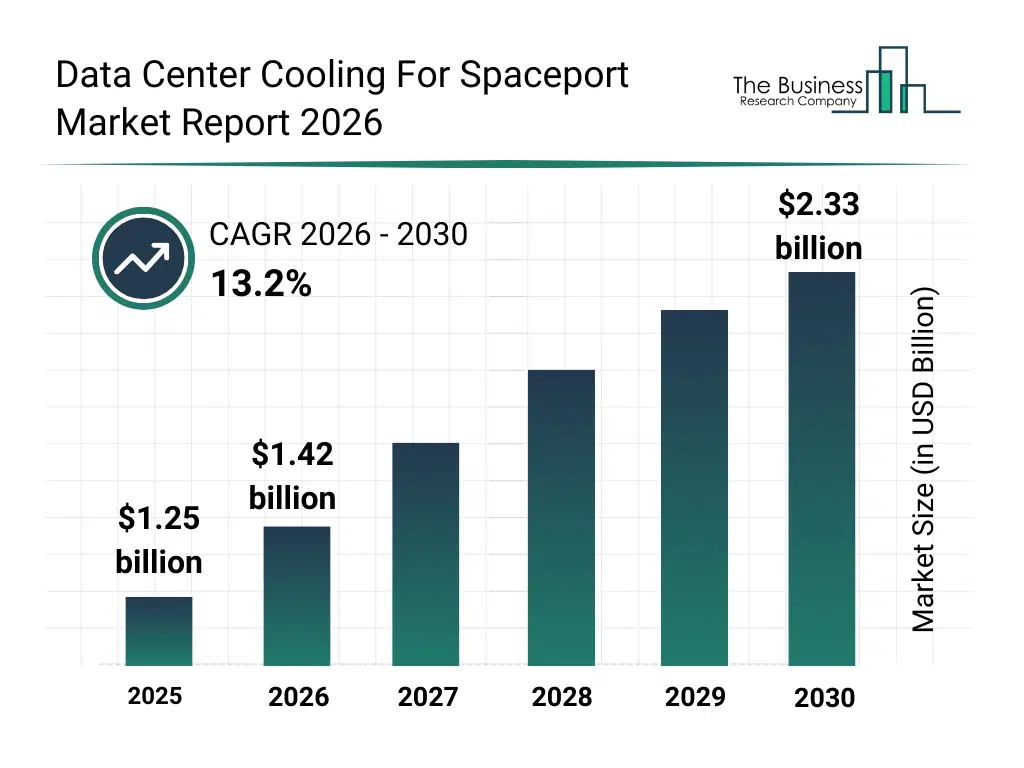
What Is The Data Center Cooling For Spaceport Market Size and Share 2026?
The data center cooling for spaceport market size has grown rapidly in recent years. It will grow from $1.25 billion in 2025 to $1.42 billion in 2026 at a compound annual growth rate (CAGR) of 13.4%. The growth in the historic period can be attributed to rising demand for high-performance computing at spaceports, challenges in maintaining thermal stability in extreme environments, increase in satellite launch activities, adoption of advanced data processing infrastructure, need for uninterrupted mission-critical operations.What Is The Data Center Cooling For Spaceport Market Growth Forecast?
The data center cooling for spaceport market size is expected to see rapid growth in the next few years. It will grow to $2.33 billion in 2030 at a compound annual growth rate (CAGR) of 13.2%. The growth in the forecast period can be attributed to deployment of AI-driven energy management systems, growth of commercial spaceports, innovations in immersion and liquid cooling technologies, integration with autonomous launch operations, increasing focus on sustainable and eco-friendly cooling methods. Major trends in the forecast period include energy-efficient cooling solutions, advanced thermal management systems, predictive maintenance and monitoring, integration with mission-critical infrastructure, scalable modular cooling designs.
Global Data Center Cooling For Spaceport Market Segmentation
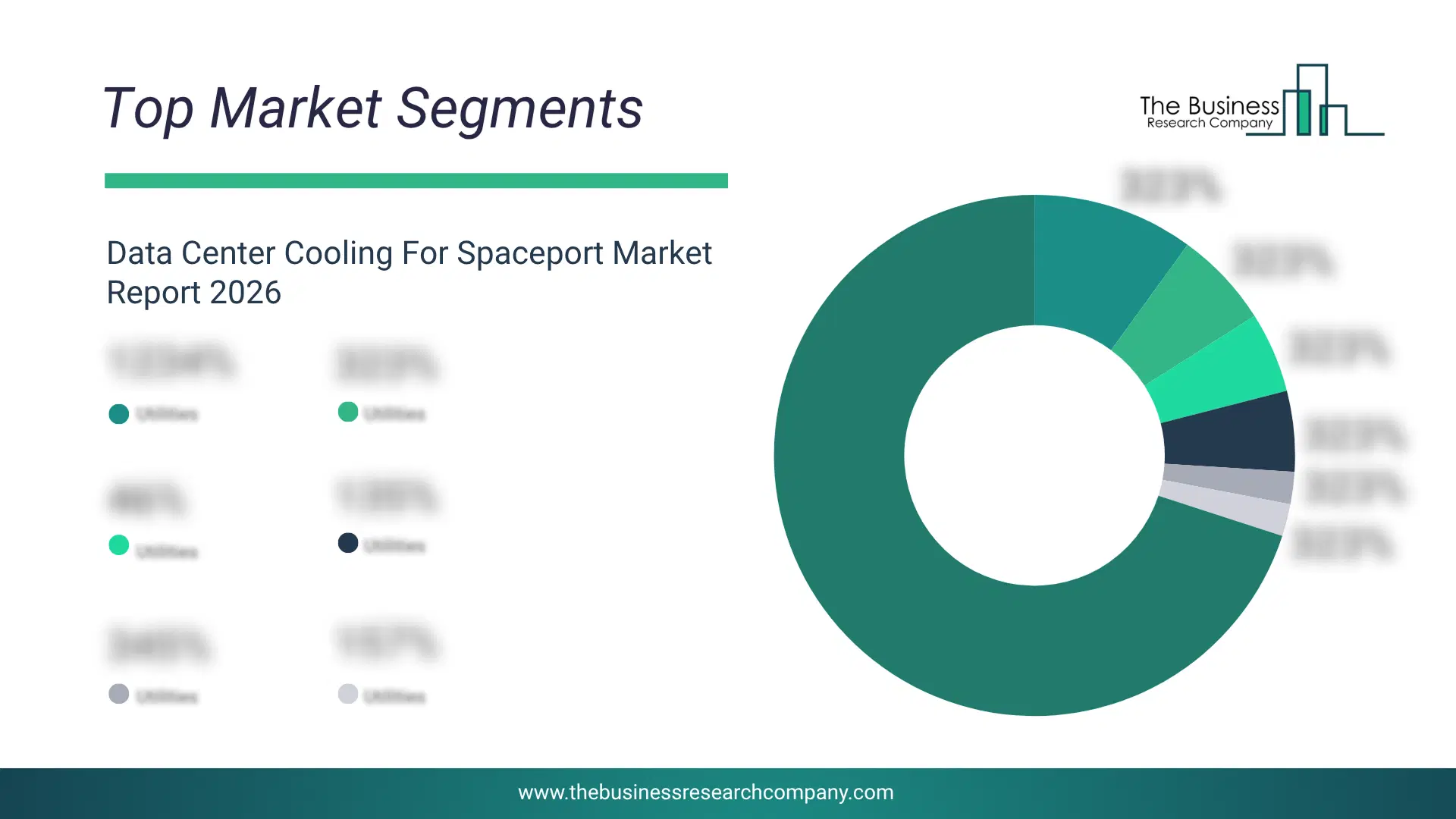
1) By Component: Hardware, Software, Services 2) By Cooling Technique: Air-Based Cooling, Liquid-Based Cooling, Immersion Cooling, Chilled Water Systems, Other Cooling Techniques 3) By Application: Launch Operations, Mission Control, Satellite Communication, Data Processing 4) By End-User: Government Space Agencies, Commercial Spaceports, Military, Other End-Users Subsegments: 1) By Hardware: Cooling Units, Airflow Management Equipment, Heat Exchangers, Chillers, Power Distribution Units 2) By Software: Monitoring And Control Software, Energy Management Software, Predictive Maintenance Software, Capacity Planning Software 3) By Services: Installation And Integration Services, Maintenance And Support Services, Consulting And Optimization Services, Training And Education ServicesWhat Are The Drivers Of The Data Center Cooling For Spaceport Market?
The increasing commercial satellite launches are expected to propel the growth of the data center cooling for spaceport market going forward. A commercial satellite refers to a privately owned and operated spacecraft designed to provide services such as communications, Earth observation, navigation, and data transmission to businesses, governments, and other non-military users for commercial purposes. Growing demand for global connectivity and real-time data is driving governments and enterprises to expand satellite constellations for broader coverage and reliability. Data center cooling for spaceports ensures reliable thermal management of ground-based data processing and mission control systems, enabling seamless operations and improving efficiency amid the rise in commercial satellite launches. For instance, in May 2025, according to the Satellite Industry Association (SIA), a US-based trade association, a record 259 launches in 2024 deployed 2,695 satellites into orbit, representing a significant year-over-year increase compared with 2023. This surge in commercial satellite launches marked the highest annual deployment to date and powered a 30% increase in global commercial launch revenues, reaching $9.3 billion. Therefore, the increasing commercial satellite launches are driving the growth of the data center cooling for spaceport industry. The rising FAA-licensed space operations are expected to propel the growth of data center cooling for the spaceport market going forward. Federal Aviation Administration (FAA)-licensed space operations refer to commercial or non-governmental space activities conducted within the United States or its territories that are officially authorized and regulated by the FAA to ensure compliance with safety, environmental, and national security standards. The growth in FAA-licensed space operations is primarily driven by the commercialization of space, as private enterprise participation promotes innovation, cost efficiency, and competitiveness, encouraging entities to secure licenses within a regulated framework. Data center cooling at spaceports ensures reliable operation of servers and mission-critical systems, supporting telemetry, launch control, and FAA-compliant space operations by maintaining optimal thermal conditions. For instance, in February 2025, according to the Annual Report published by Spaceport America, a US-based commercial spaceport, FAA-licensed commercial space launches recorded a 25.6% increase in 2024 compared with the previous year. Therefore, the rising FAA-licensed space operations are driving the growth of the data center cooling for the spaceport market. The increasing number of spaceport facilities globally is expected to drive the growth in data center cooling for the spaceport market going forward. Spaceport facilities are specialized infrastructure sites designed to support the launch, landing, and operation of spacecraft. The number of spaceport facilities is rising due to the growth of commercial space activities, which drives demand for dedicated launch and support infrastructure to handle increased missions safely and efficiently. Data center cooling in spaceports ensures reliable operation of servers and mission-critical systems that manage launches, telemetry, and communications. For instance, in April 2023, the Space Foundation, a U.S.-based nonprofit organization, reported a 48% increase in the number of proposed spaceports over four years, as countries worldwide develop spaceport policies and attract launch providers and related space industries to expand their access to orbit. Therefore, the increasing number of spaceport facilities globally is driving the data center cooling for the spaceport market.Key Players In The Global Data Center Cooling For Spaceport Market
Major companies operating in the data center cooling for spaceport market are Huawei Technologies Co. Ltd., Daikin Industries Ltd., Schneider Electric, Mitsubishi Electric Corporation, Fujitsu Limited, Johnson Controls International plc, Eaton Corporation, Trane Technologies plc, Emerson Electric Co., Delta Electronics Inc., Vertiv Group Corp., Stulz GmbH, Munters Group AB, Submer Technologies, Asetek A/S, Green Revolution Cooling, CoolIT Systems, LiquidStack, Iceotope, Asperitas.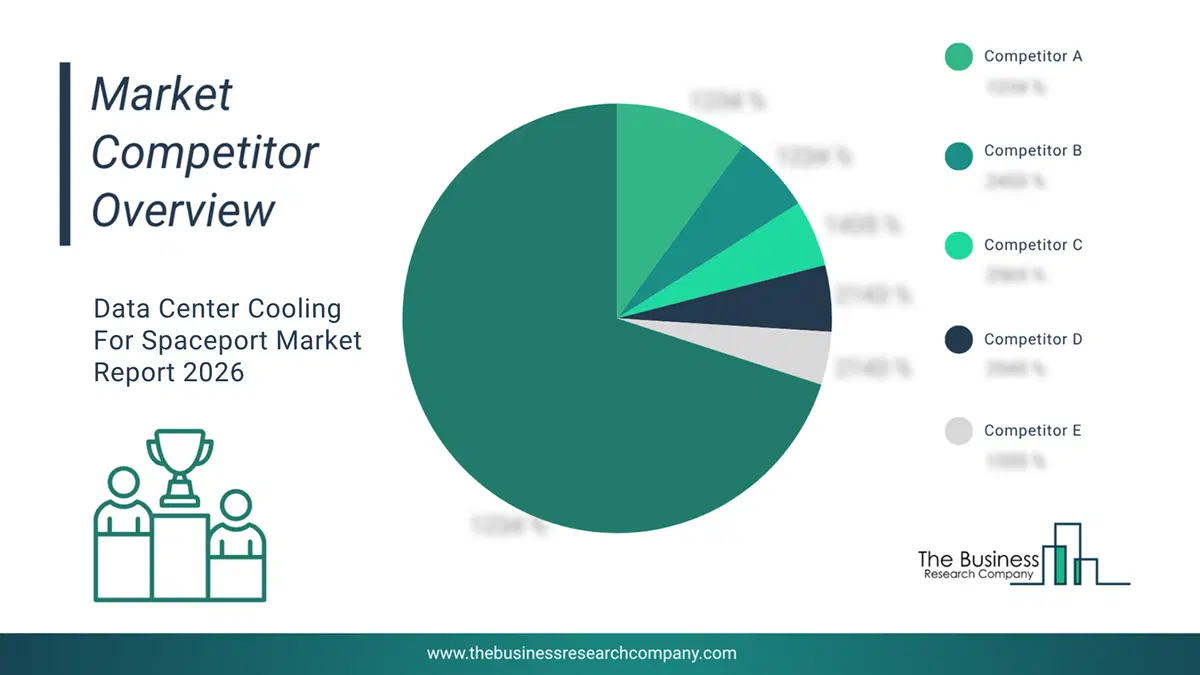
This chart is for illustrative purposes; the full report includes a detailed competitor analysis and comprehensive overview of the top 10 companies in the market.
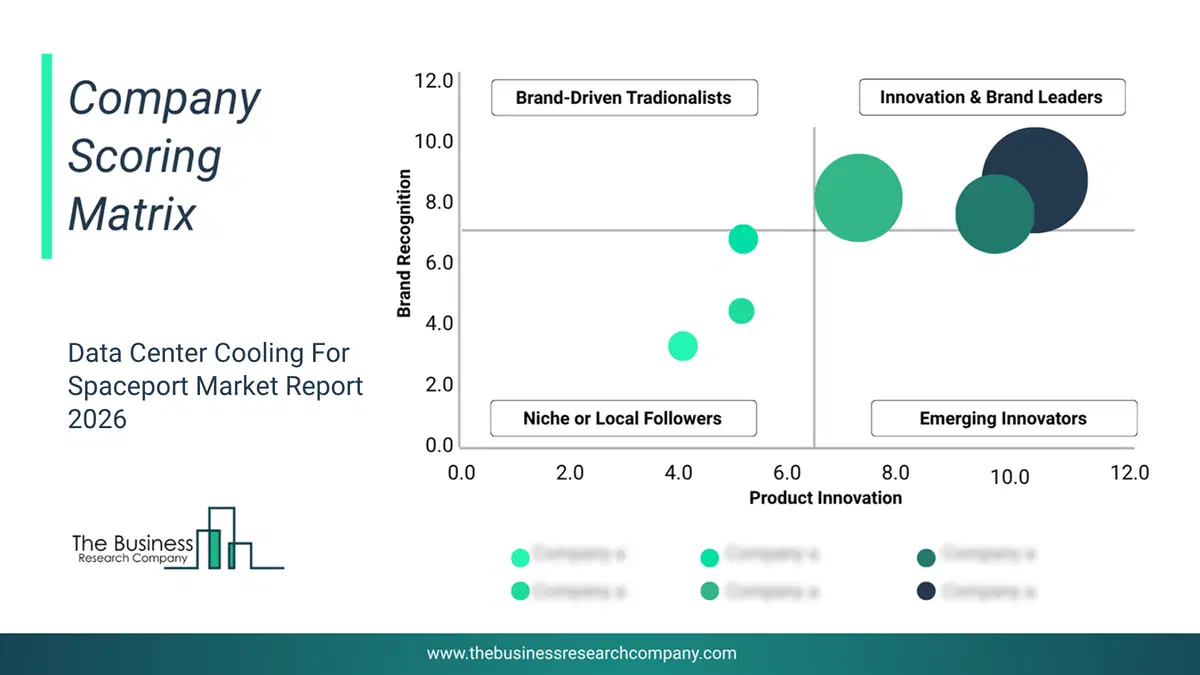
This chart maps companies by product innovation and brand strength, with bubble size indicating relative revenue, helping identify market leaders, challengers, and niche players. This is an illustrative chart; the full report provides a complete and accurate competitive analysis.
Regional Insights
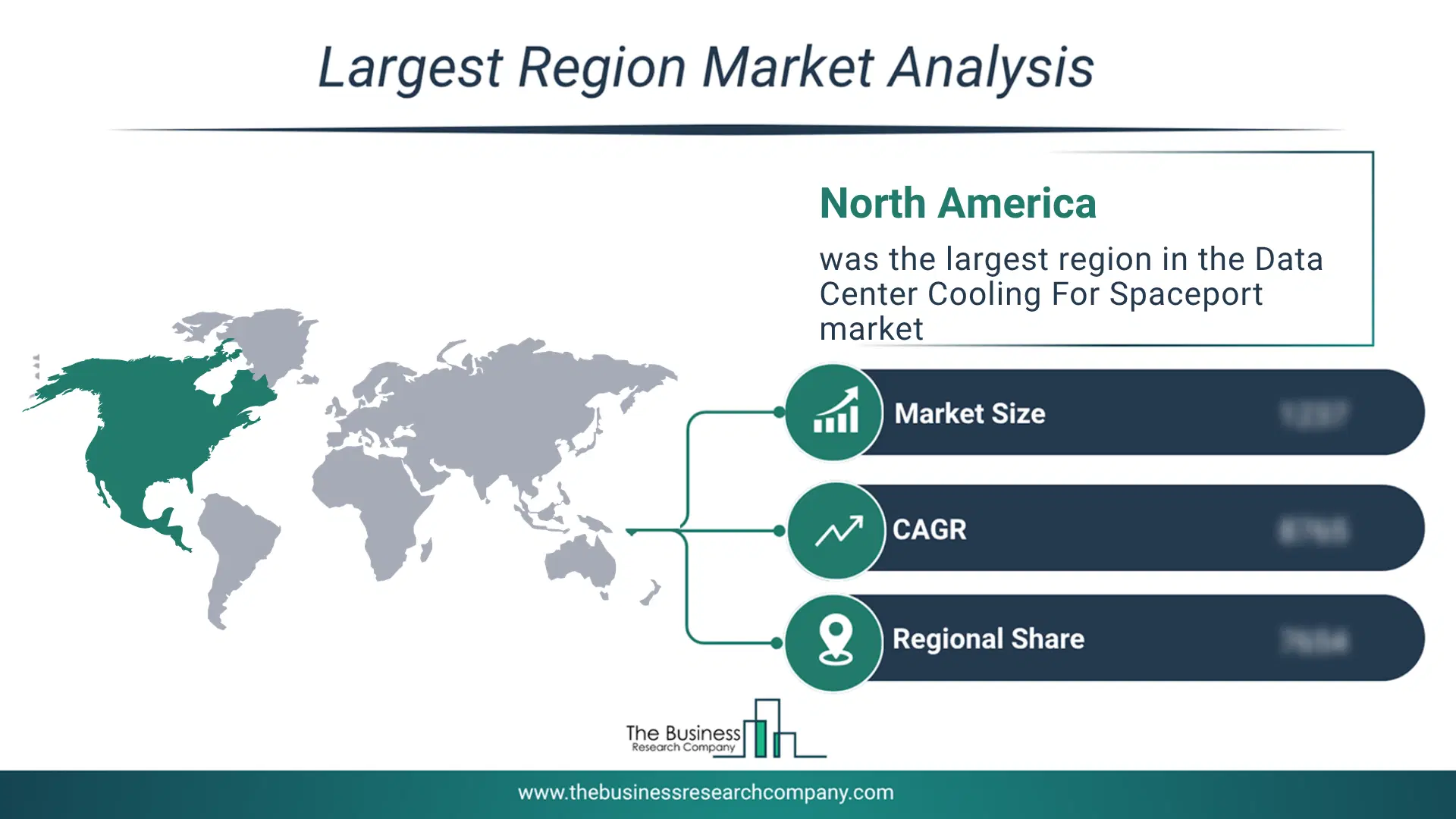
North America was the largest region in the data center cooling for spaceport market in 2025. The regions covered in this market report are Asia-Pacific, South East Asia, Western Europe, Eastern Europe, North America, South America, Middle East, Africa. The countries covered in this market report are Australia, Brazil, China, France, Germany, India, Indonesia, Japan, Taiwan, Russia, South Korea, UK, USA, Canada, Italy, Spain.What Defines the Data Center Cooling For Spaceport Market?
The data center cooling for spaceport market consists of revenues earned by entities by providing services such as thermal energy storage solutions, advanced heat exchanger systems, modular cooling units, predictive cooling management software, and hybrid cooling infrastructure integration. The market value includes the value of related goods sold by the service provider or included within the service offering. The data center cooling for spaceport market also includes sales of precision cooling units, thermal energy storage systems, and hybrid cooling systems. Values in this market are ‘factory gate’ values, that is, the value of goods sold by the manufacturers or creators of the goods, whether to other entities (including downstream manufacturers, wholesalers, distributors, and retailers) or directly to end customers. The value of goods in this market includes related services sold by the creators of the goods.How is Market Value Defined and Measured?
The market value is defined as the revenues that enterprises gain from the sale of goods and/or services within the specified market and geography through sales, grants, or donations in terms of the currency (in USD unless otherwise specified). The revenues for a specified geography are consumption values that are revenues generated by organizations in the specified geography within the market, irrespective of where they are produced. It does not include revenues from resales along the supply chain, either further along the supply chain or as part of other products.
This chart presents market attractiveness based on a quantitative evaluation of growth, competition, strategic alignment, and risk, offering a clear view of opportunity areas for decision-making. This chart is for illustrative purposes; the full report contains the complete analysis.

This chart highlights the Total Addressable Market (TAM) by estimating the maximum revenue opportunity using an assumption-driven approach, supporting strategic planning and opportunity sizing across markets. The chart is illustrative; the full report provides a more comprehensive analysis.
What Key Data and Analysis Are Included in the Data Center Cooling For Spaceport Market Report 2026?
The data center cooling for spaceport market research report is one of a series of new reports from The Business Research Company that provides market statistics, including industry global market size, regional shares, competitors with the market share, detailed market segments, market trends and opportunities, and any further data you may need to thrive in the data center cooling for spaceport industry. The market research report delivers a complete perspective of everything you need, with an in-depth analysis of the current and future state of the industry.Data Center Cooling For Spaceport Market Report Forecast Analysis
| Report Attribute | Details |
|---|---|
| Market Size Value In 2026 | $1.42 billion |
| Revenue Forecast In 2030 | $2.33 billion |
| Growth Rate | CAGR of 13.2% from 2026 to 2030 |
| Base Year For Estimation | 2025 |
| Actual Estimates/Historical Data | 2020-2025 |
| Forecast Period | 2026 - 2030 |
| Market Representation | Revenue in USD Billion and CAGR from 2026 to 2030 |
| Segments Covered | Component, Cooling Technique, Application, End-User |
| Regional Scope | Asia-Pacific, Western Europe, Eastern Europe, North America, South America, Middle East, Africa |
| Country Scope | The Countries Covered In This Market Report Are Australia, Brazil, China, France, Germany, India, Indonesia, Japan, Taiwan, Russia, South Korea, Uk, Usa, Canada, Italy, Spain. |
| Key Companies Profiled | Huawei Technologies Co. Ltd., Daikin Industries Ltd., Schneider Electric, Mitsubishi Electric Corporation, Fujitsu Limited, Johnson Controls International plc, Eaton Corporation, Trane Technologies plc, Emerson Electric Co., Delta Electronics Inc., Vertiv Group Corp., Stulz GmbH, Munters Group AB, Submer Technologies, Asetek A/S, Green Revolution Cooling, CoolIT Systems, LiquidStack, Iceotope, Asperitas. |
| Customization Scope | Request for Customization |
| Pricing And Purchase Options | Explore Purchase Options |