
Diabetes Care Drugs Market Report 2026
Global Outlook – By Drug Class (Insulin, Biguanides, Sulfonylureas, Dipeptidyl Peptidase (DPP)-4 Inhibitors, Sodium-Glucose Co-Transporter (SGLT)-2 Inhibitors, Glucagon-Like Peptide (GLP)-1 Receptor Agonists, Thiazolidinediones, Alpha-Glucosidase Inhibitors), By Formulation Type (Tablets, Injections, Solutions, Gels, Extended-Release Formulations), By Administration Route (Oral, Injectable, Inhalable), By Condition (Diabetes Type 1, Diabetes Type 2), By Distribution Channel (Hospital Pharmacies, Specialty Pharmacies) – Market Size, Trends, Strategies, and Forecast to 2030
Diabetes Care Drugs Market Overview
• Diabetes Care Drugs market size has reached to $73.48 billion in 2025 • Expected to grow to $95.13 billion in 2030 at a compound annual growth rate (CAGR) of 5.2% • Growth Driver: Increasing Number Of Diabetic Patients Fueling The Growth Of The Market Due To Unhealthy Diets And Sedentary Lifestyles • Market Trend: Dual Action Therapy Controls Fasting And Post Meal Glucose Spikes • North America was the largest region in 2025 and Asia-Pacific is the fastest growing region.What Is Covered Under Diabetes Care Drugs Market?
Diabetes care drugs are medications used to manage blood glucose levels in individuals with diabetes mellitus, including type 1, type 2, and gestational diabetes. These drugs work by improving insulin production, enhancing insulin sensitivity, or reducing glucose absorption. The main aim of these drugs is to prevent complications by maintaining healthy blood sugar levels. The main drug classes in diabetes care drugs are insulin, biguanides, sulfonylureas, dipeptidyl peptidase (DPP)-4 inhibitors, sodium-glucose co-transporter (SGLT)-2 inhibitors, glucagon-like peptide (GLP)-1 receptor agonists, thiazolidinediones, and alpha-glucosidase inhibitors. Insulin refers to a pharmaceutical preparation of the hormone insulin, administered via injection or inhalation to compensate for the body's insufficient natural production or utilization. These drugs are available in various formulation types, such as tablets, injections, solutions, gels, and extended-release formulations. They can be administered through oral, injectable, and inhalable routes and are primarily indicated for managing Type 1 and Type 2 diabetes. These drugs are distributed through various channels, including hospital pharmacies and specialty pharmacies.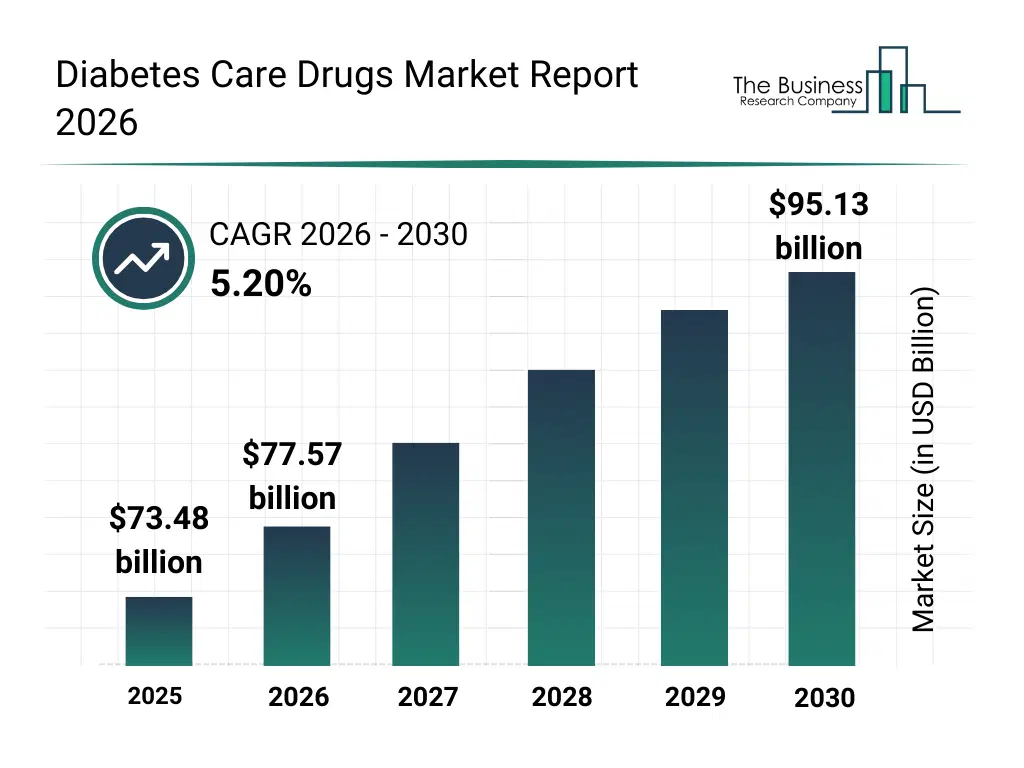
What Is The Diabetes Care Drugs Market Size and Share 2026?
The diabetes care drugs market size has grown strongly in recent years. It will grow from $73.48 billion in 2025 to $77.57 billion in 2026 at a compound annual growth rate (CAGR) of 5.6%. The growth in the historic period can be attributed to limited availability of advanced insulin formulations, growing awareness of diabetes management, rising healthcare infrastructure, dependence on oral antidiabetic drugs, increasing incidence of type 2 diabetes.What Is The Diabetes Care Drugs Market Growth Forecast?
The diabetes care drugs market size is expected to see strong growth in the next few years. It will grow to $95.13 billion in 2030 at a compound annual growth rate (CAGR) of 5.2%. The growth in the forecast period can be attributed to development of novel GLP-1 receptor agonists, adoption of SGLT-2 inhibitors, expansion of injectable and inhalable drug options, growth in home-based diabetes care, integration of digital health monitoring systems. Major trends in the forecast period include rising prevalence of diabetes worldwide, increased adoption of combination therapies, growth in personalized diabetes management, expansion of specialty pharmacies and hospital distribution channels, focus on extended-release and patient-friendly formulations.

Global Diabetes Care Drugs Market Segmentation
1) By Drug Class: Insulin, Biguanides, Sulfonylureas, Dipeptidyl Peptidase (DPP)‑4 Inhibitors, Sodium‑Glucose Co‑Transporter (SGLT)‑2 Inhibitors, Glucagon‑Like Peptide (GLP)-1 Receptor Agonists, Thiazolidinediones, Alpha-Glucosidase Inhibitors 2) By Formulation Type: Tablets, Injections, Solutions, Gels, Extended-Release Formulations 3) By Administration Route: Oral, Injectable, Inhalable 4) By Condition: Diabetes Type 1, Diabetes Type 2 5) By Distribution Channel: Hospital Pharmacies, Specialty Pharmacies Subsegments: 1) By Insulin: Rapid-acting insulin, Short-acting insulin, Intermediate-acting insulin, Long-acting insulin, Pre-mixed insulin 2) By Biguanides: Metformin Immediate Release (IR), Metformin Extended Release (ER) 3) By Sulfonylureas: First-generation sulfonylureas, Second-generation sulfonylureas 4) By Dipeptidyl Peptidase (DPP)‑4 Inhibitors: Sitagliptin, Saxagliptin, Linagliptin, Alogliptin 5) By Sodium‑Glucose Co‑Transporter (SGLT)‑2 Inhibitors: Canagliflozin, Dapagliflozin, Empagliflozin, Ertugliflozin 6) By Glucagon‑Like Peptide (GLP)-1 Receptor Agonists: Exenatide, Liraglutide, Dulaglutide, Semaglutide, Lixisenatide 7) By Thiazolidinediones (TZDs): Pioglitazone, Rosiglitazone 8) By Alpha-Glucosidase Inhibitors: Acarbose, MiglitolWhat Is The Driver Of The Diabetes Care Drugs Market?
The increasing number of diabetic patients is expected to propel the growth of the diabetes care drugs market going forward. Diabetic patients refer to individuals who have been diagnosed with diabetes mellitus, a chronic medical condition that affects how the body processes blood sugar (glucose). The increasing number of diabetic patients is mainly due to unhealthy diets and sedentary lifestyles, as they promote obesity and insulin resistance. Diabetes care drugs help diabetic patients manage blood glucose levels effectively, making them vital for controlling type 1 and type 2 diabetes. They prevent complications by stabilizing sugar levels, improving overall health, and improving quality of life. For instance, in June 2024, according to the National Health Service, a UK-based government department, 3,615,330 individuals registered with a general practitioner (GP) were diagnosed with non-diabetic hyperglycemia or pre-diabetes in 2023, marking an 18% increase from 3,065,825 cases in 2022. Therefore, the increasing number of diabetic patients is driving the growth of the diabetes care drugs industry.Key Players In The Global Diabetes Care Drugs Market
Major companies operating in the diabetes care drugs market are Johnson & Johnson, Merck & Co. Inc., Bayer AG, Sanofi S.A., Bristol‑Myers Squibb Company, AstraZeneca plc, Eli Lilly and Company, Teva Pharmaceuticals Limited, Astellas Pharma Inc., Sun Pharmaceutical Industries Ltd., Aurobindo Pharma Limited, Dr. Reddy's Laboratories, Cipla Limited, Lupin Limited, Takeda Pharmaceutical Company Limited, Biocon Limited, Glenmark Pharmaceuticals Limited, Torrent Pharmaceuticals Ltd., Hanmi Pharmaceutical Limited, Wockhardt, Mitsubishi Tanabe Pharma, Gan & Lee Pharmaceuticals, Apotex.
This chart is for illustrative purposes; the full report includes a detailed competitor analysis and comprehensive overview of the top 10 companies in the market.

This chart maps companies by product innovation and brand strength, with bubble size indicating relative revenue, helping identify market leaders, challengers, and niche players. This is an illustrative chart; the full report provides a complete and accurate competitive analysis.
Global Diabetes Care Drugs Market Trends and Insights
Major companies operating in the diabetes care drugs market are focusing on developing advanced treatments, such as fixed-ratio combination therapies, to improve glycemic control, enhance patient adherence, and simplify treatment regimens. Fixed-ratio combination therapies refer to medications that combine two complementary antidiabetic agents in a single injection, offering a more convenient and effective approach to managing diabetes. For instance, in April 2024, Sanofi SA, a France-based pharmaceutical company, launched Soliqua, a once-daily fixed-ratio combination of insulin glargine and lixisenatide specifically designed for adults with type 2 diabetes and obesity. Soliqua combines long-acting insulin glargine, which provides steady fasting glucose control, with lixisenatide, a GLP-1 receptor agonist. This combination enhances glucose-dependent insulin secretion, suppresses glucagon production, and slows gastric emptying to reduce post-meal blood sugar levels, thereby offering comprehensive daily glycemic management. The launch of Soliqua aims to simplify diabetes management, improve glycemic control, and enhance patient adherence by decreasing the need for multiple daily injections and minimizing potential side effects such as hypoglycemia and weight gain.What Are Latest Mergers And Acquisitions In The Diabetes Care Drugs Market?
In December 2024, Lupin Limited, an India-based pharmaceutical company, acquired anti-diabetes trademarks from Boehringer Ingelheim International GmbH for an undisclosed amount. With this acquisition, Lupin holds full trademark rights to GIBTULIO, GIBTULIO MET, and AJADUO, enabling the company to fully integrate and independently market these oral antidiabetic products across India, thereby consolidating and expanding its diabetes care portfolio. Boehringer Ingelheim International GmbH is a Germany-based pharmaceutical company that specializes in manufacturing diabetes care drugs.
Regional Insights
North America was the largest region in the diabetes care drugs market in 2025. Asia-Pacific is expected to be the fastest-growing region in the forecast period. The regions covered in this market report are Asia-Pacific, South East Asia, Western Europe, Eastern Europe, North America, South America, Middle East, Africa. The countries covered in this market report are Australia, Brazil, China, France, Germany, India, Indonesia, Japan, Taiwan, Russia, South Korea, UK, USA, Canada, Italy, Spain.What Defines the Diabetes Care Drugs Market?
The diabetes care drugs market consists of sales of oral antidiabetic drugs, non-insulin injectable drugs, and combination drugs. The market value includes the value of related goods sold by the service provider or contained within the service offering. Only goods and services traded between entities or sold to end consumers are included.How is Market Value Defined and Measured?
The market value is defined as the revenues that enterprises gain from the sale of goods and/or services within the specified market and geography through sales, grants, or donations in terms of the currency (in USD unless otherwise specified). The revenues for a specified geography are consumption values that are revenues generated by organizations in the specified geography within the market, irrespective of where they are produced. It does not include revenues from resales along the supply chain, either further along the supply chain or as part of other products.
This chart presents market attractiveness based on a quantitative evaluation of growth, competition, strategic alignment, and risk, offering a clear view of opportunity areas for decision-making. This chart is for illustrative purposes; the full report contains the complete analysis.

This chart highlights the Total Addressable Market (TAM) by estimating the maximum revenue opportunity using an assumption-driven approach, supporting strategic planning and opportunity sizing across markets. The chart is illustrative; the full report provides a more comprehensive analysis.
What Key Data and Analysis Are Included in the Diabetes Care Drugs Market Report 2026?
The diabetes care drugs market research report is one of a series of new reports from The Business Research Company that provides market statistics, including industry global market size, regional shares, competitors with the market share, detailed market segments, market trends and opportunities, and any further data you may need to thrive in the diabetes care drugs industry. The market research report delivers a complete perspective of everything you need, with an in-depth analysis of the current and future state of the industry.Diabetes Care Drugs Market Report Forecast Analysis
| Report Attribute | Details |
|---|---|
| Market Size Value In 2026 | $77.57 billion |
| Revenue Forecast In 2030 | $95.13 billion |
| Growth Rate | CAGR of 5.6% from 2026 to 2030 |
| Base Year For Estimation | 2025 |
| Actual Estimates/Historical Data | 2020-2025 |
| Forecast Period | 2026 - 2030 |
| Market Representation | Revenue in USD Billion and CAGR from 2026 to 2030 |
| Segments Covered | Drug Class, Formulation Type, Administration Route, Condition, Distribution Channel |
| Regional Scope | Asia-Pacific, Western Europe, Eastern Europe, North America, South America, Middle East, Africa |
| Country Scope | The countries covered in the report are Australia, Brazil, China, France, Germany, India, Indonesia, Japan, Taiwan, Russia, South Korea, UK, USA, Canada, Italy, Spain. |
| Key Companies Profiled | Johnson & Johnson, Merck & Co. Inc., Bayer AG, Sanofi S.A., Bristol‑Myers Squibb Company, AstraZeneca plc, Eli Lilly and Company, Teva Pharmaceuticals Limited, Astellas Pharma Inc., Sun Pharmaceutical Industries Ltd., Aurobindo Pharma Limited, Dr. Reddy's Laboratories, Cipla Limited, Lupin Limited, Takeda Pharmaceutical Company Limited, Biocon Limited, Glenmark Pharmaceuticals Limited, Torrent Pharmaceuticals Ltd., Hanmi Pharmaceutical Limited, Wockhardt, Mitsubishi Tanabe Pharma, Gan & Lee Pharmaceuticals, Apotex. |
| Customization Scope | Request for Customization |
| Pricing And Purchase Options | Explore Purchase Options |