
Direct Reduced Iron Market Report 2026
Global Outlook – By Production Process (Coal-Based, Gas-Based Or Midrex), By Form (Pellets, Lumps), By Application (Electric Arc Furnace (EAF) Steelmaking, Basic Oxygen Furnace (BOF) Or Blast Furnace (BF) Charge Enrichment, Hot Briquetted Iron (HBI) for Merchant Trade, Foundry Applications) – Market Size, Trends, Strategies, and Forecast to 2030
Direct Reduced Iron Market Overview
• Direct Reduced Iron market size has reached to $33.59 billion in 2025 • Expected to grow to $51.95 billion in 2030 at a compound annual growth rate (CAGR) of 9.2% • Growth Driver: Increased Infrastructure Investments Expected To Drive Growth In Direct Reduced Iron Market • Market Trend: Strategic Investments Propel Growth In Direct Reduced Iron Market • Asia-Pacific was the largest region in 2025.What Is Covered Under Direct Reduced Iron Market?
Direct reduced iron (DRI), also known as sponge iron, refers to an iron produced by reducing iron ore directly into iron using a reducing gas, such as natural gas or coal, or carbon dioxide. It is an effective feedstock for small-mill electric furnaces to employ lower grades of scrap for the rest of the charge or generate higher steel rates. The main production processes involved in direct reduced iron are coal-based, gas-based, or midrex. The coal-based direct reduction rotary kiln process was developed to transform iron ore directly into metallic iron without melting the ingredients. The procedure has the advantage of requiring less capital and no coking coal. It is available in the form of pellets and lumps and is used for steel-making and construction applications.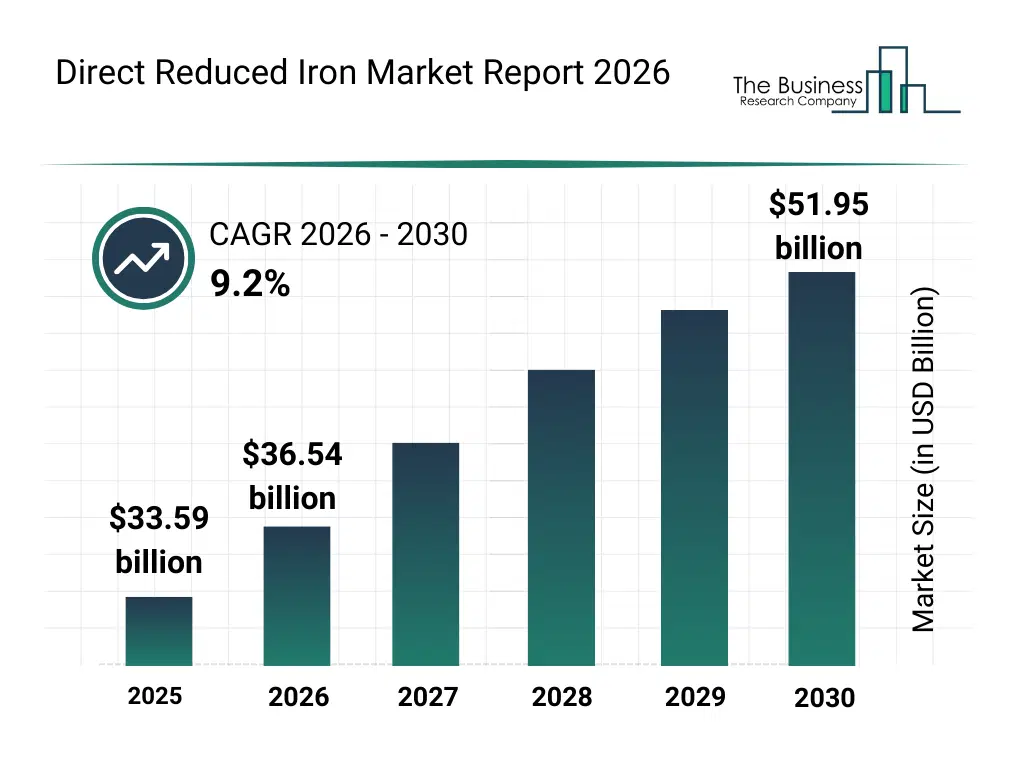
What Is The Direct Reduced Iron Market Size and Share 2026?
The direct reduced iron market size has grown strongly in recent years. It will grow from $33.59 billion in 2025 to $36.54 billion in 2026 at a compound annual growth rate (CAGR) of 8.8%. The growth in the historic period can be attributed to adoption of coal-based dri production, early use of midrex and hyl processes, growth of steel-making industry, increasing sponge iron production to meet demand, rising demand from construction sector.What Is The Direct Reduced Iron Market Growth Forecast?
The direct reduced iron market size is expected to see strong growth in the next few years. It will grow to $51.95 billion in 2030 at a compound annual growth rate (CAGR) of 9.2%. The growth in the forecast period can be attributed to expansion of gas-based dri production capacity, increasing demand for pellets in electric furnaces, adoption of eco-friendly reduction techniques, growth in steel and construction applications, integration of advanced process control and automation. Major trends in the forecast period include growth in gas-based dri production processes, increasing adoption of coal-based sponge iron production, rising demand for pellets and lumps in steel making, expansion of dri usage in construction applications, integration of high-efficiency midrex and hyl processes.
Global Direct Reduced Iron Market Segmentation
1) By Production Process: Coal-Based, Gas-Based Or Midrex 2) By Form: Pellets, Lumps 3) By Application: Electric Arc Furnace (EAF) Steelmaking, Basic Oxygen Furnace (BOF) Or Blast Furnace (BF) Charge Enrichment, Hot Briquetted Iron (HBI) for Merchant Trade, Foundry Applications Subsegments: 1) By Coal-Based: Direct Reduced Iron (DRI) From Coal, Sponge Iron Production Via Coal Gasification 2) By Gas-Based Or Midrex: Midrex Process, Hyl Process (HY-Lite)What Is The Driver Of The Direct Reduced Iron Market?
The rising investments in infrastructure development are expected to propel the growth of the direct reduced iron market. Infrastructure development refers to the process of planning, designing, financing, constructing, and maintaining physical and organizational structures and facilities that are essential for the functioning of a society or economy. DRI is used in the production of steel for constructing infrastructure in the energy sector, further supporting the demand for direct reduced iron. For instance, in July 2025, according to the Office for National Statistics, a UK-based Statistics Authority, total general government investment in infrastructure rose by 2.2% to $38.7 billion (£28.9 billion) in current prices in 2024, compared with 2023.Therefore, rising investments in infrastructure development will drive the growth of the direct reduced iron industry.Key Players In The Global Direct Reduced Iron Market
Major companies operating in the direct reduced iron market report are ArcelorMittal, JFE Steel Corporation, Cleveland-Cliffs Inc., Kobe Steel Ltd., Gallantt Group of Industries, Voestalpine AG, Ternium SA, Nucor Corporation, Mobarakeh Steel Company, Hadeed Steel Industries, Jindal Steel and Power Ltd, Qatar Steel Company, Salzgitter AG, Jindal Shadeed Iron & Steel LLC, Tosyali Algeria, Tata Sponge, Tuwairqi Steel Mills Limited, JSW Ispat Special Products Limited, Midrex Technologies Inc., AM/NS India, Tenova SpA, Khouzestan Steel Company, Essar Steel
This chart is for illustrative purposes; the full report includes a detailed competitor analysis and comprehensive overview of the top 10 companies in the market.
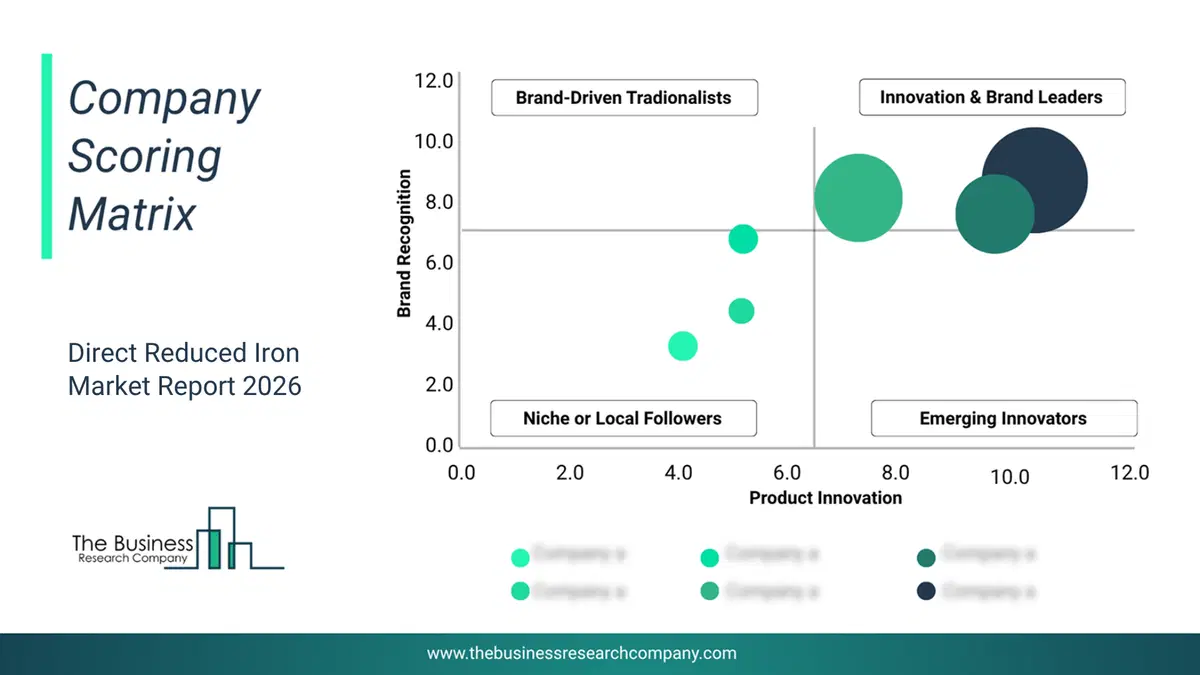
This chart maps companies by product innovation and brand strength, with bubble size indicating relative revenue, helping identify market leaders, challengers, and niche players. This is an illustrative chart; the full report provides a complete and accurate competitive analysis.
Global Direct Reduced Iron Market Trends and Insights
Major companies operating in the direct reduction iron market are focused on strategic investments, such as the direct reduction plant, to meet growing demand and expand their customer base. A direct reduction plant is a facility where iron ore is processed using a reduction process, typically involving the use of natural gas or hydrogen, to produce direct reduced iron (DRI) for steelmaking. For instance, in August 2023, a Germany-based Raw Materials Manufacturing partnership of Namibian and German companies inaugurated the world's largest direct reduction plant for green iron at RWE's Emsland gas-fired power plant site. This facility, funded by a €3 million contribution from the Lower Saxony Ministry of Environment, is dedicated to reducing iron ore exclusively through the utilization of green hydrogen. The project also involves the examination of the application of sponge iron in steel production, starting in 2024. The choice of Lingen as HyIron's location was influenced by the concentrated presence of hydrogen projects in the broader Emsland H2 region, particularly at the RWE's Emsland gas-fired power plant site. In the forthcoming stages, green hydrogen for HyIron will be generated at RWE's 14-megawatt pilot electrolysis plant, slated to commence operations directly adjacent to the direct reduction plant by the end of 2023.What Are Latest Mergers And Acquisitions In The Direct Reduced Iron Market?
In April 2025, Clariant International Limited, a Switzerland-based specialty chemicals company, partnered with Midrex to deepen collaboration in direct reduced iron (DRI) technology and support the decarbonization of steel production. With this partnership, Clariant aims to strengthen its low-carbon syngas and catalyst solutions across the DRI value chain, expand its presence in decarbonization technologies, and accelerate the adoption of lower-CO₂ steelmaking routes. Midrex Technologies Inc is a US-based provider of direct reduced iron (DRI) process technology and plant solutions that help reduce CO₂ emissions in steel production.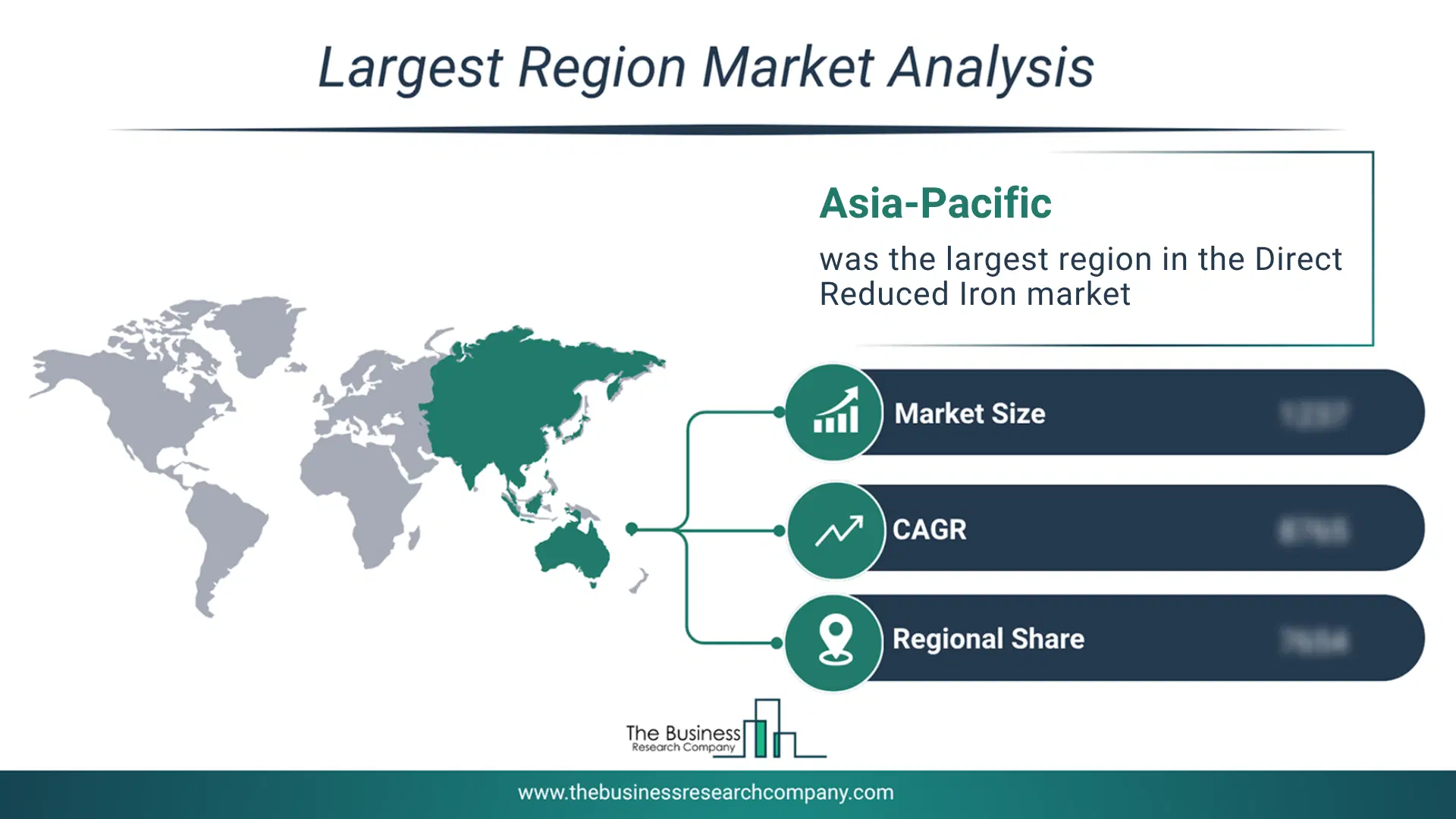
Regional Outlook
Asia-Pacific was the largest region in the direct reduced iron market in 2025. The regions covered in the direct reduced iron market are Asia-Pacific, South East Asia, Western Europe, Eastern Europe, North America, South America, Middle East, Africa. The countries covered in the direct reduced iron market are Australia, Brazil, China, France, Germany, India, Indonesia, Japan, Taiwan, Russia, South Korea, UK, USA, Canada, Italy, Spain.What Defines the Direct Reduced Iron Market?
The direct reduced iron market consists of sales of gas-based direct reduced iron and coal-based direct reduced iron. Values in this market are ‘factory gate’ values, that is the value of goods sold by the manufacturers or creators of the goods, whether to other entities (including downstream manufacturers, wholesalers, distributors and retailers) or directly to end customers. The value of goods in this market includes related services sold by the creators of the goods.How is Market Value Defined and Measured?
The market value is defined as the revenues that enterprises gain from the sale of goods and/or services within the specified market and geography through sales, grants, or donations in terms of the currency (in USD unless otherwise specified). The revenues for a specified geography are consumption values that are revenues generated by organizations in the specified geography within the market, irrespective of where they are produced. It does not include revenues from resales along the supply chain, either further along the supply chain or as part of other products.
This chart presents market attractiveness based on a quantitative evaluation of growth, competition, strategic alignment, and risk, offering a clear view of opportunity areas for decision-making. This chart is for illustrative purposes; the full report contains the complete analysis.

This chart highlights the Total Addressable Market (TAM) by estimating the maximum revenue opportunity using an assumption-driven approach, supporting strategic planning and opportunity sizing across markets. The chart is illustrative; the full report provides a more comprehensive analysis.
What Key Data and Analysis Are Included in the Direct Reduced Iron Market Report 2026?
The direct reduced iron market research report is one of a series of new reports from The Business Research Company that provides market statistics, including Market Report 2026?global market size, regional shares, competitors with the market share, detailed market segments, market trends and opportunities, and any further data you may need to thrive in the direct reduced iron Market Report 2026? The market research report delivers a complete perspective of everything you need, with an in-depth analysis of the current and future state of the Market Report 2026?Direct Reduced Iron Market Report Forecast Analysis
| Report Attribute | Details |
|---|---|
| Market Size Value In 2026 | $36.54 billion |
| Revenue Forecast In 2030 | $51.95 billion |
| Growth Rate | CAGR of 8.8% from 2026 to 2030 |
| Base Year For Estimation | 2025 |
| Actual Estimates/Historical Data | 2020-2025 |
| Forecast Period | 2026 - 2030 |
| Market Representation | Revenue in USD Billion and CAGR from 2026 to 2030 |
| Segments Covered | Production Process, Form, Application |
| Regional Scope | Asia-Pacific, Western Europe, Eastern Europe, North America, South America, Middle East, Africa |
| Country Scope | The countries covered in the report are Australia, Brazil, China, France, Germany, India, Indonesia, Japan, Taiwan, Russia, South Korea, UK, USA, Canada, Italy, Spain. |
| Key Companies Profiled | ArcelorMittal, JFE Steel Corporation, Cleveland-Cliffs Inc., Kobe Steel Ltd., Gallantt Group of Industries, Voestalpine AG, Ternium SA, Nucor Corporation, Mobarakeh Steel Company, Hadeed Steel Industries, Jindal Steel and Power Ltd, Qatar Steel Company, Salzgitter AG, Jindal Shadeed Iron & Steel LLC, Tosyali Algeria, Tata Sponge, Tuwairqi Steel Mills Limited, JSW Ispat Special Products Limited, Midrex Technologies Inc., AM/NS India, Tenova SpA, Khouzestan Steel Company, Essar Steel |
| Customization Scope | Request for Customization |
| Pricing And Purchase Options | Explore Purchase Options |