

Discrete Automation Market Report 2026
Global Outlook – By Type (Product Lifecycle Management (PLM), Manufacturing Execution System (MES), Programmable Logic Controllers (PLC), Distributed Control System (DCS), Other Types), By Component (Solutions, Services), By Application (Packaging, Automotive, Textile, Aerospace And Defense, Other Applications) – Market Size, Trends, Strategies, and Forecast to 2030
Discrete Automation Market Overview
• Discrete Automation market size has reached to $6.35 billion in 2025 • Expected to grow to $8.22 billion in 2030 at a compound annual growth rate (CAGR) of 5.2% • Growth Driver: Efficient Manufacturing Fuels Discrete Automation Market Growth • Market Trend: Technological Advancements Driving A Competitive Edge In The Discrete Automation Market • Asia-Pacific was the largest region in 2025 and North America is the fastest growing region.What Is Covered Under Discrete Automation Market?
Discrete automation refers the use of automated systems to control specific processes or tasks in manufacturing, industrial, or other operational environments. These systems are designed to perform tasks with more accuracy, speed, and dependability, resulting in increased efficiency, productivity, and quality in manufacturing and other industrial operations. The main types of discrete automation are product lifecycle management (PLM), manufacturing execution system (MES), programmable logic controllers (PLC), distributed control system (DCS), and others. Product lifecycle management (PLM) refers to the process of managing the entire lifecycle of a product, from its conception through design and manufacturing to service and disposal. The components are categorized into solutions and services, which are used for several applications, including packaging, automotive, textile, aerospace and defense, food processing, and others.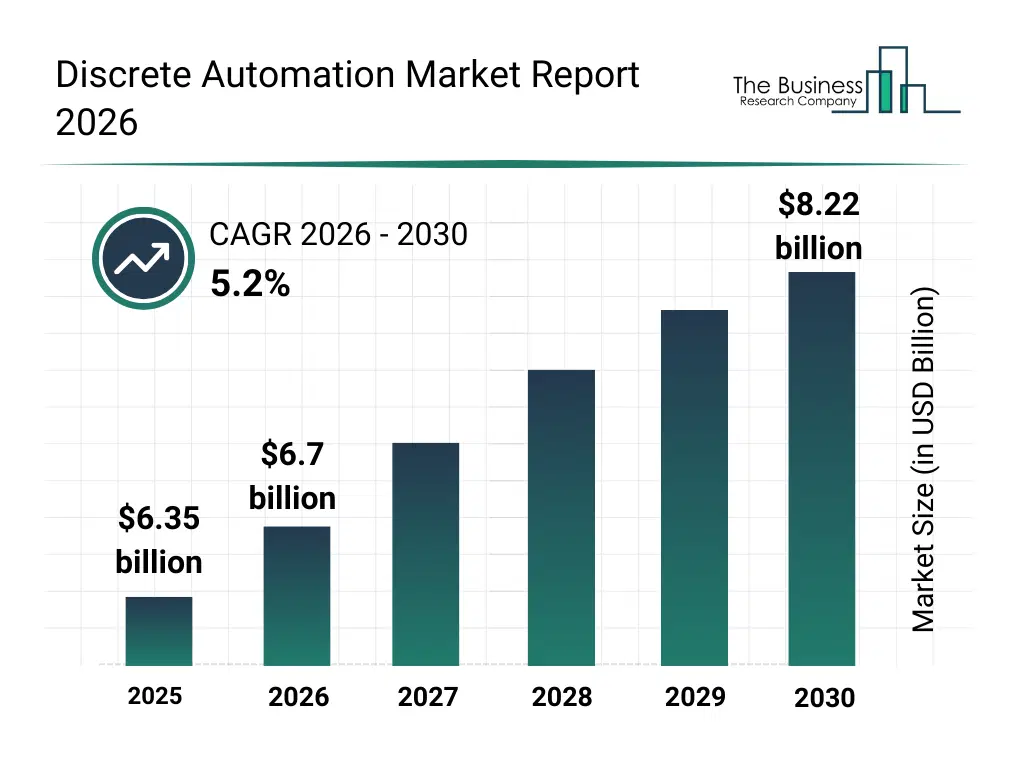
What Is The Discrete Automation Market Size and Share 2026?
The discrete automation market size has grown strongly in recent years. It will grow from $6.35 billion in 2025 to $6.7 billion in 2026 at a compound annual growth rate (CAGR) of 5.4%. The growth in the historic period can be attributed to rising demand for automation in manufacturing, need for precision and efficiency, adoption of plc and dcs systems, expansion of automotive and aerospace industries, focus on quality control and production optimization.What Is The Discrete Automation Market Growth Forecast?
The discrete automation market size is expected to see strong growth in the next few years. It will grow to $8.22 billion in 2030 at a compound annual growth rate (CAGR) of 5.2%. The growth in the forecast period can be attributed to increasing adoption of ai-powered automation, growth of smart factories, demand for iot-enabled process control, shift towards digital twins and simulation, expansion of food processing and packaging automation. Major trends in the forecast period include integration of predictive maintenance systems, real-time production monitoring and analytics, modular and scalable automation solutions, enhanced human-machine interface (hmi) adoption, cloud-based control and remote operations.
Global Discrete Automation Market Segmentation
1) By Type: Product Lifecycle Management (PLM), Manufacturing Execution System (MES), Programmable Logic Controllers (PLC), Distributed Control System (DCS), Other Types 2) By Component: Solutions, Services 3) By Application: Packaging, Automotive, Textile, Aerospace And Defense, Other Applications Subsegments: 1) By Product Lifecycle Management (PLM): Product Data Management (PDM), Product Design And Development, Change Management, Collaboration Tools 2) By Manufacturing Execution System (MES): Production Monitoring, Process Control, Quality Management, Inventory Management, Scheduling And Dispatching 3) By Programmable Logic Controllers (PLC): Modular PLC, Compact PLC, Rack-Mounted PLC 4) By Distributed Control System (DCS): Process Control Systems, Supervisory Control Systems, Integrated Control Systems 5) By Other Types: Human-Machine Interface (HMI), Supervisory Control And Data Acquisition (SCADA), Industrial Robots, Motion Control SystemsWhat Is The Driver Of The Discrete Automation Market?
The increasing demand for efficient manufacturing is expected to propel the growth of the discrete automation market going forward. Efficient manufacturing refers to the ability to produce goods with the lowest possible total cost while minimizing waste of materials, time, and energy and increasing the effectiveness and quality of the work done. Rising labor costs, fluctuating raw material prices, and escalating energy expenses compel manufacturers to seek methods for process optimization and cost reduction, thereby driving the pursuit of efficient manufacturing practices. Discrete automation technologies, including robotics, PLCs (programmable logic controllers), and conveyor systems, streamline production processes by enabling automated assembly lines to operate continuously at consistent speeds, thus enhancing productivity and reducing cycle times. For instance, in July 2024, according to the Office for National Statistics (ONS), a UK-based government agency, in May 2024, monthly production output increased by 0.2%, with growth observed in 7 of the 13 sub-sectors. Therefore, the increasing demand for efficient manufacturing is driving the growth of the discrete automation industry.Key Players In The Global Discrete Automation Market
Major companies operating in the discrete automation market are Hitachi Ltd.; Siemens AG; Mitsubishi Electric Corporation; Honeywell International Inc.; ABB Ltd.; Invensys plc; Toshiba Corporation; Eaton Corporation plc; Emerson Electric Co.; ANDRITZ GROUP; Rockwell Automation Inc.; Omron Corporation; Valmet Oyj; Azbil Corporation; Ingeteam; Chongqing Chuanyi Automation Co. Ltd.; HollySys Automation Technologies; Nanjing Sciyon Automation Group Co. Ltd.; ShanghAI Automation Instrumentation Co. Ltd.; Yokogawa Electric Corporation; SUPCON Technology Co. Ltd.; ShanghAI Xin Hua Control Technology Co. Ltd.; Nanjing Delto Technology.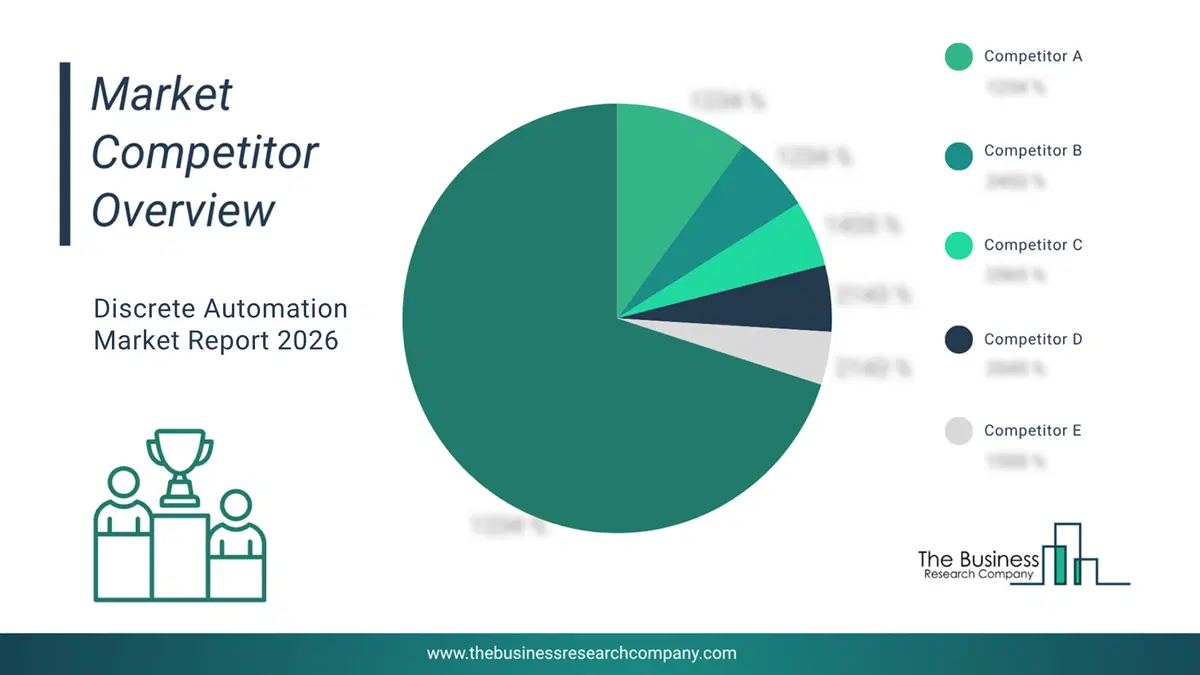
This chart is for illustrative purposes; the full report includes a detailed competitor analysis and comprehensive overview of the top 10 companies in the market.
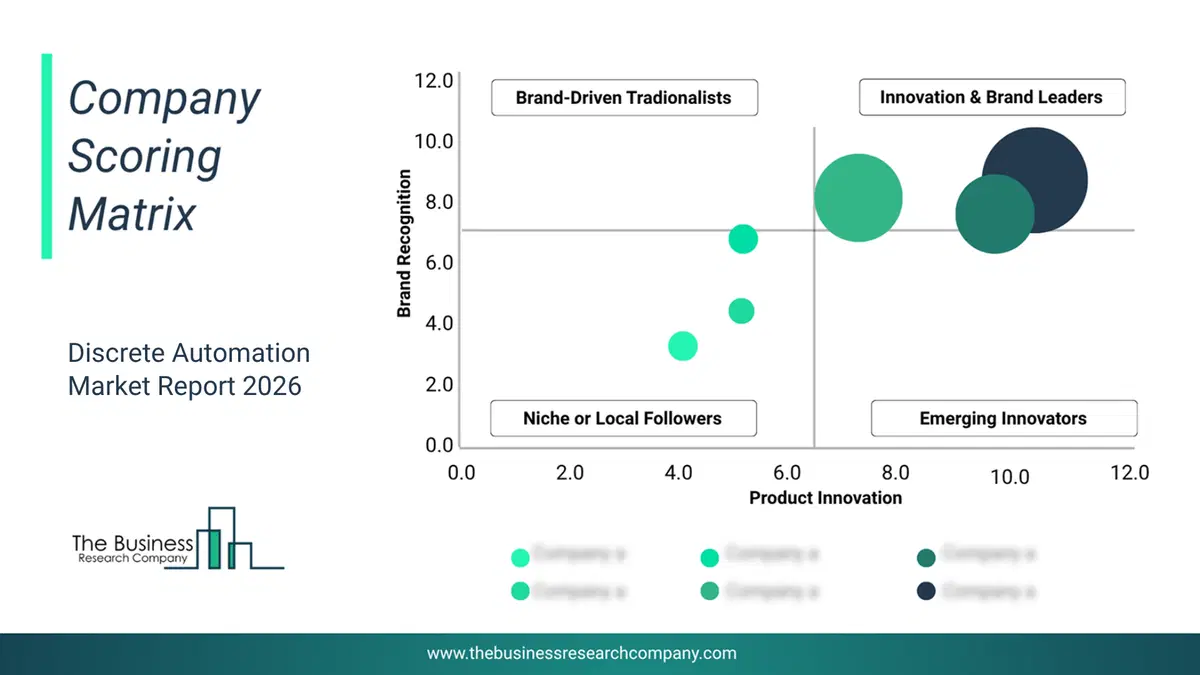
This chart maps companies by product innovation and brand strength, with bubble size indicating relative revenue, helping identify market leaders, challengers, and niche players. This is an illustrative chart; the full report provides a complete and accurate competitive analysis.
Global Discrete Automation Market Trends and Insights
Major companies operating in the discrete automation market are increasing their focus on developing advanced solutions, such as life cycle assessment (LCA) automation, to gain a competitive edge in the market. LCA automation refers to a technology that offers a comprehensive solution for discrete manufacturing, integrating advanced automation technologies to streamline production processes, optimize efficiency, and enhance overall productivity. For instance, in March 2023, Sphera Solutions Inc., a US-based software company, launched the latest advancement in LCA automation, revolutionizing product sustainability practices in discrete manufacturing. With Sphera's new solution, conducting enterprise-wide LCA analyses will transition from months to mere minutes, drastically improving efficiency. By automatically importing primary product data from the Bill of Materials (BOM) and swiftly calculating emissions, this iteration empowers discrete manufacturers to conduct reliable LCAs at scale across their entire product range within condensed timeframes. The ultimate aim of LCA Automation is to enable businesses, particularly those dealing with intricate products, to systematically reduce greenhouse gas (GHG) emissions throughout the production process, aligning with sustainability objectives.What Are Latest Mergers And Acquisitions In The Discrete Automation Market?
In January 2024, ABB Ltd., a Switzerland-based engineering company acquired Sevensense Robotics AG for an undisclosed amount. This acquisition brings advanced sensing technology and a broader product portfolio, significantly enhancing ABB's position in the discrete automation market by meeting growing demand, improving manufacturing efficiency, enhancing safety, reducing costs, and future-proofing manufacturing processes. Sevensense Robotics AG is a Switzerland-based robotics company that develops technology to enable mobile robots to navigate safely and autonomously in dynamic spaces.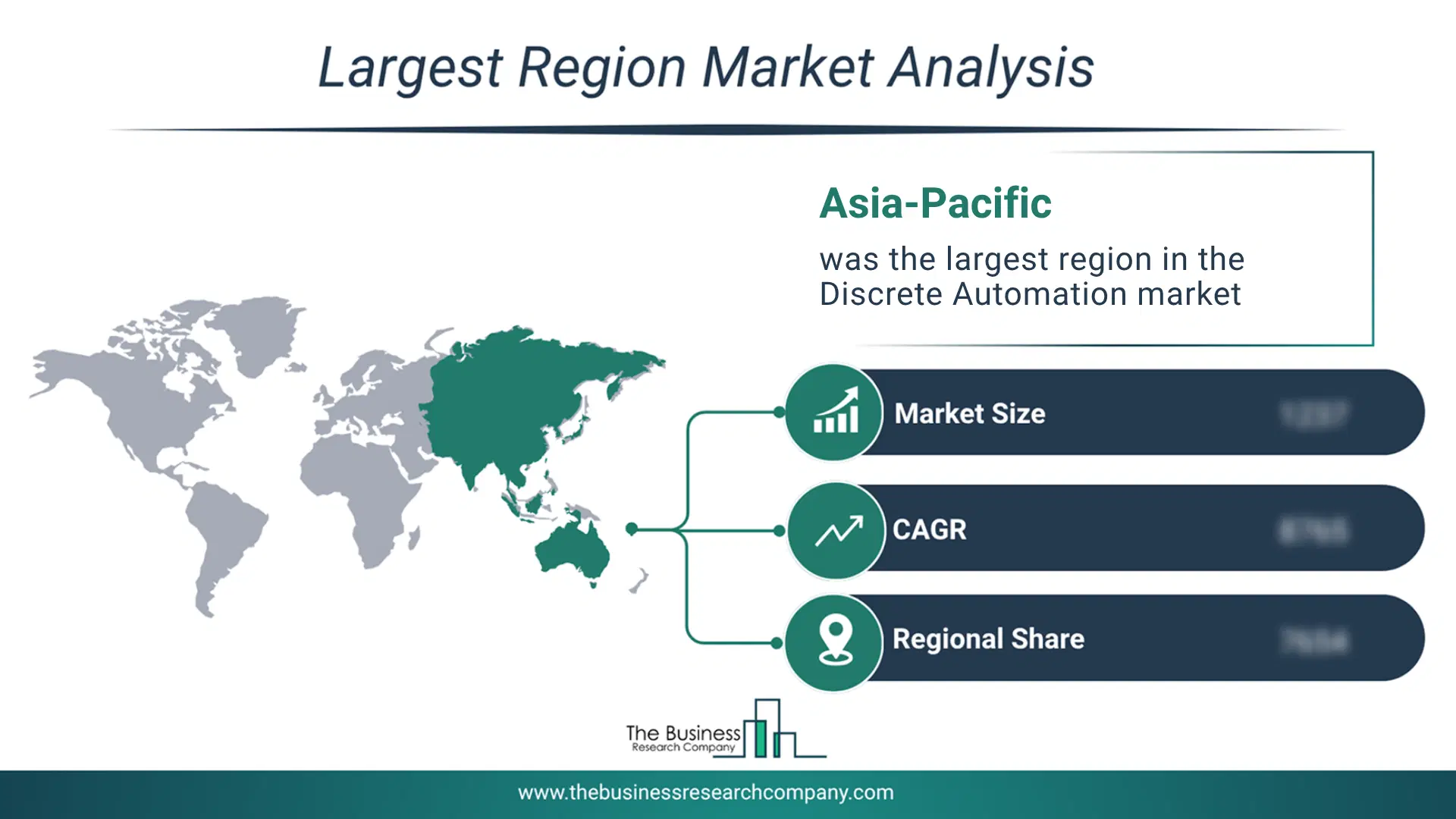
Regional Insights
Asia-Pacific was the largest region in the discrete automation market in 2025. North America is expected to be the fastest-growing region in the forecast period. The regions covered in this market report are Asia-Pacific, South East Asia, Western Europe, Eastern Europe, North America, South America, Middle East, Africa. The countries covered in this market report are Australia, Brazil, China, France, Germany, India, Indonesia, Japan, Taiwan, Russia, South Korea, UK, USA, Canada, Italy, SpainWhat Defines the Discrete Automation Market?
The discrete automation market consists of revenues earned by entities providing services such as consulting, integration, installation, maintenance, repair, and training related to automation technologies. The market value includes the value of related goods sold by the service provider or included within the service offering. The discrete automation market also includes sales of products such as industrial robots, human-machine interface (HMI) systems, motion control systems, sensors, vision systems, and machine vision cameras. Values in this market are ‘factory gate’ values, that is the value of goods sold by the manufacturers or creators of the goods, whether to other entities (including downstream manufacturers, wholesalers, distributors and retailers) or directly to end customers. The value of goods in this market includes related services sold by the creators of the goods.How is Market Value Defined and Measured?
The market value is defined as the revenues that enterprises gain from the sale of goods and/or services within the specified market and geography through sales, grants, or donations in terms of the currency (in USD unless otherwise specified). The revenues for a specified geography are consumption values that are revenues generated by organizations in the specified geography within the market, irrespective of where they are produced. It does not include revenues from resales along the supply chain, either further along the supply chain or as part of other products.
This chart presents market attractiveness based on a quantitative evaluation of growth, competition, strategic alignment, and risk, offering a clear view of opportunity areas for decision-making. This chart is for illustrative purposes; the full report contains the complete analysis.

This chart highlights the Total Addressable Market (TAM) by estimating the maximum revenue opportunity using an assumption-driven approach, supporting strategic planning and opportunity sizing across markets. The chart is illustrative; the full report provides a more comprehensive analysis.
What Key Data and Analysis Are Included in the Discrete Automation Market Report 2026?
The discrete automation market research report is one of a series of new reports from The Business Research Company that provides market statistics, including industry global market size, regional shares, competitors with the market share, detailed market segments, market trends and opportunities, and any further data you may need to thrive in the discrete automation industry. The market research report delivers a complete perspective of everything you need, with an in-depth analysis of the current and future state of the industry.Discrete Automation Market Report Forecast Analysis
| Report Attribute | Details |
|---|---|
| Market Size Value In 2026 | $6.7 billion |
| Revenue Forecast In 2030 | $8.22 billion |
| Growth Rate | CAGR of 5.2% from 2026 to 2030 |
| Base Year For Estimation | 2025 |
| Actual Estimates/Historical Data | 2020-2025 |
| Forecast Period | 2026 - 2030 |
| Market Representation | Revenue in USD Billion and CAGR from 2026 to 2030 |
| Segments Covered | Type, Component, Application |
| Regional Scope | Asia-Pacific, Western Europe, Eastern Europe, North America, South America, Middle East, Africa |
| Country Scope | The Countries Covered In This Market Report Are Australia, Brazil, China, France, Germany, India, Indonesia, Japan, Taiwan, Russia, South Korea, Uk, Usa, Canada, Italy, Spain. |
| Key Companies Profiled | Hitachi Ltd., Siemens AG, Mitsubishi Electric Corporation, Honeywell International Inc., ABB Ltd., Invensys plc, Toshiba Corporation, Eaton Corporation plc, Emerson Electric Co., ANDRITZ GROUP, Rockwell Automation Inc., Omron Corporation, Valmet Oyj, Azbil Corporation, Ingeteam, Chongqing Chuanyi Automation Co. Ltd., HollySys Automation Technologies, Nanjing Sciyon Automation Group Co. Ltd., ShanghAI Automation Instrumentation Co. Ltd., Yokogawa Electric Corporation, SUPCON Technology Co. Ltd., ShanghAI Xin Hua Control Technology Co. Ltd., Nanjing Delto Technology. |
| Customization Scope | Request for Customization |
| Pricing And Purchase Options | Explore Purchase Options |