
Dried Food Market Report 2026
Global Outlook – By Product Type (Dried Fruits, Dried Vegetables, Dried Meat And Seafood, Dried Herbs And Spices, Dried Ready Meals), By Drying Method (Sun Drying, Air Drying, Freeze Drying, Spray Drying, Vacuum Drying), By Nature (Conventional Dried Foods, Organic Dried Foods, Fortified And Enriched Dried Foods, Functional Dried Foods, Gourmet And Premium Dried Foods), By Distribution Channel (Supermarkets And Hypermarkets, Convenience Stores, Online Retail, Specialty Stores), By Application (Household Consumption, Food Processing Industry, Foodservice Industry) – Market Size, Trends, Strategies, and Forecast to 2030
Dried Food Market Overview
• Dried Food market size has reached to $30.66 billion in 2025 • Expected to grow to $32.51 billion in 2030 at a compound annual growth rate (CAGR) of 6.3% • Growth Driver: Rising Consumption Of Ready-To-Eat Meals Fueling The Growth Of The Market Due To Increasing Consumer Demand For Convenient And Time-Saving Food Solutions • Market Trend: Technological Advancements In Drying Techniques Reshaping Competitive Dynamics • Asia-Pacific was the largest region and fastest growing region.What Is Covered Under Dried Food Market?
Dried food refers to food products that have undergone dehydration or moisture removal processes to extend shelf life, preserve nutritional value, and enhance storage stability. These products are processed using methods such as sun drying, freeze drying, spray drying, or air drying to inhibit microbial growth and reduce spoilage. They are engineered to retain flavor, texture, and essential nutrients while enabling easy transportation, storage, and long-term usability without refrigeration. The main product types of dried food comprise dried fruits, dried vegetables, dried meat and seafood, dried herbs and spices, and dried ready meals. Dried fruits refer to fruits that have had most of their moisture content removed through various drying methods, resulting in lightweight, shelf-stable products that retain much of their natural flavor, nutrients, and sweetness while offering extended storage life and convenience for consumption and use in food preparation. The various drying methods include sun drying, air drying, freeze drying, spray drying, and vacuum drying, while the nature of dried foods includes conventional dried foods, organic dried foods, fortified and enriched dried foods, functional dried foods, and gourmet and premium dried foods, and these products are distributed through multiple channels such as supermarkets and hypermarkets, convenience stores, online retail, and specialty stores, and are used in applications including household consumption, the food processing industry, and the foodservice industry.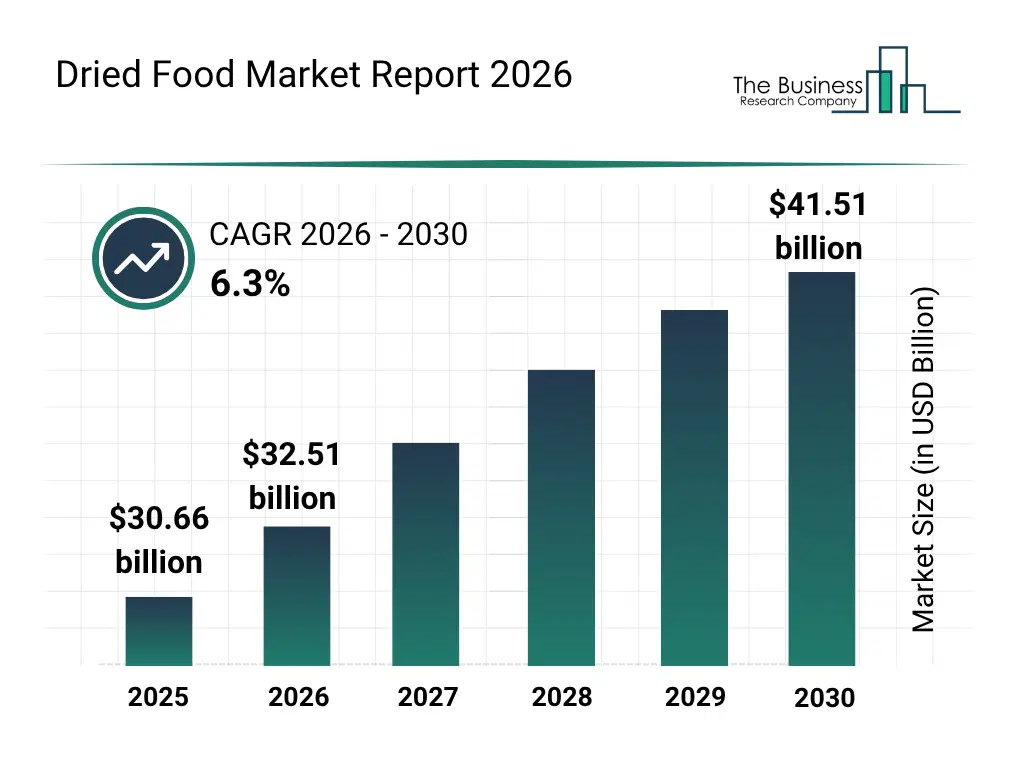
What Is The Dried Food Market Size and Share 2026?
The dried food market size has grown strongly in recent years. It will grow from $30.66 billion in 2025 to $32.51 billion in 2026 at a compound annual growth rate (CAGR) of 6.1%. The growth in the historic period can be attributed to rising demand for long shelf-life foods, expansion of traditional preservation methods, growth in rural food preservation practices, increasing urbanization and packaged food consumption, development of basic food processing infrastructure.What Is The Dried Food Market Growth Forecast?
The dried food market size is expected to see strong growth in the next few years. It will grow to $41.51 billion by 2030 at a compound annual growth rate (CAGR) of 6.3%. The growth in the forecast period can be attributed to rising demand for nutrient-dense convenience foods, growth in premium dried food segments, expansion of e-commerce food distribution, innovation in advanced drying technologies, rising demand for emergency preparedness foods. Major trends in the forecast period include Increasing demand for shelf-stable and convenience-oriented food products, Growth of freeze-dried and premium dried food categories, Rising preference for organic and clean-label dehydrated foods, Expansion of online retail and direct-to-consumer dried food sales, Growing adoption of fortified and functional dried food products.
Global Dried Food Market Segmentation
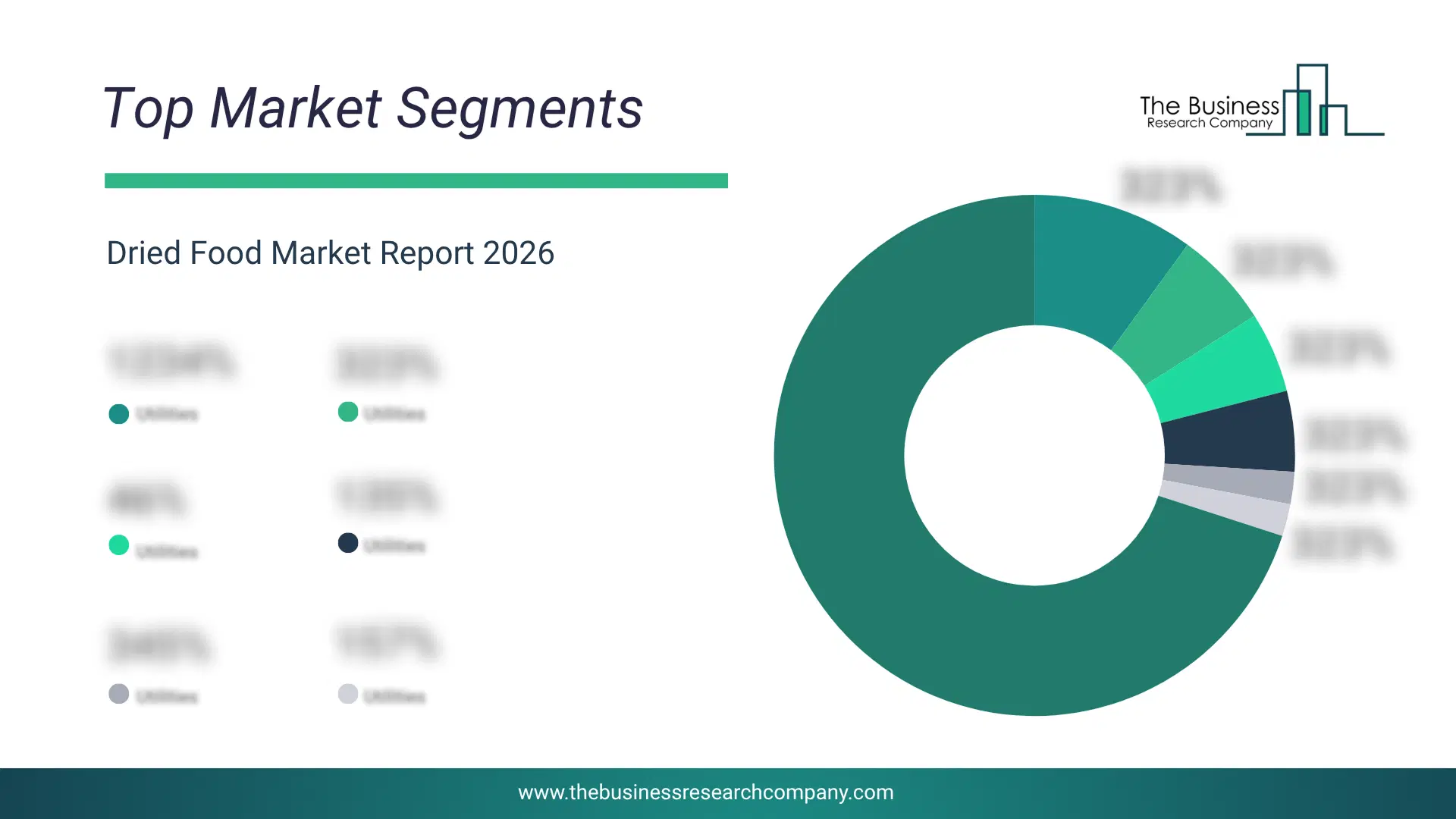
1) By Product Type: Dried Fruits, Dried Vegetables, Dried Meat And Seafood, Dried Herbs And Spices, Dried Ready Meals 2) By Drying Method: Sun Drying, Air Drying, Freeze Drying, Spray Drying, Vacuum Drying 3) By Nature: Conventional Dried Foods, Organic Dried Foods, Fortified And Enriched Dried Foods, Functional Dried Foods, Gourmet And Premium Dried Foods 4) By Distribution Channel: Supermarkets And Hypermarkets, Convenience Stores, Online Retail, Specialty Stores 5) By Application: Household Consumption, Food Processing Industry, Foodservice Industry Subsegments: 1) By Dried Fruits: Sun Dried Fruits, Freeze Dried Fruits, Infused Dried Fruits, Organic Dried Fruits, Sweetened Dried Fruits 2) By Dried Vegetables: Dehydrated Leafy Vegetables, Root Vegetable Dry Products, Freeze Dried Vegetable Mixes, Air Dried Vegetable Products, Organic Dried Vegetables 3) By Dried Meat And Seafood: Dried Red Meat Products, Dried Poultry Products, Dried Fish Products, Dried Shellfish Products, Freeze Dried Meat Products 4) By Dried Herbs And Spices: Dried Culinary Herbs, Ground Spice Products, Whole Spice Products, Organic Herbs And Spices, Blended Seasoning Mixes 5) By Dried Ready Meals: Instant Soup Mixes, Dehydrated Pasta Meals, Freeze Dried Complete Meals, Ready-To-Cook Meal Kits, Ethnic Dried Meal ProductsWhat Is The Driver Of The Dried Food Market?
The rising consumption of ready-to-eat meals is expected to propel the growth of the dried food market going forward. Ready-to-eat meals are fully prepared food products that can be consumed with little or no additional cooking or preparation. Consumption of ready-to-eat meals is increasing due to increasingly time-constrained lifestyles, particularly among working professionals and younger consumer cohorts, which are driving demand for convenient food solutions that minimize preparation time while maintaining nutritional value and taste. Dried food products support the growing consumption of ready-to-eat meals by serving as key components in product formulations, offering shelf-stable, lightweight, and extended shelf-life characteristics that enable efficient storage, transportation, and rapid reconstitution. For instance, in January 2025, according to the National Frozen & Refrigerated Foods Association, a US-based non-profit trade association representing all segments of the frozen and refrigerated foods industry, 88% of Gen Z and millennial consumers in the United States prioritized meals that could be prepared within 45 minutes or less, while 68% relied on frozen food options to streamline daily routines, with year-over-year data indicating continued growth in frozen food purchases compared to 2023 levels. Therefore, the rising consumption of ready-to-eat meals is expected to drive the growth of the dried food industry.Key Players In The Global Dried Food Market
Major companies operating in the dried food market are Cargill Incorporated, Nestlé S.A., Archer Daniels Midland Company, Unilever PLC, Kraft Heinz Company, Olam Food Ingredients, Ajinomoto Co.Inc., Kerry Group plc, McCormick & Company Incorporated, Döhler Group, Bühler Group, Mercer Foods LLC, Sensient Technologies Corporation, Jain Irrigation Systems Ltd., Van Drunen Farms, Meelunie B.V., European Freeze Dry, Paradise Fruits Solutions GmbH, Symrise AG, SensoryEffects Ingredient Solutions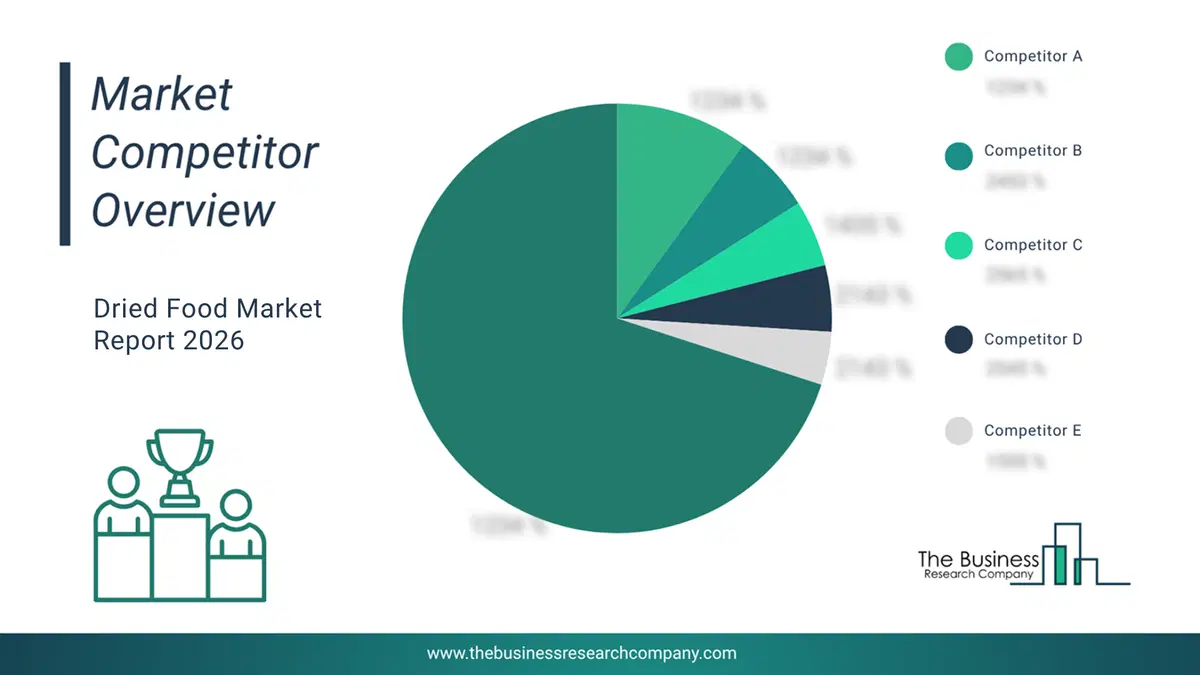
This chart is for illustrative purposes; the full report includes a detailed competitor analysis and comprehensive overview of the top 10 companies in the market.
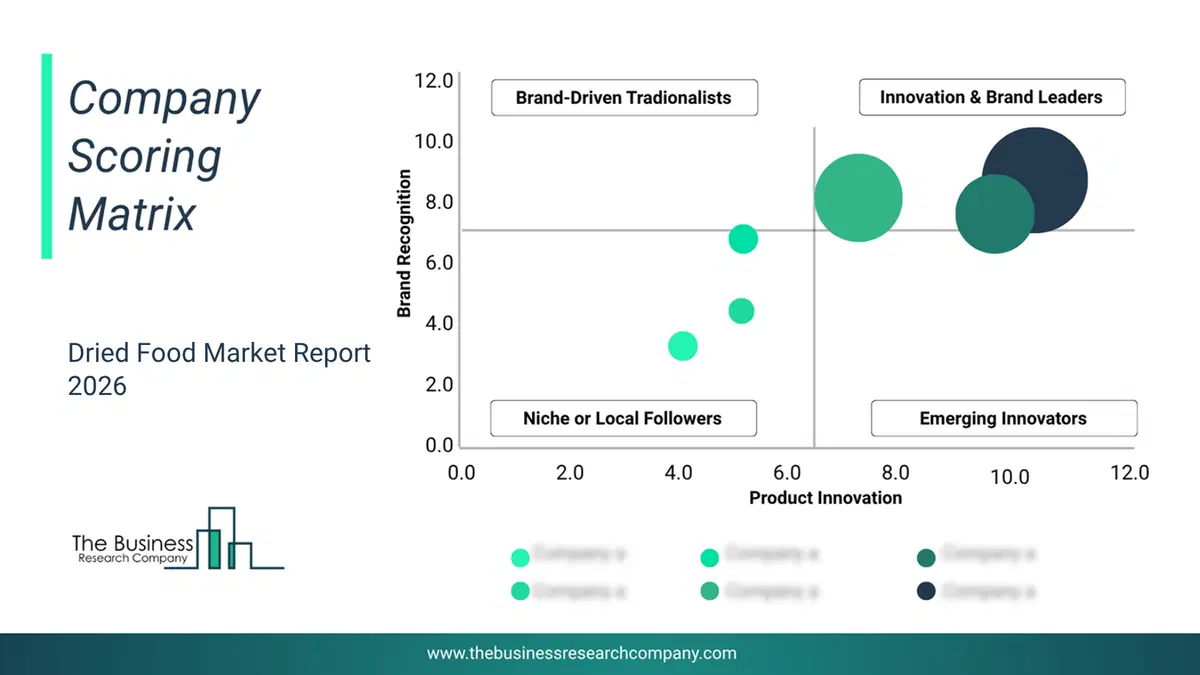
This chart maps companies by product innovation and brand strength, with bubble size indicating relative revenue, helping identify market leaders, challengers, and niche players. This is an illustrative chart; the full report provides a complete and accurate competitive analysis.
Global Dried Food Market Trends and Insights
Major companies operating in the dried food market are increasingly focusing on technological advancements in drying techniques, such as lyophilization, to strengthen their competitive positioning. Lyophilization, or freeze-drying, is an advanced low-temperature dehydration process that removes moisture from food by initially freezing the product and subsequently sublimating the ice under controlled vacuum conditions. This method enables superior preservation of nutritional content, cellular structure, flavor, texture, and overall organoleptic properties compared to conventional heat-based drying techniques, thereby enhancing product quality and shelf stability. For instance, in May 2024, Mountain House, a US-based food manufacturing company, introduced two new freeze-dried Adventure Meals, Chicken Tikka Masala and Kung Pao Chicken, as part of its portfolio expansion in premium ready-to-eat outdoor and emergency food solutions. These products are developed using advanced freeze-drying technology to retain essential vitamins, nutrients, and authentic flavor profiles, while enabling rapid rehydration within minutes through the addition of boiling water.What Are Latest Mergers And Acquisitions In The Dried Food Market?
In December 2025, Mars, Inc., a US-based provider of confectionery, pet care, and diversified food products, acquired Kellanova for $36 billion. Through this acquisition, Mars aims to accelerate its growth in the global snacking and wholesome food segments by integrating a portfolio of established brands, including those offering dried, shelf-stable, and fruit-based snack products, thereby enhancing product diversification and strengthening its presence across high-growth categories. Kellanova is a US-based provider of snacks and convenience foods, including dried snack brands such as Pringles, Cheez-It, and various plant-based products under the MorningStar Farms label.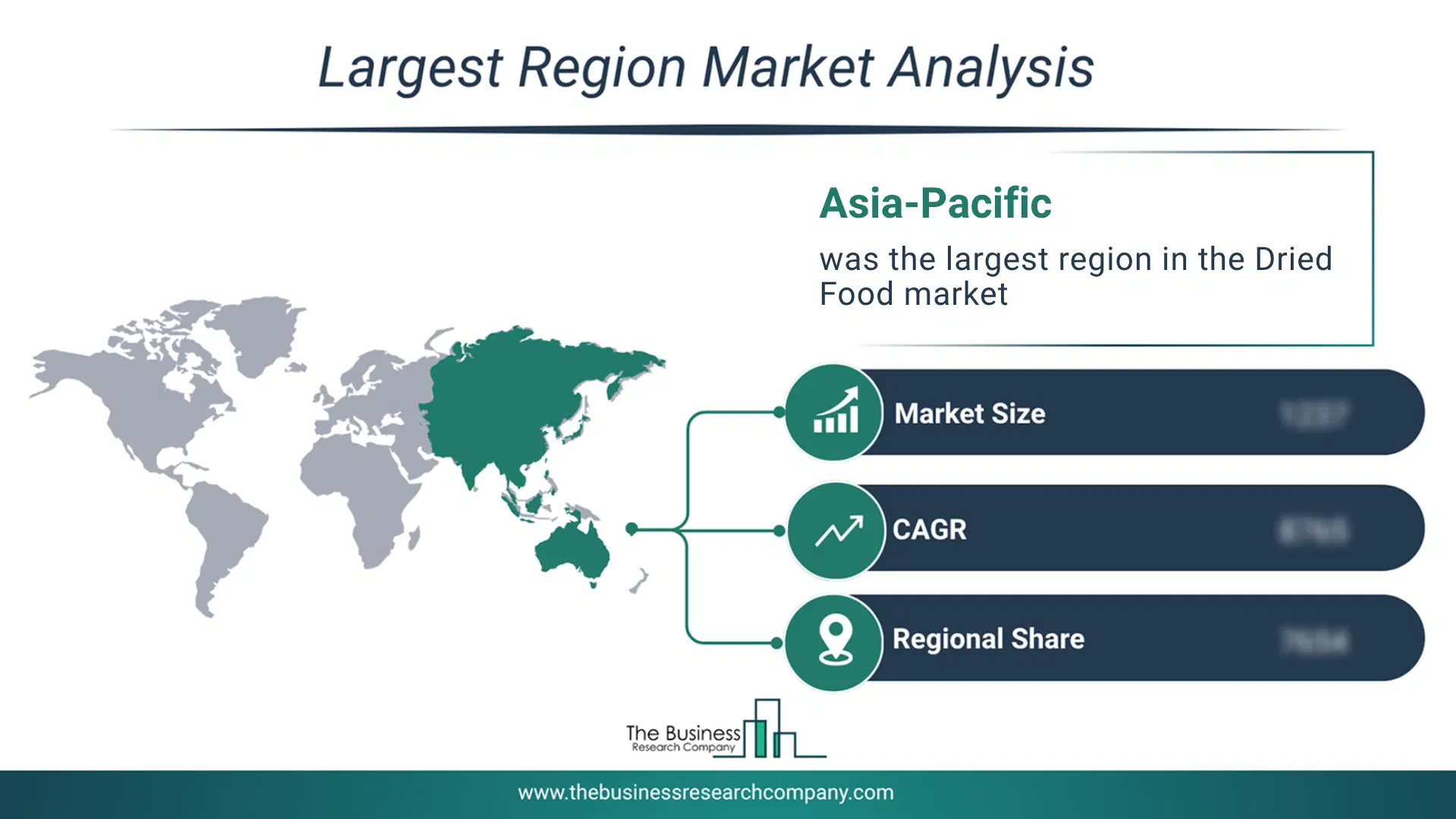
Regional Insights
Asia-Pacific was the largest region in the dried food market in 2025, and it is expected to be the fastest-growing region in the forecast period. The regions covered in this market report are Asia-Pacific, South East Asia, Western Europe, Eastern Europe, North America, South America, Middle East, Africa. The countries covered in this market report are Australia, Brazil, China, France, Germany, India, Indonesia, Japan, Taiwan, Russia, South Korea, UK, USA, Canada, Italy, Spain.What Defines the Dried Food Market?
The dried food market consists of sales of instant soups, powdered food products, dried herbs, dried spices, ready-to-reconstitute meals, and dried dairy products. Values in this market are ‘factory gate’ values, that is, the value of goods sold by the manufacturers or creators of the goods, whether to other entities (including downstream manufacturers, wholesalers, distributors, and retailers) or directly to end customers. The value of goods in this market includes related services sold by the creators of the goods.How is Market Value Defined and Measured?
The market value is defined as the revenues that enterprises gain from the sale of goods and/or services within the specified market and geography through sales, grants, or donations in terms of the currency (in USD unless otherwise specified). The revenues for a specified geography are consumption values that are revenues generated by organizations in the specified geography within the market, irrespective of where they are produced. It does not include revenues from resales along the supply chain, either further along the supply chain or as part of other products.
This chart presents market attractiveness based on a quantitative evaluation of growth, competition, strategic alignment, and risk, offering a clear view of opportunity areas for decision-making. This chart is for illustrative purposes; the full report contains the complete analysis.

This chart highlights the Total Addressable Market (TAM) by estimating the maximum revenue opportunity using an assumption-driven approach, supporting strategic planning and opportunity sizing across markets. The chart is illustrative; the full report provides a more comprehensive analysis.
What Key Data and Analysis Are Included in the Dried Food Market Report 2026?
The dried food market research report is one of a series of new reports from The Business Research Company that provides market statistics, including industry global market size, regional shares, competitors with the market share, detailed market segments, market trends and opportunities, and any further data you may need to thrive in the dried food industry. The market research report delivers a complete perspective of everything you need, with an in-depth analysis of the current and future state of the industry.Dried Food Market Report Forecast Analysis
| Report Attribute | Details |
|---|---|
| Market Size Value In 2026 | $32.51 billion |
| Revenue Forecast In 2030 | $41.51 billion |
| Growth Rate | CAGR of 6.30% from 2026 to 2030 |
| Base Year For Estimation | 2025 |
| Actual Estimates/Historical Data | 2020-2025 |
| Forecast Period | 2026 - 2030 |
| Market Representation | Revenue in USD Billion and CAGR from 2026 to 2030 |
| Segments Covered | Product Type, Drying Method, Nature, Distribution Channel, Application |
| Regional Scope | Asia-Pacific, Western Europe, Eastern Europe, North America, South America, Middle East, Africa |
| Country Scope | The countries covered in the report are Australia, Brazil, China, France, Germany, India, Indonesia, Japan, Taiwan, Russia, South Korea, UK, USA, Canada, Italy, Spain. |
| Key Companies Profiled | Cargill Incorporated, Nestlé S.A., Archer Daniels Midland Company, Unilever PLC, Kraft Heinz Company, Olam Food Ingredients, Ajinomoto Co.Inc., Kerry Group plc, McCormick & Company Incorporated, Döhler Group, Bühler Group, Mercer Foods LLC, Sensient Technologies Corporation, Jain Irrigation Systems Ltd., Van Drunen Farms, Meelunie B.V., European Freeze Dry, Paradise Fruits Solutions GmbH, Symrise AG, SensoryEffects Ingredient Solutions |
| Customization Scope | Request for Customization |
| Pricing And Purchase Options | Explore Purchase Options |