
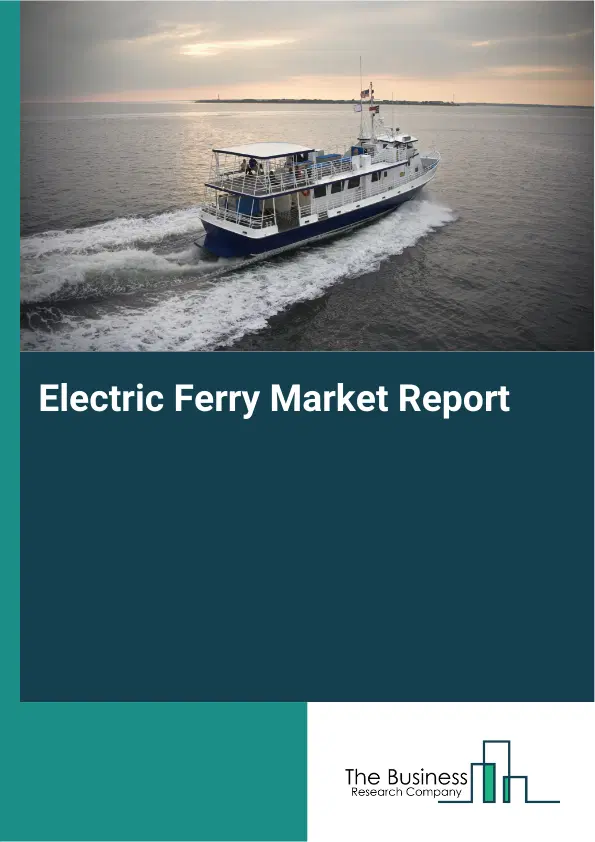
Electric Ferry Market Report 2026
Global Outlook – By Type (Battery Electric Ferry, Plug-In Hybrid Electric Ferry), By Charging Infrastructure (Shore Charging Systems, Onboard Charging Systems, Rapid Charging Stations, Inductive Charging Technologies), By Vessel Type (Passenger Ferries, Vehicle Ferries, Cargo Ferries, High-Speed Ferries), By Application (Municipal, Enterprise), By End User (Public Transportation, Cruise And Tourism, Private Operators, Government And Defence.) – Market Size, Trends, Strategies, and Forecast to 2030
Electric Ferry Market Overview
• Electric Ferry market size has reached to $2.64 billion in 2025 • Expected to grow to $5.25 billion in 2030 at a compound annual growth rate (CAGR) of 14.7% • Growth Driver: Increase In Seaborne Trade Fueling The Growth Of The Electric Ferry Market Due To Rising Demand For Clean And Efficient Marine Transport • Market Trend: Advanced Fully Electric Ferries Driving Growth In The Electric Ferry Market Through Enhanced Sustainability And Emission Reduction • Europe was the largest region in 2025 and Asia-Pacific is the fastest growing region.What Is Covered Under Electric Ferry Market?
Electric ferries are vessels powered entirely by electric energy, typically stored in large onboard batteries, instead of using traditional fuel engines such as diesel. These ferries operate with zero direct emissions, making them a clean and environmentally friendly alternative for transporting passengers and vehicles, especially over short to medium distances. The main types of electric ferries are battery electric ferries and plug-in hybrid electric ferries. A battery electric ferry is a type of watercraft powered entirely by electricity stored in onboard rechargeable batteries rather than using traditional fossil fuels like diesel or gasoline. The charging infrastructure involved includes shore charging systems, onboard charging systems, rapid charging stations, and inductive charging technologies for vessels such as passenger ferries, vehicle ferries, cargo ferries, and high-speed ferries. The various application involved are municipal, enterprise for public transportation, cruise and tourism, private operators, government and defence.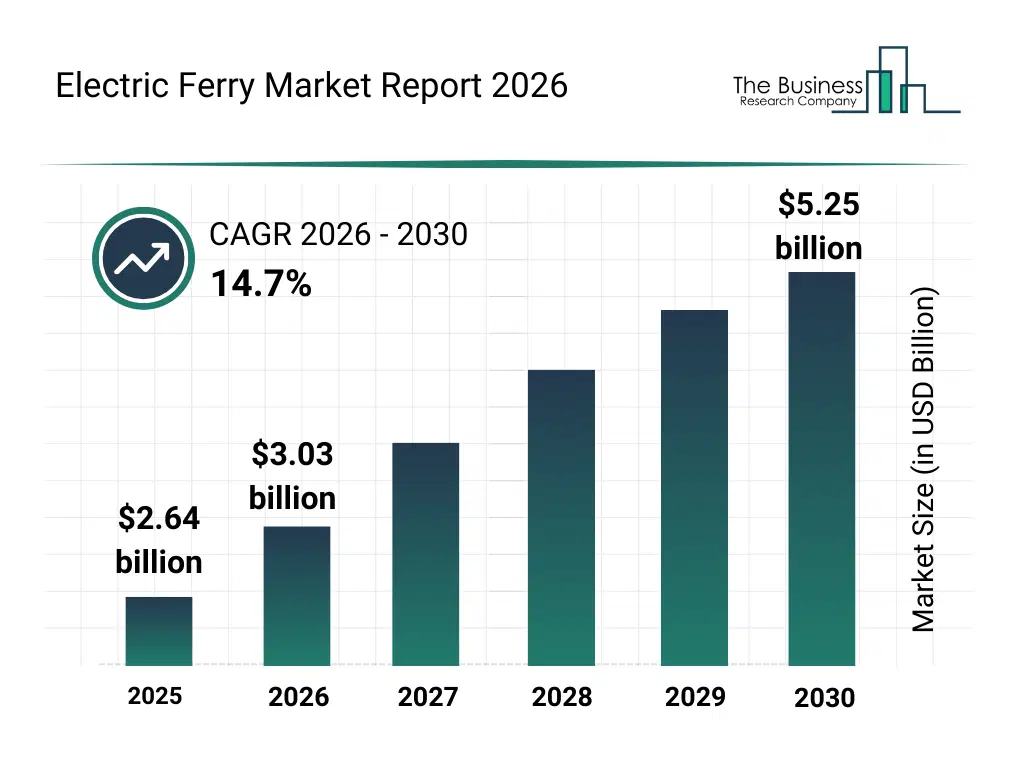
What Is The Electric Ferry Market Size and Share 2026?
The electric ferry market size has grown rapidly in recent years. It will grow from $2.64 billion in 2025 to $3.03 billion in 2026 at a compound annual growth rate (CAGR) of 15.0%. The growth in the historic period can be attributed to government emission regulations, pilot electric ferry projects, rising fuel costs, urban water transport demand, public sector investments.What Is The Electric Ferry Market Growth Forecast?
The electric ferry market size is expected to see rapid growth in the next few years. It will grow to $5.25 billion in 2030 at a compound annual growth rate (CAGR) of 14.7%. The growth in the forecast period can be attributed to increasing decarbonization targets, advancements in marine battery technology, expansion of coastal transport electrification, smart port development, sustainability-driven policies. Major trends in the forecast period include expansion of battery electric ferry fleets, development of fast charging infrastructure, growth of autonomous ferry concepts, adoption of lightweight vessel designs, integration of smart energy management.
Global Electric Ferry Market Segmentation
1) By Type: Battery Electric Ferry, Plug-In Hybrid Electric Ferry 2) By Charging Infrastructure: Shore Charging Systems, Onboard Charging Systems, Rapid Charging Stations, Inductive Charging Technologies 3) By Vessel Type: Passenger Ferries, Vehicle Ferries, Cargo Ferries, High-Speed Ferries 4) By Application: Municipal, Enterprise 5) By End User: Public Transportation, Cruise And Tourism, Private Operators, Government And Defence. Subsegments: 1) By Battery Electric Ferry: Short-Range Commuter Ferries, Medium-Range Passenger Ferries, Fully Autonomous Electric Ferries, Solar-Assisted Electric Ferries 2) By Plug-In Hybrid Electric Ferry: Passenger And Vehicle Ferries, High-Capacity Hybrid Ferries, Diesel-Electric Hybrid Ferries, LNG-Electric Hybrid FerriesWhat Is The Driver Of The Electric Ferry Market?
The increase in seaborne trade is expected to propel the growth of the electric ferry market going forward. Seaborne trade refers to the movement of goods and commodities across global waters in a cost-effective and energy-efficient manner, supported by expanding trade routes, port infrastructure upgrades, and rising demand for key cargoes. The increase in seaborne trade is due to the growth of globalization and international commerce, which has led to higher demand for the transportation of goods across countries. Electric ferries support seaborne trade by offering a cleaner and more efficient mode of transporting goods and passengers over short to medium distances, especially in busy ports and coastal areas. They lower fuel costs and dependence on fossil fuels, enhancing economic efficiency. For instance, in October 2024, according to a report published by the United Nations Conference on Trade and Development (UNCTAD), a Switzerland-based United Nations body focused on trade and development, total seaborne trade is expected to grow at an average annual rate of 2.4% by 2025 to 2029 with containerized trade increasing slightly faster at 2.7% per year. Therefore, the increase in seaborne trade drive growth in the electric ferry industry.Key Players In The Global Electric Ferry Market
Major companies operating in the electric ferry market report include ABB Ltd., Siemens AG, Wärtsilä Corporation, Kongsberg Gruppen, Rolls-Royce Holdings plc, Mitsubishi Heavy Industries, Ltd., Hyundai Heavy Industries Co., Ltd., The Damen Group, Austal Limited, Incat Tasmania Pty Ltd, Havyard Group ASA, Tersan Shipyard, Sefine Shipyard, Norled AS, Stena Line, BC Ferries, Baleària, Corvus Energy, Saft, Leclanché SA, Echandia Marine AB, Siemens Energy Marine Solutions, Vard Group AS, Candela Technology AB, XALT Energy
This chart is for illustrative purposes; the full report includes a detailed competitor analysis and comprehensive overview of the top 10 companies in the market.
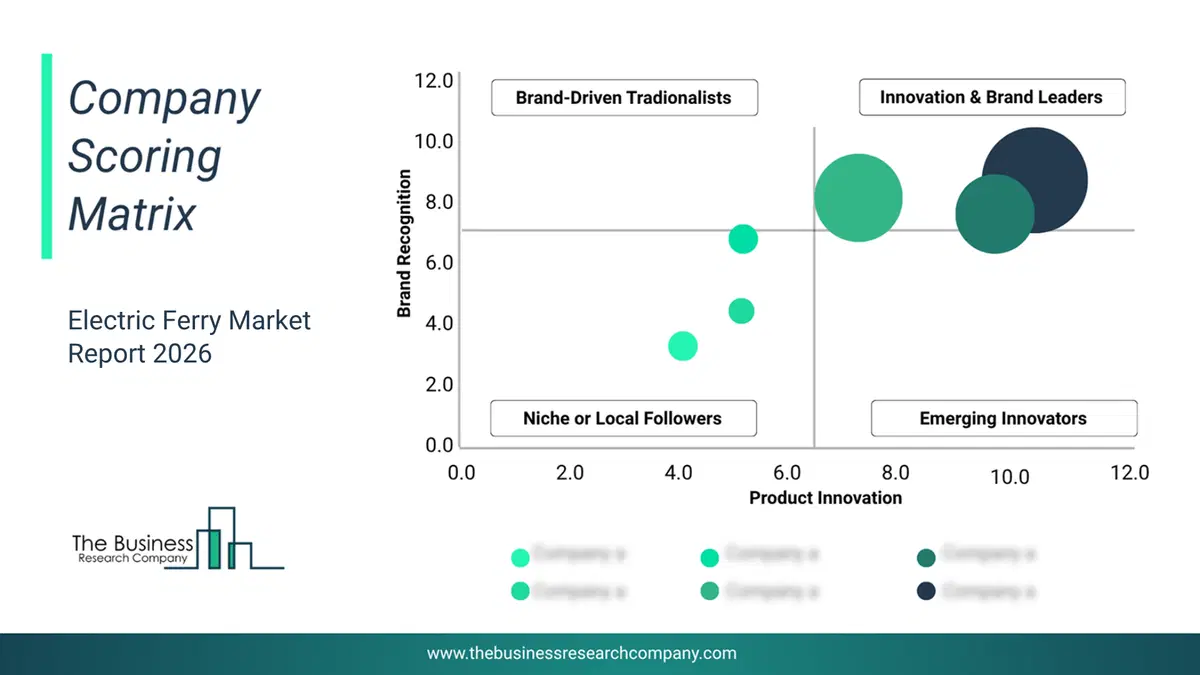
This chart maps companies by product innovation and brand strength, with bubble size indicating relative revenue, helping identify market leaders, challengers, and niche players. This is an illustrative chart; the full report provides a complete and accurate competitive analysis.
Global Electric Ferry Market Trends and Insights
Major companies operating in the electric ferry market are focusing on developing innovative products, such as fully electric ferries, to enhance sustainability, reduce emissions, and improve energy efficiency in maritime transportation. Fully electric ferries operate entirely on advanced battery systems and electric propulsion, aiming to eliminate greenhouse gas emissions while decreasing operational noise and fuel costs. For instance, in May 2025, Incat Tasmania, an Australia-based shipbuilding company, launched Hull 096, a fully electric ferry. This 130-meter vessel can carry up to 2,100 passengers and 225 vehicles. Hull 096 features a lightweight aluminum structure and advanced battery technology, enabling high-speed, zero-emission operations across the Río de la Plata. This launch aims to deliver sustainable marine transport by accelerating the adoption of fully electric vessels, driving the industry’s transition toward electrification and stronger environmental stewardship.What Are Latest Mergers And Acquisitions In The Electric Ferry Market?
In April 2024, Yamaha Motor, a Japan-based manufacturing company engaged in land mobility, marine, robotics, and financial services, acquired Torqeedo for $17 billion. The acquisition aims to strengthen Yamaha’s position in the electric propulsion market by integrating Torqeedo’s advanced electric marine technology, accelerating innovation in sustainable boating solutions, and expanding its global footprint in eco-friendly marine mobility. Torqeedo is a Germany-based manufacturing company of electric and hybrid marine propulsion systems.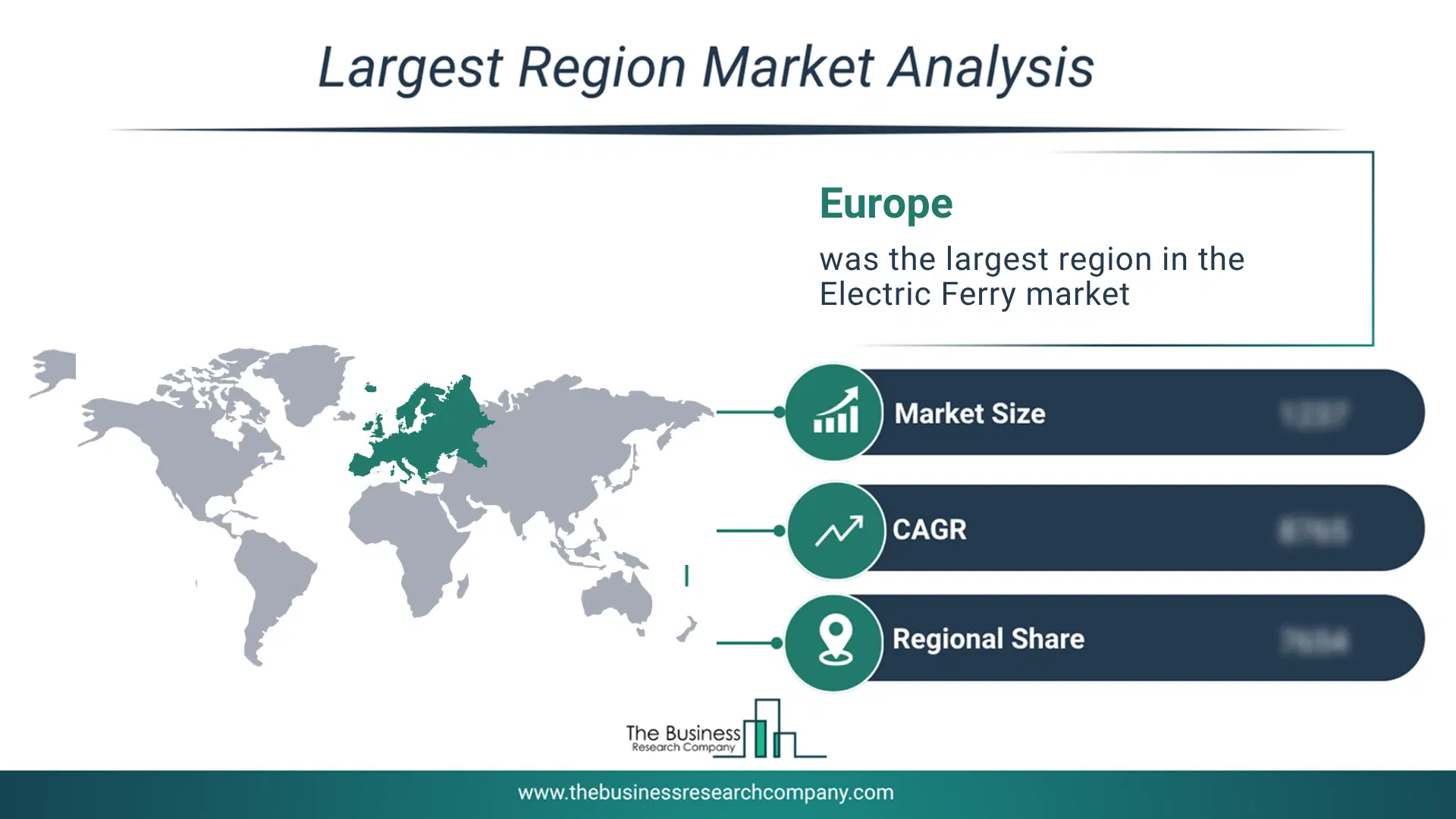
Regional Outlook
Europe was the largest region in the electric ferry market in 2025. Asia-Pacific is expected to be the fastest-growing region in the forecast period. The regions covered in this market report include Asia-Pacific, South East Asia, Western Europe, Eastern Europe, North America, South America, Middle East, Africa. The countries covered in this market report include Australia, Brazil, China, France, Germany, India, Indonesia, Japan, Taiwan, Russia, South Korea, UK, USA, Canada, Italy, SpainWhat Defines the Electric Ferry Market?
The electric ferries market consists of sales fully electric ferries, hybrid-electric ferries, solar-assisted electric ferries, and hydrogen-electric ferries. Values in this market are ‘factory gate’ values, that is the value of goods sold by the manufacturers or creators of the goods, whether to other entities (including downstream manufacturers, wholesalers, distributors and retailers) or directly to end customers. The value of goods in this market includes related services sold by the creators of the goods.How is Market Value Defined and Measured?
The market value is defined as the revenues that enterprises gain from the sale of goods and/or services within the specified market and geography through sales, grants, or donations in terms of the currency (in USD unless otherwise specified). The revenues for a specified geography are consumption values that are revenues generated by organizations in the specified geography within the market, irrespective of where they are produced. It does not include revenues from resales along the supply chain, either further along the supply chain or as part of other products.
This chart presents market attractiveness based on a quantitative evaluation of growth, competition, strategic alignment, and risk, offering a clear view of opportunity areas for decision-making. This chart is for illustrative purposes; the full report contains the complete analysis.

This chart highlights the Total Addressable Market (TAM) by estimating the maximum revenue opportunity using an assumption-driven approach, supporting strategic planning and opportunity sizing across markets. The chart is illustrative; the full report provides a more comprehensive analysis.
What Key Data and Analysis Are Included in the Electric Ferry Market Report 2026?
The electric ferry market research report is one of a series of new reports from The Business Research Company that provides market statistics, including industry global market size, regional shares, competitors with the market share, detailed market segments, market trends and opportunities, and any further data you may need to thrive in the electric ferry industry. The market research report delivers a complete perspective of everything you need, with an in-depth analysis of the current and future state of the industry.Electric Ferry Market Report Forecast Analysis
| Report Attribute | Details |
|---|---|
| Market Size Value In 2026 | $3.03 billion |
| Revenue Forecast In 2030 | $5.25 billion |
| Growth Rate | CAGR of 15.0% from 2026 to 2030 |
| Base Year For Estimation | 2025 |
| Actual Estimates/Historical Data | 2020-2025 |
| Forecast Period | 2026 - 2030 - 2030 |
| Market Representation | Revenue in USD Billion and CAGR from 2026 to 2030 |
| Segments Covered | Type, Charging Infrastructure, Vessel Type, Application, End User |
| Regional Scope | Asia-Pacific, Western Europe, Eastern Europe, North America, South America, Middle East, Africa |
| Country Scope | The countries covered in the report are Australia, Brazil, China, France, Germany, India, Indonesia, Japan, Taiwan, Russia, South Korea, UK, USA, Canada, Italy, Spain. |
| Key Companies Profiled | ABB Ltd., Siemens AG, Wärtsilä Corporation, Kongsberg Gruppen, Rolls-Royce Holdings plc, Mitsubishi Heavy Industries, Ltd., Hyundai Heavy Industries Co., Ltd., The Damen Group, Austal Limited, Incat Tasmania Pty Ltd, Havyard Group ASA, Tersan Shipyard, Sefine Shipyard, Norled AS, Stena Line, BC Ferries, Baleària, Corvus Energy, Saft, Leclanché SA, Echandia Marine AB, Siemens Energy Marine Solutions, Vard Group AS, Candela Technology AB, XALT Energy |
| Customization Scope | Request for Customization |
| Pricing And Purchase Options | Explore Purchase Options |