
Enterprise Large Language Models (LLM) Market Report 2026
Global Outlook – By Component (Software, Hardware, Services), By Deployment Mode (Cloud, On-Premises, Hybrid), By Model Type (General-Purpose Large Language Models (LLMs), Domain-Specific Large Language Models (LLMs), Custom Or Proprietary Large Language Models (LLMs)), By Enterprise Size (Small And Medium Size, Large Enterprises), By Industry Vertical (Banking, Financial Services, And Insurance (BFSI), Healthcare, Retail And E-Commerce, Legal And Compliance, Manufacturing, Other Industry Verticals) – Market Size, Trends, Strategies, and Forecast to 2030
Enterprise Large Language Models (LLM) Market Overview
• Enterprise Large Language Models (LLM) market size has reached to $7.55 billion in 2025 • Expected to grow to $27.77 billion in 2030 at a compound annual growth rate (CAGR) of 29.8% • Growth Driver: Expansion Of Cloud Computing Infrastructure Driving The Market Growth Due To Increasing Demand For AI And Data Processing Capabilities • Market Trend: Advancements In Enterprise Large Language Models Enhance Operational Efficiency and Decision Intelligence • North America was the largest region in 2025 and Asia-Pacific is the fastest growing region.What Is Covered Under Enterprise Large Language Models (LLM) Market?
Enterprise large language models (LLMs) are AI models tailored for organizational use to process, analyze, and generate language based on enterprise-specific data and workflows. They are designed with enhanced security, privacy, compliance, and integration capabilities to operate within corporate IT environments. It is used to enable secure, scalable, and context-aware language intelligence across enterprise operations. The main components of enterprise large language models (LLMs) include software, hardware, and services. Software refers to enterprise-grade LLM platforms and frameworks that enable organizations to develop, fine-tune, deploy, and manage large language models for business-critical applications with governance, security, and scalability controls. The solutions are deployed through cloud, on-premises, and hybrid modes. The model types include general-purpose large language models (LLMs), domain-specific large language models (LLMs), and custom or proprietary large language models (LLMs). The enterprise large language model solutions are adopted by small and medium-sized enterprises and large enterprises. The industry verticals utilizing enterprise large language models include banking, financial services, and insurance (BFSI), healthcare, retail and e-commerce, legal and compliance, manufacturing, and other industry verticals.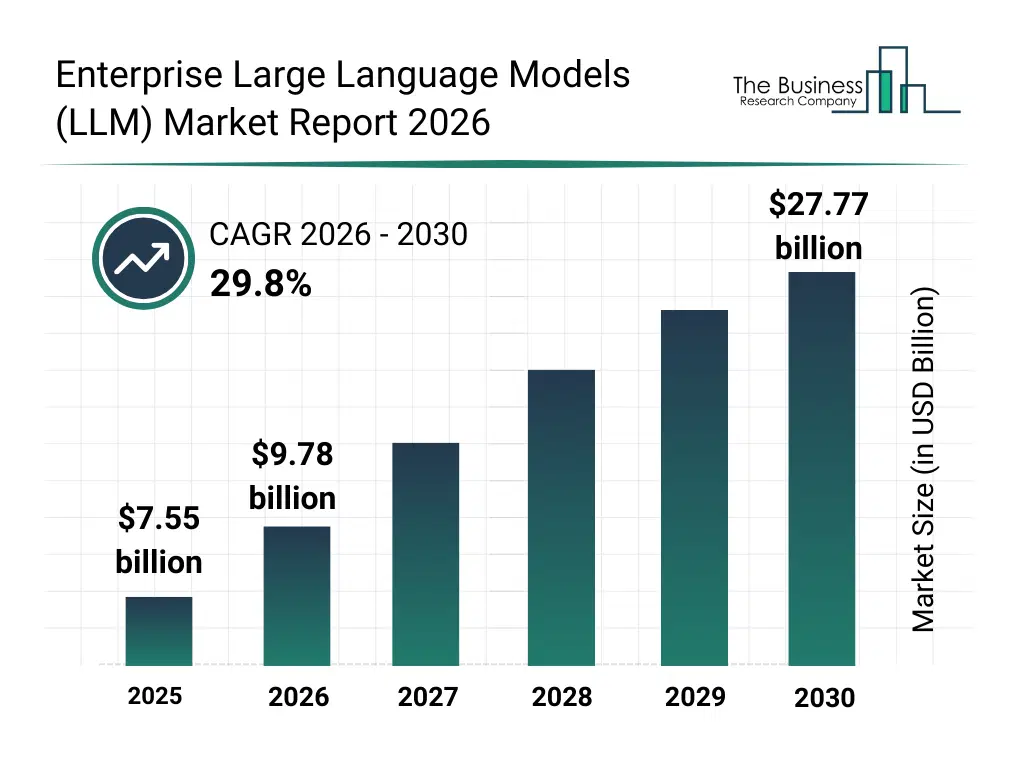
What Is The Enterprise Large Language Models (LLM) Market Size and Share 2026?
The enterprise large language models (llm) market size has grown exponentially in recent years. It will grow from $7.55 billion in 2025 to $9.78 billion in 2026 at a compound annual growth rate (CAGR) of 29.6%. The growth in the historic period can be attributed to increasing enterprise data digitization, growth in cloud-based enterprise software adoption, rising demand for advanced analytics and automation, expansion of enterprise AI pilot programs, availability of high-performance computing infrastructure.What Is The Enterprise Large Language Models (LLM) Market Growth Forecast?
The enterprise large language models (llm) market size is expected to see exponential growth in the next few years. It will grow to $27.77 billion in 2030 at a compound annual growth rate (CAGR) of 29.8%. The growth in the forecast period can be attributed to increasing regulatory scrutiny on AI usage, rising investments in enterprise AI platforms, growing adoption of generative AI across business functions, expansion of hybrid and on-premises AI deployments, increasing demand for explainable and auditable AI systems. Major trends in the forecast period include increasing adoption of domain-specific enterprise llms, rising demand for secure and private model deployment, growing focus on AI governance and compliance tooling, expansion of llm orchestration and monitoring platforms, increasing use of multilingual enterprise language systems.
Global Enterprise Large Language Models (LLM) Market Segmentation
1) By Component: Software; Hardware; Services 2) By Deployment Mode: Cloud; On-Premises; Hybrid 3) By Model Type: General-Purpose Large Language Models (LLMs); Domain-Specific Large Language Models (LLMs); Custom Or Proprietary Large Language Models (LLMs) 4) By Enterprise Size: Small And Medium Size; Large Enterprises 5) By Industry Vertical: Banking, Financial Services, And Insurance (BFSI); Healthcare; Retail And E-Commerce; Legal And Compliance; Manufacturing; Other Industry Verticals Subsegments: 1) By Software: Natural Language Processing Platforms; Model Training And Fine Tuning Tools; Application Programming Interfaces And Integration Tools; Enterprise Knowledge Management Software; Monitoring And Governance Software 2) By Hardware: High Performance Computing Servers; Graphics Processing Unit Accelerators; Tensor Processing Unit Accelerators; Data Storage And Memory Systems; Edge Computing Infrastructure 3) By Services: Consulting And Strategy Services; Model Customization And Fine Tuning Services; System Integration Services; Managed And Support Services; Training And Capability Development ServicesWhat Is The Driver Of The Enterprise Large Language Models (LLM) Market?
The expansion of cloud computing infrastructure is expected to propel the growth of the enterprise Large Language Model (LLM) market going forward. Cloud computing infrastructure refers to the hardware and software components, such as servers, storage systems, networking equipment, and data centers, that enable the delivery of computing services over the internet. The expansion of cloud computing infrastructure is rising due to the rapid adoption of artificial intelligence applications, which require massive computational power and scalable resources that traditional on-premises systems cannot efficiently provide. Expanding cloud infrastructure enables organizations to deploy and scale large language models efficiently by providing the necessary computational resources, storage capacity, and processing power required for training and running sophisticated AI models. For instance, in March 2025, according to the Office for National Statistics, a UK-based government department, in 2023, artificial intelligence (AI) was adopted by 9% of firms, while cloud-based computing systems and applications were adopted by 69% of firms in the UK. Therefore, the expansion of cloud computing infrastructure is driving the growth of the enterprise large language models market.Key Players In The Global Enterprise Large Language Models (LLM) Market
Major companies operating in the enterprise large language models (llm) market are Google LLC, Microsoft Corporation, Meta Platforms Inc., Amazon Web Services Inc., International Business Machines Corporation, Oracle Corporation, SAP SE, Salesforce Inc., Baidu Inc., OpenAI LLC, ServiceNow Inc., Databricks Inc., Palantir Technologies Inc., Snowflake Inc., Anthropic PBC, Scale AI Inc., C3.AI Inc., Mistral AI SAS, Cohere Inc., Together Computer Inc., AI21 Labs Ltd., Writer Technologies Inc., Stability AI Ltd., Aleph Alpha GmbH, and Hugging Face Inc.
This chart is for illustrative purposes; the full report includes a detailed competitor analysis and comprehensive overview of the top 10 companies in the market.
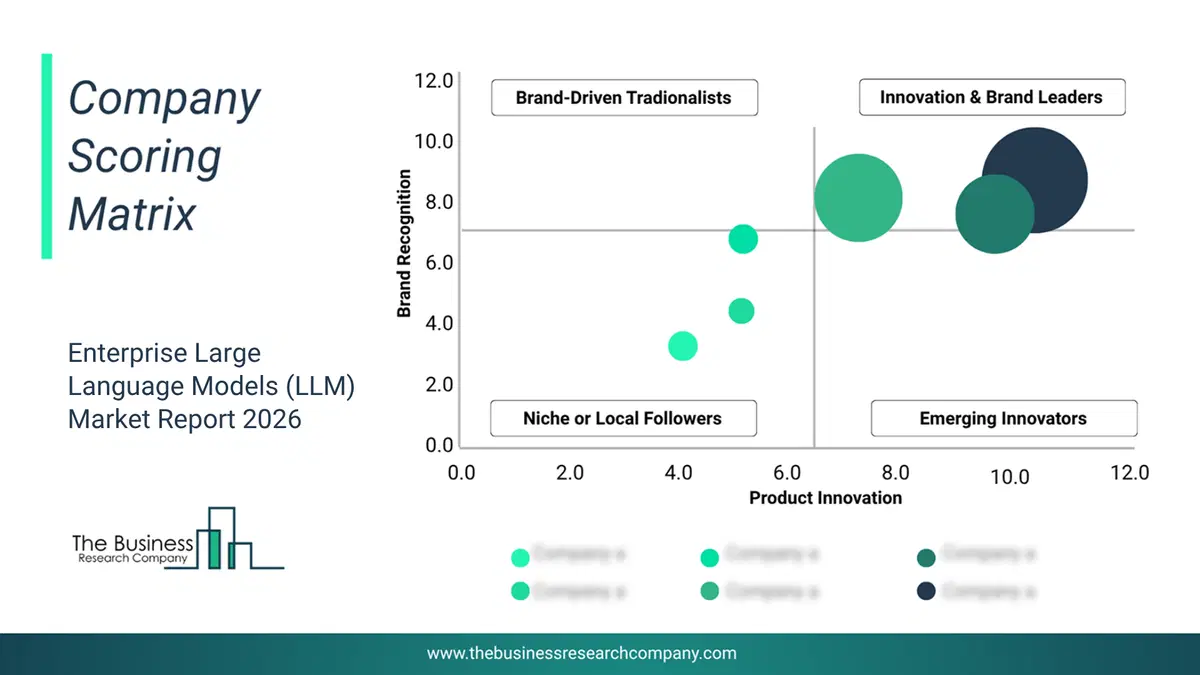
This chart maps companies by product innovation and brand strength, with bubble size indicating relative revenue, helping identify market leaders, challengers, and niche players. This is an illustrative chart; the full report provides a complete and accurate competitive analysis.
Global Enterprise Large Language Models (LLM) Market Trends and Insights
Major companies operating in the enterprise large language model market are focusing on developing technology advancements, such as industry-specific large language models for insurance, to enhance claims processing accuracy and improve regulatory compliance. Industry-specific large language models refer to large language models that are fine-tuned with highly curated, domain-relevant data to perform specialized tasks within a particular industry, enabling more precise data interpretation, automated workflows, and improved decision-making. For instance, in September 2024, EXL, a US-based data analytics and digital operations company, launched the EXL Insurance Large Language Model, designed to handle claims reconciliation, data extraction, anomaly detection, and question answering. The model incorporates retrieval augmented generation for long document processing, supervised fine-tuning with proprietary insurance data, and NeMo Guardrails for controlled input-output management, achieving 30 percent higher task accuracy and lower operational costs compared to generic pre-trained large language models.What Are Latest Mergers And Acquisitions In The Enterprise Large Language Models (LLM) Market?
In December 2025, ServiceNow, Inc., a US-based provider of cloud-based workflow automation platforms and digital service management solutions, acquired Moveworks for an undisclosed amount. Through this acquisition, ServiceNow aims to strengthen its enterprise large language model (LLM) and conversational AI capabilities by integrating Moveworks’ autonomous AI agents to enable intelligent IT service resolution, knowledge retrieval, and workflow automation across enterprise systems while ensuring data security and compliance. Moveworks Inc. is a US-based provider of enterprise-scale large language model (LLM) capabilities as part of its AI platform that’s built specifically for large organizations.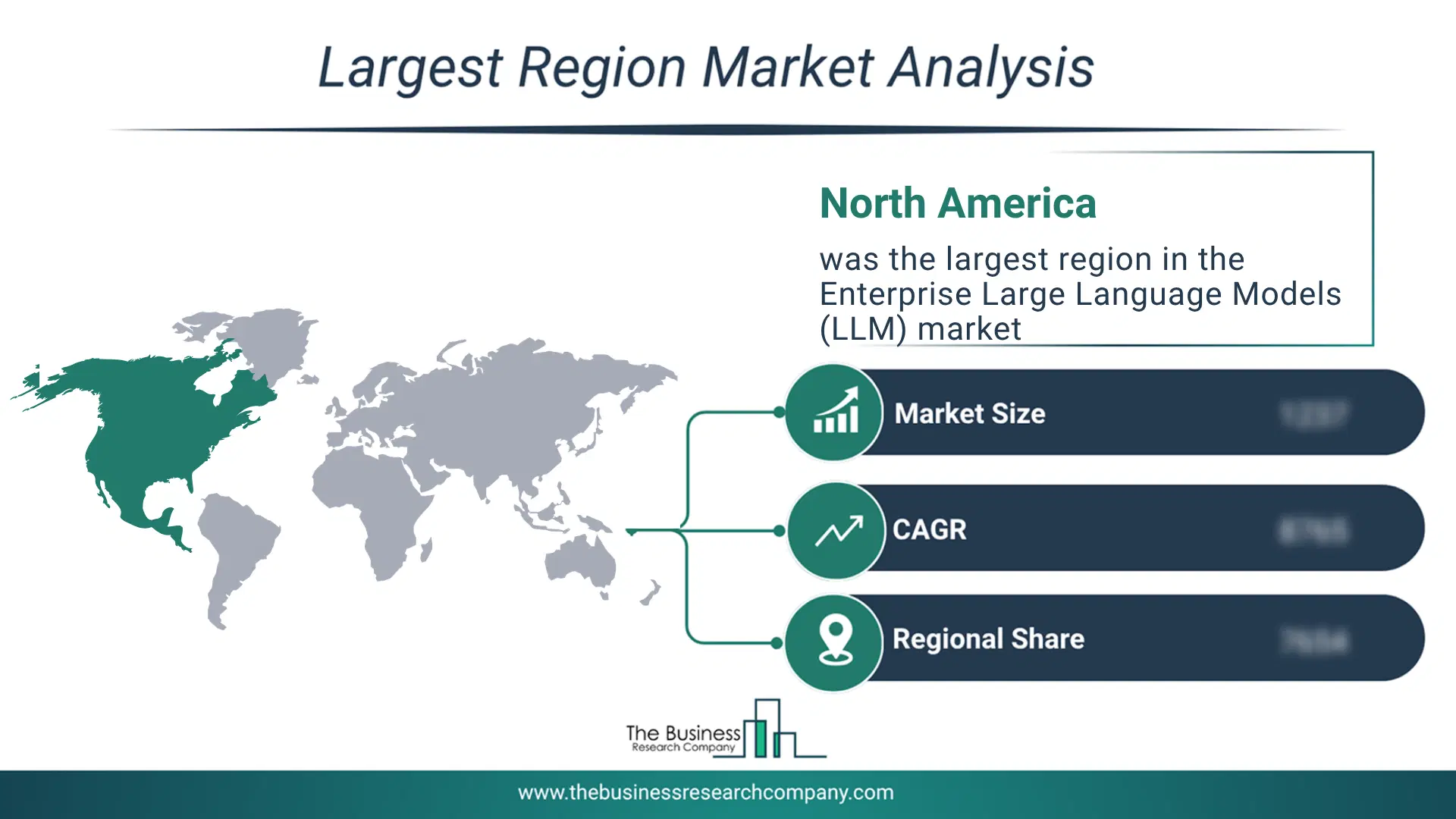
Regional Insights
North America was the largest region in the enterprise large language models (LLM) market in 2025. Asia-Pacific is expected to be the fastest-growing region in the forecast period. The regions covered in this market report are Asia-Pacific, South East Asia, Western Europe, Eastern Europe, North America, South America, Middle East, Africa. The countries covered in this market report are Australia, Brazil, China, France, Germany, India, Indonesia, Japan, Taiwan, Russia, South Korea, UK, USA, Canada, Italy, Spain.What Defines the Enterprise Large Language Models (LLM) Market?
The enterprise large language models (LLMs) market consists of revenues earned by entities by providing services such as custom model fine-tuning, data engineering services, data annotation and labelling, prompt engineering, AI governance and compliance services, cybersecurity and data privacy services, and multilingual language support. The market value includes the value of related goods sold by the service provider or included within the service offering. The enterprise large language models (LLMs) market also includes sales of enterprise prompt management tools, LLM orchestration engines, model monitoring and governance software, and enterprise-ready model compression and optimization tools. Values in this market are ‘factory gate’ values, that is the value of goods sold by the manufacturers or creators of the goods, whether to other entities (including downstream manufacturers, wholesalers, distributors and retailers) or directly to end customers. The value of goods in this market includes related services sold by the creators of the goods.How is Market Value Defined and Measured?
The market value is defined as the revenues that enterprises gain from the sale of goods and/or services within the specified market and geography through sales, grants, or donations in terms of the currency (in USD unless otherwise specified). The revenues for a specified geography are consumption values that are revenues generated by organizations in the specified geography within the market, irrespective of where they are produced. It does not include revenues from resales along the supply chain, either further along the supply chain or as part of other products.
This chart presents market attractiveness based on a quantitative evaluation of growth, competition, strategic alignment, and risk, offering a clear view of opportunity areas for decision-making. This chart is for illustrative purposes; the full report contains the complete analysis.

This chart highlights the Total Addressable Market (TAM) by estimating the maximum revenue opportunity using an assumption-driven approach, supporting strategic planning and opportunity sizing across markets. The chart is illustrative; the full report provides a more comprehensive analysis.
What Key Data and Analysis Are Included in the Enterprise Large Language Models (LLM) Market Report 2026?
The enterprise large language models (llm) market research report is one of a series of new reports from The Business Research Company that provides market statistics, including industry global market size, regional shares, competitors with the market share, detailed market segments, market trends and opportunities, and any further data you may need to thrive in the enterprise large language models (llm) industry. The market research report delivers a complete perspective of everything you need, with an in-depth analysis of the current and future state of the industry.Enterprise Large Language Models (LLM) Market Report Forecast Analysis
| Report Attribute | Details |
|---|---|
| Market Size Value In 2026 | $9.78 billion |
| Revenue Forecast In 2030 | $27.77 billion |
| Growth Rate | CAGR of 29.8% from 2026 to 2030 |
| Base Year For Estimation | 2025 |
| Actual Estimates/Historical Data | 2020-2025 |
| Forecast Period | 2026 - 2030 |
| Market Representation | Revenue in USD Billion and CAGR from 2026 to 2030 |
| Segments Covered | Component, Deployment Mode, Model Type, Enterprise Size, Industry Vertical |
| Regional Scope | Asia-Pacific, Western Europe, Eastern Europe, North America, South America, Middle East, Africa |
| Country Scope | The Countries Covered In This Market Report Are Australia, Brazil, China, France, Germany, India, Indonesia, Japan, Taiwan, Russia, South Korea, Uk, Usa, Canada, Italy, Spain. |
| Key Companies Profiled | Google LLC, Microsoft Corporation, Meta Platforms Inc., Amazon Web Services Inc., International Business Machines Corporation, Oracle Corporation, SAP SE, Salesforce Inc., Baidu Inc., OpenAI LLC, ServiceNow Inc., Databricks Inc., Palantir Technologies Inc., Snowflake Inc., Anthropic PBC, Scale AI Inc., C3.AI Inc., Mistral AI SAS, Cohere Inc., Together Computer Inc., AI21 Labs Ltd., Writer Technologies Inc., Stability AI Ltd., Aleph Alpha GmbH, and Hugging Face Inc. |
| Customization Scope | Request for Customization |
| Pricing And Purchase Options | Explore Purchase Options |