
Epidural Catheter Market Report 2026
Global Outlook – By Type (Continuous Epidural Catheter, Single Dose Epidural Catheter), By Material (Polyurethane, Silicon, Latex), By Application (Hospitals, Clinics, Other Applications), By End User (Adults, Pediatric, Geriatric) - Market Size, Trends, Strategies, and Forecast to 2030
Epidural Catheter Market Overview
• Epidural Catheter market size has reached to $15.81 billion in 2025 • Expected to grow to $80 billion in 2030 at a compound annual growth rate (CAGR) of 38.3% • Growth Driver: Increasing Surgeries Drive Demand For Epidural Catheter • Market Trend: Investment In Epidural Catheters Enhancing Biocompatibility And Design While Boosting Ontario's Manufacturing • North America was the largest region in 2025.What Is Covered Under Epidural Catheter Market?
An epidural catheter is a thin tube inserted into the spine's epidural space to deliver pain-relieving medications directly. It is commonly used for childbirth, surgery, and chronic pain management. Epidural catheters are crucial in pain management and anesthesia, offering targeted and effective pain relief in various medical contexts. The main types of epidural catheters are continuous epidural catheters and single-dose epidural catheters. The continuous epidural catheter is a flexible tube inserted into the epidural space of the spine, allowing for ongoing administration of pain medication. The various materials include polyurethane, silicon, and latex. These are used in various applications such as hospitals, clinics, others and also by various end users such as adults, pediatric, and geriatric.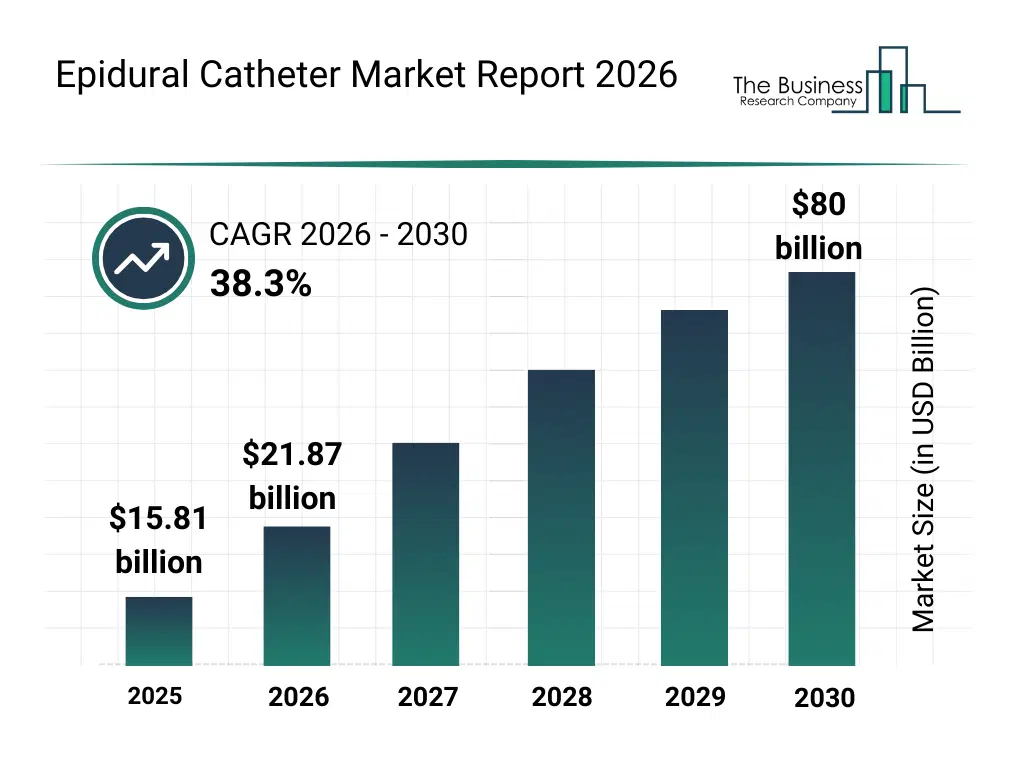
What Is The Epidural Catheter Market Size and Share 2026?
The epidural catheter market size has grown exponentially in recent years. It will grow from $15.81 billion in 2025 to $21.87 billion in 2026 at a compound annual growth rate (CAGR) of 38.4%. The growth in the historic period can be attributed to surgical procedure volumes, childbirth analgesia demand, anesthesia practice adoption, hospital pain management protocols, catheter design improvements.What Is The Epidural Catheter Market Growth Forecast?
The epidural catheter market size is expected to see exponential growth in the next few years. It will grow to $80 billion in 2030 at a compound annual growth rate (CAGR) of 38.3%. The growth in the forecast period can be attributed to minimally invasive surgeries, chronic pain prevalence, outpatient procedure growth, advanced biomaterials, safety-focused device innovation. Major trends in the forecast period include rising demand for labor pain management, increased use in post-surgical analgesia, growth in disposable epidural devices, expansion of chronic pain management applications, emphasis on infection-resistant materials.
Global Epidural Catheter Market Segmentation
1) By Type: Continuous Epidural Catheter, Single Dose Epidural Catheter 2) By Material: Polyurethane, Silicon, Latex 3) By Application: Hospitals, Clinics, Other Applications 4) By End User: Adults, Pediatric, Geriatric Subsegments: 1) By Continuous Epidural Catheter: Multi-Port Continuous Epidural Catheters, Closed Tip Continuous Epidural Catheters, Flexible Tip Continuous Epidural Catheters, Reinforced Continuous Epidural Catheters 2) By Single Dose Epidural Catheter: Standard Single Dose Epidural Catheters, Flexible Single Dose Epidural Catheters, Reinforced Single Dose Epidural Catheters, Multi-Port Single Dose Epidural CathetersWhat Are The Drivers Of The Epidural Catheter Market?
The growing number of surgeries is expected to propel the growth of the epidural catheters market going forward. Surgeries are medical procedures where doctors use tools to treat injuries or illnesses by making cuts in the body to assess and fix problems. The increasing number of surgeries can be attributed to several factors, such as advancements in medical technology, greater awareness and access to healthcare, an aging population with more complex health needs, and evolving surgical techniques that allow for safer and more effective treatments. Epidural catheters offer targeted, adjustable pain relief, significantly improving surgical outcomes and patient comfort. The catheter allows for continuous infusion or patient-controlled analgesia, giving surgeons and patients flexible options for managing pain based on individual needs. For instance, in 2023, according to the International Society of Aesthetic Plastic Surgery, a US-based non-profit organization, the total number of surgical procedures increased from 14,986,982 in 2022 to 15,813,353 in 2023. Therefore, the growing number of surgeries drives the epidural catheter industry. The growing prevalence of chronic pain disorders is expected to propel the growth of the epidural catheter market going forward. Chronic pain refers to persistent or recurrent pain lasting longer than three months, affecting daily activities and quality of life. The prevalence of chronic pain is increasing as more individuals experience conditions such as lower back pain and recognize the impact of persistent pain on their daily activities, leading them to seek effective pain management solutions. Epidural catheters play a crucial role in pain management by delivering targeted analgesia directly to the epidural space, providing sustained relief while minimizing systemic side effects. For instance, in November 2024, according to the Center for Disease Control (CDC), a US-based government agency, in 2023, 24.3% of adults had chronic pain, and 8.5% of adults had high-impact chronic pain. Women were more likely to have chronic pain (25.4%) and high-impact chronic pain (9.6%) than men (23.2% and 7.3%, respectively). Therefore, the growing prevalence of chronic pain disorders is driving the growth of the epidural catheters industry.Key Players In The Global Epidural Catheter Market
Major companies operating in the epidural catheter market are Becton Dickinson and Company, B Braun Melsungen AG, Cook Group Incorporated, Teleflex Incorporated, Halyard Health, Vygon SAS, Argon Medical Devices Inc., Galt Medical Corporation, sfm medical devices GmbH, Pacific Hospital Supply, PAJUNK Medical Produkte GmbH, Flexicare Medical Ltd., Epimed International Inc., Boston Scientific Corporation, Medtronic plc, Merit Medical Systems Inc, Weigao Group Medical Polymer Co Ltd, Hollister Incorporated, Nipro Corporation, Rocket Medical plc, Heka Healthcare
This chart is for illustrative purposes; the full report includes a detailed competitor analysis and comprehensive overview of the top 10 companies in the market.
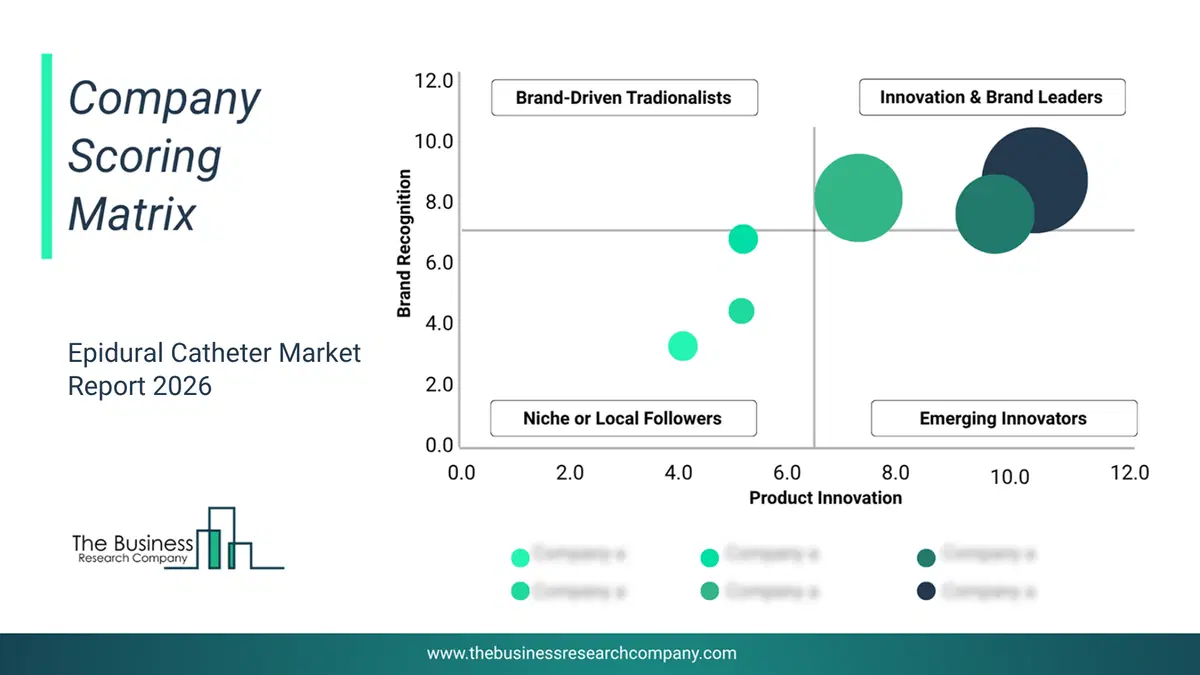
This chart maps companies by product innovation and brand strength, with bubble size indicating relative revenue, helping identify market leaders, challengers, and niche players. This is an illustrative chart; the full report provides a complete and accurate competitive analysis.
Global Epidural Catheter Market Trends and Insights
Major companies operating in the epidural catheters market are focused on investing in producing epidural catheters to provide enhanced biocompatibility, improved design for ease of insertion, and technologies aimed at reducing the risk of complications. These advancements are driven by the increasing demand for safer and more effective pain management solutions in various medical fields, including anesthesiology and chronic pain management. For instance, in May 2023, Oakville Medical, a Canada-based medical company, received support from Canadian Hospital Specialties Limited, a Canada-based hospital, with a $775,000 financial boost from the province's Ontario Together Fund, investing over $1.5 million to produce the epidural catheters, which are used predominantly during childbirth to inject medications for pain relief. This funding is part of a larger investment of over $1.5 million to expand CHS's manufacturing capabilities, particularly for producing epidural catheters.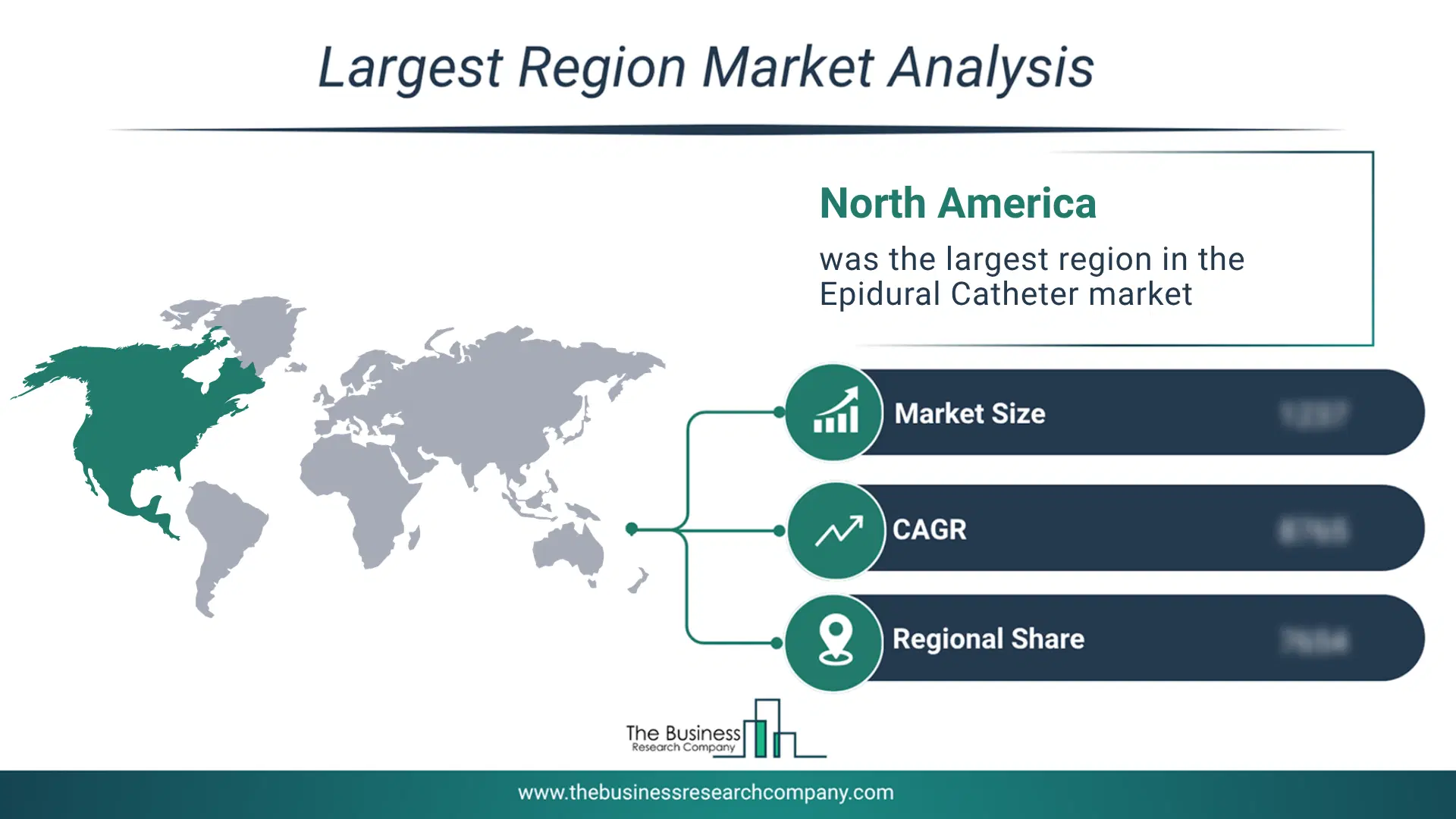
Regional Outlook
North America was the largest region in the epidural catheter market in 2025. The regions covered in this market report are Asia-Pacific, South East Asia, Western Europe, Eastern Europe, North America, South America, Middle East, Africa. The countries covered in this market report are Australia, Brazil, China, France, Germany, India, Indonesia, Japan, Taiwan, Russia, South Korea, UK, USA, Canada, Italy, Spain.What Defines the Epidural Catheter Market?
The epidural catheter market consists of sales of epidural needles, local anesthetics, an infusion pump, syringes, and needles. Values in this market are ‘factory gate’ values, that is, the value of goods sold by the manufacturers or creators of the goods, whether to other entities (including downstream manufacturers, wholesalers, distributors, and retailers) or directly to end customers. The value of goods in this market includes related services sold by the creators of the goods.How is Market Value Defined and Measured?
The market value is defined as the revenues that enterprises gain from the sale of goods and/or services within the specified market and geography through sales, grants, or donations in terms of the currency (in USD unless otherwise specified). The revenues for a specified geography are consumption values that are revenues generated by organizations in the specified geography within the market, irrespective of where they are produced. It does not include revenues from resales along the supply chain, either further along the supply chain or as part of other products.
This chart presents market attractiveness based on a quantitative evaluation of growth, competition, strategic alignment, and risk, offering a clear view of opportunity areas for decision-making. This chart is for illustrative purposes; the full report contains the complete analysis.

This chart highlights the Total Addressable Market (TAM) by estimating the maximum revenue opportunity using an assumption-driven approach, supporting strategic planning and opportunity sizing across markets. The chart is illustrative; the full report provides a more comprehensive analysis.
What Key Data and Analysis Are Included in the Epidural Catheter Market Report 2026?
The epidural catheter market research report is one of a series of new reports from The Business Research Company that provides market statistics, including industry global market size, regional shares, competitors with the market share, detailed market segments, market trends and opportunities, and any further data you may need to thrive in the epidural catheter industry. The market research report delivers a complete perspective of everything you need, with an in-depth analysis of the current and future state of the industry.Epidural Catheter Market Report Forecast Analysis
| Report Attribute | Details |
|---|---|
| Market Size Value In 2026 | $21.87 billion |
| Revenue Forecast In 2030 | $80 billion |
| Growth Rate | CAGR of 38.3% from 2026 to 2030 |
| Base Year For Estimation | 2025 |
| Actual Estimates/Historical Data | 2020-2025 |
| Forecast Period | 2026 - 2030 |
| Market Representation | Revenue in USD Billion and CAGR from 2026 to 2030 |
| Segments Covered | Type, Material, Application, End User |
| Regional Scope | Asia-Pacific, Western Europe, Eastern Europe, North America, South America, Middle East, Africa |
| Country Scope | The countries covered in the report are Australia, Brazil, China, France, Germany, India, Indonesia, Japan, Taiwan, Russia, South Korea, UK, USA, Canada, Italy, Spain |
| Key Companies Profiled | Becton Dickinson and Company, B Braun Melsungen AG, Cook Group Incorporated, Teleflex Incorporated, Halyard Health, Vygon SAS, Argon Medical Devices Inc., Galt Medical Corporation, sfm medical devices GmbH, Pacific Hospital Supply, PAJUNK Medical Produkte GmbH, Flexicare Medical Ltd., Epimed International Inc., Boston Scientific Corporation, Medtronic plc, Merit Medical Systems Inc, Weigao Group Medical Polymer Co Ltd, Hollister Incorporated, Nipro Corporation, Rocket Medical plc, Heka Healthcare |
| Customization Scope | Request for Customization |
| Pricing And Purchase Options | Explore Purchase Options |