
Fiber Optic Transceivers Market Report 2026
Global Outlook – By Type ( Short-Reach Transceivers, Medium-Reach Transceivers, Long-Reach Transceivers, Very-Long-Reach Transceivers, Ultra-Long-Reach Transceivers, Parallel Transceivers), By Form Factor ( Small Form-Factor Pluggable (SFP), Quad Small Form-Factor Pluggable (QSFP), Compact Form-Factor Pluggable (CFP), Mini-Connectorized Transceiver (MCX), Dual In-Line Memory Module (DIMM), Other Form Factors), By Fiber Type ( Single-Mode, Multimode), By Data Rate ( Less Than 10 Gbps, 10 Gbps to 40 Gbps, 41 Gbps to 100 Gbps, More Than 100 Gbps), By Application ( Data Center Networks, Telecommunication Networks, High-Performance Computing (HPC), Consumer Electronics, Industrial Automation, Aerospace And Defense, Medical Imaging) – Market Size, Trends, Strategies, and Forecast to 2030
Fiber Optic Transceivers Market Overview
• Fiber Optic Transceivers market size has reached to $9.63 billion in 2025 • Expected to grow to $17.16 billion in 2030 at a compound annual growth rate (CAGR) of 12.2% • Growth Driver: Rising Demand For High-Speed Low-Latency Connectivity Boosts Market Growth Amid Expanding Data Center Adoption • Market Trend: Innovative Solutions Enable Seamless Real-Time Communication • North America was the largest region in 2025 and Asia-Pacific is the fastest growing region.What Is Covered Under Fiber Optic Transceivers Market?
A fiber optic transceiver is a device that transmits and receives data over fiber optic cables, converting electrical signals to optical signals and then converting incoming optical signals back into electrical signals. It enables high-speed, long-distance communication with minimal signal loss. These transceivers are widely used in telecommunications, data centers, and enterprise networking for efficient data transmission. The main types of fiber optic transceivers are short-reach transceivers, medium-reach transceivers, long-reach transceivers, very-long-reach transceivers, ultra-long-reach transceivers, and parallel transceivers. Short-reach transceivers are optical transceivers designed for data transmission over relatively short distances, up to 300 meters using multimode fiber (MMF). Various form factors include small form-factor pluggable (SFP), quad small form-factor pluggable (QSFP), compact form-factor pluggable (CFP), mini-connectorized transceiver (MCX), dual in-line memory module (DIMM), and others. Fiber types are divided into single-mode and multimode. Data rates are classified into less than 10 Gbps, 10 Gbps to 40 Gbps, 41 Gbps to 100 Gbps, and more than 100 Gbps. Key applications include data center networks, telecommunication networks, high-performance computing (HPC), consumer electronics, industrial automation, aerospace and defense, medical imaging, and others.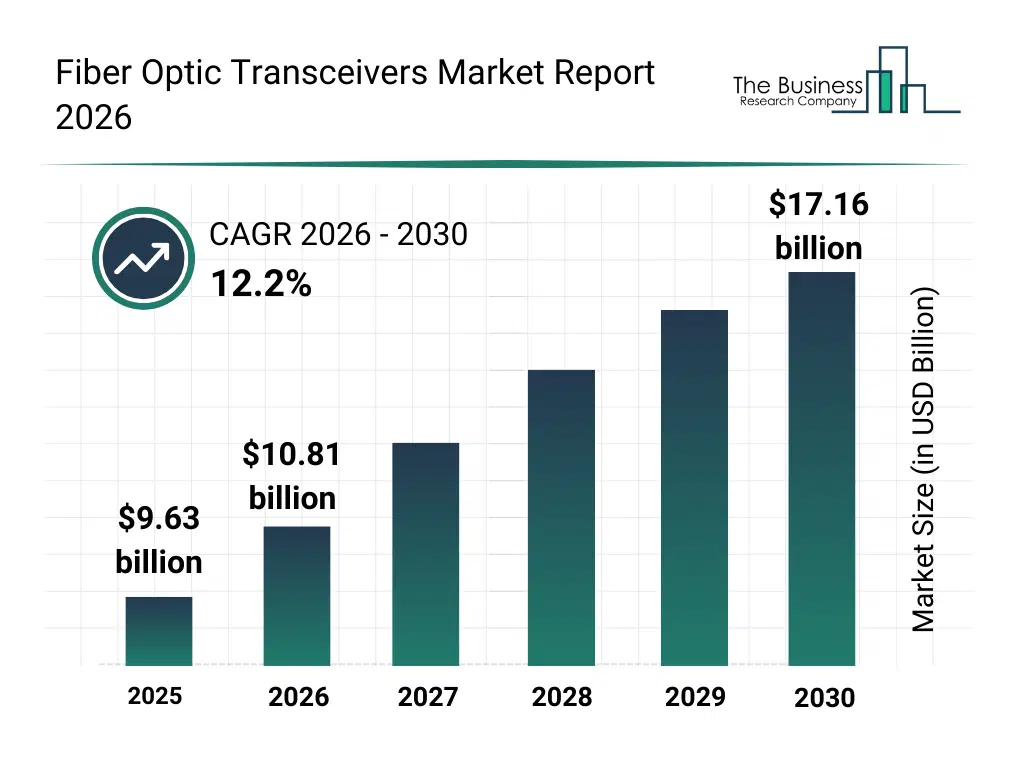
What Is The Fiber Optic Transceivers Market Size 2026 And Growth Rate?
The fiber optic transceivers market size has grown rapidly in recent years. It will grow from $9.63 billion in 2025 to $10.81 billion in 2026 at a compound annual growth rate (CAGR) of 12.3%. The growth in the historic period can be attributed to increasing demand for high-speed internet, expansion of telecommunication networks, early adoption of fiber optic technology, rising internet penetration, need for long-distance communication.What Is The Fiber Optic Transceivers Market Growth Forecast?
The fiber optic transceivers market size is expected to see rapid growth in the next few years. It will grow to $17.16 billion in 2030 at a compound annual growth rate (CAGR) of 12.2%. The growth in the forecast period can be attributed to growth of 5g networks, surge in cloud computing and data centers, demand for high-bandwidth applications, expansion in smart cities and iot infrastructure, rise in telecommunication infrastructure investment. Major trends in the forecast period include high-speed data transmission adoption, growth in cloud data centers, expansion in telecommunication infrastructure, miniaturization of network devices, energy-efficient optical networking.
Global Fiber Optic Transceivers Market Segmentation
1) By Type: Short-Reach Transceivers, Medium-Reach Transceivers, Long-Reach Transceivers, Very-Long-Reach Transceivers, Ultra-Long-Reach Transceivers, Parallel Transceivers 2) By Form Factor: Small Form-Factor Pluggable (SFP), Quad Small Form-Factor Pluggable (QSFP), Compact Form-Factor Pluggable (CFP), Mini-Connectorized Transceiver (MCX), Dual In-Line Memory Module (DIMM), Other Form Factors 3) By Fiber Type: Single-Mode, Multimode 4) By Data Rate: Less Than 10 Gbps, 10 Gbps to 40 Gbps, 41 Gbps to 100 Gbps, More Than 100 Gbps 5) By Application: Data Center Networks, Telecommunication Networks, High-Performance Computing (HPC), Consumer Electronics, Industrial Automation, Aerospace And Defense, Medical Imaging, Other Applications Subsegments: 1) By Short-Reach Transceivers: Short-Range (SR), Short-Range 4-Lane (SR4), Multi-Mode Fiber (MMF) Transceivers 2) By Medium-Reach Transceivers: Long-Range (LR), Long-Range 4-Lane (LR4), Single-Mode Fiber (SMF) Transceivers 3) By Long-Reach Transceivers: Extended-Range (ER), Extended-Range 4-Lane (ER4), CWDM Transceivers 4) By Very-Long-Reach Transceivers: Ultra-Long-Range (ZR), Extended (ZR+), DWDM Transceivers 5) By Ultra-Long-Reach Transceivers: Coherent Optical Transceivers, 400G ZR Or ZR+ Transceivers, Submarine Network Transceivers 6) By Parallel Transceivers: Quad Small Form-factor Pluggable (QSFP), C Form-Factor Pluggable (CFP), 100G Parallel Optics (CXP)What Is The Driver Of The Fiber Optic Transceivers Market?
The growing adoption of data centers is expected to propel the growth of the fiber optic transceivers market going forward. A data center is a physical facility used to house computer systems, servers, and networking equipment for the storage, management, and processing of large volumes of data. The number of data centers is increasing due to factors such as growing demand for cloud services, the rise of big data and analytics, the expansion of 5G networks, the need for enhanced data storage and security and the rapid adoption of Internet of Things (IoT) devices. Fiber optic transceiver helps data centers by enabling high-speed, long-distance data transmission with low latency and high bandwidth, ensuring efficient connectivity between servers, switches, and storage devices. For instance, in January 2025, according to CBRE, a US-based commercial real estate services and investment firm, data center availability in Latin America saw a modest increase driven primarily by expanded capacity in São Paulo, where availability rose from 52.3 MW in 2023 to 62.1 MW in 2024. Therefore, the growing adoption of data centers is driving the growth of the fiber optic transceivers industry.Key Players In The Global Fiber Optic Transceivers Market
Major companies operating in the fiber optic transceivers market are Hon HAI Precision Industry Co. Ltd., Huawei Technologies Co. Ltd., Cisco Systems Inc., Broadcom Inc., Sumitomo Electric Industries Ltd., Fujitsu Limited, NVIDIA Corporation, Texas Instruments Incorporated, Infineon Technologies AG, Fujikura Ltd., Juniper Networks Inc., Arista Networks Inc., Ciena Corporation, Coherent Corp., Belden Inc., Samtec Inc., Lumentum Operations LLC, Accelink Technologies Corporation, Source Photonics Inc., Allied Telesis Inc., FS.COM Inc., New H3C Technologies Co. Ltd., InnoLight Technology Corporation, Hisense Broadband Inc., Finisar Corporation, Optoway Technology Inc., Gigalight, QSFPTEK Technology Co. Ltd, ZTE Corporation, Perle Systems
This chart is for illustrative purposes; the full report includes a detailed competitor analysis and comprehensive overview of the top 10 companies in the market.
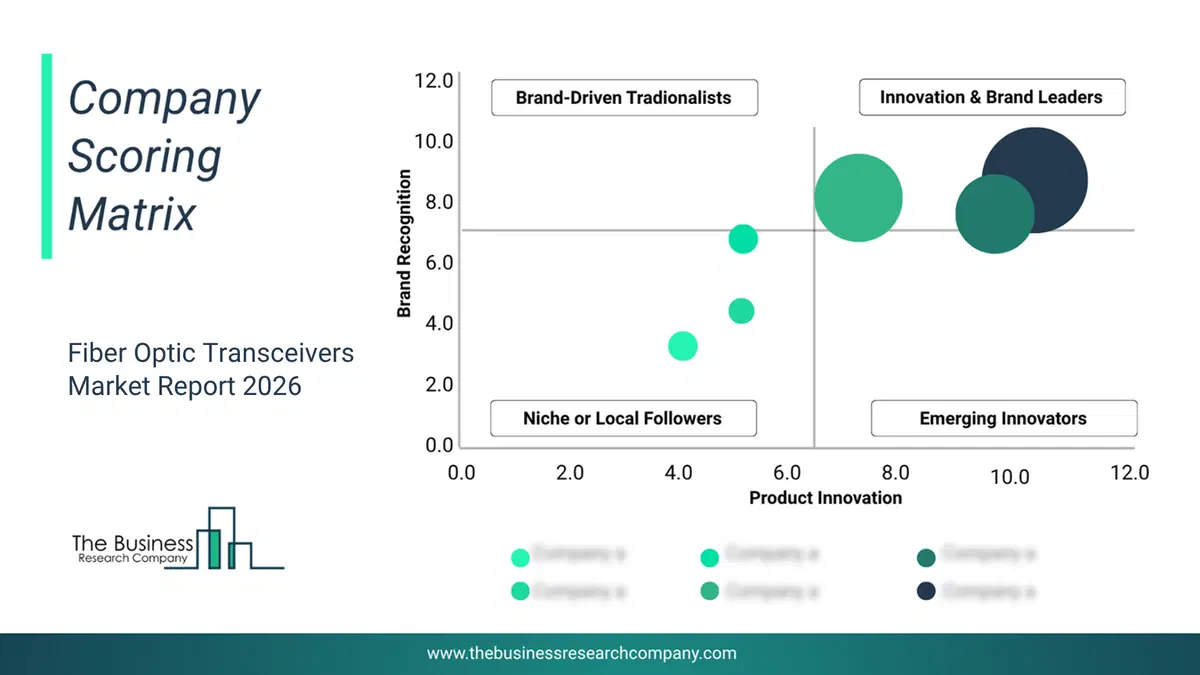
This chart maps companies by product innovation and brand strength, with bubble size indicating relative revenue, helping identify market leaders, challengers, and niche players. This is an illustrative chart; the full report provides a complete and accurate competitive analysis.
Global Fiber Optic Transceivers Market Trends and Insights
Major companies operating in the fiber optic transceivers market are developing innovative products with advanced technologies, such as latency adjustment technology to enhance network performance, reduce data transmission delays, and support high-speed, real-time applications across industries such as telecommunications, data centers, and cloud computing. Latency adjustment technology refers to methods used to minimize or compensate for delays in data transmission, ensuring faster and more efficient network performance. For instance, in May 2024, Fujitsu Limited, a Japan-based information and communications technology company, launched 1FINITY T250, a disaggregation-type optical transmission device to achieve the innovative optical and wireless network (IOWN) initiative. The 1FINITY T250 enables an all-photonics network (APN) by utilizing latency adjustment technology to optimize data transmission, reduce delays, and ensure seamless, high-speed communication across long-distance optical networks.What Are Latest Mergers And Acquisitions In The Fiber Optic Transceivers Market?
In November 2023, Lumentum Holdings Inc., a US-based telecommunications equipment commercial company, acquired Cloud Light Technology Limited for $750 million. With this acquisition, Lumentum will be well-positioned to serve the growing needs of cloud and networking customers, particularly those focused on optimizing their data center infrastructure for the demands of artificial intelligence and machine learning. Cloud Light Technology Limited is a Hong Kong-based manufacturer of fiber optic transceiver modules.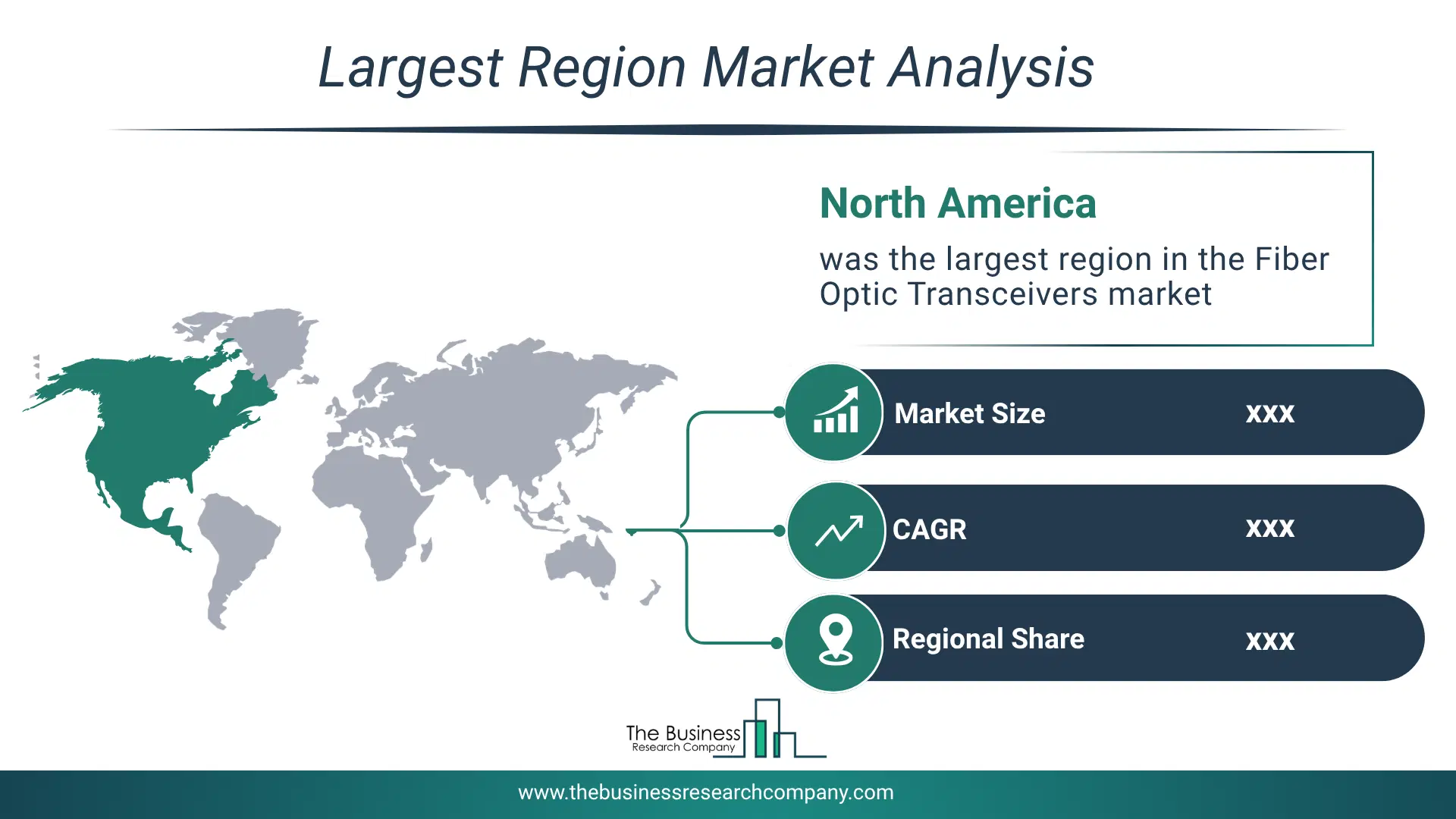
Regional Outlook
North America was the largest region in the fiber optic transceivers market in 2025. Asia-Pacific is expected to be the fastest-growing region in the forecast period. The regions covered in this market report are Asia-Pacific, South East Asia, Western Europe, Eastern Europe, North America, South America, Middle East, Africa. The countries covered in this market report are Australia, Brazil, China, France, Germany, India, Indonesia, Japan, Taiwan, Russia, South Korea, UK, USA, Canada, Italy, Spain.What Defines the Fiber Optic Transceivers Market?
The fiber optic transceivers market consists of sales of single-mode transceivers, multi-mode transceiver, bidirectional (BiDi) transceiver, coarse wavelength division multiplexing (CWDM) transceiver, and dense wavelength division multiplexing (DWDM) transceivers. Values in this market are ‘factory gate’ values, that is, the value of goods sold by the manufacturers or creators of the goods, whether to other entities (including downstream manufacturers, wholesalers, distributors, and retailers) or directly to end customers. The value of goods in this market includes related services sold by the creators of the goods.How is Market Value Defined and Measured?
The market value is defined as the revenues that enterprises gain from the sale of goods and/or services within the specified market and geography through sales, grants, or donations in terms of the currency (in USD unless otherwise specified). The revenues for a specified geography are consumption values that are revenues generated by organizations in the specified geography within the market, irrespective of where they are produced. It does not include revenues from resales along the supply chain, either further along the supply chain or as part of other products.
This chart presents market attractiveness based on a quantitative evaluation of growth, competition, strategic alignment, and risk, offering a clear view of opportunity areas for decision-making. This chart is for illustrative purposes; the full report contains the complete analysis.

This chart highlights the Total Addressable Market (TAM) by estimating the maximum revenue opportunity using an assumption-driven approach, supporting strategic planning and opportunity sizing across markets. The chart is illustrative; the full report provides a more comprehensive analysis.
What Key Data and Analysis Are Included in the Fiber Optic Transceivers Market Report 2026?
The fiber optic transceivers market research report is one of a series of new reports from The Business Research Company that provides market statistics, including industry global market size, regional shares, competitors with the market share, detailed market segments, market trends and opportunities, and any further data you may need to thrive in the fiber optic transceivers industry. The market research report delivers a complete perspective of everything you need, with an in-depth analysis of the current and future state of the industry.Fiber Optic Transceivers Market Report Forecast Analysis
| Report Attribute | Details |
|---|---|
| Market Size Value In 2026 | $10.81 billion |
| Revenue Forecast In 2030 | $17.16 billion |
| Growth Rate | CAGR of 12.2% from 2026 to 2030 |
| Base Year For Estimation | 2025 |
| Actual Estimates/Historical Data | 2020-2025 |
| Forecast Period | 2026 - 2030 |
| Market Representation | Revenue in USD Billion and CAGR from 2026 to 2030 |
| Segments Covered | Type, Form Factor, Fiber Type, Data Rate, Application |
| Regional Scope | Asia-Pacific, Western Europe, Eastern Europe, North America, South America, Middle East, Africa |
| Country Scope | The countries covered in the report are Australia, Brazil, China, France, Germany, India, Indonesia, Japan, Taiwan, Russia, South Korea, UK, USA, Canada, Italy, Spain. |
| Key Companies Profiled | Hon HAI Precision Industry Co. Ltd., Huawei Technologies Co. Ltd., Cisco Systems Inc., Broadcom Inc., Sumitomo Electric Industries Ltd., Fujitsu Limited, NVIDIA Corporation, Texas Instruments Incorporated, Infineon Technologies AG, Fujikura Ltd., Juniper Networks Inc., Arista Networks Inc., Ciena Corporation, Coherent Corp., Belden Inc., Samtec Inc., Lumentum Operations LLC, Accelink Technologies Corporation, Source Photonics Inc., Allied Telesis Inc., FS.COM Inc., New H3C Technologies Co. Ltd., InnoLight Technology Corporation, Hisense Broadband Inc., Finisar Corporation, Optoway Technology Inc., Gigalight, QSFPTEK Technology Co. Ltd, ZTE Corporation, Perle Systems |
| Customization Scope | Request for Customization |
| Pricing And Purchase Options | Explore Purchase Options |