

Flat Panel Display Market Report 2026
Global Outlook – By Technology ( Liquid Crystal Display (LCD), Organic Light Emitting Diode (OLED), Light Emitting Diode (LED), Quantum Dot, Other Technologies), By Screen Size ( Small Screen, Medium Screen, Large Screen), By Application ( Smartphone And Tablet, Television And Digital Signage, Personal Computer (PC) And Laptop, Vehicle Display, Smart Wearable, Other Applications) – Market Size, Trends, Strategies, and Forecast to 2030
Flat Panel Display Market Overview
• Flat Panel Display market size has reached to $145.57 billion in 2025 • Expected to grow to $196.38 billion in 2030 at a compound annual growth rate (CAGR) of 6.2% • Growth Driver: Automotive Industry Growth Fuels Demand For Flat Panel Displays • Market Trend: Advancements In The AI-enabled Flat Panel Display Market • North America was the largest region in 2025 and Asia-Pacific is the fastest growing region.Market Gains By 2030 – Top Opportunities By Segment
Market Gain identifies the most promising market opportunities by highlighting the segments or products expected to generate the highest incremental revenue growth over the next five years.
What Is Covered Under Flat Panel Display Market?
A flat panel display refers to a type of electronic display device that utilizes flat screens, offering higher resolution, better color accuracy, and sharper image quality compared to cathode ray tube (CRT) displays. These displays are characterized by their thin, lightweight design and typically consist of a flat panel of glass or plastic where images or video are displayed electronically. It consists of a flat panel with millions of tiny pixels that emit light when an electrical current passes through them, producing images and colors. The main types of technologies for flat panel display are liquid crystal display (LCD), organic light emitting diode (OLED), light emitting diode (LED), quantum dot, and others. A liquid crystal display (LCD) is a flat-panel display technology that uses liquid crystals sandwiched between two layers of glass or plastic to produce images or text. The screen sizes include small screen, medium screen, and large screen, and they are used for various applications such as smartphones and tablets, television and digital signage, personal computer (PC) and laptops, vehicle displays, smart wearables, and others.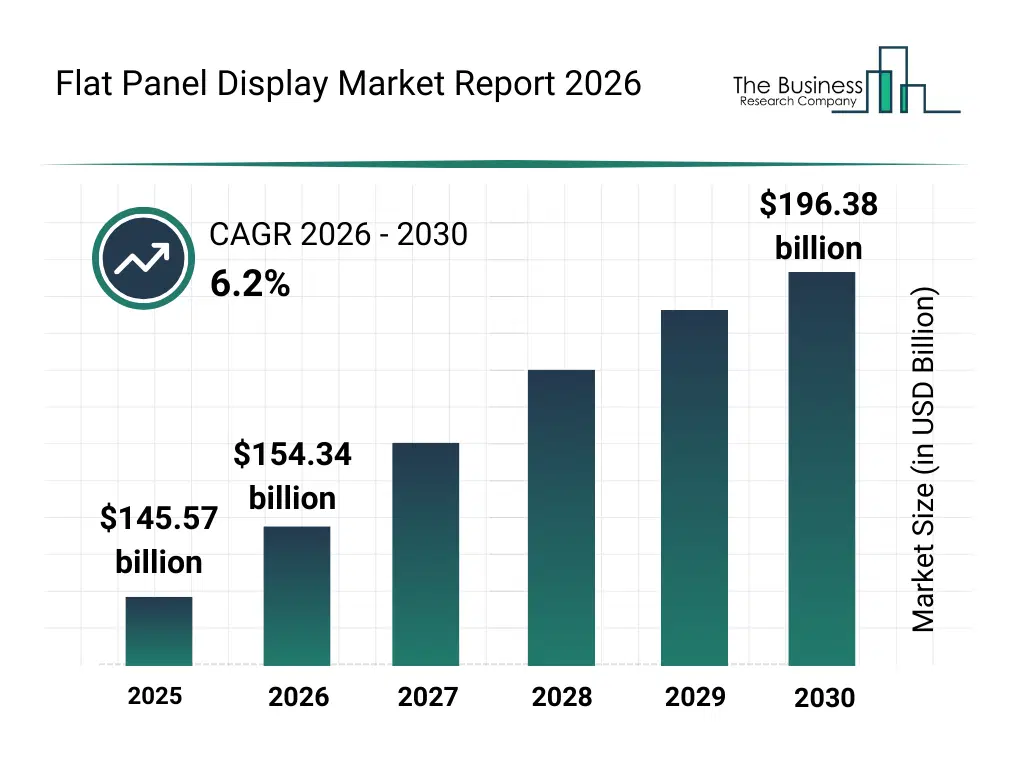
What Is The Flat Panel Display Market Size 2026 And Growth Rate?
The flat panel display market size has grown strongly in recent years. It will grow from $145.57 billion in 2025 to $154.34 billion in 2026 at a compound annual growth rate (CAGR) of 6.0%. The growth in the historic period can be attributed to shift from CRT to flat panel displays, growth in consumer electronics adoption, declining manufacturing cost of LCD panels, expansion of television and PC markets, improvements in display resolution standards.What Is The Flat Panel Display Market Growth Forecast?
The flat panel display market size is expected to see strong growth in the next few years. It will grow to $196.38 billion in 2030 at a compound annual growth rate (CAGR) of 6.2%. The growth in the forecast period can be attributed to rising demand for OLED and microLED displays, growth of electric and autonomous vehicles, increasing adoption of digital signage, expansion of wearable device usage, demand for higher refresh rate and HDR displays. Major trends in the forecast period include adoption of high resolution and ultra-thin displays, growing demand for flexible and foldable screens, expansion of large format displays for signage, rising integration of displays in vehicles, increasing use of energy efficient display technologies.
Global Flat Panel Display Market Segmentation
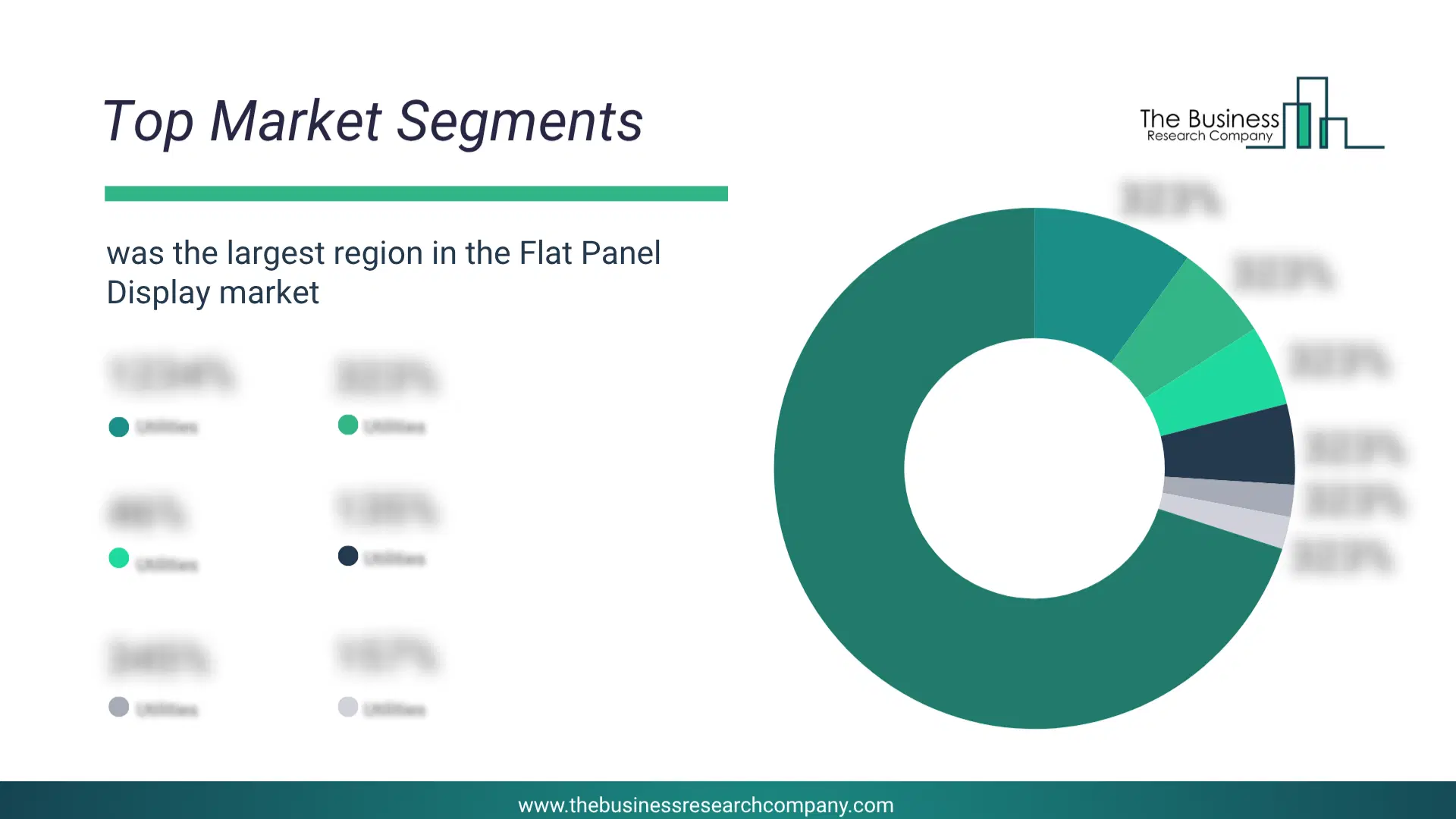
1) By Technology: Liquid Crystal Display (LCD), Organic Light Emitting Diode (OLED), Light Emitting Diode (LED), Quantum Dot, Other Technologies 2) By Screen Size: Small Screen, Medium Screen, Large Screen 3) By Application: Smartphone And Tablet, Television And Digital Signage, Personal Computer (PC) And Laptop, Vehicle Display, Smart Wearable, Other Applications Subsegments: 1) By Liquid Crystal Display (LCD): Twisted Nematic (TN), In-Plane Switching (IPS), Vertical Alignment (VA), Advanced Fringe Field Switching (AFFS) 2) By Organic Light Emitting Diode (OLED): Active Matrix OLED (AMOLED), Passive Matrix OLED (PMOLED), Transparent OLED, Flexible OLED 3) By Light Emitting Diode (LED): Edge-lit LED, Back-lit LED, MicroLED 4) By Quantum Dot: QLED (Quantum Dot LED), Nano-LED 4) By Other Technologies: MicroLED, Electroluminescent (EL) Displays, Plasma Displays, ePaper Displays The top segments in the flat panel display market will be: • Liquid Crystal Display (LCD) will reach $91.64 Billion by 2030. • Organic Light Emitting Diode (OLED) will reach $50.07 Billion by 2030. • Quantum Dot will reach $23.88 Billion by 2030. • Light Emitting Diode (LED) will reach $19.7 Billion by 2030. • Other Technologies will reach $9.62 Billion by 2030.What Is The Driver Of The Flat Panel Display Market?
The rising automotive industry is expected to propel the growth of the flat panel display market going forward. The automotive industry encompasses designing, manufacturing, marketing, and selling motor vehicles, including cars, trucks, and motorcycles. The automotive industry is rising due to technological advancements, increasing demand for electric and autonomous vehicles, and global economic growth. Flat panel displays in the automotive sector serve as instrumental components for infotainment systems, providing drivers and passengers with intuitive interfaces for navigation, entertainment, and vehicle diagnostics, enhancing the overall driving experience and safety. For instance, in January 2024, according to the European Automobile Manufacturers' Association (ACEA), a Belgium-based lobbying and standards group for the automobile industry, the EU car market experienced a robust growth of 13.9% in 2023, with sales reaching 867,052 units compared to 2022, culminating in a total annual volume of 10.5 million units. Most markets saw double-digit increases, notably three of the largest: Italy (+18.9%), Spain (+16.7%), and France (+16.1%). In contrast, Germany reported a more modest year-on-year growth of 7.3%. Therefore, the rising automotive industry is driving the growth of the flat panel display industry.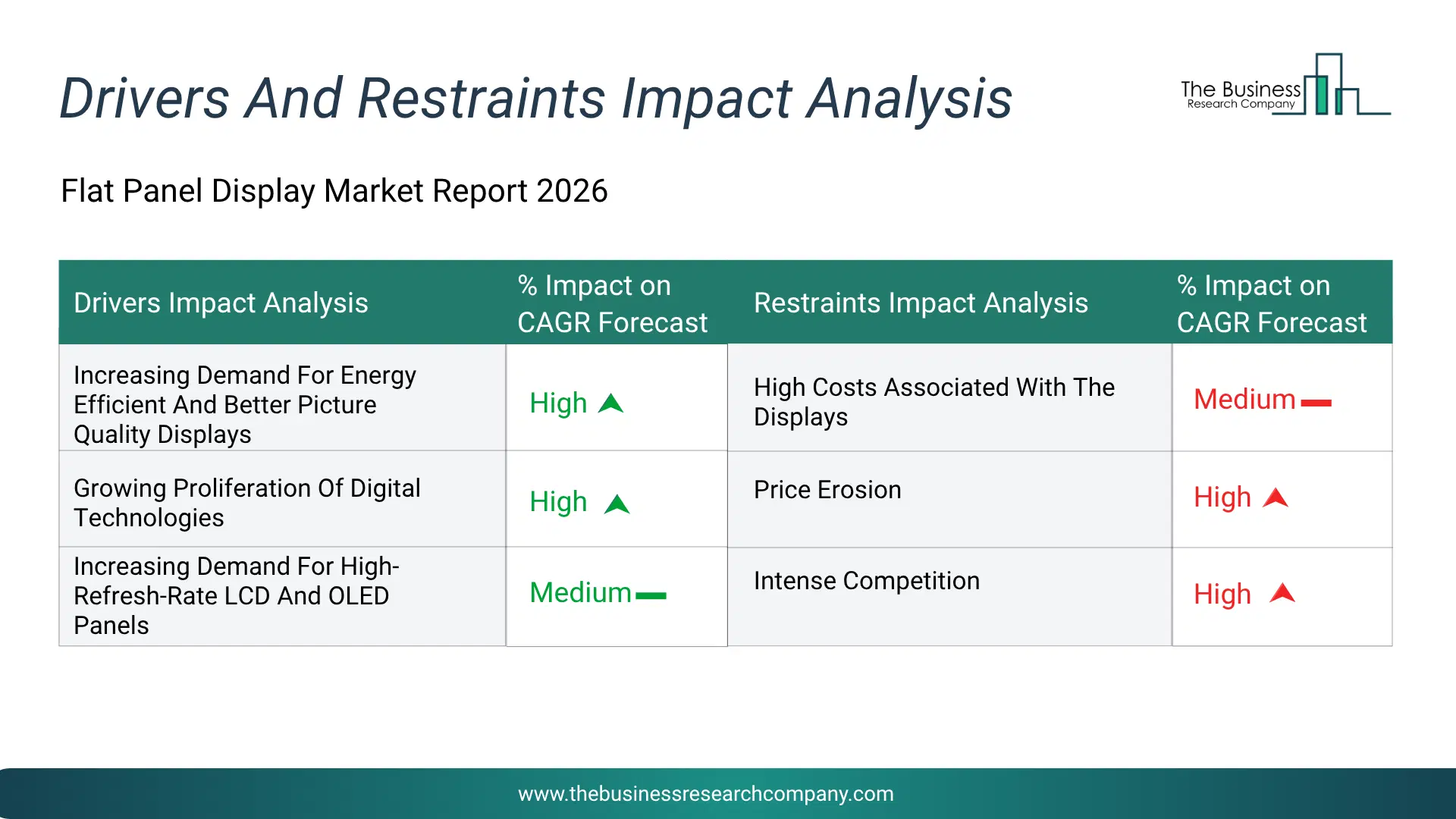
Infographic Chart Showing Key Market Drivers Analysis And Restraints For Flat Panel Display Market
The chart presents an impact analysis of key drivers and restraints, quantifying their relative influence on the market's growth rate and helping assess the balance between growth enablers and limiting factors. This chart offers a high-level perspective; the full report contains more detailed insights.
How Will The Drivers Impact Growth In The Global Flat Panel Display Market?
• Increasing Demand For Energy Efficient And Better Picture Quality Displays (High) – During the forecast period, the increasing demand for energy efficient and better picture quality displays is expected to become a key growth driver for the flat panel display market by 2030. The increasing demand for energy efficient and better picture quality displays is a major driver of the flat panel display market as consumers and businesses increasingly prioritize superior visual experiences with lower power consumption. Advancements in display technologies such as OLED and mini-LED enable sharper resolution, enhanced brightness, and deeper contrast while reducing energy usage. This demand is especially strong in televisions, smartphones, and monitors, where users seek immersive viewing and longer battery life. Manufacturers are investing heavily in R&D to develop innovative panels that meet evolving performance and sustainability expectations. Regulatory emphasis on energy efficiency standards is also encouraging the adoption of advanced displays. As a result, companies are continuously upgrading their product portfolios to remain competitive. This ongoing shift toward high-quality, energy-efficient displays significantly accelerates market growth. • Growing Proliferation Of Digital Technologies (High) – During the forecast period, the growing proliferation of digital technologies is expected to emerge as a major factor driving the expansion of the flat panel display market by 2030. The Growing Proliferation Of Digital Technologies is driving the flat panel display market by expanding the range of applications that rely on advanced visual interfaces. The rapid adoption of technologies such as IoT, artificial intelligence, and cloud computing has increased the need for display-integrated devices across industries. From smart homes and wearable devices to industrial automation systems, displays serve as critical interaction points. The expansion of digital infrastructure in education, healthcare, and retail further fuels demand for interactive screens and digital signage. Additionally, remote working and online learning trends have amplified the need for high-performance monitors and tablets. This widespread digital transformation is pushing manufacturers to innovate and scale production. Consequently, the increasing integration of displays into digital ecosystems is significantly boosting market expansion. • Increasing Demand For High-Refresh-Rate LCD And OLED Panels (Medium) – During the forecast period, the increasing demand for high-refresh-rate LCD and OLED panels is expected to act as a key growth catalyst for the flat panel display market by 2030. The increasing the demand for high-refresh-rate LCD and OLED panels is a key driver of the flat panel display market, particularly in gaming, entertainment, and professional applications. High-refresh-rate displays offer smoother motion, reduced screen tearing, and enhanced user experience, making them highly desirable among gamers and content creators. The rise of esports and high-definition streaming platforms has further accelerated the adoption of such panels. In addition, advancements in graphics processing technologies support higher frame rates, encouraging consumers to upgrade their displays. Smartphone manufacturers are also integrating high-refresh-rate screens to enhance user interaction and competitiveness. This trend is prompting display manufacturers to focus on performance optimization and innovation. As demand for seamless and responsive visual experiences grows, it continues to propel the market forward.How Will The Restraints Impact Growth In The Global Flat Panel Display Market?
• High Costs Associated With The Displays (High) – During the forecast period, the high costs associated with the displays act as a significant restraint on the flat panel display market by limiting widespread adoption, especially in price-sensitive regions. Advanced display technologies such as OLED and high-resolution panels require expensive raw materials and complex manufacturing processes, increasing overall product costs. This makes premium displays less accessible to a large segment of consumers and small businesses. Additionally, high initial investment requirements for production facilities discourage new entrants, reducing market expansion potential. Even for existing manufacturers, maintaining profitability while managing high costs remains challenging. As a result, buyers often delay upgrades or opt for lower-cost alternatives. This cost barrier ultimately slows down the overall growth trajectory of the market. • Price Erosion (High) – During the forecast period, the price erosion restrains the flat panel display market by continuously reducing profit margins for manufacturers due to intense pricing pressure. Rapid technological advancements and frequent product launches lead to shorter product life cycles, causing prices to decline quickly. While this benefits consumers, it creates financial strain on producers who must recover high R&D and production costs within a limited timeframe. The commoditization of display panels further intensifies this issue, making it difficult for companies to differentiate their offerings. As prices drop, manufacturers are forced to focus on cost-cutting strategies, which may impact innovation and quality. Smaller players, in particular, struggle to sustain operations under declining margins. Consequently, persistent price erosion limits long-term profitability and market stability. • Intense Competition (Medium) – During the forecast period, the intense competition acts as a restraint on the flat panel display market by creating a highly saturated and challenging business environment. Numerous global and regional players compete aggressively on pricing, technology, and product features, leaving little room for differentiation. This competition drives continuous innovation but also increases operational and marketing costs for companies. Established firms must constantly invest in new technologies to maintain their market position, while new entrants face barriers in gaining visibility and market share. The pressure to offer competitive pricing further compresses profit margins across the industry. Additionally, strategic moves such as mergers, partnerships, and capacity expansions heighten rivalry. As a result, intense competition makes it difficult for companies to sustain long-term growth and profitability.Key Players In The Global Flat Panel Display Market
Major companies operating in the flat panel display market are Samsung Electronics Co. Ltd, Sony Corporation, Panasonic Corporation, Toshiba Corporation, BOE Technology Group, Applied Materials Inc., NEC Corporation, Sharp Corporation, LG Display Co. Ltd., Koninklijke Philips N.V., ASUSTeK Computer Inc., Tokyo Electron Limited, TCL Display Technology Holdings Limited, AU Optronics Corporation, Innolux Corp, Japan Display Inc., Planar Systems Inc., BenQ Corporation, Densitron Technologies Plc., Hannstar Display Corporation, Emerging Display Technologies Corporation, Novaled AG, Crystal Display Systems Ltd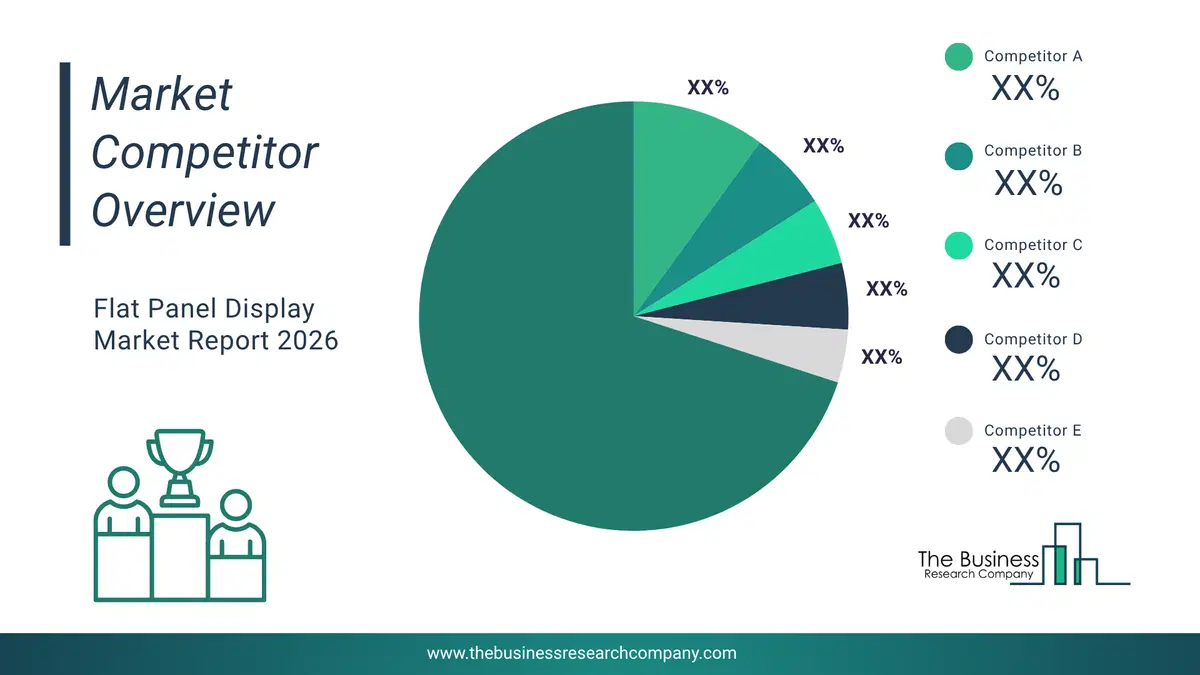
This chart is for illustrative purposes; the full report includes a detailed competitor analysis and comprehensive overview of the top 10 companies in the market.
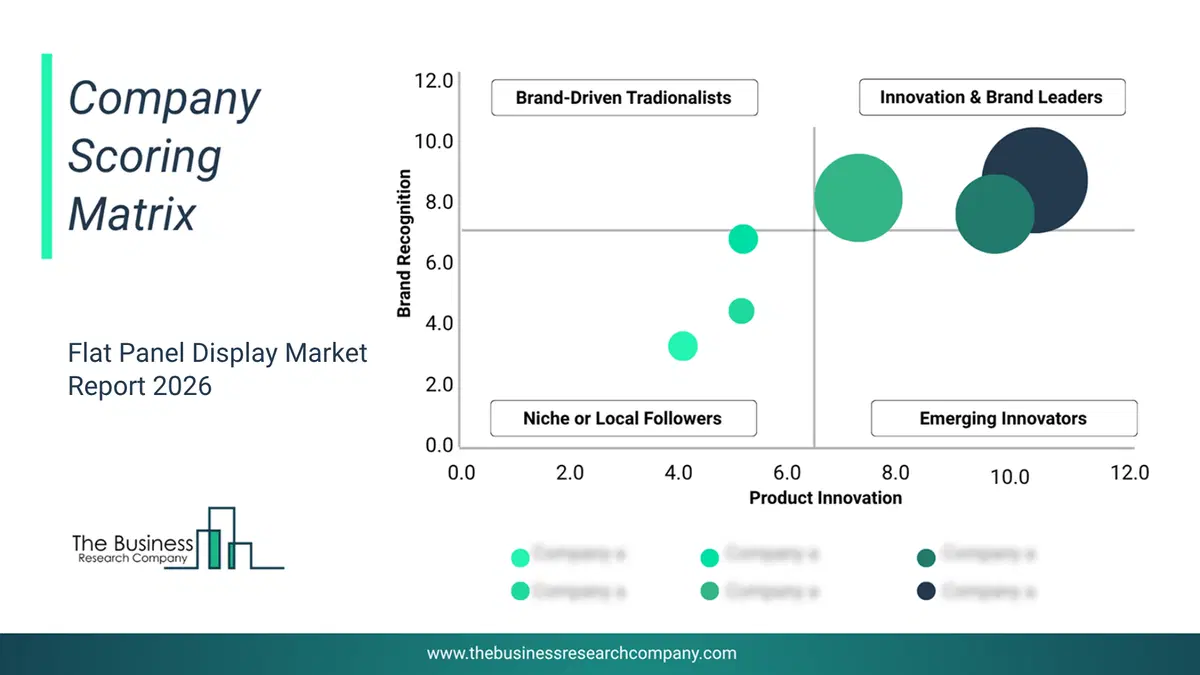
This chart maps companies by product innovation and brand strength, with bubble size indicating relative revenue, helping identify market leaders, challengers, and niche players. This is an illustrative chart; the full report provides a complete and accurate competitive analysis.
Global Flat Panel Display Market Trends and Insights
Major companies operating in the flat panel display market are developing innovative products such as artificial intelligence (AI) -enabled interactive flat panels to better serve customers with advanced features. AI-enabled interactive flat panels are display screens with artificial intelligence capabilities, allowing users to interact seamlessly with digital content through touch, gesture, or voice commands. For instance, in May 2023, MAXHUB, a Netherlands-based provider of communication and audio-visual technologies, launched an AI-enabled V6 Series of interactive flat panels. The V6 series consists of transcendent and classic interactive flat panels in sizes ranging from 55 to 86 inches. These panels boast cutting-edge audio-visual capabilities powered by artificial intelligence to improve communication in both corporate and educational settings. The V6 series, which includes seamless screen sharing, powerful whiteboard features, and exceptional audio-visual performance, is designed to meet various collaboration and learning demands.What Are Latest Mergers And Acquisitions In The Flat Panel Display Market?
In August 2024, Taiwan Semiconductor Manufacturing Company (TSMC), a Taiwan-based semiconductor company, acquired Innolux Corp's flat-panel display plant in Tainan for a deal of $530.6 million. As a result of the acquisition, Innolux has reached a significant milestone, strengthening its connections within the global technology sector. The company plans to utilize the Tainan facility to support its future operations. Innolux Corporation is a Taiwan-based manufacturer of flat panel displays.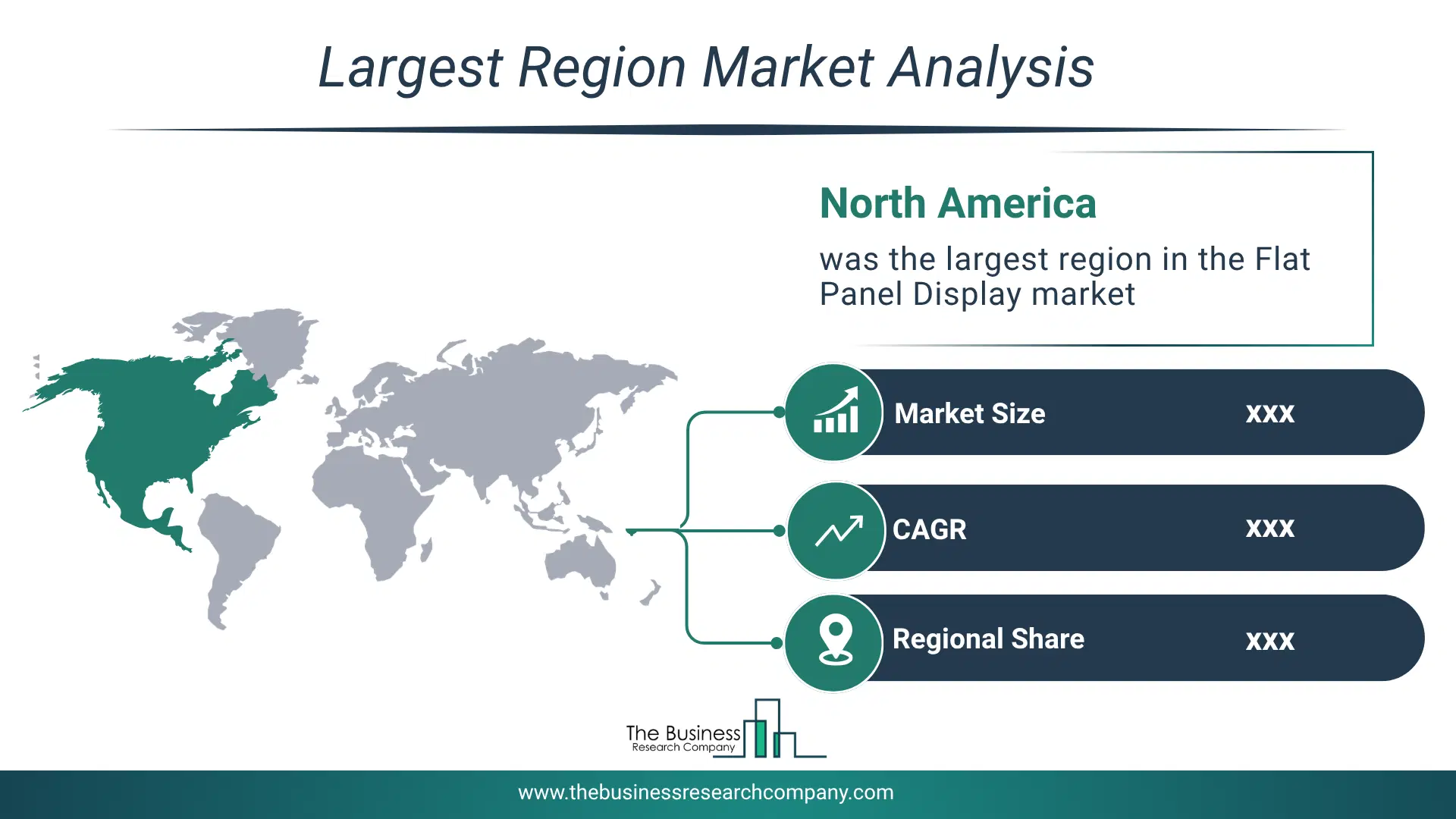
Regional Outlook
North America was the largest region in the flat panel display market in 2025. Asia-Pacific is expected to be the fastest-growing region in the forecast period. The regions covered in this market report are Asia-Pacific, South East Asia, Western Europe, Eastern Europe, North America, South America, Middle East, Africa. The countries covered in this market report are Australia, Brazil, China, France, Germany, India, Indonesia, Japan, Taiwan, Russia, South Korea, UK, USA, Canada, Italy, Spain.What Defines the Flat Panel Display Market?
The flat panel display market consists of sales of plasma displays, interactive whiteboards, and touchscreen displays. Values in this market are ‘factory gate’ values, that is the value of goods sold by the manufacturers or creators of the goods, whether to other entities (including downstream manufacturers, wholesalers, distributors, and retailers) or directly to end customers. The value of goods in this market includes related services sold by the creators of the goods.How is Market Value Defined and Measured?
The market value is defined as the revenues that enterprises gain from the sale of goods and/or services within the specified market and geography through sales, grants, or donations in terms of the currency (in USD unless otherwise specified). The revenues for a specified geography are consumption values that are revenues generated by organizations in the specified geography within the market, irrespective of where they are produced. It does not include revenues from resales along the supply chain, either further along the supply chain or as part of other products.
This chart presents market attractiveness based on a quantitative evaluation of growth, competition, strategic alignment, and risk, offering a clear view of opportunity areas for decision-making. This chart is for illustrative purposes; the full report contains the complete analysis.

This chart highlights the Total Addressable Market (TAM) by estimating the maximum revenue opportunity using an assumption-driven approach, supporting strategic planning and opportunity sizing across markets. The chart is illustrative; the full report provides a more comprehensive analysis.
What Key Data and Analysis Are Included in the Flat Panel Display Market Report 2026?
The flat panel display market research report is one of a series of new reports from The Business Research Company that provides market statistics, including industry global market size, regional shares, competitors with the market share, detailed market segments, market trends and opportunities, and any further data you may need to thrive in the flat panel display industry. The market research report delivers a complete perspective of everything you need, with an in-depth analysis of the current and future state of the industry.Flat Panel Display Market Report Forecast Analysis Market Report Forecast Analysis
| Report Attribute | Details |
|---|---|
| Market Size Value In 2026 | $154.34 billion |
| Revenue Forecast In 2030 | $196.38 billion |
| Growth Rate | CAGR of 6.0% from 2026 to 2030 |
| Base Year For Estimation | 2025 |
| Actual Estimates/Historical Data | 2020-2025 |
| Forecast Period | 2026 - 2030 |
| Market Representation | Revenue in USD Billion and CAGR from 2026 to 2030 |
| Segments Covered | Technology, Screen Size, Application |
| Regional Scope | Asia-Pacific, Western Europe, Eastern Europe, North America, South America, Middle East, Africa |
| Country Scope | The countries covered in the report are Australia, Brazil, China, France, Germany, India, Indonesia, Japan, Taiwan, Russia, South Korea, UK, USA, Canada, Italy, Spain. |
| Key Companies Profiled | Samsung Electronics Co. Ltd, Sony Corporation, Panasonic Corporation, Toshiba Corporation, BOE Technology Group, Applied Materials Inc., NEC Corporation, Sharp Corporation, LG Display Co. Ltd., Koninklijke Philips N.V., ASUSTeK Computer Inc., Tokyo Electron Limited, TCL Display Technology Holdings Limited, AU Optronics Corporation, Innolux Corp, Japan Display Inc., Planar Systems Inc., BenQ Corporation, Densitron Technologies Plc., Hannstar Display Corporation, Emerging Display Technologies Corporation, Novaled AG, Crystal Display Systems Ltd |
| Customization Scope | Request for Customization |
| Pricing And Purchase Options | Explore Purchase Options |