
Flight Management Systems (FMS) And Stable Market Report 2026
Global Outlook – By Aircraft Type (Narrow Body Aircraft, Wide Body Aircraft, Very Large Aircraft, Regional Transport Aircraft), By Fit (Line Fit, Retrofit), By Hardware (Visual Display Unit (VDU), Control Display Unit (CDU), Flight Management Computers (FMC)) – Market Size, Trends, Strategies, and Forecast to 2030
Flight Management Systems (FMS) And Stable Market Overview
• Flight Management Systems (FMS) And Stable market size has reached to $3.63 billion in 2025 • Expected to grow to $5.14 billion in 2030 at a compound annual growth rate (CAGR) of 7% • Growth Driver: Global Fleet Orders Drive Flight Management Systems (FMS) And Stable Market Growth In Aviation. • Market Trend: Innovative Flight Management Systems Enhancing Aviation Safety And Efficiency • North America was the largest region in 2025.What Is Covered Under Flight Management Systems (FMS) And Stable Market?
Flight management systems (FMS) are sophisticated avionics systems used on aircraft to provide automated control for flight planning, navigation, and performance management. Stable is a condition where an aircraft maintains a consistent attitude and speed, which is crucial for safe flight operations. These systems, equipped with advanced technologies such as global positioning systems (GPS) and inertial navigation, optimize routes, manage fuel efficiency, and ensure adherence to flight plans. The main aircraft types of flight management systems (FMS) and stables are narrow-body aircraft, wide-body aircraft, very large aircraft, and regional transport aircraft. Narrow-body aircraft refers to commercial airplanes with a single aisle running through the cabin, typically accommodating passengers in a 3-3 configuration. These aircraft types encompass both line fit and retrofit options, integrating crucial hardware solutions such as the Visual Display Unit (VDU), Control Display Unit (CDU), and Flight Management Computers (FMC).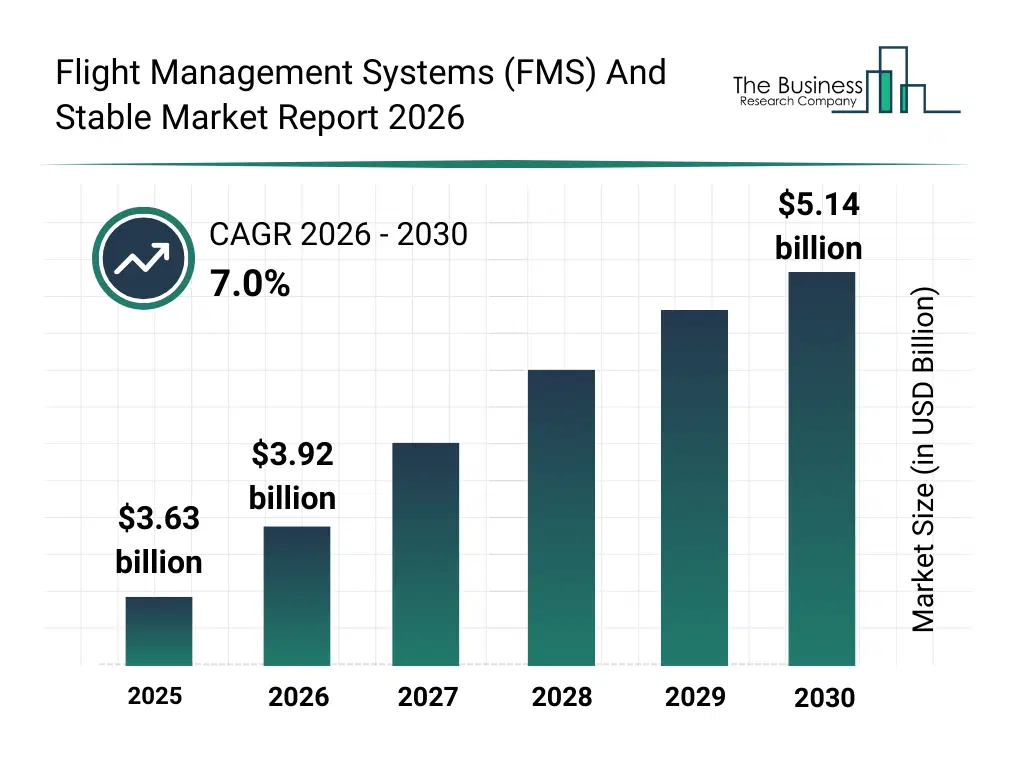
What Is The Flight Management Systems (FMS) And Stable Market Size and Share 2026?
The flight management systems (fms) and stable market size has grown strongly in recent years. It will grow from $3.63 billion in 2025 to $3.92 billion in 2026 at a compound annual growth rate (CAGR) of 7.8%. The growth in the historic period can be attributed to early adoption of GPS and inertial navigation technologies, growth in commercial and military aviation, advancements in autopilot and avionics systems, increasing demand for fuel-efficient flight operations, expansion of maintenance, repair, and overhaul (MRO) services for fms.What Is The Flight Management Systems (FMS) And Stable Market Growth Forecast?
The flight management systems (fms) and stable market size is expected to see strong growth in the next few years. It will grow to $5.14 billion in 2030 at a compound annual growth rate (CAGR) of 7.0%. The growth in the forecast period can be attributed to integration of AI and machine learning for optimized flight planning, rising adoption of connected and networked avionics systems, development of next-generation navigation sensors, expansion of software update and upgrade services, increased demand for pilot training and simulation programs. Major trends in the forecast period include increasing adoption of advanced navigation and autopilot integration, rising demand for fuel efficiency and performance optimization solutions, growing retrofit installations in aging commercial fleets, enhanced regulatory compliance for aviation safety and flight monitoring, expansion in pilot training and decision-support capabilities.
Global Flight Management Systems (FMS) And Stable Market Segmentation
1) By Aircraft Type: Narrow Body Aircraft, Wide Body Aircraft, Very Large Aircraft, Regional Transport Aircraft 2) By Fit: Line Fit, Retrofit 3) By Hardware: Visual Display Unit (VDU), Control Display Unit (CDU), Flight Management Computers (FMC) Subsegments: 1) By Narrow Body Aircraft: Single-Aisle Jetliners, Short-Haul Narrow Body Aircraft, Medium-Haul Narrow Body Aircraft, Low-Cost Carrier Aircraft 2) By Wide Body Aircraft: Twin-Aisle Jetliners, Long-Haul Wide Body Aircraft, Ultra-Long-Haul Wide Body Aircraft, Freighter Wide Body Aircraft 3) By Very Large Aircraft: Passenger Jumbo Jets, Cargo Jumbo Jets, Ultra-High Capacity Aircraft 4) By Regional Transport Aircraft: Regional Jets, Turboprop Aircraft, Short-Haul Regional Aircraft, Commuter AircraftWhat Is Driver Of The Flight Management Systems (FMS) And Stable Market?
Rising fleet orders globally are expected to propel the growth of flight management systems (FMS) and a stable market going forward. Fleet orders refer to the collective orders placed by airlines, leasing companies, or operators for new aircraft to expand or replace their existing fleet. Global fleet orders are growing due to increased air travel demand and airline expansions, necessitating newer and more efficient aircraft. Flight management systems (FMS) and stable technology are crucial for rising fleet orders because they enhance operational efficiency, ensure precise navigation and flight planning, optimize fuel consumption, and maintain stable flight conditions. For instance, in July 2023, according to the General Aviation Manufacturers Association (GAMA), a US-based trade association, airplane shipments in 2023 increased compared to 2022. Specifically, there was an 11.8% increase in piston airplane deliveries, with a total of 1,682 units. Turboprop airplane deliveries increased by 9.6% to 638 units, and business jet deliveries increased to 730 units from 712. The total value of airplane deliveries in 2023 was $23.4 billion, showing a 2.2% increase. Therefore, rising fleet orders globally are driving flight management systems (FMS) and stable industry.Key Players In The Global Flight Management Systems (FMS) And Stable Market
Major companies operating in the flight management systems (fms) and stable market are Raytheon Technologies Corporation, Boeing Company, General Electric Company, Northrop Grumman Corporation, Honeywell International Inc., Lufthansa Systems, Innovative Solutions & Support, BAE Systems, Thales Group, Leonardo S.p.A., Elbit Systems, Curtiss-Wright Corporation, Esterline CMC Electronics, Universal Avionics Systems Corporation, Genesys Aerosystems, FreeFlight Systems, BendixKing, Comsoft GmbH, Safran Electronics & Defense, DAC International Inc., Avidyne Corporation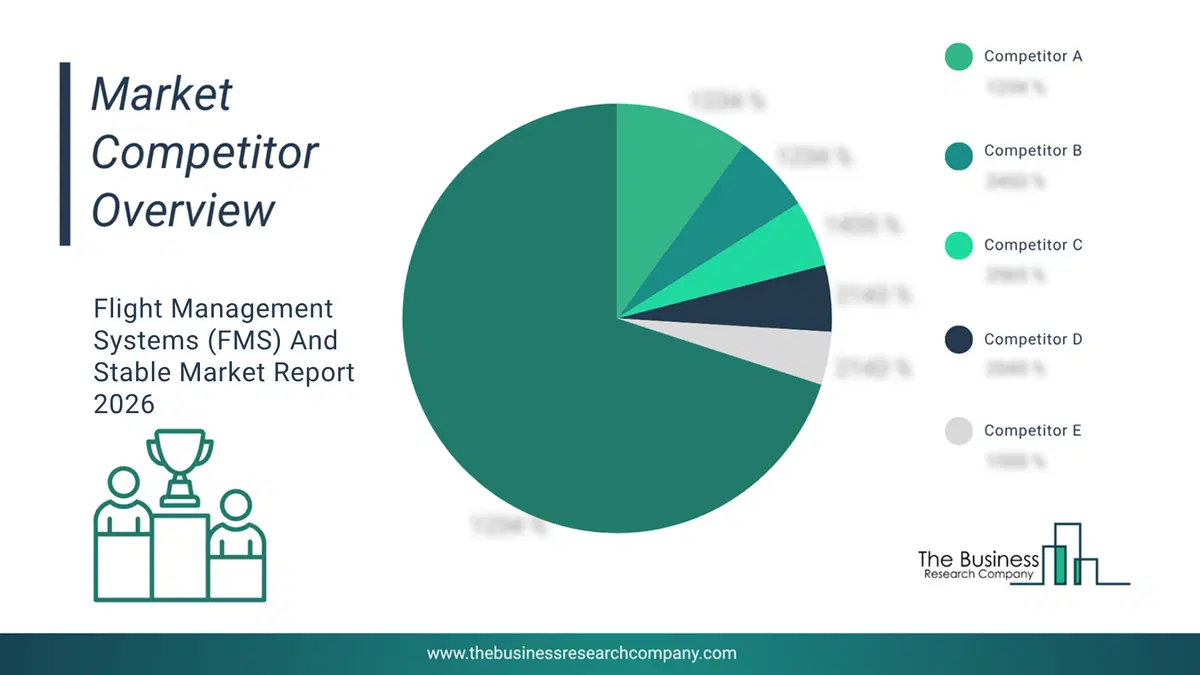
This chart is for illustrative purposes; the full report includes a detailed competitor analysis and comprehensive overview of the top 10 companies in the market.
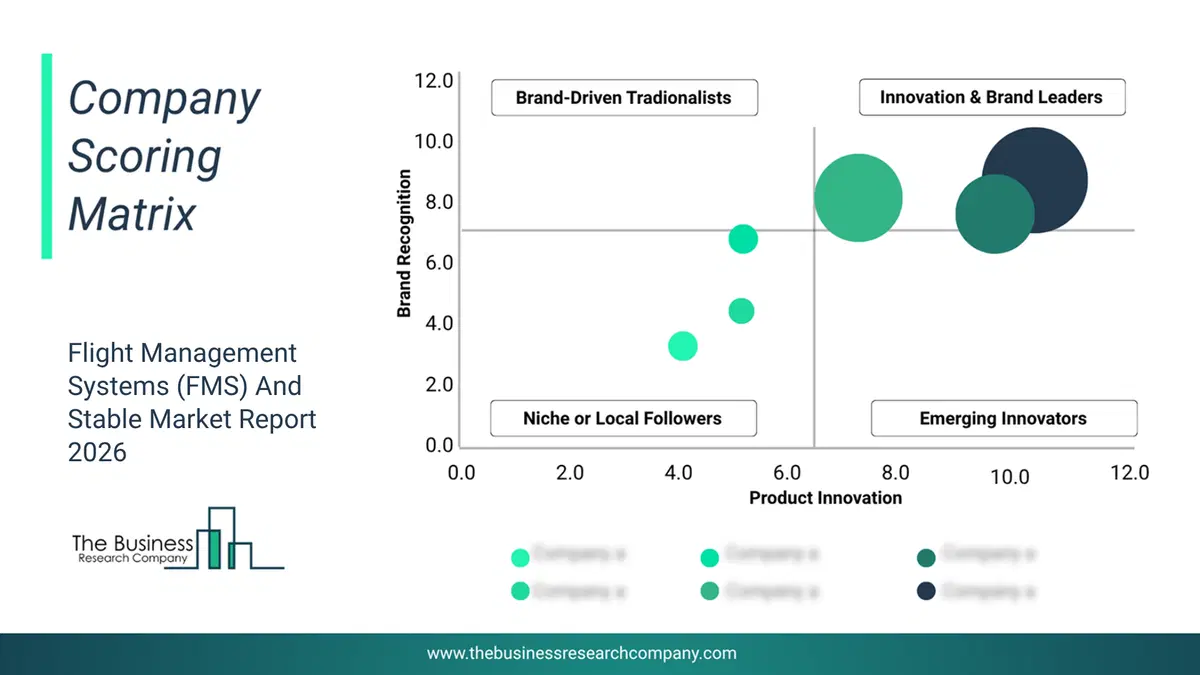
This chart maps companies by product innovation and brand strength, with bubble size indicating relative revenue, helping identify market leaders, challengers, and niche players. This is an illustrative chart; the full report provides a complete and accurate competitive analysis.
Global Flight Management Systems (FMS) And Stable Market Trends and Insights
Major companies operating in the flight management systems (FMS) and stable market are increasing their focus on launching innovative products such as guided visual procedures to provide pilots with enhanced guidance during visual approaches. Guided visual procedures in aviation utilize advanced flight management systems to provide precise navigational guidance during visual approaches and landings, enhancing safety and efficiency. For instance, in October 2023, Honeywell International Inc., a US-based technology company, announced the offering of Flight Management System Guided Visual Procedures as a stand-alone option. This includes providing lateral and vertical guidance during visual approaches, enhancing approach consistency, and reducing pilot workload. This advancement signifies Honeywell's commitment to improving safety and efficiency in aviation by addressing the challenges of unstable approaches, thereby solidifying its position in flight management systems (FMS) and a stable market for innovative technologies.What Are Latest Mergers And Acquisitions In The Flight Management Systems (FMS) And Stable Market? Malaysia Airlines Partners With Thales To Enhance Avionics Technology And Safety
In February 2024, Malaysia Airlines Berhad (MAB), a Malaysia-based aviation organization, partnered with Thales Group to enhance flight management and surveillance solutions for its fleet. This partnership focuses on optimizing these solutions specifically for Malaysia Airlines' Airbus A330neo aircraft. By leveraging Thales' advanced avionics technology, the initiative aims to boost safety, operational efficiency, and accuracy in the airline's flight operations. Thales Group, a France-based technology company, offers flight management systems (FMS) for airplane manufacturers, airlines, and pilots.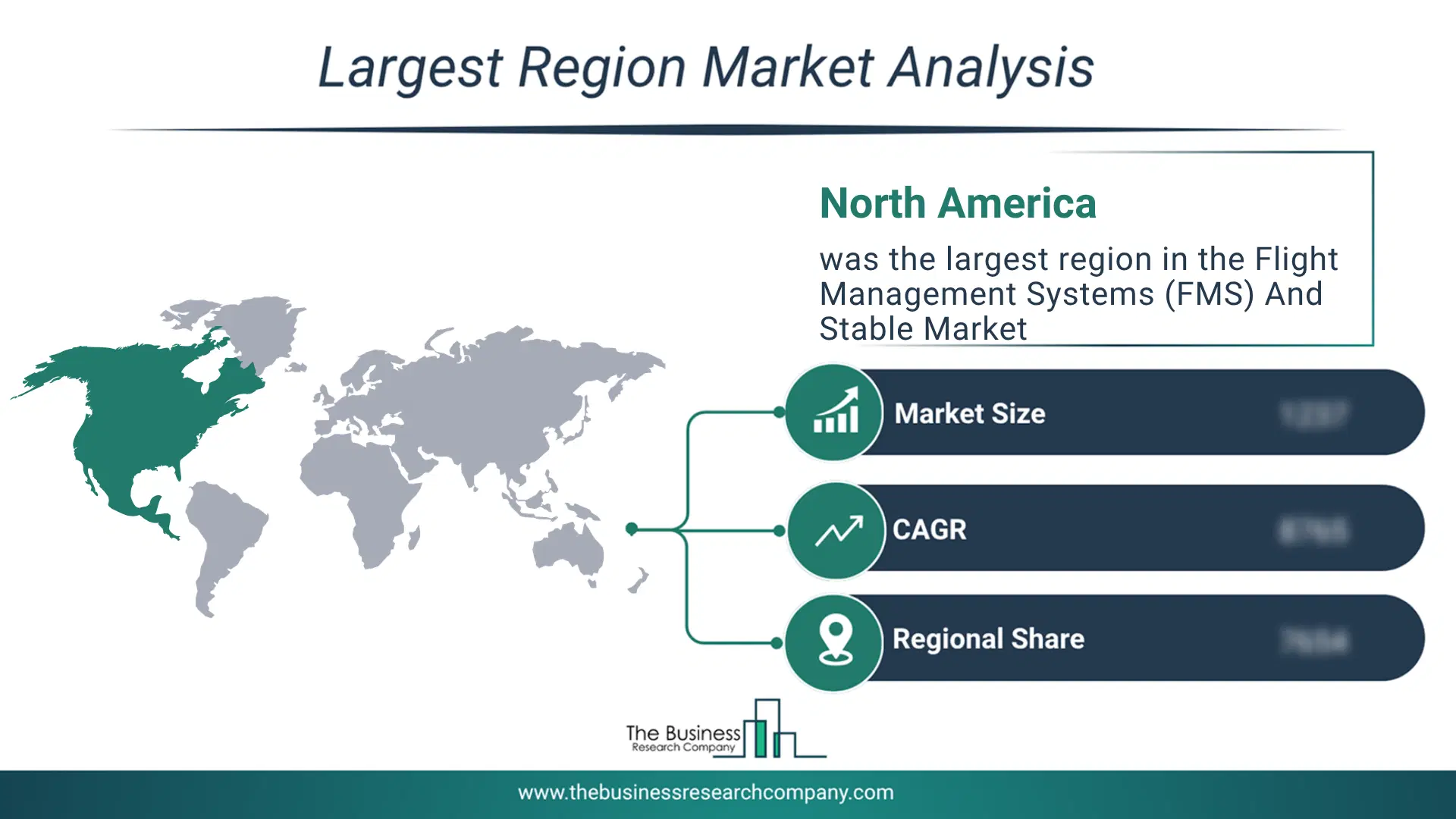
Regional Insights
North America was the largest region in the flight management systems (FMS) and stable market in 2025. The regions covered in the flight management systems (fms) and stable market report are Asia-Pacific, South East Asia, Western Europe, Eastern Europe, North America, South America, Middle East, Africa. The countries covered in the flight management systems (fms) and stable market report are Australia, Brazil, China, France, Germany, India, Indonesia, Japan, Taiwan, Russia, South Korea, UK, USA, Canada, Italy, SpainWhat Defines the Flight Management Systems (FMS) And Stable Market?
The flight management systems (FMS) and stable market consist of revenues earned by entities by providing services such as maintenance and support services, software updates and upgrades, and training programs. The market value includes the value of related goods sold by the service provider or included within the service offering. The flight management systems (FMS) and stable market also include sales of navigation sensors, communication modules, autopilot systems, and data management units. Values in this market are ‘factory gate’ values, that is, the value of goods sold by the manufacturers or creators of the goods, whether to other entities (including downstream manufacturers, wholesalers, distributors, and retailers) or directly to end customers. The value of goods in this market includes related services sold by the creators of the goods.How is Market Value Defined and Measured?
The market value is defined as the revenues that enterprises gain from the sale of goods and/or services within the specified market and geography through sales, grants, or donations in terms of the currency (in USD unless otherwise specified). The revenues for a specified geography are consumption values that are revenues generated by organizations in the specified geography within the market, irrespective of where they are produced. It does not include revenues from resales along the supply chain, either further along the supply chain or as part of other products.
This chart presents market attractiveness based on a quantitative evaluation of growth, competition, strategic alignment, and risk, offering a clear view of opportunity areas for decision-making. This chart is for illustrative purposes; the full report contains the complete analysis.

This chart highlights the Total Addressable Market (TAM) by estimating the maximum revenue opportunity using an assumption-driven approach, supporting strategic planning and opportunity sizing across markets. The chart is illustrative; the full report provides a more comprehensive analysis.
What Key Data and Analysis Are Included in the Flight Management Systems (FMS) And Stable Market Report 2026?
The flight management systems (fms) and stable market research report is one of a series of new reports from The Business Research Company that provides market statistics, including industry global market size, regional shares, competitors with the market share, detailed market segments, market trends and opportunities, and any further data you may need to thrive in the flight management systems (fms) and stable industry. The market research report delivers a complete perspective of everything you need, with an in-depth analysis of the current and future state of the industry.Flight Management Systems (FMS) And Stable Market Report Forecast Analysis
| Report Attribute | Details |
|---|---|
| Market Size Value In 2026 | $3.92 billion |
| Revenue Forecast In 2030 | $5.14 billion |
| Growth Rate | CAGR of 7% from 2026 to 2030 |
| Base Year For Estimation | 2025 |
| Actual Estimates/Historical Data | 2020-2025 |
| Forecast Period | 2026 - 2030 |
| Market Representation | Revenue in USD Billion and CAGR from 2026 to 2030 |
| Segments Covered | Aircraft Type, Fit, Hardware |
| Regional Scope | Asia-Pacific, Western Europe, Eastern Europe, North America, South America, Middle East, Africa |
| Country Scope | The countries covered in the flight management systems (fms) and stable market report are Australia, Brazil, China, France, Germany, India, Indonesia, Japan, Taiwan, Russia, South Korea, UK, USA, Canada, Italy, Spain |
| Key Companies Profiled | Raytheon Technologies Corporation, Boeing Company, General Electric Company, Northrop Grumman Corporation, Honeywell International Inc., Lufthansa Systems, Innovative Solutions & Support, BAE Systems, Thales Group, Leonardo S.p.A., Elbit Systems, Curtiss-Wright Corporation, Esterline CMC Electronics, Universal Avionics Systems Corporation, Genesys Aerosystems, FreeFlight Systems, BendixKing, Comsoft GmbH, Safran Electronics & Defense, DAC International Inc., Avidyne Corporation |
| Customization Scope | Request for Customization |
| Pricing And Purchase Options | Explore Purchase Options |