
Food Additives Market Report 2026
Global Outlook – By Product (Preservatives, Bulk Sweeteners, Sugar Substitutes, Emulsifiers, Anti-Caking Agents, Enzymes, Food Flavors, Food Colorants, Acidulants), By Source (Synthetic, Natural), By Application (Beverages, Bakery, Confectionery, Sauces And Dressings, Dairy, Other Applications) – Market Size, Trends, Strategies, and Forecast to 2030
Food Additives Market Overview
• Food Additives market size has reached to $52.91 billion in 2025 • Expected to grow to $71.93 billion in 2030 at a compound annual growth rate (CAGR) of 6.2% • Growth Driver: Increasing Consumption Of Ready-To-Eat Food Drives Growth In The Food Additives Market • Market Trend: Innovative Fermentation Additives Enhance Food Quality Safety And Production Efficiency • Asia-Pacific was the largest region and fastest growing region.What Is Covered Under Food Additives Market?
Food additives are edible substances that are added to foods to improve their color, appearance, texture, and shelf-life. Food additives can be produced artificially or derived from natural sources such as plants, animals, and minerals. The main products of food additives are preservatives, bulk sweeteners, sugar substitutes, emulsifiers, anti-caking agents, enzymes, food flavors food colorants, and acidulants. Food preservatives are used to prevent spoilage caused by bacteria, molds, fungi, and yeast. The various sources are synthetic and natural that are used for beverages, bakery, confectionery, sauces and dressings, dairy, and other applications.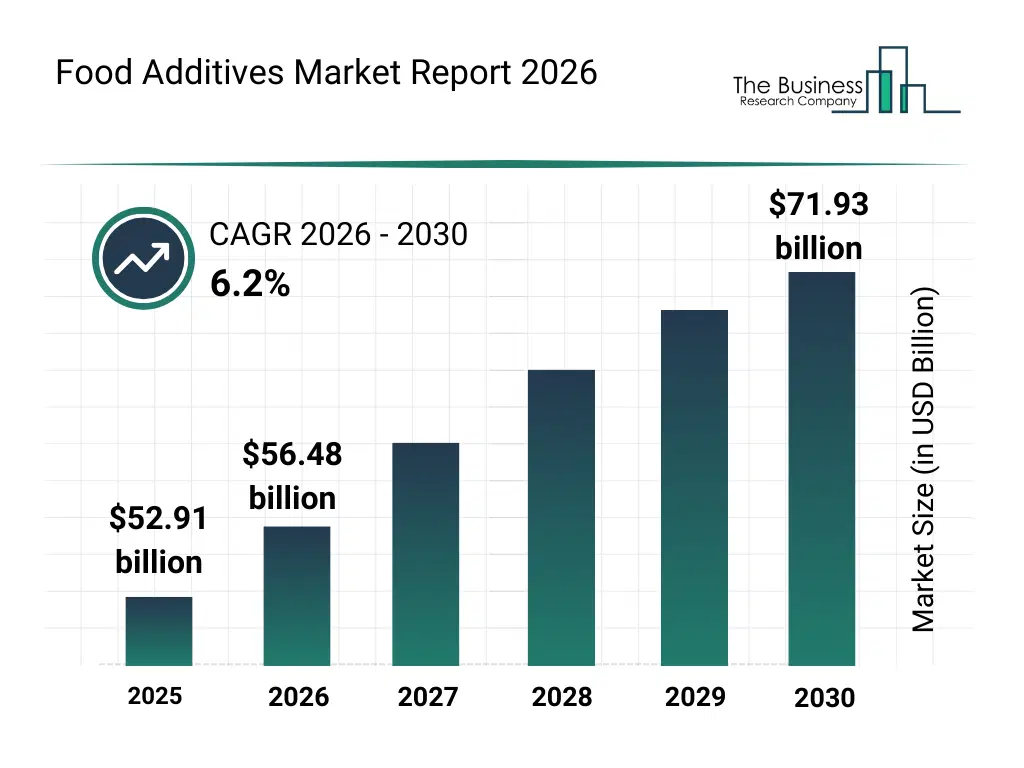
What Is The Food Additives Market Size and Share 2026?
The food additives market size has grown strongly in recent years. It will grow from $52.91 billion in 2025 to $56.48 billion in 2026 at a compound annual growth rate (CAGR) of 6.7%. The growth in the historic period can be attributed to growth of processed food consumption, expansion of beverage manufacturing, rising urbanization-driven food demand, availability of synthetic additives, industrial-scale food processing adoption.What Is The Food Additives Market Growth Forecast?
The food additives market size is expected to see strong growth in the next few years. It will grow to $71.93 billion in 2030 at a compound annual growth rate (CAGR) of 6.2%. The growth in the forecast period can be attributed to increasing consumer preference for natural ingredients, rising demand for fortified and functional foods, expansion of plant-based food products, growing regulatory scrutiny on additives, increased innovation in food formulation technologies. Major trends in the forecast period include increasing demand for clean-label additives, rising adoption of natural preservatives, growing use of functional food ingredients, expansion of shelf-life enhancement solutions, enhanced focus on texture and sensory optimization.
Global Food Additives Market Segmentation
1) By Product: Preservatives, Bulk Sweeteners, Sugar Substitutes, Emulsifiers, Anti-Caking Agents, Enzymes, Food Flavors, Food Colorants, Acidulants 2) By Source: Synthetic, Natural 3) By Application: Beverages, Bakery, Confectionery, Sauces And Dressings, Dairy, Other Applications Subsegments: 1) By Preservatives: Natural Preservatives, Synthetic Preservatives 2) By Bulk Sweeteners: High-Fructose Corn Syrup, Sugars 3) By Sugar Substitutes: Artificial Sweeteners, Natural Sweeteners 4) By Emulsifiers: Lecithin, Mono-And Diglycerides 5) By Anti-Caking Agents: Silicates, Phosphates 6) By Enzymes: Proteases, Amylases 7) By Food Flavors: Natural Flavors, Artificial Flavors 8) By Food Colorants: Natural Colorants, Synthetic Colorants 9) By Acidulants: Citric Acid, Lactic AcidWhat Is The Driver Of The Food Additives Market?
Increasing consumption of ready-to-eat food is expected to propel the growth of the food additives market going forward. Food that is in a form that may be eaten without cleaning, cooking, or additional preparation on the part of the eatery or the consumer is referred to as ready-to-eat food. Ready-to-eat foods use a variety of natural and artificial preservatives to reduce the likelihood of spoilage due to microbial reactions and to improve food quality. For instance, in August 2023, according to a survey conducted by Itochu Corporation, a Japan-based trading company, about 45% of 9,461 respondents said that they consume bento boxes, also known as ready-to-eat (RTE) lunch boxes sold at convenience stores. Results showed that more than 10% of people who buy bento boxes eat them more than once a week, with the ratio being high among men and young consumers. Therefore, increasing consumption of ready-to-eat food is expected to propel the growth of the food additives industry going forward.Key Players In The Global Food Additives Market
Major companies operating in the food additives market are Ajinomoto Co Inc., Archer Daniels Midland Company, Badische Anilin und Soda Fabrik, Cargill Incorporated, Chr. Hansen Holding A/S, Givuadan SA, Ingredion Incorporated, Kerry Group Plc., Tate & Lyle Plc., Novozymes A/S, Koninklijke DSM N.V., Evonik Industries AG, Lonza Group AG, Corbion N.V., DuPont de Nemours Inc., AGRANA Beteiligungs AG, International Flavors & Fragrances Inc., Biospringer, Ingredaco, Palmer Holland Inc., TRInternational Inc., Eastman Chemical Company, Palsgaard, DSM NV, Royal DSM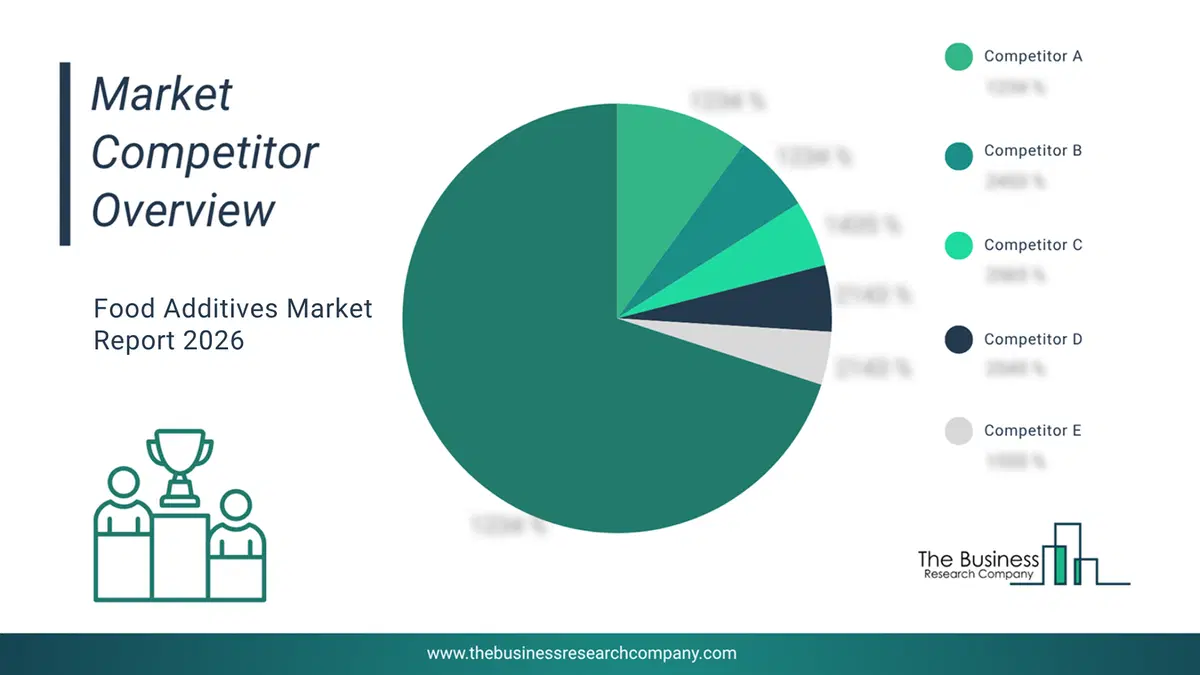
This chart is for illustrative purposes; the full report includes a detailed competitor analysis and comprehensive overview of the top 10 companies in the market.
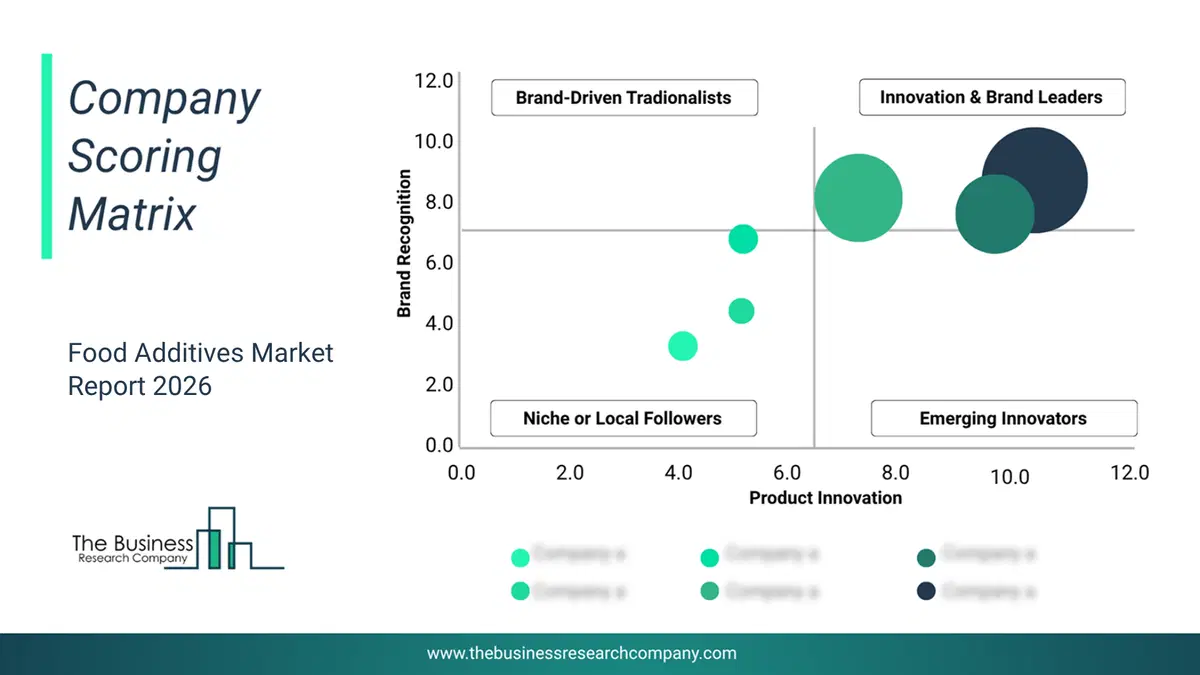
This chart maps companies by product innovation and brand strength, with bubble size indicating relative revenue, helping identify market leaders, challengers, and niche players. This is an illustrative chart; the full report provides a complete and accurate competitive analysis.
Global Food Additives Market Trends and Insights
Major companies operating in the food additives market are focused on introducing innovative products, such as advanced fermentation additives, to enhance the food industry by introducing new additives and raw materials that improve food quality, safety, and functionality. Advanced fermentation additives are specialized substances that enhance the fermentation process by improving microbial activity, increasing yield, and optimizing the production of desired metabolites in various industrial applications. For instance, in March 2023, the National Health Commission of the People's Republic of China (NHC), a China-based cabinet-level executive department, announced the approval of 16 new food additives and one new food raw material. The newly approved food additives and raw materials, including Leuconostoc pseudomesenteroides, enhance the fermentation process in products like cheese and flavored fermented milk, providing improved flavor profiles and nutritional benefits. Their significance lies in promoting food safety and quality, as they must meet stringent safety indicators, thereby supporting consumer health and expanding the options available for food manufacturers.What Are Latest Mergers And Acquisitions In The Food Additives Market?
In December 2023, Archer Daniels Midland Company (ADM), a US-based provider of nutrition and ingredient solutions, acquired FDL for an undisclosed amount. Through this acquisition, ADM aims to strengthen its food additives and functional ingredient offerings by integrating FDL’s premium flavor and ingredient systems and expanding its portfolio of customized solutions for food and beverage manufacturers. FDL is a UK-based company that develops and produces premium flavors and functional ingredient systems for the food industry.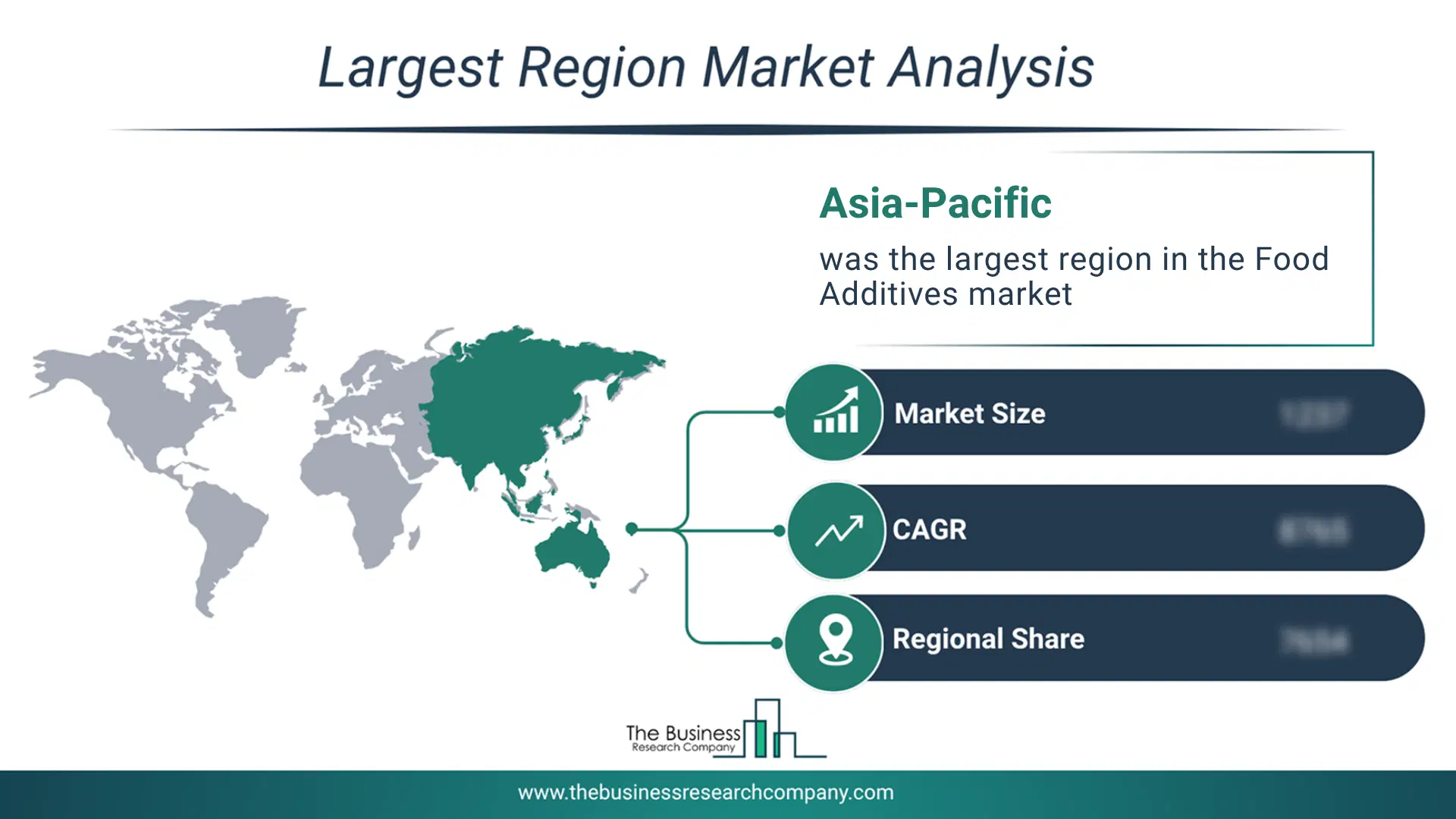
Regional Insights
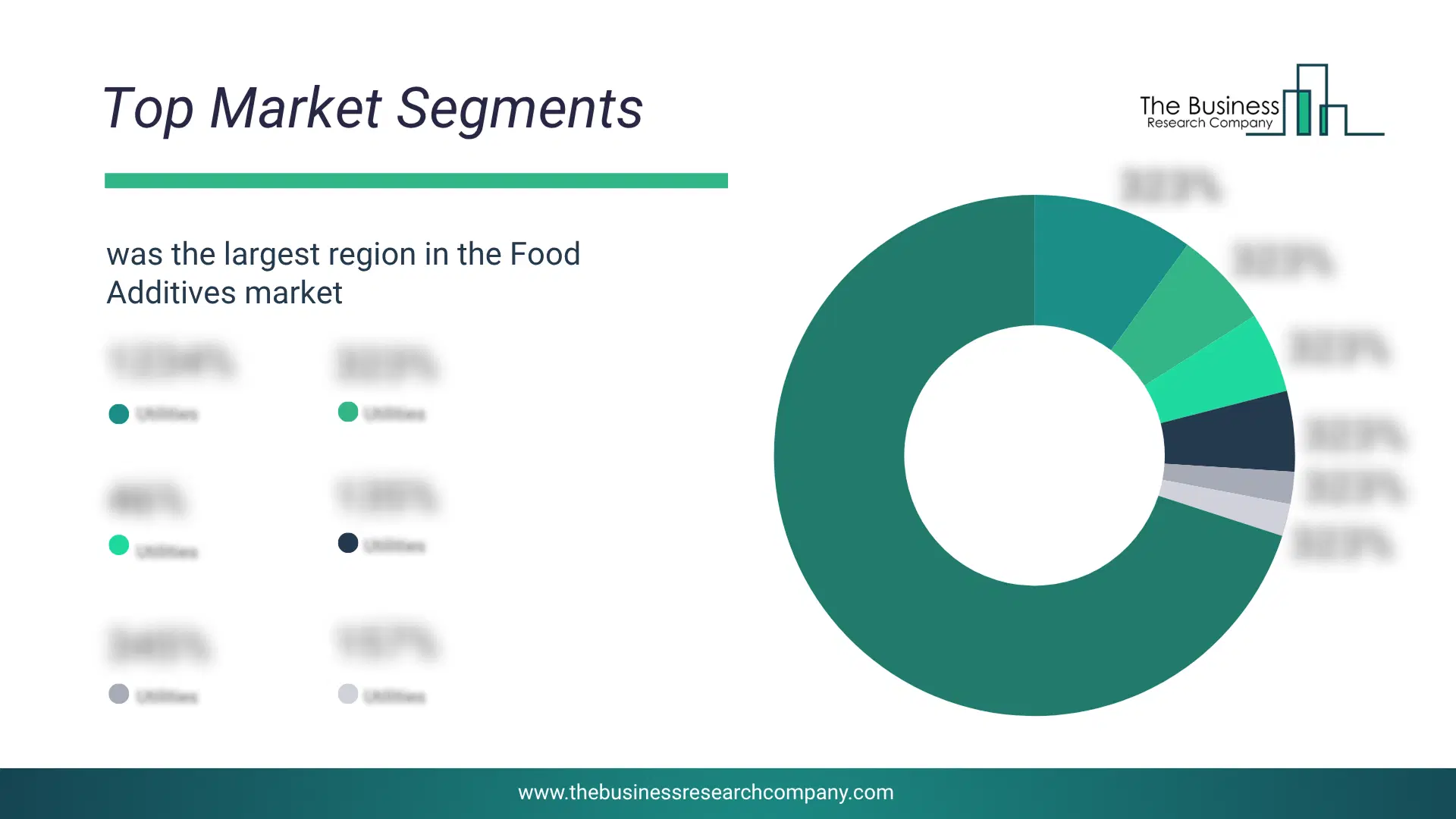
Asia-Pacific was the largest region in the food additives market share in 2025. The regions covered in this market report are Asia-Pacific, South East Asia, Western Europe, Eastern Europe, North America, South America, Middle East, Africa The countries covered in this market report are Australia, Brazil, China, France, Germany, India, Indonesia, Japan, Taiwan, Russia, South Korea, UK, USA, Canada, Italy, SpainWhat Defines the Food Additives Market?
The food additives market consists of sales of food additives used in products such as baked goods, desserts, soups, sauces, and baby food to prevent microbial growth and contamination while also increasing shelf life. Values in this market are ‘factory gate’ values, that is the value of goods sold by the manufacturers or creators of the goods, whether to other entities (including downstream manufacturers, wholesalers, distributors, and retailers) or directly to end customers. The value of goods in this market includes related services sold by the creators of the goods.How is Market Value Defined and Measured?
The market value is defined as the revenues that enterprises gain from the sale of goods and/or services within the specified market and geography through sales, grants, or donations in terms of the currency (in USD unless otherwise specified). The revenues for a specified geography are consumption values that are revenues generated by organizations in the specified geography within the market, irrespective of where they are produced. It does not include revenues from resales along the supply chain, either further along the supply chain or as part of other products.
This chart presents market attractiveness based on a quantitative evaluation of growth, competition, strategic alignment, and risk, offering a clear view of opportunity areas for decision-making. This chart is for illustrative purposes; the full report contains the complete analysis.

This chart highlights the Total Addressable Market (TAM) by estimating the maximum revenue opportunity using an assumption-driven approach, supporting strategic planning and opportunity sizing across markets. The chart is illustrative; the full report provides a more comprehensive analysis.
What Key Data and Analysis Are Included in the Food Additives Market Report 2026?
The food additives market research report is one of a series of new reports from The Business Research Company that provides market statistics, including industry global market size, regional shares, competitors with the market share, detailed market segments, market trends and opportunities, and any further data you may need to thrive in the food additives industry. The market research report delivers a complete perspective of everything you need, with an in-depth analysis of the current and future state of the industry.Food Additives Market Report Forecast Analysis
| Report Attribute | Details |
|---|---|
| Market Size Value In 2026 | $56.48 billion |
| Revenue Forecast In 2030 | $71.93 billion |
| Growth Rate | CAGR of 6.7% from 2026 to 2030 |
| Base Year For Estimation | 2025 |
| Actual Estimates/Historical Data | 2020-2025 |
| Forecast Period | 2026 - 2030 |
| Market Representation | Revenue in USD Billion and CAGR from 2026 to 2030 |
| Segments Covered | Product, Source, Application |
| Regional Scope | Asia-Pacific, Western Europe, Eastern Europe, North America, South America, Middle East, Africa |
| Country Scope | The countries covered in this market report are Australia, Brazil, China, France, Germany, India, Indonesia, Japan, Taiwan, Russia, South Korea, UK, USA, Canada, Italy, Spain |
| Key Companies Profiled | Ajinomoto Co Inc., Archer Daniels Midland Company, Badische Anilin und Soda Fabrik, Cargill Incorporated, Chr. Hansen Holding A/S, Givuadan SA, Ingredion Incorporated, Kerry Group Plc., Tate & Lyle Plc., Novozymes A/S, Koninklijke DSM N.V., Evonik Industries AG, Lonza Group AG, Corbion N.V., DuPont de Nemours Inc., AGRANA Beteiligungs AG, International Flavors & Fragrances Inc., Biospringer, Ingredaco, Palmer Holland Inc., TRInternational Inc., Eastman Chemical Company, Palsgaard, DSM NV, Royal DSM |
| Customization Scope | Request for Customization |
| Pricing And Purchase Options | Explore Purchase Options |