
Generative AI In Retail Market Report 2026
Global Outlook – By Technology (Variational Autoencoders, Generative Adversarial Networks, Deep Reinforcement Learning, Recurrent Neural Networks, Transformer Networks, Other Technologies), By Deployment (Cloud, On-Premise), By Application (Product Design And Development, Visual Merchandising, Demand Forecasting, Personalized Marketing, Fraud Detection, Inventory Management, Supply Chain And Logistics, Other Applications), By Industry (Fashion And Apparel, Consumer Electronics, Home Decor, Beauty And Cosmetics, Grocery Shops, Online Platforms) – Market Size, Trends, Strategies, and Forecast to 2030
Generative AI In Retail Market Overview
• Generative AI In Retail market size has reached to $1.11 billion in 2025 • Expected to grow to $5.85 billion in 2030 at a compound annual growth rate (CAGR) of 39.5% • Growth Driver: Impact Of E-Commerce Growth On generative AI Advancements In Retail • Market Trend: Advancements In generative Artificial Intelligence For Retail Enhancing Retail Operations • North America was the largest region in 2025 and Asia-Pacific is the fastest growing region.What Is Covered Under Generative AI In Retail Market?
Generative artificial intelligence (AI) in retail refers to the use of advanced AI models capable of creating new content, such as personalized marketing materials, product designs, and customer interaction scripts, by learning patterns from existing data. It is used to enhance customer experiences through personalized recommendations, automate content creation for marketing, optimize inventory management, and develop new product designs and strategies. The main technologies of generative AI in retail are variational autoencoders, generative adversarial networks, deep reinforcement learning, recurrent neural networks, transformer networks, and others. Variational autoencoders (VAEs) are a type of generative model used for learning latent representations of data through probabilistic encoding and decoding. These technologies are deployed through the cloud and on-premise for various applications such as product design and development, visual merchandising, demand forecasting, personalized marketing, fraud detection, inventory management, supply chain and logistics, and others. They are utilized across industries including fashion and apparel, consumer electronics, home décor, beauty and cosmetics, grocery shops, and online platforms.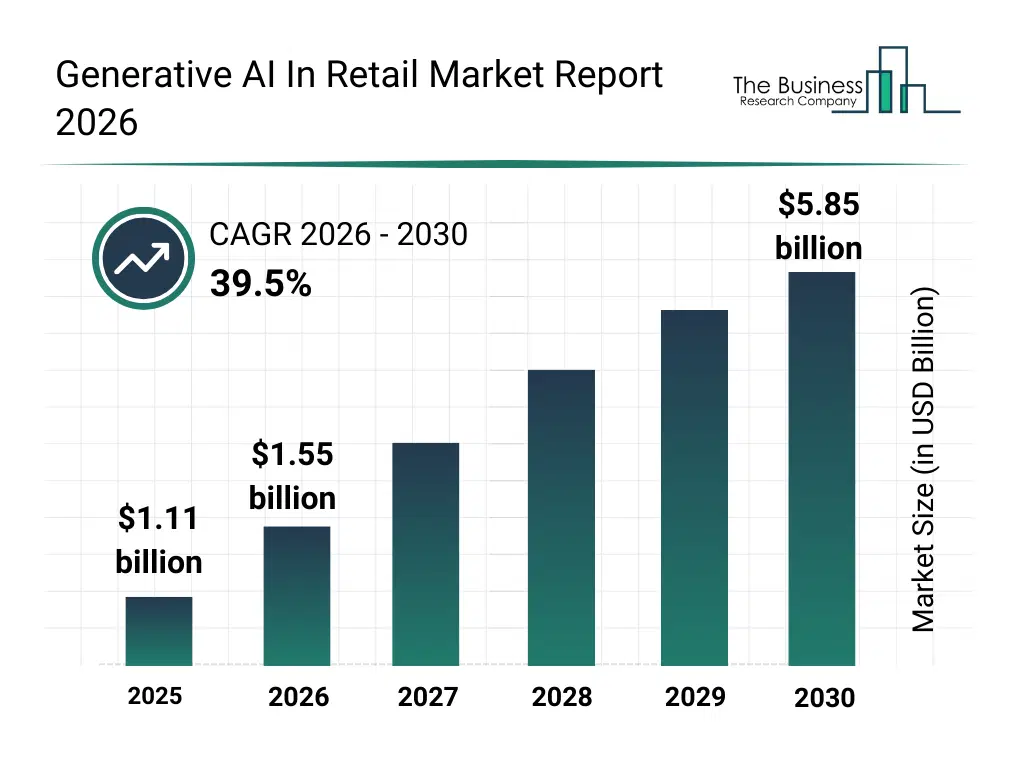
What Is The Generative AI In Retail Market Size and Share 2026?
The generative AI in retail market size has grown exponentially in recent years. It will grow from $1.11 billion in 2025 to $1.55 billion in 2026 at a compound annual growth rate (CAGR) of 39.8%. The growth in the historic period can be attributed to rise of e-commerce platforms, increased adoption of AI tools in retail, growing demand for personalized shopping experiences, advancements in cloud computing, integration of big data analytics.What Is The Generative AI In Retail Market Growth Forecast?
The generative AI in retail market size is expected to see exponential growth in the next few years. It will grow to $5.85 billion in 2030 at a compound annual growth rate (CAGR) of 39.5%. The growth in the forecast period can be attributed to expansion of immersive retail experiences, growth in demand for real-time inventory optimization, proliferation of AI-powered chatbots, increased adoption of generative design for products, integration of predictive analytics in supply chain. Major trends in the forecast period include personalized product recommendations, automated marketing content creation, AI-driven inventory management, dynamic pricing models, customer behavior analysis.
Global Generative AI In Retail Market Segmentation
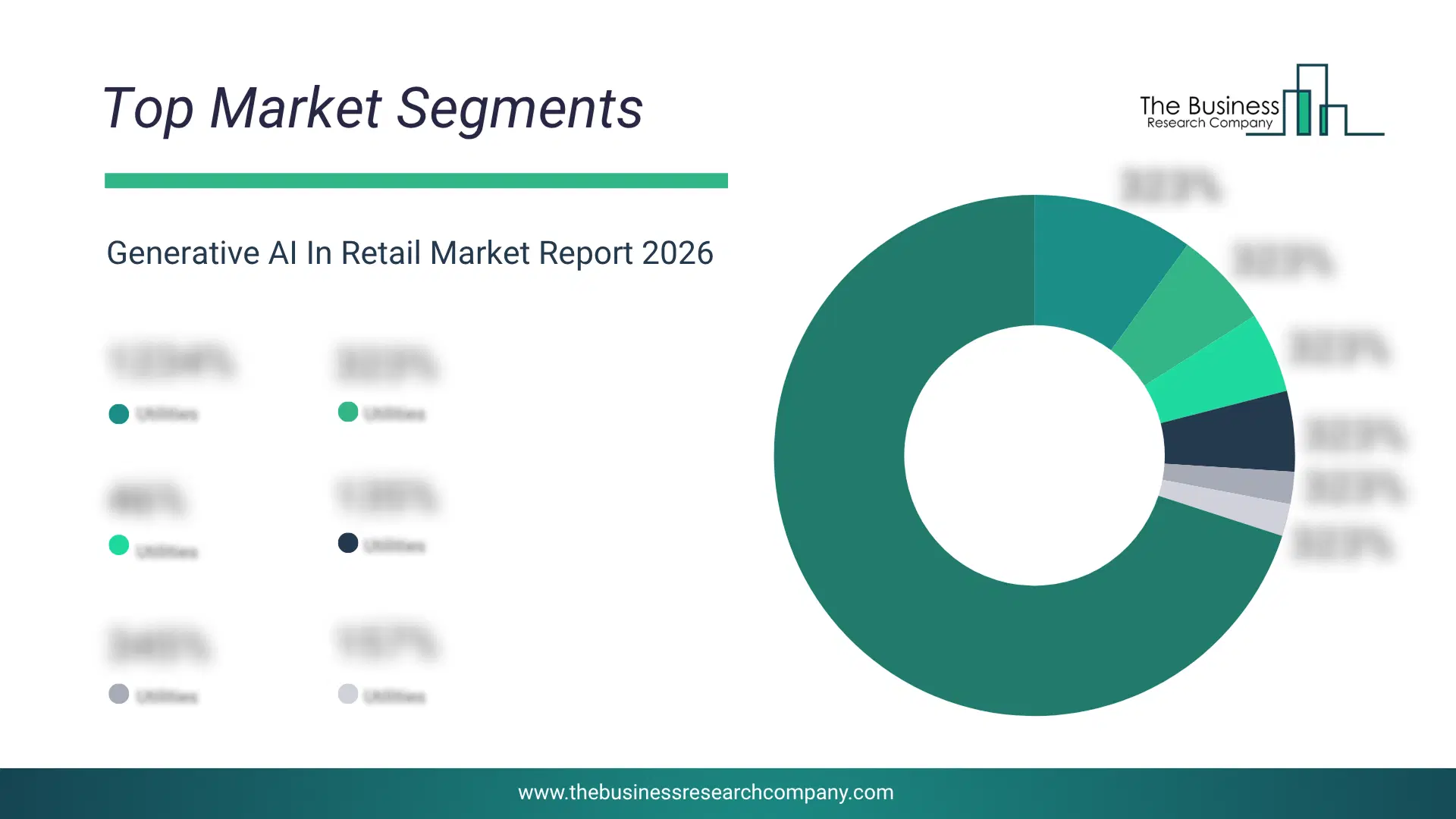
1) By Technology: Variational Autoencoders, Generative Adversarial Networks, Deep Reinforcement Learning, Recurrent Neural Networks, Transformer Networks, Other Technologies 2) By Deployment: Cloud, On-Premise 3) By Application: Product Design And Development, Visual Merchandising, Demand Forecasting, Personalized Marketing, Fraud Detection, Inventory Management, Supply Chain And Logistics, Other Applications 4) By Industry: Fashion And Apparel, Consumer Electronics, Home Decor, Beauty And Cosmetics, Grocery Shops, Online Platforms Subsegments: 1) By Variational Autoencoders (VAEs): Product Recommendation Systems, Customer Behavior Analysis, Personalized Marketing Campaigns, Image Generation For Products, Inventory Management Solutions 2) By Generative Adversarial Networks (GANs): Synthetic Data Generation, Virtual Try-On Solutions, Image-To-Image Translation For Product Images, Style Transfer For Marketing Content, Fraud Detection In Transactions 3) By Deep Reinforcement Learning: Dynamic Pricing Models, Inventory Optimization, Personalized Customer Experience Systems, Supply Chain Management, Sales Forecasting 4) By Recurrent Neural Networks (RNNs): Time Series Forecasting For Sales, Customer Engagement Prediction, Sentiment Analysis On Customer Feedback, Churn Prediction Models, Recommendation Systems For Repeat Purchases 5) By Transformer Networks: Natural Language Processing For Customer Interactions, Chatbots And Virtual Assistants, Automated Content Generation For Marketing, Customer Sentiment Analysis, Demand Forecasting 6) By Other Technologies: Self-Supervised Learning Techniques, Diffusion Models For Image Generation, Flow-Based Models For Data Generation, Federated Learning For Privacy-Preserving Data Analysis, Hybrid Models Combining Multiple Approaches.What Is The Driver Of The Generative AI In Retail Market?
The rise in e-commerce shopping is expected to propel the growth of generative AI in retail market going forward. Increasing e-commerce shopping is driven by the convenience, variety, and accessibility of online platforms compared to traditional retail. generative AI enhances e-commerce shopping by creating personalized product recommendations and improving customer interactions through dynamic, context-aware content. For instance, in May 2024, according to a report published by the Census Bureau of the Department of Commerce, a US-based governmental organization, e-commerce sales reached approximately $1,118.7 billion in 2023. For the first quarter of 2024, total retail sales were estimated at $1,820.0 billion. E-commerce sales during this period saw an 8.5% increase (±1.1%) from the same quarter in 2023, while total retail sales grew by 2.8% (±0.5%). Therefore, the rise in e-commerce shopping is driving the growth of generative AI in retail industry.Key Players In The Global Generative AI In Retail Market
Major companies operating in the generative AI in retail market are Google LLC, Microsoft Corporation, Tencent Holdings Limited, Amazon Web Services (AWS), International Business Machines (IBM), Oracle Corporation,Nvidia Corporation, Adobe Inc., SAS Institute Inc., C3.AI Inc., DataRobot Inc., ClarifAI Inc., H2O.AI Inc., Shopify Inc., Walmart Global Tech, Target Corporation (AI & Data Science), Stitch Fix Inc., Ocado Group plc, Zalando SE, Bloomreach Inc., Dynamic Yield Ltd., Coveo Solutions Inc., Stability AI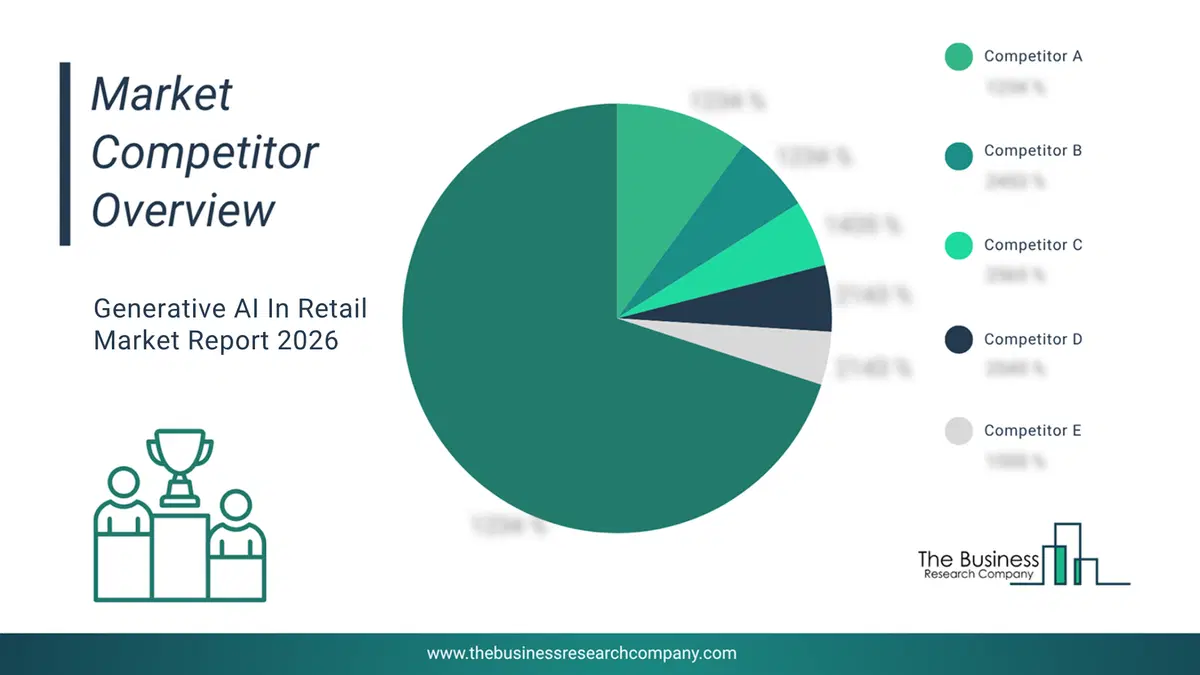
This chart is for illustrative purposes; the full report includes a detailed competitor analysis and comprehensive overview of the top 10 companies in the market.
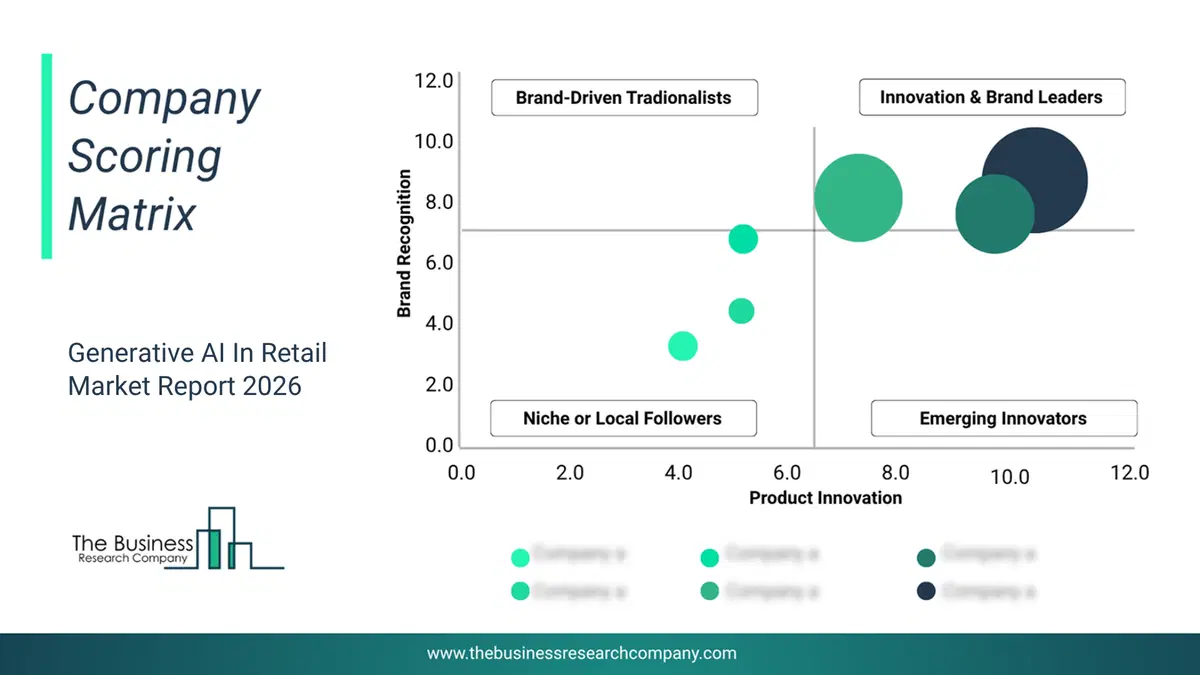
This chart maps companies by product innovation and brand strength, with bubble size indicating relative revenue, helping identify market leaders, challengers, and niche players. This is an illustrative chart; the full report provides a complete and accurate competitive analysis.
Global Generative AI In Retail Market Trends and Insights
Major companies operating in generative AI in retail are focusing on developing advanced generative artificial intelligence-powered tools to enhance customer personalization, optimize inventory management, and improve sales forecasting. generative AI-powered tools are advanced technologies that leverage artificial intelligence algorithms to create, optimize, and automate tasks such as personalized product recommendations, inventory management, and marketing strategies by analyzing data and generating insights, thereby enhancing efficiency and decision-making in the retail industry. For instance, in January 2024, Google LLC, a US-based technology company, launched new generative AI tools for retailers to enhance online shopping experiences and streamline retail operations. These tools are designed to improve online shopping experiences, streamline retail operations, and modernize customer service. New AI tools for retail feature a conversational commerce solution that integrates AI-powered virtual agents for personalized recommendations and natural language interactions, enhanced search capabilities with advanced LLM for improved product search, catalog, and content enrichment to optimize product listings, and Google distributed cloud edge to scale AI applications across multiple locations.What Are Latest Mergers And Acquisitions In The Generative AI In Retail Market?
In January 2024, International Business Machines Corporation, a US-based technology company, collaborated with SAP SE to help clients in the consumer-packaged goods and retail industries enhance their supply chain, finance operations, sales, and services using generative AI. The collaboration aims to utilize AI to tailor product assortments at the store level based on market dynamics, sales patterns, and anticipated demand. SAP SE is a Germany-based software company that provides generative AI capabilities for the retail industry.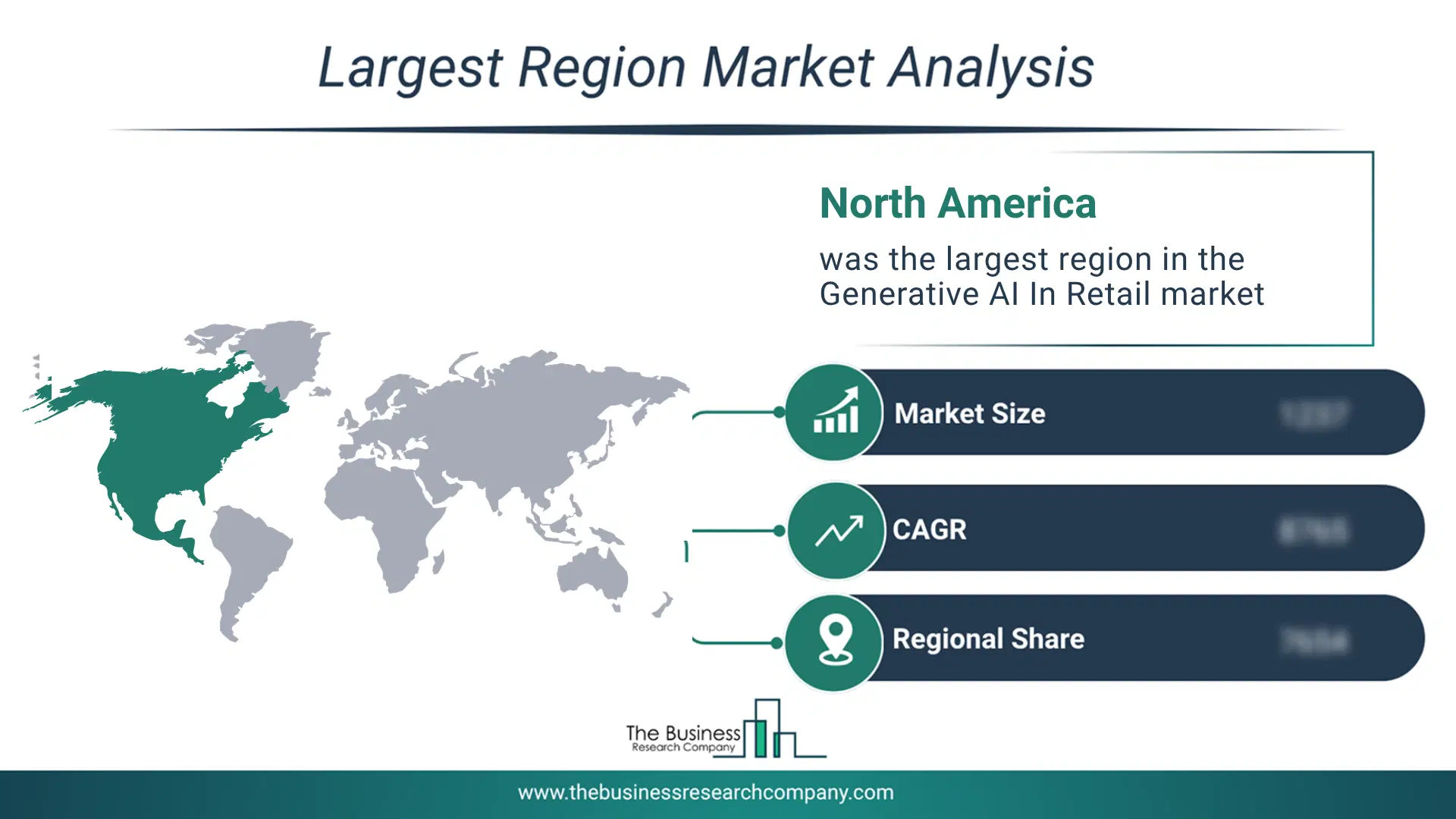
Regional Insights
North America was the largest region in the generative AI in retail market in 2025. Asia-Pacific is expected to be the fastest-growing region in the forecast period. The regions covered in this market report are Asia-Pacific, South East Asia, Western Europe, Eastern Europe, North America, South America, Middle East, Africa. The countries covered in this market report are Australia, Brazil, China, France, Germany, India, Indonesia, Japan, Taiwan, Russia, South Korea, UK, USA, Canada, Italy, Spain.What Defines the Generative AI In Retail Market?
The generative AI in retail market consists of revenues earned by entities by providing services such as customer service chatbots and virtual assistants, sentiment analysis, and customer feedback processing. The market value includes the value of related goods sold by the service provider or included within the service offering. The generative AI in retail market also includes sales of edge computing devices, Internet of Things (IoT) sensors, networking equipment, and high-performance servers. Values in this market are ‘factory gate’ values, that is the value of goods sold by the manufacturers or creators of the goods, whether to other entities (including downstream manufacturers, wholesalers, distributors and retailers) or directly to end customers. The value of goods in this market includes related services sold by the creators of the goods.How is Market Value Defined and Measured?
The market value is defined as the revenues that enterprises gain from the sale of goods and/or services within the specified market and geography through sales, grants, or donations in terms of the currency (in USD unless otherwise specified). The revenues for a specified geography are consumption values that are revenues generated by organizations in the specified geography within the market, irrespective of where they are produced. It does not include revenues from resales along the supply chain, either further along the supply chain or as part of other products.
This chart presents market attractiveness based on a quantitative evaluation of growth, competition, strategic alignment, and risk, offering a clear view of opportunity areas for decision-making. This chart is for illustrative purposes; the full report contains the complete analysis.

This chart highlights the Total Addressable Market (TAM) by estimating the maximum revenue opportunity using an assumption-driven approach, supporting strategic planning and opportunity sizing across markets. The chart is illustrative; the full report provides a more comprehensive analysis.
What Key Data and Analysis Are Included in the Generative AI In Retail Market Report 2026?
The generative ai in retail market research report is one of a series of new reports from The Business Research Company that provides market statistics, including industry global market size, regional shares, competitors with the market share, detailed market segments, market trends and opportunities, and any further data you may need to thrive in the generative ai in retail industry. The market research report delivers a complete perspective of everything you need, with an in-depth analysis of the current and future state of the industry.Generative AI In Retail Market Report Forecast Analysis
| Report Attribute | Details |
|---|---|
| Market Size Value In 2026 | $1.55 billion |
| Revenue Forecast In 2030 | $5.85 billion |
| Growth Rate | CAGR of 39.5% from 2026 to 2030 |
| Base Year For Estimation | 2025 |
| Actual Estimates/Historical Data | 2020-2025 |
| Forecast Period | 2026 - 2030 |
| Market Representation | Revenue in USD Billion and CAGR from 2026 to 2030 |
| Segments Covered | Technology, Deployment, Application, Industry |
| Regional Scope | Asia-Pacific, Western Europe, Eastern Europe, North America, South America, Middle East, Africa |
| Country Scope | The Countries Covered In This Market Report Are Australia, Brazil, China, France, Germany, India, Indonesia, Japan, Taiwan, Russia, South Korea, Uk, Usa, Canada, Italy, Spain. |
| Key Companies Profiled | Google LLC, Microsoft Corporation, Tencent Holdings Limited, Amazon Web Services (AWS), International Business Machines (IBM), Oracle Corporation,Nvidia Corporation, Adobe Inc., SAS Institute Inc., C3.AI Inc., DataRobot Inc., ClarifAI Inc., H2O.AI Inc., Shopify Inc., Walmart Global Tech, Target Corporation (AI & Data Science), Stitch Fix Inc., Ocado Group plc, Zalando SE, Bloomreach Inc., Dynamic Yield Ltd., Coveo Solutions Inc., Stability AI |
| Customization Scope | Request for Customization |
| Pricing And Purchase Options | Explore Purchase Options |