

Generative Code Review Market Report 2026
Global Outlook – By Component (Software, Services), By Deployment Mode (On-Premises, Cloud), By Enterprise Size (Small And Medium Enterprises, Large Enterprises), By Application (Bug Detection, Code Optimization, Compliance And Security, Documentation, Other Applications), By End-User (Information Technology (IT) And Telecommunications, Banking, Financial Services And Insurance (BFSI), Healthcare, Retail And E-Commerce, Manufacturing, Other End-Users) – Market Size, Trends, Strategies, and Forecast to 2030
Generative Code Review Market Overview
• Generative Code Review market size has reached to $2.12 billion in 2025 • Expected to grow to $8.73 billion in 2030 at a compound annual growth rate (CAGR) of 32.7% • Growth Driver: Surge In Electronic Health Record Adoption Fueling The Growth Of The Market Due To The Need For Secure And High-Quality Health IT Software • Market Trend: Adoption Of AI-Powered Pull Request Agents To Accelerate And Secure Code Review Cycles • North America was the largest region in 2025 and Asia-Pacific is the fastest growing region.What Is Covered Under Generative Code Review Market?
Generative code review is the automated evaluation and improvement of software code using generative artificial intelligence models that understand and generate programming logic. Its primary goal is to enhance code quality, detect vulnerabilities, and ensure adherence to best coding practices with minimal human intervention. It also accelerates development cycles, reduces manual review errors, improves developer productivity, and supports continuous integration for more reliable and efficient software delivery. The main components of the generative code review are software and services. Software is a set of programs, data, and instructions that direct a computer or device to perform specific tasks or functions. Different deployment modes are on-premises and cloud. Multiple enterprise sizes are small and medium enterprises and large enterprises. The various applications involved are bug detection, code optimization, compliance and security, documentation, and others, and they are used by several end-users such as information technology (IT) and telecommunications, banking, financial services and insurance (BFSI), healthcare, retail and e-commerce, manufacturing, and others.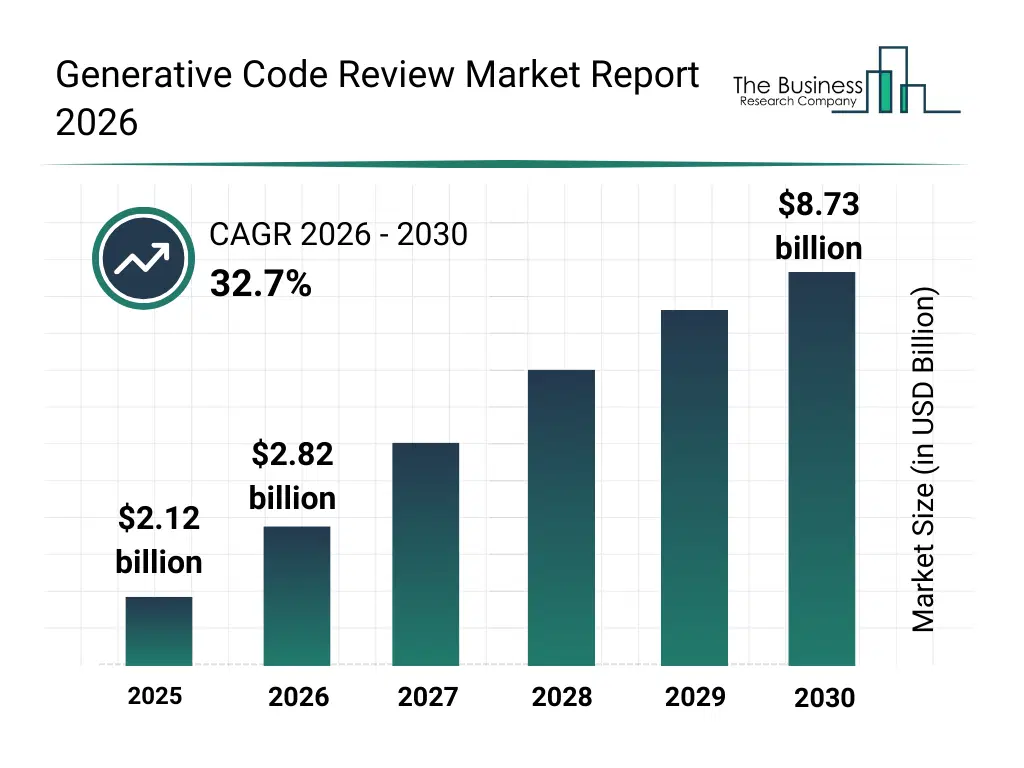
What Is The Generative Code Review Market Size and Share 2026?
The generative code review market size has grown exponentially in recent years. It will grow from $2.12 billion in 2025 to $2.82 billion in 2026 at a compound annual growth rate (CAGR) of 32.9%. The growth in the historic period can be attributed to growth in agile and devops practices, rising software complexity, need to reduce manual review effort, increase in security vulnerabilities, adoption of continuous integration tools.What Is The Generative Code Review Market Growth Forecast?
The generative code review market size is expected to see exponential growth in the next few years. It will grow to $8.73 billion in 2030 at a compound annual growth rate (CAGR) of 32.7%. The growth in the forecast period can be attributed to wider adoption of generative AI copilots, increasing focus on secure software supply chain, automation of compliance and governance, demand for faster release cycles, growth in enterprise developer platforms. Major trends in the forecast period include AI-assisted secure coding adoption, shift-left security in ci/cd, automated code quality governance, developer productivity optimization, integration with devops toolchains.
Global Generative Code Review Market Segmentation
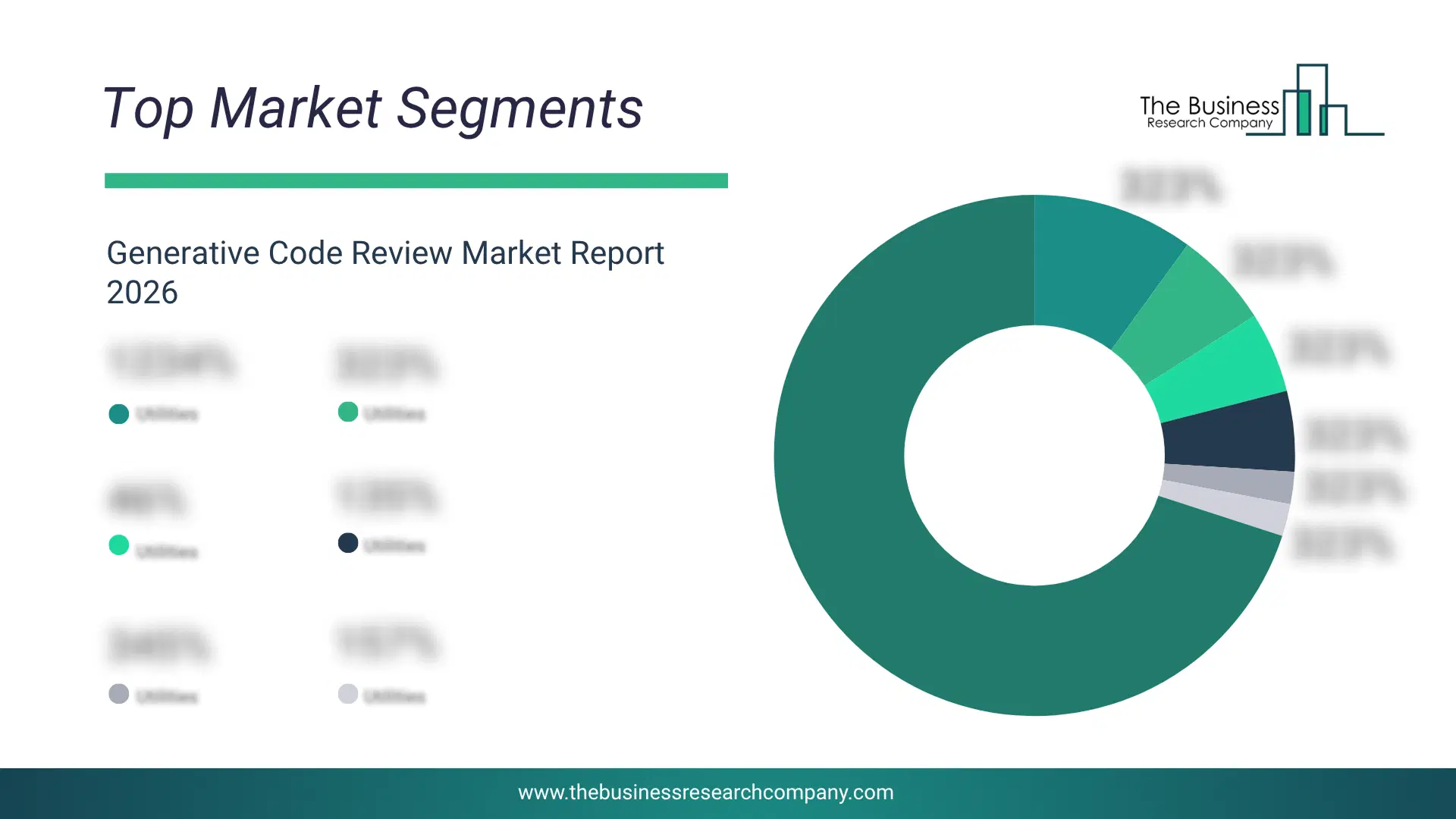
1) By Component: Software, Services 2) By Deployment Mode: On-Premises, Cloud 3) By Enterprise Size: Small And Medium Enterprises, Large Enterprises 4) By Application: Bug Detection, Code Optimization, Compliance And Security, Documentation, Other Applications 5) By End-User: Information Technology (IT) And Telecommunications, Banking, Financial Services And Insurance (BFSI), Healthcare, Retail And E-Commerce, Manufacturing, Other End-Users Subsegments: 1) By Software: Code Quality Analysis Tools, Security And Vulnerability Detection Tools, Automated Refactoring Tools, Compliance And Standards Verification Tools, Custom Model Training Platforms, Integrated Development Environment (IDE) Plugins 2) By Services: Implementation And Integration Services, Consulting Services, Support And Maintenance Services, Training And Education Services, Managed Code Review ServicesWhat Is The Driver Of The Generative Code Review Market?
The growing use of electronic health records is expected to propel the growth of the generative code review market. Electronic health records refer to digital systems used by healthcare providers to securely collect, store, and manage patient information for clinical, administrative, and regulatory purposes. The rise in electronic health record adoption is due to the need for improved data accuracy, interoperability, and compliance with healthcare standards, which require reliable and secure software infrastructure. Generative code review supports electronic health records by helping developers identify vulnerabilities, improve code quality, and ensure that health information technology (IT) applications meet security, privacy, and performance requirements. For instance, in September 2023, according to the Organisation for Economic Co-operation and Development (OECD), a France-based intergovernmental organization, inpatient hospital electronic medical record coverage rose to about 96% in some member countries from roughly 19%, showing large gains in digital record deployment. Therefore, the growing use of electronic health records is driving the growth of the generative code review industry.Key Players In The Global Generative Code Review Market
Major companies operating in the generative code review market are Amazon Inc., OpenAI LLC, GitHub Inc., SonarSource SA, Snyk Limited, Google DeepMind Limited, Anthropic PBC, Sourcegraph Inc., Codacy Lda, Diffblue Ltd., Swimm Inc., DeepSource Inc., CodeRabbit Inc., Aikido Security Inc., Greptile Inc., Qodo Inc., Tabnine Inc., CodeScene AB, Embold Technologies GmbH, Panto AI Inc.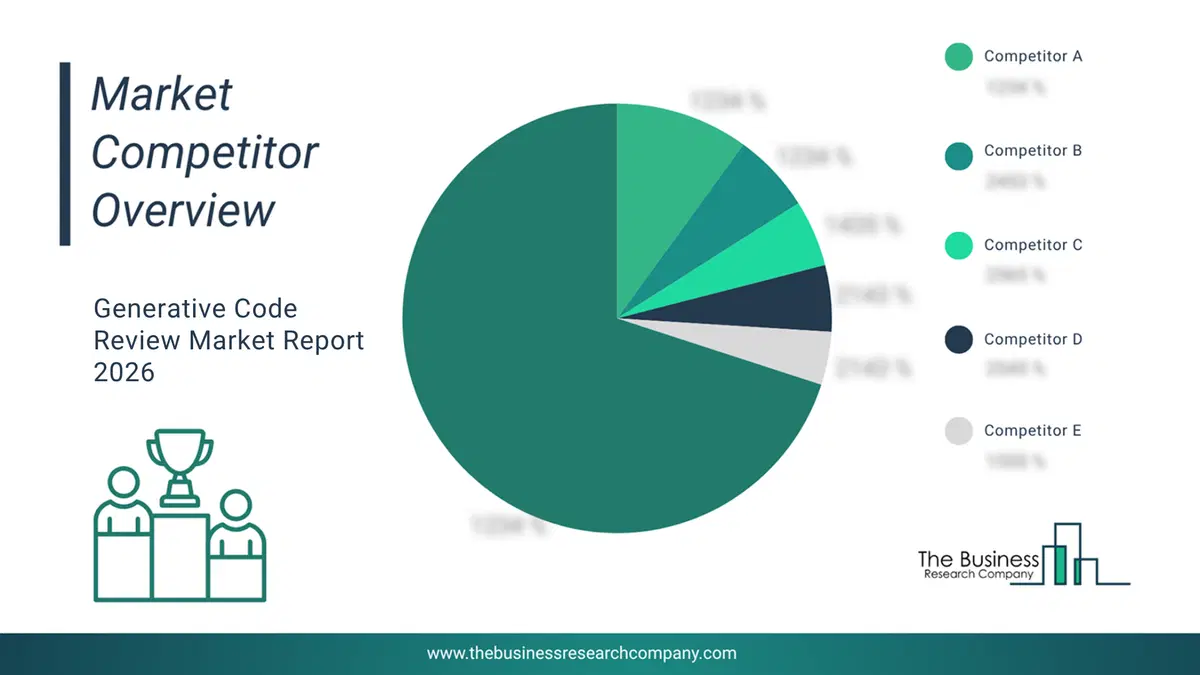
This chart is for illustrative purposes; the full report includes a detailed competitor analysis and comprehensive overview of the top 10 companies in the market.
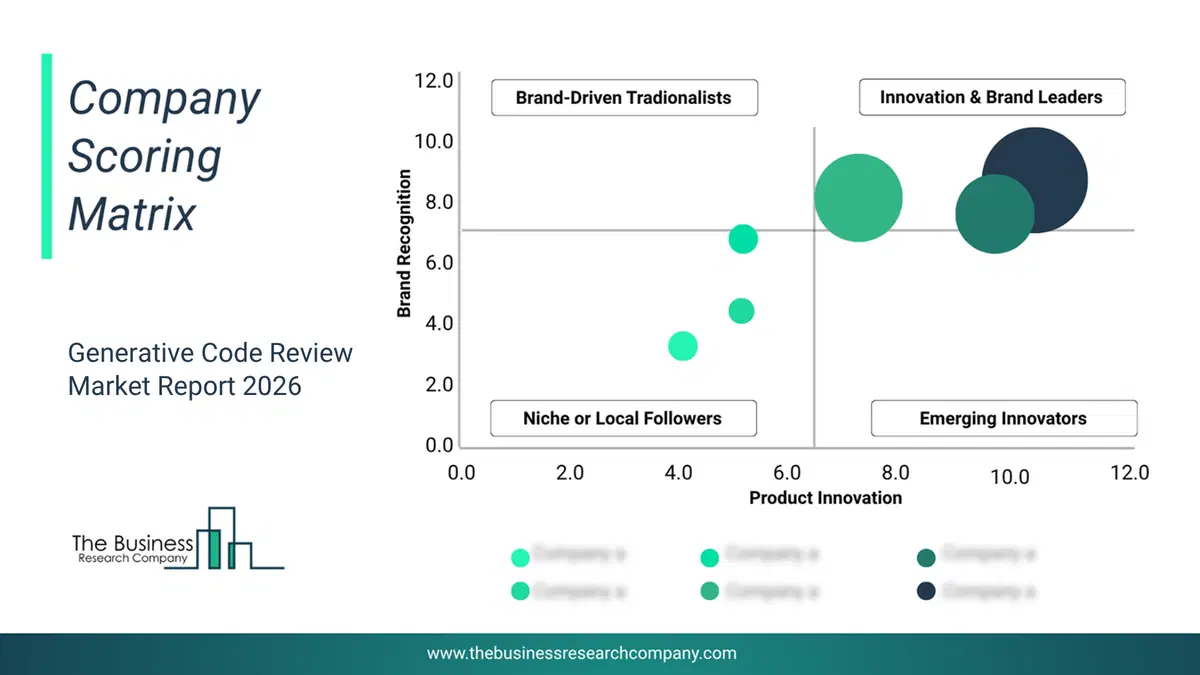
This chart maps companies by product innovation and brand strength, with bubble size indicating relative revenue, helping identify market leaders, challengers, and niche players. This is an illustrative chart; the full report provides a complete and accurate competitive analysis.
Global Generative Code Review Market Trends and Insights
Major companies operating in the generative code review market are focusing on developing artificial intelligence (AI)-powered pull request agents to enhance development speed, improve code accuracy, reduce deployment risks, and streamline collaboration between human reviewers and autonomous systems. Artificial intelligence (AI)-powered pull request agents refer to intelligent review companions that automatically analyze code changes, detect bugs, flag vulnerabilities, enforce style rules, and provide instant feedback within developer workflows. For instance, in March 2025, Graphite, a US-based code collaboration platform, announced the launch of Diamond, an artificial intelligence (AI) code review agent designed to deliver automated feedback, summarize pull requests, suggest fixes, and support CI self-healing across repositories. The platform integrates features such as customizable review rules, codebase awareness, GitHub compatibility, automated insights, and one-click corrections, helping engineering teams accelerate pull request cycles, reduce manual review effort, and enhance code quality with artificial intelligence (AI)-backed precision, representing a modern approach to scaling development efficiency through hybrid human–machine collaboration.What Are Latest Mergers And Acquisitions In The Generative Code Review Market?
In September 2025, Nvidia Corporation, a US-based technology company, acquired Solver for an undisclosed amount. With this acquisition, Nvidia aims to expand its artificial intelligence (AI) software capabilities by integrating autonomous coding agents into its existing development ecosystem, strengthening its position in end-to-end AI infrastructure and accelerating enterprise adoption of AI-driven software tools. Solver Inc. is a US-based artificial intelligence (AI)-driven coding agent company specializing in generative code review and autonomous software development.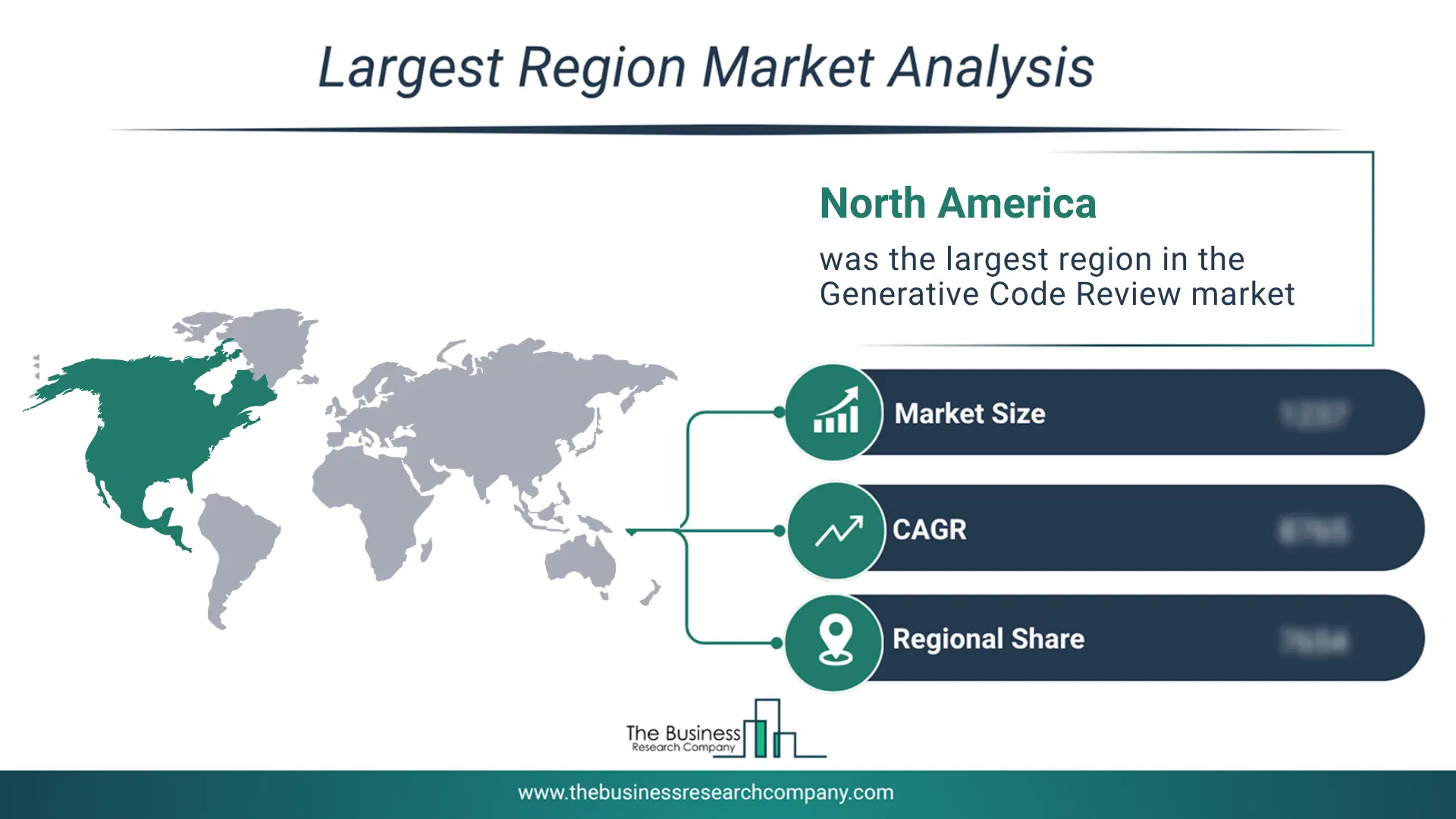
Regional Insights
North America was the largest region in the generative code review market in 2025. Asia-Pacific is expected to be the fastest-growing region in the forecast period. The regions covered in this market report are Asia-Pacific, South East Asia, Western Europe, Eastern Europe, North America, South America, Middle East, Africa. The countries covered in this market report are Australia, Brazil, China, France, Germany, India, Indonesia, Japan, Taiwan, Russia, South Korea, UK, USA, Canada, Italy, Spain.What Defines the Generative Code Review Market?
The generative code review market includes revenues earned by entities by providing services such as artificial intelligence (AI)-powered debugging assistance, compliance and standards verification, code refactoring services, custom model training services, and developer productivity enhancement services. The market value includes the value of related goods sold by the service provider or included within the service offering. Only goods and services traded between entities or sold to end consumers are included.How is Market Value Defined and Measured?
The market value is defined as the revenues that enterprises gain from the sale of goods and/or services within the specified market and geography through sales, grants, or donations in terms of the currency (in USD unless otherwise specified). The revenues for a specified geography are consumption values that are revenues generated by organizations in the specified geography within the market, irrespective of where they are produced. It does not include revenues from resales along the supply chain, either further along the supply chain or as part of other products.
This chart presents market attractiveness based on a quantitative evaluation of growth, competition, strategic alignment, and risk, offering a clear view of opportunity areas for decision-making. This chart is for illustrative purposes; the full report contains the complete analysis.

This chart highlights the Total Addressable Market (TAM) by estimating the maximum revenue opportunity using an assumption-driven approach, supporting strategic planning and opportunity sizing across markets. The chart is illustrative; the full report provides a more comprehensive analysis.
What Key Data and Analysis Are Included in the Generative Code Review Market Report 2026?
The generative code review market research report is one of a series of new reports from The Business Research Company that provides market statistics, including industry global market size, regional shares, competitors with the market share, detailed market segments, market trends and opportunities, and any further data you may need to thrive in the generative code review industry. The market research report delivers a complete perspective of everything you need, with an in-depth analysis of the current and future state of the industry.Generative Code Review Market Report Forecast Analysis
| Report Attribute | Details |
|---|---|
| Market Size Value In 2026 | $2.82 billion |
| Revenue Forecast In 2030 | $8.73 billion |
| Growth Rate | CAGR of 32.7% from 2026 to 2030 |
| Base Year For Estimation | 2025 |
| Actual Estimates/Historical Data | 2020-2025 |
| Forecast Period | 2026 - 2030 |
| Market Representation | Revenue in USD Billion and CAGR from 2026 to 2030 |
| Segments Covered | Component, Deployment Mode, Enterprise Size, Application, End-User |
| Regional Scope | Asia-Pacific, Western Europe, Eastern Europe, North America, South America, Middle East, Africa |
| Country Scope | The Countries Covered In This Market Report Are Australia, Brazil, China, France, Germany, India, Indonesia, Japan, Taiwan, Russia, South Korea, Uk, Usa, Canada, Italy, Spain. |
| Key Companies Profiled | Amazon Inc., OpenAI LLC, GitHub Inc., SonarSource SA, Snyk Limited, Google DeepMind Limited, Anthropic PBC, Sourcegraph Inc., Codacy Lda, Diffblue Ltd., Swimm Inc., DeepSource Inc., CodeRabbit Inc., Aikido Security Inc., Greptile Inc., Qodo Inc., Tabnine Inc., CodeScene AB, Embold Technologies GmbH, Panto AI Inc. |
| Customization Scope | Request for Customization |
| Pricing And Purchase Options | Explore Purchase Options |