
Hardware As A Service Market Report 2026
Global Outlook – By Component (Hardware, Services), By Enterprise Size (Small and Medium Enterprises, Large Enterprises), By Deployment Model (On Premises, Public Cloud, Private Cloud, Hybrid Cloud), By End Use Industry (Retail and Wholesale, Education, Banking Financial Services and Insurance, Manufacturing, Healthcare, Information Technology and Telecommunications, Other End User Industries) – Market Size, Trends, Strategies, and Forecast to 2030
Hardware As A Service Market Overview
• Hardware As A Service market size has reached to $127.52 billion in 2025 • Expected to grow to $365.78 billion in 2030 at a compound annual growth rate (CAGR) of 23.4% • Growth Driver: The Increasing Adoption Of Internet Of Things (IoT) Devices Driving Market Growth Due To Real-Time Data Collection And Scalable Infrastructure • Market Trend: Innovative Solutions Empower Seamless, Scalable Collaboration Across Workforces • North America was the largest region in 2025 and Asia-Pacific is the fastest growing region.Market Gains By 2030 – Top Opportunities By Segment
Market Gain identifies the most promising market opportunities by highlighting the segments or products expected to generate the highest incremental revenue growth over the next five years.
What Is Covered Under Hardware As A Service Market?
Hardware as a service is a service model where businesses provide physical computing hardware such as servers, desktops, networking devices, or storage on a subscription or pay-per-use basis rather than selling it outright. It allows organizations to access up-to-date technology without large upfront investments, while maintenance, upgrades, and support are typically managed by the service provider. It helps to reduce capital expenditure, ensure scalability, and provide flexible, managed access to essential hardware resources. The main components of hardware as a service are hardware and services. Hardware comprises physical information technology infrastructure such as servers, storage devices, networking equipment, and computing devices, designed to support diverse enterprise operations. These components are available for small and medium enterprises as well as large enterprises, distributed through both offline and online channels, and are applied across on-premises, public cloud, private cloud, and hybrid cloud deployment models. They cater to various end-use industries such as retail and wholesale, education, banking financial services and insurance, manufacturing, healthcare, information technology and telecommunications, and other end-user industries.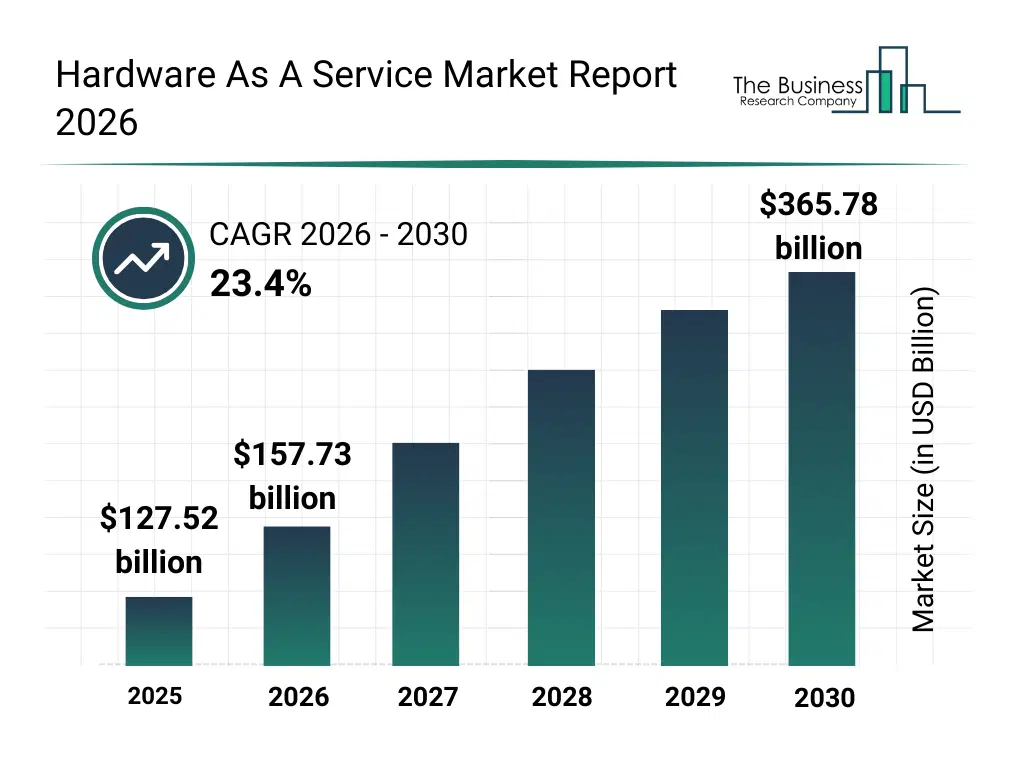
What Is The Hardware As A Service Market Size and Share 2026?
The hardware as a service market size has grown exponentially in recent years. It will grow from $127.52 billion in 2025 to $157.73 billion in 2026 at a compound annual growth rate (CAGR) of 23.7%. The growth in the historic period can be attributed to rising adoption of cloud computing, increasing demand for cost-efficient IT solutions, growth of enterprise IT spending, need for hardware upgrades without capital expenditure, emergence of managed IT service providers.What Is The Hardware As A Service Market Growth Forecast?
The hardware as a service market size is expected to see exponential growth in the next few years. It will grow to $365.78 billion in 2030 at a compound annual growth rate (CAGR) of 23.4%. The growth in the forecast period can be attributed to expansion of IoT-enabled devices, increasing adoption of hybrid cloud models, growing focus on sustainability and e-waste reduction, rising demand for edge computing solutions, integration of AI for predictive hardware maintenance. Major trends in the forecast period include subscription-based hardware provisioning, managed IT infrastructure services, flexible hardware scaling, predictive maintenance for devices, hardware lifecycle optimization.
Global Hardware As A Service Market Segmentation
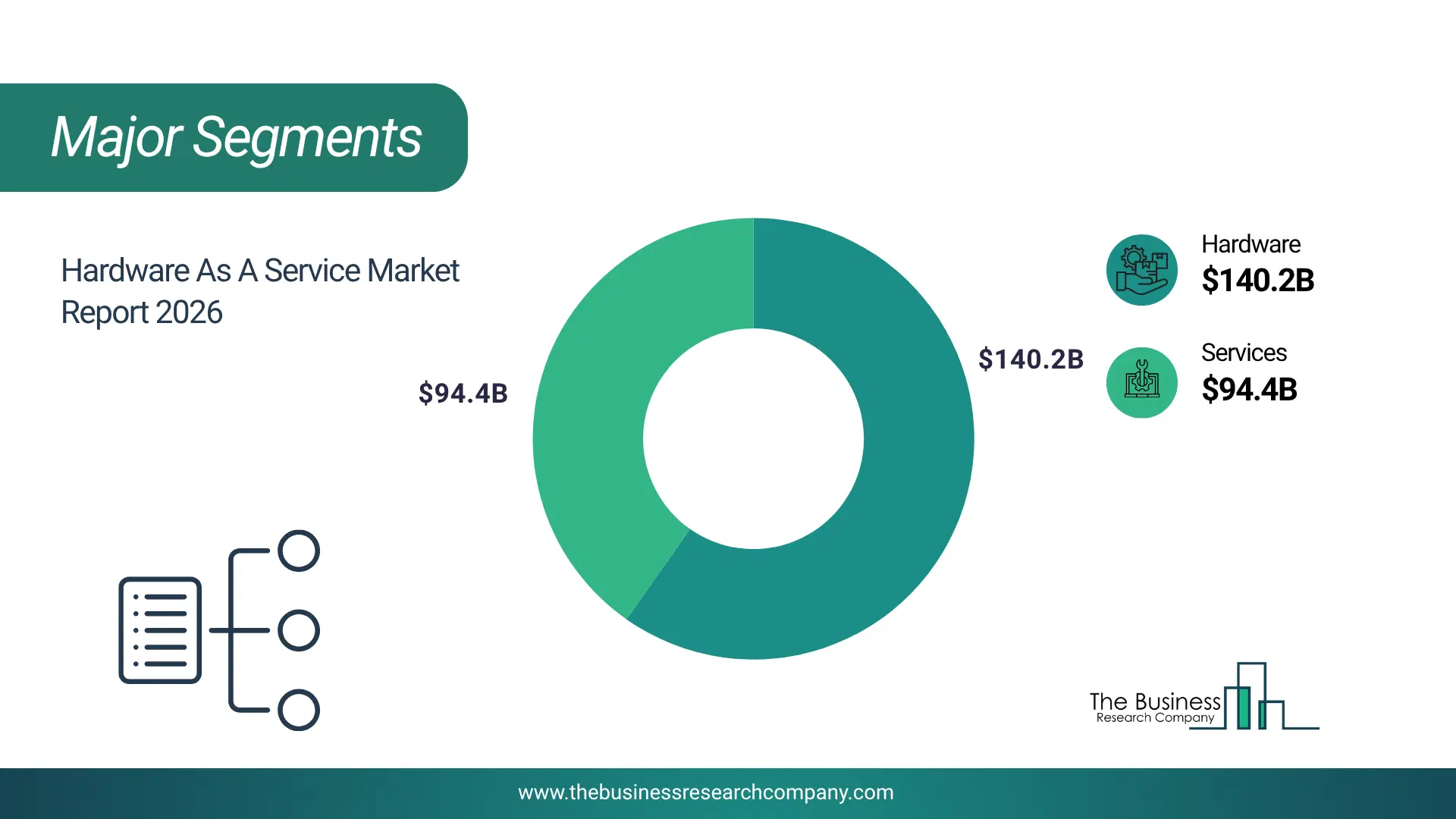
1) By Component: Hardware, Services 2) By Enterprise Size: Small and Medium Enterprises, Large Enterprises 3) By Deployment Model: On Premises, Public Cloud, Private Cloud, Hybrid Cloud 4) By End Use Industry: Retail and Wholesale, Education, Banking Financial Services and Insurance, Manufacturing, Healthcare, Information Technology and Telecommunications, Other End User Industries Subsegments: 1) By Hardware: Computing Hardware, Networking Hardware, Storage Hardware, Peripheral Hardware 2) By Services: Installation Services, Maintenance Services, Managed Services, Consulting Services The top segments in the hardware as a service market will be: • Hardware will reach $140.11 billion by 2030. • Services will reach $94.37 billion by 2030.What Is The Driver Of The Hardware As A Service Market?
The increasing adoption of internet of things (IoT) devices is expected to propel the growth of the hardware as a service market going forward. Internet of Things (IoT) devices refer to physical objects embedded with sensors, software, and connectivity capabilities that allow them to collect, exchange, and act on data over the internet. The increasing adoption of Internet of Things (IoT) devices is due to their ability to collect and transmit real-time data, enabling businesses and individuals to monitor, analyze, and respond to events instantly. Hardware as a service enables seamless deployment and management of IoT devices by providing scalable, up-to-date infrastructure and reducing the need for large upfront hardware investments. For instance, in July 2025, the European Commission, a Belgium-based governing body, reported that in 2023, the number of installed IoT-connected devices was around 40 billion and is projected to grow to 49 billion by 2026, representing an annual growth rate of 7%. Therefore, increasing adoption of internet of things (IoT) devices is driving the growth of the hardware as a service industry.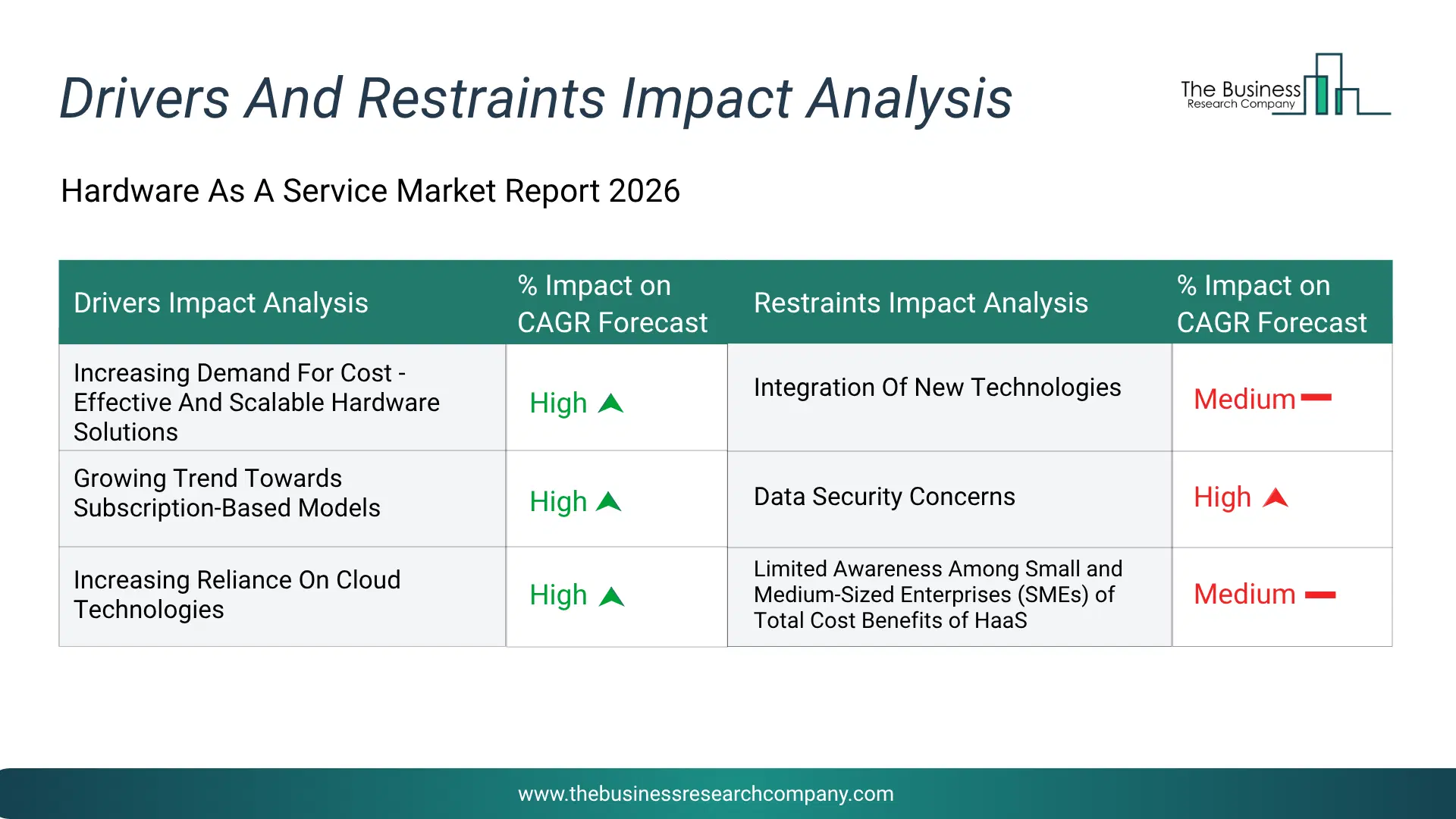
Infographic Chart Showing Key Market Drivers Analysis And Restraints For Hardware As A Service Market
The chart presents an impact analysis of key drivers and restraints, quantifying their relative influence on the market's growth rate and helping assess the balance between growth enablers and limiting factors. This chart offers a high-level perspective; the full report contains more detailed insights.
How Will The Drivers Impact Growth In The Global Hardware As A Service Market?
• Increasing Demand For Cost -Effective And Scalable Hardware Solutions (High) – During the forecast period, the increasing demand for cost -effective and scalable hardware solutions is expected to become a key growth driver for the hardware as a service (haas) market by 2030. Enterprises are increasingly seeking flexible infrastructure models that allow them to deploy servers, networking equipment, storage systems, and endpoint devices without large upfront investments. Hardware as a service enables organizations to access modern it infrastructure through subscription -based payments while allowing easy scalability as operational needs grow. Businesses can quickly upgrade or expand their hardware environments without complex procurement cycles, reducing financial risk and improving operational agility. This shift toward flexible infrastructure consumption is encouraging organizations to modernize their it ecosystems while maintaining predictable operating costs. • Growing Trend Towards Subscription-Based Models (High) – During the forecast period, the growing trend toward subscription-based models is expected to significantly drive the expansion of the hardware as a service (haas) market by 2030. Organizations across industries are increasingly adoption of subscription-based it consumption frameworks that replace traditional hardware ownership with recurring service agreements. These models include bundled services such as device provisioning, maintenance, remote monitoring, lifecycle management, and technology upgrades. Subscription-based hardware models help enterprises align technology spending with operational budgets while ensuring continuous access to the latest hardware platforms. Vendors are also increasingly offering flexible subscription tiers tailored to enterprise needs, further accelerating adoption. • Increasing Reliance On Cloud Technologies (High) – During the forecast period, the increasing reliance on cloud technologies is expected to act as another major driver supporting the growth of the hardware as a service (haas) market by 2030. As organizations expand their use of cloud computing, hybrid it environments, and edge infrastructure, the demand for compatible and scalable hardware platforms is rising rapidly. Haas solutions enable enterprises to deploy cloud-connected servers, networking devices, and storage infrastructure with integrated management tools and remote monitoring capabilities. This approach simplifies infrastructure deployment while supporting data-intensive workloads, artificial intelligence applications, and real-time analytics. The integration of hardware subscriptions with cloud ecosystems is therefore strengthening enterprise adoption of haas solutions.How Will The Restraints Impact Growth In The Global Hardware As A Service Market?
• Integration Of New Technologies (Medium) – During the forecast period, the integration of new technologies can act as a restraint for hardware as a service (haas) because rapidly evolving hardware and software standards require frequent upgrades and adaptation, which can increase operational complexity for providers. Enterprises may face compatibility issues when connecting haas solutions with existing legacy systems, leading to implementation delays and higher costs. The learning curve associated with adopting cutting-edge technologies can also limit user acceptance and slow deployment. Additionally, frequent updates or changes in technology can disrupt ongoing services and impact reliability. These factors collectively create barriers that can hinder smooth adoption and scalability of haas solutions. • Data Security Concerns (High) – During the forecast period, the data security concerns act as a restraint for hardware as a service (haas) because organizations often hesitate to entrust critical hardware and sensitive data to external providers. Potential risks include unauthorized access, data breaches, or insufficient security measures by the service provider. Enterprises may also worry about compliance with industry-specific regulations when hardware management is outsourced. These concerns can slow adoption, especially in sectors handling highly confidential information. As a result, companies may prefer traditional on-premises hardware to maintain direct control over security and reduce perceived risks. • Limited Awareness Among Small and Medium-Sized Enterprises (SMEs) of Total Cost Benefits of HaaS (Medium) – During the forecast period, the limited awareness among small and medium-sized enterprises (smes) about the total cost benefits of hardware as a service (haas) acts as a significant restraint on market growth. Many smes continue to rely on traditional hardware purchase models due to a lack of understanding of subscription-based advantages, such as reduced upfront capital expenditure, maintenance savings, and scalability. This knowledge gap slows adoption rates, preventing haas providers from reaching a large segment of potential customers. As a result, market penetration is limited, and the overall expansion of haas is restrained. Increasing awareness and education are therefore crucial for overcoming this barrier.Key Players In The Global Hardware As A Service Market
Major companies operating in the hardware as a service market are Microsoft Corporation, Dell Technologies Inc., Hewlett Packard Enterprise Company, Cisco Systems Inc., Amazon.com Inc., Alphabet Inc. (Google LLC), Lenovo Group Limited, HP Inc., Samsung Electronics Co. Ltd., NetApp Inc., Pure Storage Inc., NVIDIA Corporation, Huawei Technologies Co. Ltd., Hitachi Ltd., Ingram Micro Inc., Panasonic Holdings Corporation, Fujitsu Limited, International Business Machines Corporation, Arista Networks Inc., Nokia Corporation, Juniper Networks Inc., Xyte Inc., PCG IT Services LLC, CSC Leasing Company, ioX-Connect Inc., Century Solutions Group Inc., and Capstone IT Services LLC.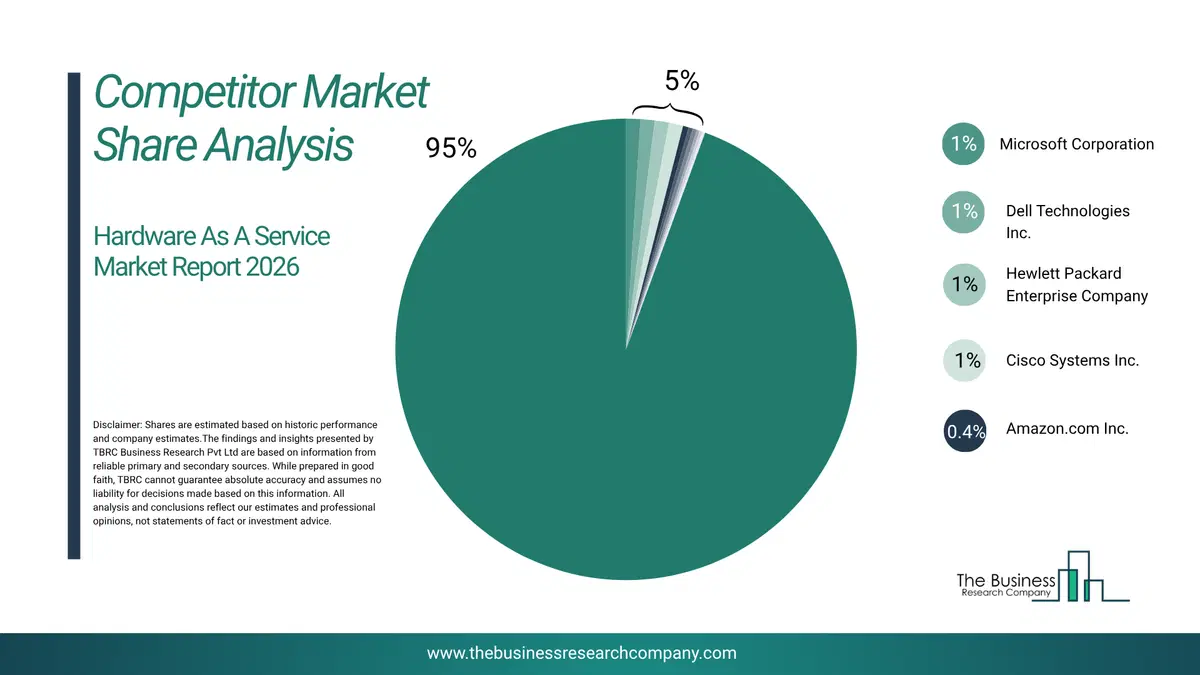
This chart is for illustrative purposes; the full report includes a detailed competitor analysis and comprehensive overview of the top 10 companies in the market.
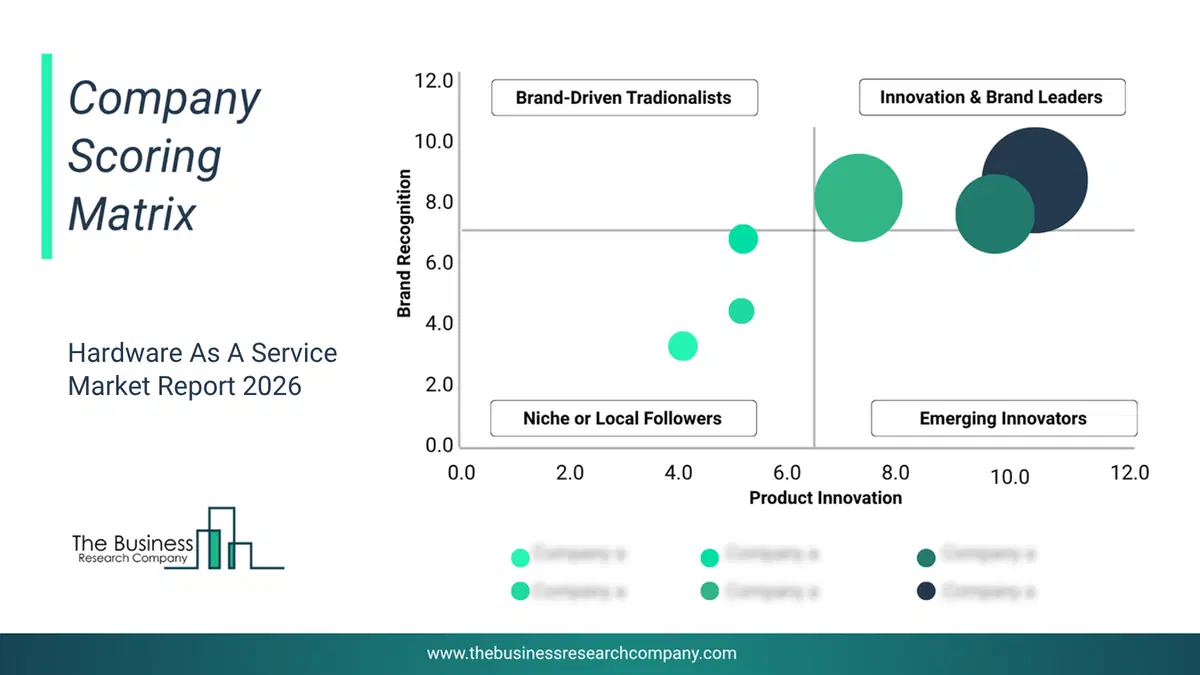
This chart maps companies by product innovation and brand strength, with bubble size indicating relative revenue, helping identify market leaders, challengers, and niche players. This is an illustrative chart; the full report provides a complete and accurate competitive analysis.
Global Hardware As A Service Market Trends and Insights
Major companies operating in the hardware-as-a-service market are focusing on developing innovative solutions, such as hybrid unified communications platforms, to enable seamless, scalable, and cost-effective collaboration across distributed workforces. A hybrid unified communications platform is a system that integrates multiple communication tools such as voice, video, messaging, and collaboration across both on-premises and cloud environments to provide seamless connectivity and flexibility for users. For instance, in April 2025, Zultys Inc., a US-based telecommunications company, launched Hardware as a Service (HaaS), offering businesses a flexible, subscription-based model for unified communications hardware. This solution allows companies to access enterprise-grade phones, PBX systems, and related equipment without large upfront investments, with predictable per-user, per-month pricing. The HaaS model supports on-premise, cloud, and hybrid deployments, ensuring business continuity, enhanced redundancy, and seamless communication across multiple locations.What Are Latest Mergers And Acquisitions In The Hardware As A Service Market?
In May 2025, Aker Business, Inc., a US-based private equity and investment company, acquired Elarasys Worldwide, LLC and IT Hardware Plus, LLC for an undisclosed amount. With this acquisition, Aker Business aims to expand its footprint in the IT services sector by integrating Elarasys's comprehensive IT hardware solutions and IT Hardware Plus's tailored technology infrastructure services. Elarasys Worldwide, LLC is a US-based provider of IT hardware and services, specializing in cost-effective solutions for data centers and enterprise environments. IT Hardware Plus, LLC is a U.S.-based provider of technology infrastructure solutions, offering services such as hyper-converged infrastructure, cloud solutions, and hardware as a service (HaaS).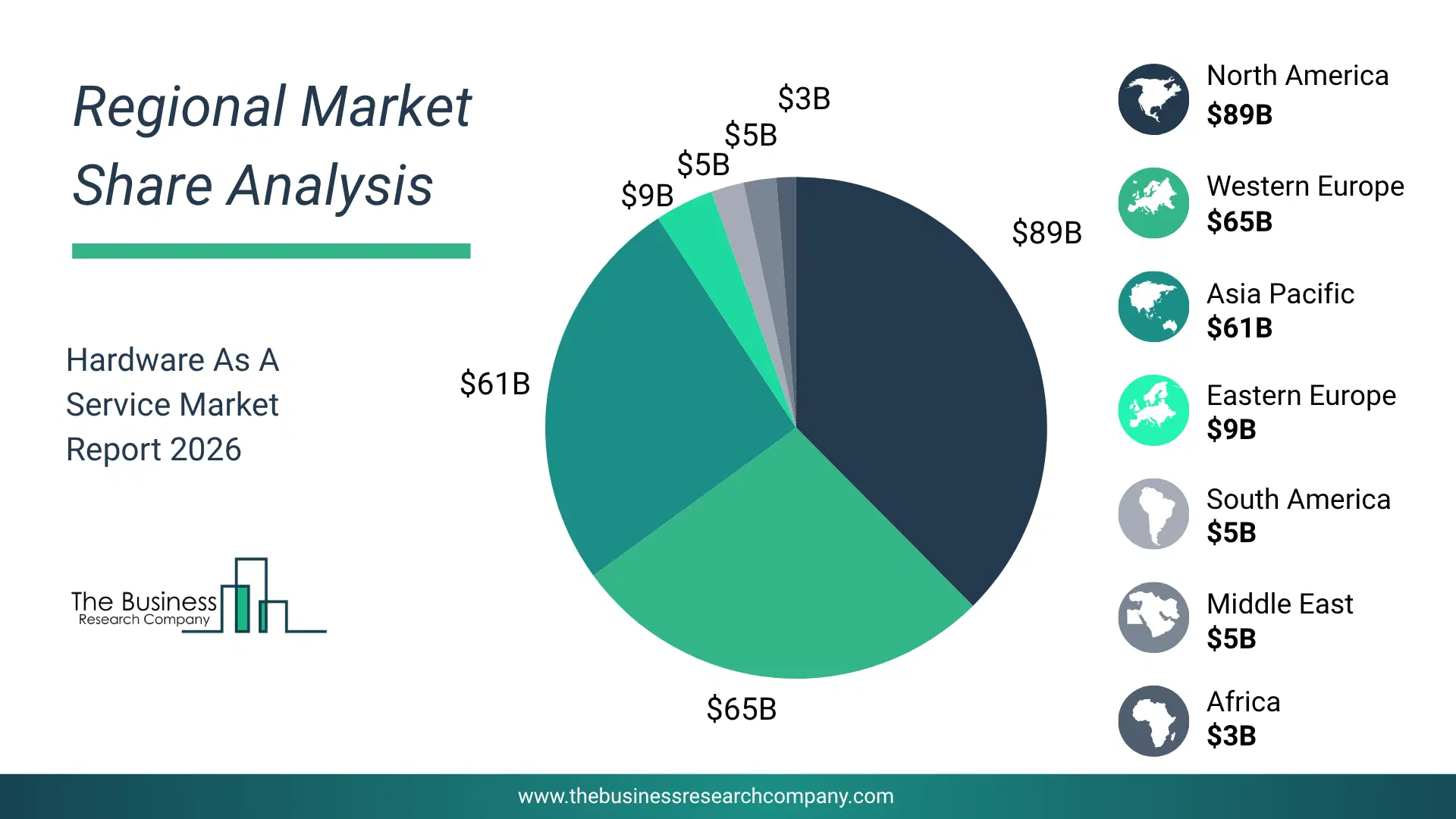
Regional Insights
North America was the largest region in the hardware as a service market in 2025. Asia-Pacific is expected to be the fastest-growing region in the forecast period. The regions covered in this market report are Asia-Pacific, South East Asia, Western Europe, Eastern Europe, North America, South America, Middle East, Africa. The countries covered in this market report are Australia, Brazil, China, France, Germany, India, Indonesia, Japan, Taiwan, Russia, South Korea, UK, USA, Canada, Italy, Spain.What Defines the Hardware As A Service Market?
The hardware as a service market includes revenues earned by entities through hardware installation and configuration, system monitoring and management, regular maintenance and repairs, firmware and software updates, technical support and troubleshooting, asset lifecycle management, and hardware optimization consulting. The market value includes the value of related goods sold by the service provider or included within the service offering. Only goods and services traded between entities or sold to end consumers are included.How is Market Value Defined and Measured?
The market value is defined as the revenues that enterprises gain from the sale of goods and/or services within the specified market and geography through sales, grants, or donations in terms of the currency (in USD unless otherwise specified). The revenues for a specified geography are consumption values that are revenues generated by organizations in the specified geography within the market, irrespective of where they are produced. It does not include revenues from resales along the supply chain, either further along the supply chain or as part of other products.
This chart presents market attractiveness based on a quantitative evaluation of growth, competition, strategic alignment, and risk, offering a clear view of opportunity areas for decision-making. This chart is for illustrative purposes; the full report contains the complete analysis.

This chart highlights the Total Addressable Market (TAM) by estimating the maximum revenue opportunity using an assumption-driven approach, supporting strategic planning and opportunity sizing across markets. The chart is illustrative; the full report provides a more comprehensive analysis.
What Key Data and Analysis Are Included in the Hardware As A Service Market Report 2026?
The hardware as a service market research report is one of a series of new reports from The Business Research Company that provides market statistics, including industry global market size, regional shares, competitors with the market share, detailed market segments, market trends and opportunities, and any further data you may need to thrive in the hardware as a service industry. The market research report delivers a complete perspective of everything you need, with an in-depth analysis of the current and future state of the industry.Hardware As A Service Market Report Forecast Analysis
| Report Attribute | Details |
|---|---|
| Market Size Value In 2026 | $157.73 billion |
| Revenue Forecast In 2030 | $365.78 billion |
| Growth Rate | CAGR of 23.4% from 2026 to 2030 |
| Base Year For Estimation | 2025 |
| Actual Estimates/Historical Data | 2020-2025 |
| Forecast Period | 2026 - 2030 |
| Market Representation | Revenue in USD Billion and CAGR from 2026 to 2030 |
| Segments Covered | Component, Enterprise Size, Deployment Model, End Use Industry |
| Regional Scope | Asia-Pacific, Western Europe, Eastern Europe, North America, South America, Middle East, Africa |
| Country Scope | The countries covered in the report are Australia, Brazil, China, France, Germany, India, ... |
| Key Companies Profiled | Microsoft Corporation, Dell Technologies Inc., Hewlett Packard Enterprise Company, Cisco Systems Inc., Amazon.com Inc., Alphabet Inc. (Google LLC), Lenovo Group Limited, HP Inc., Samsung Electronics Co. Ltd., NetApp Inc., Pure Storage Inc., NVIDIA Corporation, Huawei Technologies Co. Ltd., Hitachi Ltd., Ingram Micro Inc., Panasonic Holdings Corporation, Fujitsu Limited, International Business Machines Corporation, Arista Networks Inc., Nokia Corporation, Juniper Networks Inc., Xyte Inc., PCG IT Services LLC, CSC Leasing Company, ioX-Connect Inc., Century Solutions Group Inc., and Capstone IT Services LLC. </b> |
| Customization Scope | Request for Customization |
| Pricing And Purchase Options | Explore Purchase Options |