
Quick Service Restaurant IT Market Report 2026
Global Outlook – By Component (Software, Hardware, Service), By Technology Adoption (Traditional Systems, Cloud-Based Solutions, Mobile Applications, Self-Service Kiosks, Point Of Sale Systems), By Deployment Mode (On-Premises, Cloud), By Application (Order Management, Inventory Management, Customer Relationship Management, Payment Processing, Other Applications), By End-User (Independent Quick Service Restaurant, Chain Quick Service Restaurant) – Market Size, Trends, Strategies, and Forecast to 2035
Quick Service Restaurant IT Market Overview
• Quick Service Restaurant IT market size has reached to $24.82 billion in 2025 • Expected to grow to $40.23 billion in 2030 at a compound annual growth rate (CAGR) of 10.1% • Growth Driver: The Growing Deployment Of Self-Service Kiosks Propelled The Market Due To Increased Labor Cost Pressures • Market Trend: AI Assistants Transform Operational Efficiency In Quick Service Restaurant Management • North America was the largest region in 2025 and Asia-Pacific is the fastest growing region.What Is Covered Under Quick Service Restaurant IT Market?
Quick service restaurant information technology (IT) refers to the use of digital systems, software, and technology solutions to streamline operations, enhance customer experience, and improve efficiency in fast-food and quick-service restaurants. Its primary purpose is to manage order processing, inventory, payments, kitchen operations, and customer engagement efficiently, enabling faster service and data-driven decision-making. It also supports online ordering, mobile apps, and loyalty programs to meet modern consumer demands. The main components of quick service restaurant information technology (IT) are software, hardware, and services. Software refers to digital applications and systems used to manage ordering, payment, kitchen operations, staffing, inventory, and overall restaurant workflow. It adopts various technologies such as traditional systems, cloud-based solutions, mobile applications, self-service kiosks, and point-of-sale (POS) systems, and is deployed through on-premises or cloud environments. It supports a wide range of applications, including order management, inventory management, customer relationship management (CRM), payment processing, and other operational functions, and caters to different end-users, such as independent quick service restaurants and chain quick service restaurants.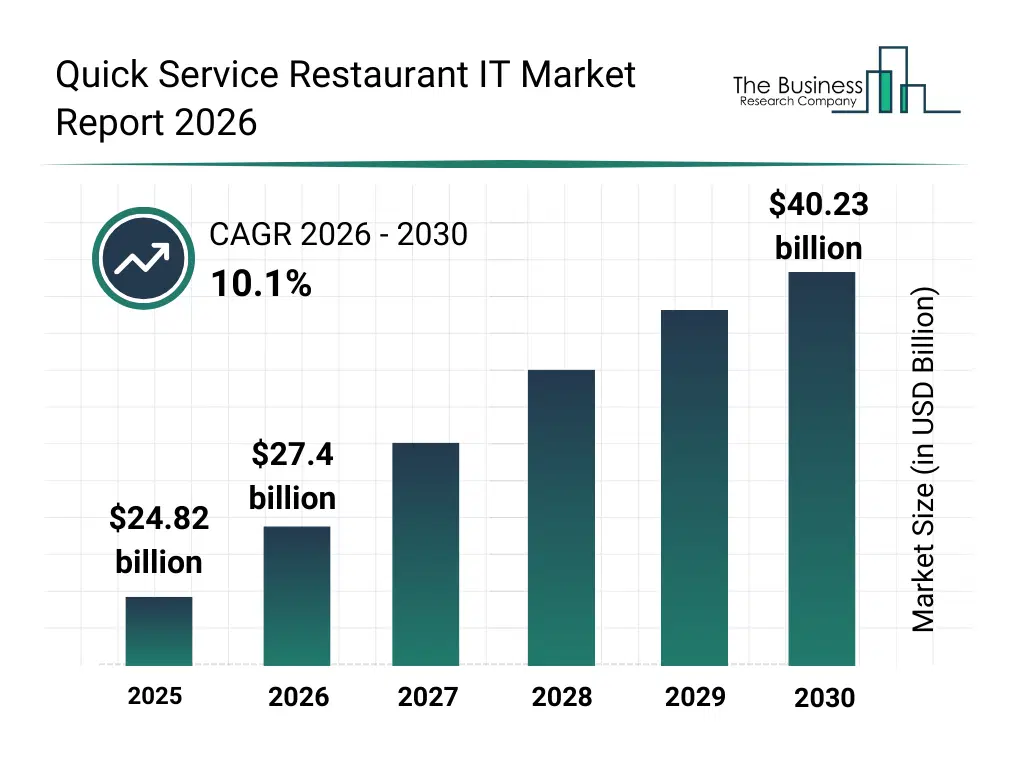
What Is The Quick Service Restaurant IT Market Size and Share 2026?
The quick service restaurant it market size has grown rapidly in recent years. It will grow from $24.82 billion in 2025 to $27.4 billion in 2026 at a compound annual growth rate (CAGR) of 10.4%. The growth in the historic period can be attributed to expansion of fast food and QSR chains globally, consumer demand for faster service and convenience, rise of digital payments and card acceptance, need for better inventory control and waste reduction, growth of online food delivery platforms.What Is The Quick Service Restaurant IT Market Growth Forecast?
The quick service restaurant it market size is expected to see rapid growth in the next few years. It will grow to $40.23 billion in 2030 at a compound annual growth rate (CAGR) of 10.1%. The growth in the forecast period can be attributed to increasing adoption of self-service kiosks, AI-driven upselling and personalization in ordering, greater integration with delivery aggregators, higher investment in cybersecurity for payment systems, expansion of omnichannel customer engagement platforms. Major trends in the forecast period include cloud-based POS and order management, mobile ordering and loyalty integration, kitchen display and workflow automation, contactless and digital payment adoption, real-time inventory and demand analytics.
Global Quick Service Restaurant IT Market Segmentation
1) By Component: Software, Hardware, Service 2) By Technology Adoption: Traditional Systems, Cloud-Based Solutions, Mobile Applications, Self-Service Kiosks, Point Of Sale Systems 3) By Deployment Mode: On-Premises, Cloud 4) By Application: Order Management, Inventory Management, Customer Relationship Management, Payment Processing, Other Applications 5) By End-User: Independent Quick Service Restaurant, Chain Quick Service Restaurant Subsegments: 1) By Software: Point Of Sale Software, Inventory Management Software, Customer Relationship Management Software, Kitchen Display Software, Online Ordering Software, Employee Scheduling Software, Analytics And Reporting Software, Loyalty Program Software 2) By Hardware: Point Of Sale Terminals, Kitchen Display Screens, Self Service Kiosks, Payment Terminals, Printers, Barcode Scanners, Tablets, Networking Equipment 3) By Service: Installation Services, Maintenance Services, Cloud Hosting Services, Consulting Services, Training Services, Integration Services, Support And Helpdesk Services, Customization ServicesWhat Is The Driver Of The Quick Service Restaurant IT Market?
The growing deployment of self-service kiosks propelled the growth of the quick service restaurant (QSR) IT market in the historic years. Self-service kiosks are automated systems that allow customers to place their orders and make payments without interacting with staff, improving ordering speed and accuracy. Rising adoption of these kiosks stems from operational efficiency gains, including reduced wait times and streamlined workflows, particularly during peak service periods. Quick service restaurant IT supports kiosk deployment by providing seamless integration with point-of-sale systems, inventory management, and data analytics. For instance, in June 2024, according to Deliverect, a Belgium-based SaaS company, Self-service kiosks are preferred by 66% of American customers over manned checkout counters. Therefore, the growing deployment of self-service kiosks propelled the growth of the quick service restaurant (QSR) IT market.Key Players In The Global Quick Service Restaurant IT Market
Major companies operating in the quick service restaurant it market are NCR Voyix Corporation, Toast Inc., Lightspeed Commerce Inc., Verifone Systems Inc., Shift4 Payments Inc., Panasonic Corporation, Fujitsu Limited, Zebra Technologies Corporation, PAX Technology Limited, Star Micronics Co. Ltd., SumUp Payments Limited, Heartland Payment Systems LLC, HM Electronics Inc., PAR Technology Corporation, Agilysys NV LLC, LG Corporation (LG Business Solutions), TouchBistro Inc., Clover Network LLC, Epos Now Limited, Wachter Inc., Shenzhen Xinguodu Payment Technology Co. Ltd, QSR Automations LLC, GoFrugal Technologies Pvt. Ltd., SZZT Electronics Co. Ltd., Diebold Nixdorf Inc., NEC Display Solutions of America Inc., Presto Automation Inc., Posist Technologies Pvt. Ltd., SilverWare POS Inc., Delphi Display Systems Inc., Abcom Pty Ltd, Restroworks, Restaurant Service Solutions Inc., Focus POS Systems LLC, Clear Solutions Inc., CAKE Corporation, and Chowly Inc.Global Quick Service Restaurant IT Market Trends and Insights
Major companies operating in the quick service restaurant (QSR) IT market are focusing on developing technological advancements such as AI-powered restaurant management assistants to improve operational accuracy, decision-making efficiency, and workforce productivity. An AI-powered restaurant management assistant is an intelligent digital system that leverages artificial intelligence and voice-interactive technologies to support restaurant managers in overseeing daily operations, including scheduling, inventory control, and quality management, through real-time insights and automated recommendations. For instance, in June 2025, Yum China Holdings, Inc., a China-based restaurant company, launched the Q-Smart assistant. The system employs artificial intelligence (AI) and natural language processing to enable hands-free communication through wearable devices, allowing managers to efficiently manage scheduling, inventory, and quality tasks. It provides real-time insights, proactive alerts, and intelligent decision support, enhancing operational responsiveness and optimizing restaurant management efficiency.What Are Latest Mergers And Acquisitions In The Quick Service Restaurant IT Market?
In April 2025, Qu, a US-based provider of unified commerce and point-of-sale (POS) technology, acquired Fourtop for an undisclosed amount. Through this acquisition, Qu aims to strengthen its technological capabilities in AI-driven operational intelligence and smart kitchen automation, enabling real-time data integration and workflow optimization across multi-unit restaurant operations. Fourtop is a US-based provider of AI-powered restaurant technology solutions that offers offers IT solutions tailored specifically for the Quick Service Restaurant (QSR) industry.Regional Insights
North America was the largest region in the quick service restaurant information technology (IT) market in 2025. Asia-Pacific is expected to be the fastest-growing region in the forecast period. The regions covered in this market report are Asia-Pacific, South East Asia, Western Europe, Eastern Europe, North America, South America, Middle East, Africa. The countries covered in this market report are Australia, Brazil, China, France, Germany, India, Indonesia, Japan, Taiwan, Russia, South Korea, UK, USA, Canada, Italy, Spain.What Defines the Quick Service Restaurant IT Market?
The quick service restaurant information technology (IT) market consists of revenues earned by entities by providing services such as point-of-sale (POS) system solutions, digital ordering and payment platforms, kitchen display systems, mobile app development, cloud-based analytics, and loyalty program management. The market value includes the value of related goods sold by the service provider or included within the service offering. The quick service restaurant information technology market also includes sales of self-service kiosks, tablets, printers, barcode scanners, digital menu boards, kitchen display screens, and networking equipment. Values in this market are ‘factory gate’ values, that is the value of goods sold by the manufacturers or creators of the goods, whether to other entities (including downstream manufacturers, wholesalers, distributors and retailers) or directly to end customers. The value of goods in this market includes related services sold by the creators of the goods.How is Market Value Defined and Measured?
The market value is defined as the revenues that enterprises gain from the sale of goods and/or services within the specified market and geography through sales, grants, or donations in terms of the currency (in USD unless otherwise specified). The revenues for a specified geography are consumption values that are revenues generated by organizations in the specified geography within the market, irrespective of where they are produced. It does not include revenues from resales along the supply chain, either further along the supply chain or as part of other products.What Key Data and Analysis Are Included in the Quick Service Restaurant IT Market Report 2026?
The quick service restaurant it market research report is one of a series of new reports from The Business Research Company that provides market statistics, including industry global market size, regional shares, competitors with the market share, detailed market segments, market trends and opportunities, and any further data you may need to thrive in the quick service restaurant it industry. The market research report delivers a complete perspective of everything you need, with an in-depth analysis of the current and future state of the industry.Quick Service Restaurant IT Market Report Forecast Analysis
| Report Attribute | Details |
|---|---|
| Market Size Value In 2026 | $27.4 billion |
| Revenue Forecast In 2035 | $40.23 billion |
| Growth Rate | CAGR of 10.4% from 2026 to 2035 |
| Base Year For Estimation | 2025 |
| Actual Estimates/Historical Data | 2020-2025 |
| Forecast Period | 2026 - 2030 - 2035 |
| Market Representation | Revenue in USD Billion and CAGR from 2026 to 2035 |
| Segments Covered | Component, Technology Adoption, Deployment Mode, Application, End-User |
| Regional Scope | Asia-Pacific, Western Europe, Eastern Europe, North America, South America, Middle East, Africa |
| Country Scope | The countries covered in the report are Australia, Brazil, China, France, Germany, India, ... |
| Key Companies Profiled | NCR Voyix Corporation, Toast Inc., Lightspeed Commerce Inc., Verifone Systems Inc., Shift4 Payments Inc., Panasonic Corporation, Fujitsu Limited, Zebra Technologies Corporation, PAX Technology Limited, Star Micronics Co. Ltd., SumUp Payments Limited, Heartland Payment Systems LLC, HM Electronics Inc., PAR Technology Corporation, Agilysys NV LLC, LG Corporation (LG Business Solutions), TouchBistro Inc., Clover Network LLC, Epos Now Limited, Wachter Inc., Shenzhen Xinguodu Payment Technology Co. Ltd, QSR Automations LLC, GoFrugal Technologies Pvt. Ltd., SZZT Electronics Co. Ltd., Diebold Nixdorf Inc., NEC Display Solutions of America Inc., Presto Automation Inc., Posist Technologies Pvt. Ltd., SilverWare POS Inc., Delphi Display Systems Inc., Abcom Pty Ltd, Restroworks, Restaurant Service Solutions Inc., Focus POS Systems LLC, Clear Solutions Inc., CAKE Corporation, and Chowly Inc. </b> |
| Customization Scope | Request for Customization |
| Pricing And Purchase Options | Explore Purchase Options |