
Robotic Biobanking Systems Market Report 2026
Global Outlook – By Product Type (Automated Sample Storage Systems, Automated Sample Retrieval Systems, Automated Sample Processing Systems), By Sample Type (Blood, Tissue, Cells, Deoxyribonucleic Acid (DNA) Or Ribonucleic Acid (RNA)), By Storage Type (Cryogenic, Ambient, Refrigerated), By Application (Clinical Research, Pharmaceutical And Biotech Research, Academic And Research Institutes, Biobank Management), By End-User (Hospitals, Research Institutes, Pharma And Biotech, Contract Research Organizations (CROs)) – Market Size, Trends, Strategies, and Forecast to 2030
Robotic Biobanking Systems Market Overview
• Robotic Biobanking Systems market size has reached to $2.3 billion in 2025 • Expected to grow to $4.57 billion in 2030 at a compound annual growth rate (CAGR) of 14.6% • Growth Driver: The Rising Volume Of Biological Sample Collections Is Driving The Market Due To Increasing Precision Medicine Demands • Market Trend: Strategic Partnerships Driving Innovation And Automation In Modern Biobanking • North America was the largest region in 2025 and Asia-Pacific is the fastest growing region.What Is Covered Under Robotic Biobanking Systems Market?
Robotic biobanking systems refer to automated, computer-controlled platforms designed to manage, process, and store biological specimens with high precision and minimal human intervention, integrating robotics, artificial intelligence, and data management technologies to ensure accuracy, traceability, and long-term sample integrity within biorepositories. These systems are primarily utilized in biomedical research, clinical studies, and pharmaceutical development to streamline specimen handling and enhance operational efficiency. The main product types in robotic biobanking systems are automated sample storage systems, automated sample retrieval systems, automated sample processing systems, and others. Automated sample storage systems in robotic biobanking refer to technologically advanced, fully automated units designed to securely store, manage, and retrieve biological samples with high precision and efficiency under controlled environmental conditions. The sample types in these are blood, tissue, cells, deoxyribonucleic acid (DNA) or ribonucleic acid (RNA), and others, which are stored in storage types including cryogenic, ambient, and refrigerated. It is used in applications such as clinical research, pharmaceutical and biotech research, academic and research institutes, and biobank management by several end-users, including hospitals, research institutes, pharma and biotech, and contract research organizations (CROs).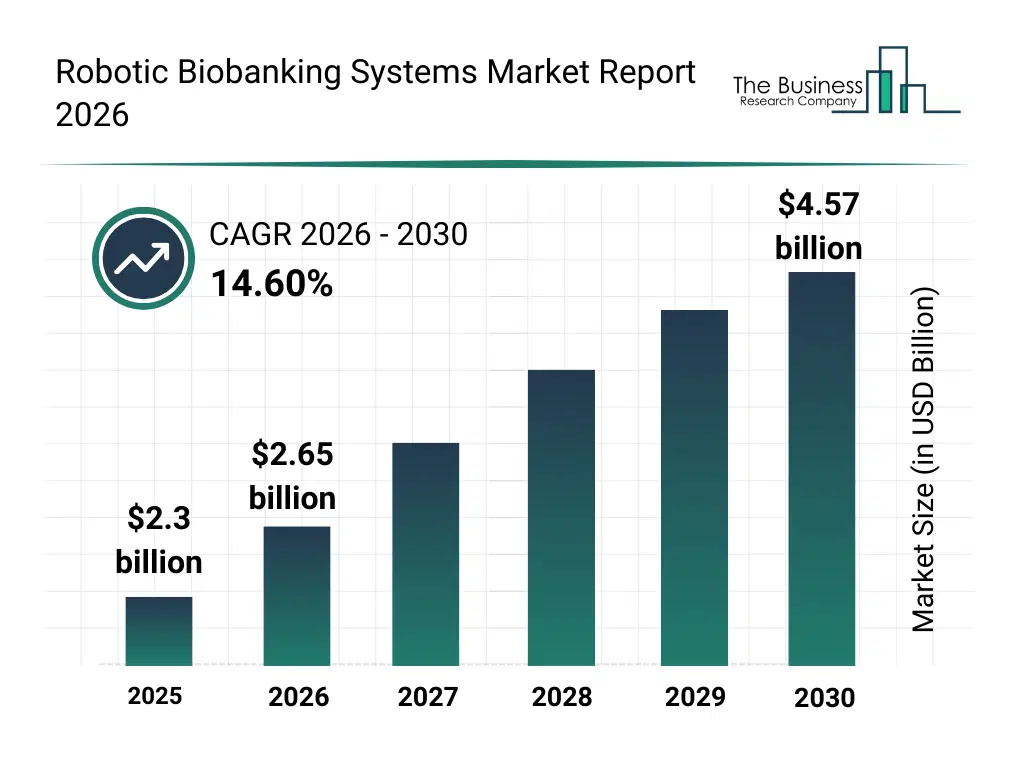
What Is The Robotic Biobanking Systems Market Size and Share 2026?
The robotic biobanking systems market size has grown rapidly in recent years. It will grow from $2.3 billion in 2025 to $2.65 billion in 2026 at a compound annual growth rate (CAGR) of 14.9%. The growth in the historic period can be attributed to growth in clinical research samples, biobank infrastructure investments, demand for sample traceability, limitations of manual storage, early automation adoption.What Is The Robotic Biobanking Systems Market Growth Forecast?
The robotic biobanking systems market size is expected to see rapid growth in the next few years. It will grow to $4.57 billion in 2030 at a compound annual growth rate (CAGR) of 14.6%. The growth in the forecast period can be attributed to precision medicine growth, expansion of genomic studies, large scale clinical trials, digital biorepository management, AI enabled sample analytics. Major trends in the forecast period include automated sample storage and retrieval, enhanced sample traceability, high throughput biobank operations, reduced human handling errors, long term sample integrity management.
Global Robotic Biobanking Systems Market Segmentation
1) By Product Type: Automated Sample Storage Systems, Automated Sample Retrieval Systems, Automated Sample Processing Systems 2) By Sample Type: Blood, Tissue, Cells, Deoxyribonucleic Acid (DNA) Or Ribonucleic Acid (RNA) 3) By Storage Type: Cryogenic, Ambient, Refrigerated 4) By Application: Clinical Research, Pharmaceutical And Biotech Research, Academic And Research Institutes, Biobank Management 5) By End-User: Hospitals, Research Institutes, Pharma And Biotech, Contract Research Organizations (CROs) Subsegments: 1) By Automated Sample Storage Systems: Modular Storage Units, High-Throughput Storage Systems, Compact Storage Systems, Integrated Storage And Tracking Platforms 2) By Automated Sample Retrieval Systems: Barcode-Based Retrieval Systems, Robotic Arm Retrieval Systems, Automated Carousel Retrieval Systems, Vertical Lift Retrieval Systems 3) By Automated Sample Processing Systems: Automated Sample Aliquoting Systems, Automated Sample Sorting Systems, Automated Sample Labeling Systems, Automated Sample Tracking SystemsWhat Is The Driver Of The Robotic Biobanking Systems Market?
The rising volume of biological sample collections is expected to propel the growth of the robotic biobanking systems market going forward. Biological sample collections refer to systematically gathered and preserved biological materials, such as blood, tissue, saliva, or other biospecimens, along with associated data, maintained for use in biomedical research, diagnostics, and therapeutic development. The rising volume of biological sample collections is primarily driven by the growing emphasis on precision medicine, as modern healthcare increasingly depends on large, well-characterized biospecimen repositories to enable genomic research, biomarker discovery, and the development of individualized treatment strategies. Robotic biobanking systems support this expansion by automating the handling, storage, and retrieval of samples, thereby ensuring scalability, accuracy, and efficiency in managing rapidly increasing sample inventories. For instance, in July 2025, according to the UK Biobank Limited, a UK-based large-scale biomedical database, UK Biobank plans to relocate over 11 million to its new Manchester headquarters in 2026, where four next-generation automated freezers will accommodate up to 20 million samples and robotic systems will retrieve around 1 million samples annually, four times faster than current capacity. Therefore, the rising volume of biological sample collections is driving the growth of the robotic biobanking systems industry.Key Players In The Global Robotic Biobanking Systems Market
Major companies operating in the robotic biobanking systems market are Thermo Fisher Scientific Inc., Beckman Coulter Inc., Tecan Group Ltd., Hamilton Company, Azenta Life Sciences, Haier Biomedical Co., BICO, SPT Labtech Ltd., HighRes Biosolutions Inc., LiCONiC AG, ASKION GmbH, Angelantoni Life Science Srl, SciRobotics Ltd., MGI Tech Co. Ltd., B Medical Systems S.a.r.l, Sakura Finetek Japan Co. Ltd., Panasonic Healthcare Co. Ltd., Brooks Automation Inc., Labcyte Inc., RTS Life Science Ltd., Kriosystem Life Sciences S.r.l.
This chart is for illustrative purposes; the full report includes a detailed competitor analysis and comprehensive overview of the top 10 companies in the market.
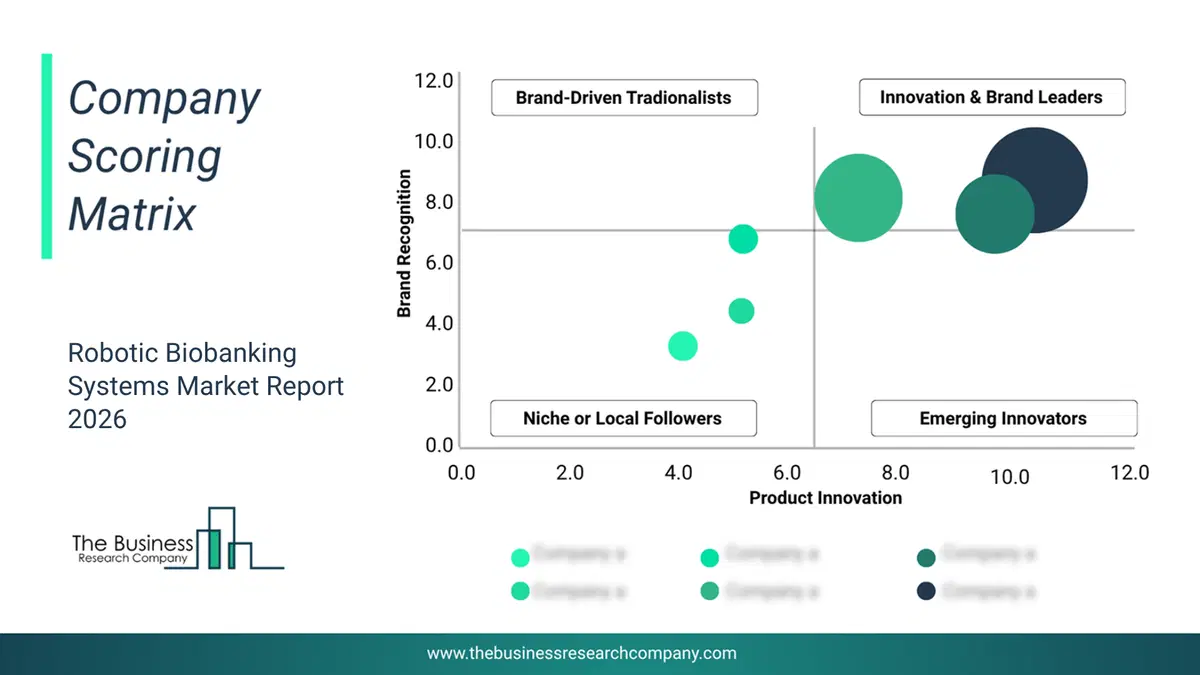
This chart maps companies by product innovation and brand strength, with bubble size indicating relative revenue, helping identify market leaders, challengers, and niche players. This is an illustrative chart; the full report provides a complete and accurate competitive analysis.
Global Robotic Biobanking Systems Market Trends and Insights
Major companies operating in the robotic biobanking systems market are focusing on developing strategic collaborations to expand technological capabilities, enhance service accessibility, and accelerate the integration of automation in advanced biobanking workflows. Strategic collaborations refer to mutually beneficial partnerships between technology providers, healthcare institutions, and research organizations aimed at leveraging complementary strengths to advance innovation, optimize operational efficiency, and broaden market presence. For instance, in October 2025, Abu Dhabi Biobank, a UAE-based hybrid cord blood bank, collaborated with NMC Healthcare, a UAE-based healthcare provider, to expand access to private and public cord blood banking services across major hospitals in the region, supporting personalized healthcare and advancing stem cell research through the integration of robotic and automated biobanking systems. The partnership aims to build one of the region’s largest repositories of cord blood samples supported by advanced robotic handling and long-term automated storage technologies. It also focuses on promoting awareness and education about the benefits of cord blood preservation, empowering families to contribute to future-ready biomedical research and regenerative medicine initiatives.What Are Latest Mergers And Acquisitions In The Robotic Biobanking Systems Market?
In July 2025, Hamilton Company, a Switzerland-based provider of liquid handling, process analytics, robotics, and automated storage solutions, acquired UK Robotics and Trisonic Discovery for an undisclosed amount. With this acquisition, Hamilton aims to enhance its laboratory automation capabilities, integrating advanced scheduling software, system integration expertise, and precision acoustic dispensing technologies to deliver fully automated, scalable research workflows. UK Robotics and Trisonic Discovery are UK-based providers of robotic biobanking systems.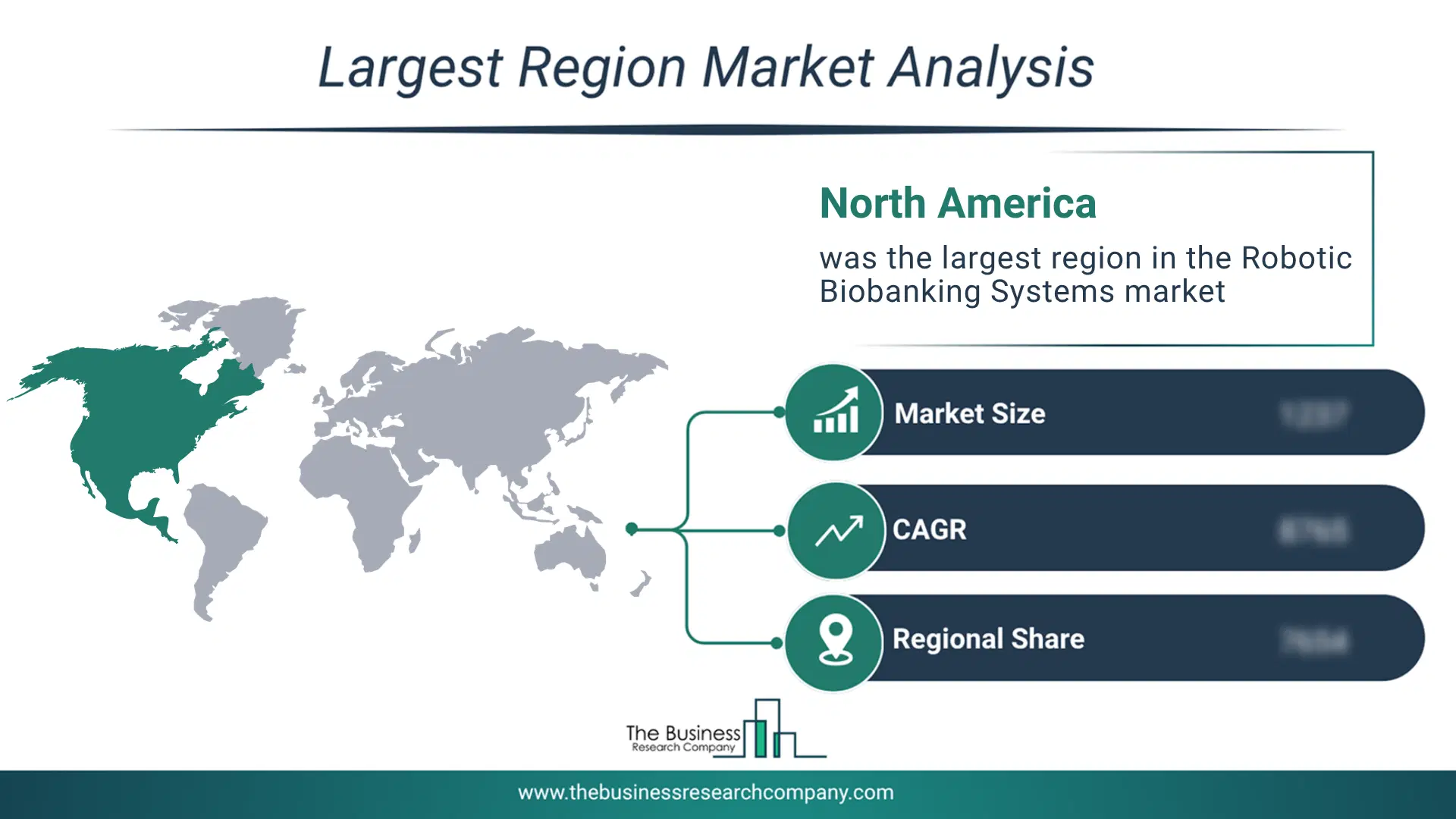
Regional Outlook
North America was the largest region in the robotic biobanking systems market in 2025. Asia-Pacific is expected to be the fastest-growing region in the forecast period. The regions covered in this market report are Asia-Pacific, South East Asia, Western Europe, Eastern Europe, North America, South America, Middle East, Africa. The countries covered in this market report are Australia, Brazil, China, France, Germany, India, Indonesia, Japan, Taiwan, Russia, South Korea, UK, USA, Canada, Italy, SpainWhat Defines the Robotic Biobanking Systems Market?
The robotic biobanking systems market consists of sales of automated tube decapping systems, automated capping and recapping systems, robotic plate handling systems, automated liquid handling systems, and sample identification and scanning modules. Values in this market are ‘factory gate’ values, that is the value of goods sold by the manufacturers or creators of the goods, whether to other entities (including downstream manufacturers, wholesalers, distributors and retailers) or directly to end customers. The value of goods in this market includes related services sold by the creators of the goods.How is Market Value Defined and Measured?
The market value is defined as the revenues that enterprises gain from the sale of goods and/or services within the specified market and geography through sales, grants, or donations in terms of the currency (in USD unless otherwise specified). The revenues for a specified geography are consumption values that are revenues generated by organizations in the specified geography within the market, irrespective of where they are produced. It does not include revenues from resales along the supply chain, either further along the supply chain or as part of other products.
This chart presents market attractiveness based on a quantitative evaluation of growth, competition, strategic alignment, and risk, offering a clear view of opportunity areas for decision-making. This chart is for illustrative purposes; the full report contains the complete analysis.

This chart highlights the Total Addressable Market (TAM) by estimating the maximum revenue opportunity using an assumption-driven approach, supporting strategic planning and opportunity sizing across markets. The chart is illustrative; the full report provides a more comprehensive analysis.
What Key Data and Analysis Are Included in the Robotic Biobanking Systems Market Report 2026?
The robotic biobanking systems market research report is one of a series of new reports from The Business Research Company that provides market statistics, including industry global market size, regional shares, competitors with the market share, detailed market segments, market trends and opportunities, and any further data you may need to thrive in the robotic biobanking systems industry. The market research report delivers a complete perspective of everything you need, with an in-depth analysis of the current and future state of the industry.Robotic Biobanking Systems Market Report Forecast Analysis
| Report Attribute | Details |
|---|---|
| Market Size Value In 2026 | $2.65 billion |
| Revenue Forecast In 2030 | $4.57 billion |
| Growth Rate | CAGR of 14.6% from 2026 to 2030 |
| Base Year For Estimation | 2025 |
| Actual Estimates/Historical Data | 2020-2025 |
| Forecast Period | 2026 - 2030 |
| Market Representation | Revenue in USD Billion and CAGR from 2026 to 2030 |
| Segments Covered | Product Type, Sample Type, Storage Type, Application, End-User |
| Regional Scope | Asia-Pacific, Western Europe, Eastern Europe, North America, South America, Middle East, Africa |
| Country Scope | The countries covered in the report are Australia, Brazil, China, France, Germany, India, Indonesia, Japan, Taiwan, Russia, South Korea, UK, USA, Canada, Italy, Spain. |
| Key Companies Profiled | Thermo Fisher Scientific Inc., Beckman Coulter Inc., Tecan Group Ltd., Hamilton Company, Azenta Life Sciences, Haier Biomedical Co., BICO, SPT Labtech Ltd., HighRes Biosolutions Inc., LiCONiC AG, ASKION GmbH, Angelantoni Life Science Srl, SciRobotics Ltd., MGI Tech Co. Ltd., B Medical Systems S.a.r.l, Sakura Finetek Japan Co. Ltd., Panasonic Healthcare Co. Ltd., Brooks Automation Inc., Labcyte Inc., RTS Life Science Ltd., Kriosystem Life Sciences S.r.l. |
| Customization Scope | Request for Customization |
| Pricing And Purchase Options | Explore Purchase Options |