Contact Us
  Search
The Business Research Company Logo
Healthcare Buildings Market 2025
Published :May 2025
Pages :311
Format :PDF
Delivery Time :2-3 Business Days
Why 2-3 days? We update the report with the latest data and news before delivery. Let us know if you need us to expedite.
Report Price :$4,490.00

Healthcare Buildings Market 2025

By Facility Type (Hospitals, Ambulatory Surgery Centers, Long Term Care Facilities And Nursing Homes, Academic Institutes, Other Facility Types), By Service Type (New Construction, Refurbishment), By Healthcare Type (Public Healthcare, Private Healthcare), And By Region, Opportunities And Strategies – Global Forecast To 2035

Healthcare Buildings Market Size and growth rate 2025 to 2029: Graph

Healthcare Buildings Market Definition

Healthcare buildings refer to specialized facilities designed and constructed to provide medical services, healthcare treatment and support for patients' well-being. These buildings are essential components of the healthcare infrastructure and encompass a wide range of structures, each serving specific functions within the healthcare system. The healthcare buildings market consists of revenues earned by entities (organizations, sole traders and partnerships) through specialized structures designed and constructed to facilitate the provision of medical services, treatment and care.
Research Expert

Book your 30 minutes free consultation with our research experts

Healthcare Buildings Market Size

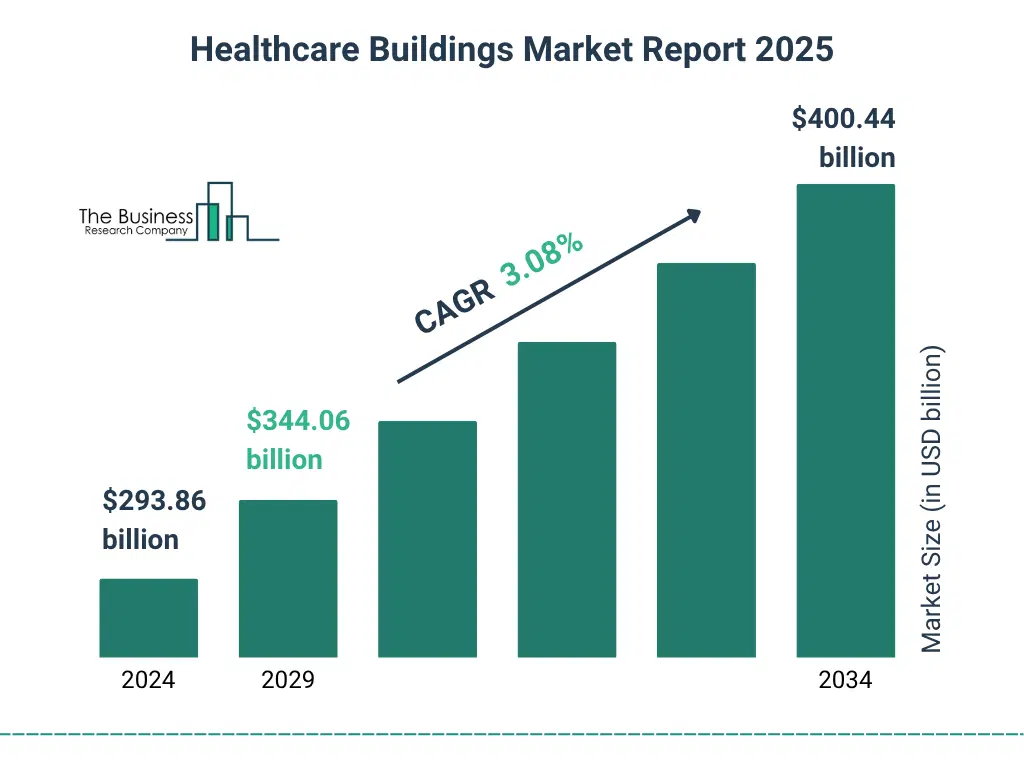
The global healthcare buildings market reached a value of nearly $293,860.72 million in 2024, having grown at a compound annual growth rate (CAGR) of 3.94% since 2019. The market is expected to grow from $293,860.72 million in 2024 to $344,061.36 million in 2029 at a rate of 3.20%. The market is then expected to grow at a CAGR of 3.08% from 2029 and reach $400,444.36 million in 2034. Growth in the historic period resulted from the high investments in healthcare infrastructure, increased number of patients and rise in healthcare expenditure. Factors that negatively affected growth in the historic period were stringent regulatory requirements and long construction timelines. Going forward, the increasing prevalence of chronic diseases, rising medical tourism, increasing aging population and favorable government initiatives will drive the growth. Factor that could hinder the growth of the healthcare buildings market in the future include sustainability and environmental compliance pressures and rising material and labor costs.

Healthcare Buildings Market Drivers

The key drivers of the healthcare buildings market include: Rising Medical Tourism The rising medical tourism is expected to propel the healthcare buildings market going forward. Rising medical tourism refers to the increasing global movement of patients seeking high-quality, cost-effective medical treatments across international borders, driven by factors such as affordability, advanced healthcare infrastructure, shorter waiting times, and availability of specialized treatments. Healthcare buildings provide state-of-the-art medical facilities, ensuring patient comfort, and maintaining international standards in healthcare services, thereby attracting foreign patients seeking superior treatment options. For instance, in February 2025, according to the Ministry of Tourism, an India-based nodal agency, India, a global hub for Ayurveda, yoga, and affordable healthcare, has seen wellness and medical tourism emerge as key contributors, attracting 6.9% of foreign visitors for medical purposes in 2023, with international tourist arrivals (ITAs) surpassing pre-pandemic levels and projected to reach 20 million by 2025. Therefore, the rising medical tourism is propelling the healthcare buildings market.

Healthcare Buildings Market Restraints

The key restraints on the healthcare buildings market include: Rising Material And Labor Costs The rising material and labor costs are expected to hamper the healthcare buildings market going forward. Healthcare buildings are hampered by rising material and labor costs, as these escalating expenses increase the overall financial burden of construction, renovation, and maintenance, making it challenging for developers to complete projects within budget. Consequently, rising material and labor costs limit the affordability and feasibility of new healthcare infrastructure, leading to project delays, scaled-down developments, and compromises in quality. This challenge restrains market growth, as higher costs reduce investment incentives, deter potential stakeholders, and create financial uncertainties that slow down the expansion and modernization of healthcare facilities. For example, in May 2024, according to the report published by the American Hospital Association (AHA), a US-based national organization, hospitals experienced a significant rise in labor costs, increasing by over $42.5 billion between 2021 and 2023 to reach $839 billion, with contract labor expenses amounting to $51.1 billion in 2023, while advertised wage rates surged by 10.1% during the year, and the growing imbalance between healthcare worker supply and demand is expected to sustain labor cost challenges over the next decade. Additionally, in March 2025, according to the Building Cost Information Service (BCIS), a UK-based construction data and insurance company, a 15% increase in the materials cost index over the projected period, with building costs rising by 17% and tender prices increasing by 15% over the next five years. Therefore, rising material and labor costs could hamper the healthcare buildings market's growth.

Need data on a specific region in this market?

Opportunities And Recommendations In The Healthcare Buildings Market

Opportunities – The top opportunities in the healthcare buildings market segmented by facility type will arise in the hospitals segment, which will gain $26,440.20 million of global annual sales by 2029. The top opportunities in the healthcare buildings market segmented by service type will arise in the new construction segment, which will gain $31,210.67 million of global annual sales by 2029. The top opportunities in the healthcare buildings market segmented by healthcare type will arise in the private healthcare segment, which will gain $31,270.77 million of global annual sales by 2029. The healthcare buildings market size will gain the most in China at $6,545.64 million. Recommendations- To take advantage of the opportunities, The Business Research Company recommends the healthcare buildings to focus on strategic investments to improve energy resilience and sustainability, focus on strategic investments to expand capacity and drive innovation in healthcare infrastructure, focus on ambulatory surgery centers to capture high-growth opportunities, focus on refurbishment to maximize growth and efficiency, focus on public healthcare to capture strongest growth momentum, expand in emerging markets, focus on public-private partnerships to advance automation and energy efficiency, focus on value-based pricing to align with buyer expectations, prioritize targeted outreach over broad awareness campaigns, invest in content marketing to establish industry authority and focus on enhancing workforce engagement to strengthen end-user relationships.
Chat with us