
Holographic TV Market Report 2026
Global Outlook – By Type (Laser Plasma, Micromagnetic Piston Display, Holographic Television Display, Touchable Holograms), By Distribution Channel (Online, Offline), By End User (Education, Consumer Applications, Aerospace And Defense, Industrial Applications, Healthcare, Other End Users) – Market Size, Trends, Strategies, and Forecast to 2030
Holographic TV Market Overview
• Holographic TV market size has reached to $5.4 billion in 2025 • Expected to grow to $14 billion in 2030 at a compound annual growth rate (CAGR) of 20.9% • Growth Driver: Medical Imaging Surge Drives The Holographic TV Market • Market Trend: Advancements In Immersive Visual Experiences • North America was the largest region in 2025 and Asia-Pacific is the fastest growing region.What Is Covered Under Holographic TV Market?
Holographic television, or holovision, is a futuristic display technology that projects three-dimensional images that can be viewed without special glasses. It enables viewers to perceive images from various angles, creating a more immersive and lifelike visual experience. The main types of holographic TVs are laser plasma, magnetic piston displays, holographic television displays, and touchable holograms. Laser plasma typically refers to a state of matter created when lasers are used to ionize or excite a gas, creating a high-energy plasma that can be employed in the creation of dynamic and vibrant holographic images on a television display. The various distribution channels include online and offline for end users such as education, consumer applications, aerospace and defense, industrial applications, healthcare, and others.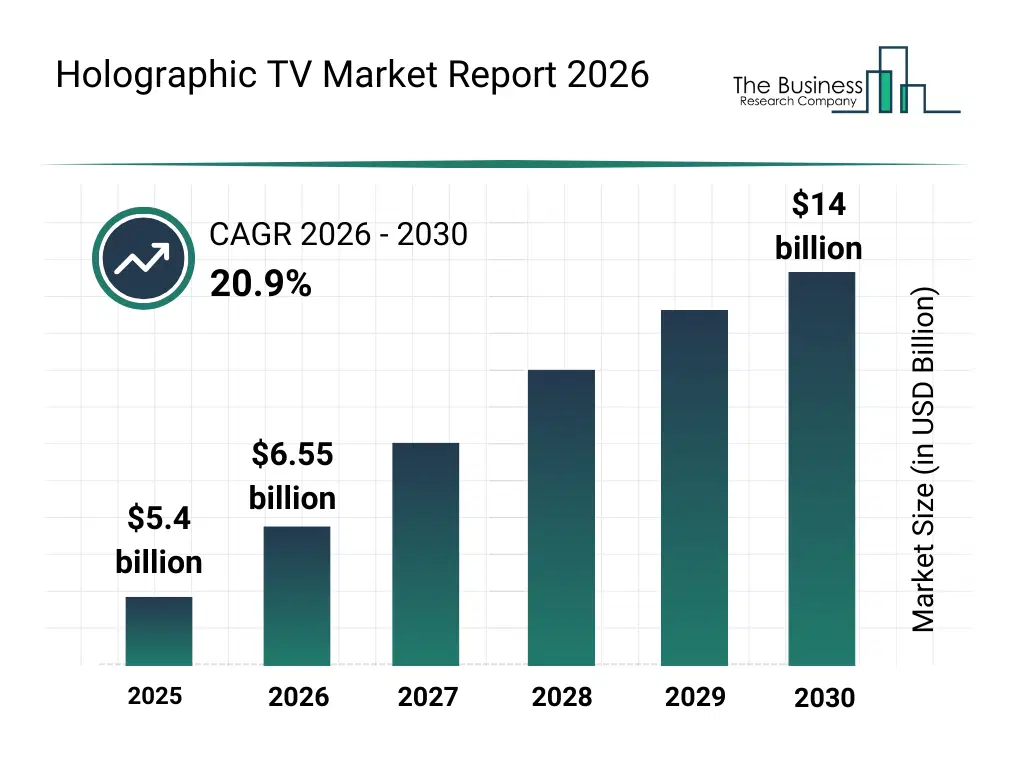
What Is The Holographic TV Market Size and Share 2026?
The holographic tv market size has grown exponentially in recent years. It will grow from $5.4 billion in 2025 to $6.55 billion in 2026 at a compound annual growth rate (CAGR) of 21.2%. The growth in the historic period can be attributed to advancements in display technologies, demand for immersive entertainment, early adoption in defense visualization, growth of digital content creation, investments in visual communication systems.What Is The Holographic TV Market Growth Forecast?
The holographic tv market size is expected to see exponential growth in the next few years. It will grow to $14 billion in 2030 at a compound annual growth rate (CAGR) of 20.9%. The growth in the forecast period can be attributed to expansion of metaverse applications, adoption in education and training, rising demand for interactive advertising, integration with ai-driven graphics, decreasing cost of holographic components. Major trends in the forecast period include glasses-free 3D visualization, multi-angle viewing capability, real-time holographic rendering, high-resolution spatial imaging, interactive holographic displays.
Global Holographic TV Market Segmentation
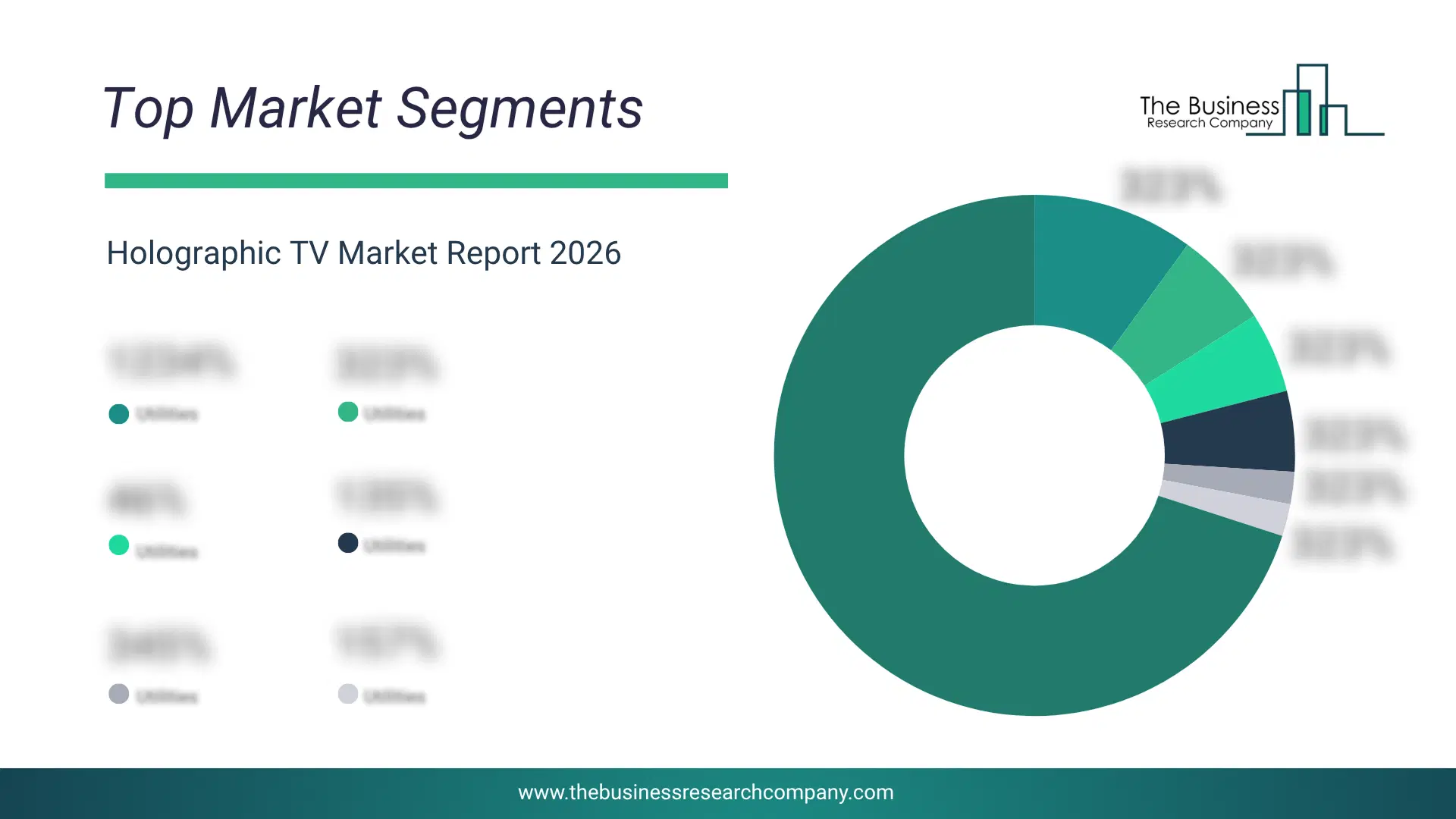
1) By Type: Laser Plasma, Micromagnetic Piston Display, Holographic Television Display, Touchable Holograms 2) By Distribution Channel: Online, Offline 3) By End User: Education, Consumer Applications, Aerospace And Defense, Industrial Applications, Healthcare, Other End Users Subsegments: 1) By Laser Plasma: Solid-State Laser Plasma Displays, Gas Laser Plasma Displays 2) By Micromagnetic Piston Display: Electromagnetic Actuated Displays, Piezoelectric Actuated Displays 3) By Holographic Television Display: Static Holographic Displays, Dynamic Holographic Displays 4) By Touchable Holograms: Tactile Feedback Holograms, Interactive Holographic InterfacesWhat Is The Driver Of The Holographic TV Market?
The rising use of medical imaging is expected to propel the growth of the holographic TV market in the coming years. Medical imaging, or radiography, is a branch of medicine in which medical experts make different pictures of body parts for clinical examination, medical intervention, and pictorial depiction of organ or tissue function. Holographic TV in medical imaging allows surgeons to observe and interact with 3D human anatomy, improving preoperative preparation and intraoperative guidance for more accurate and successful surgeries. For instance, in November 2023, according to the National Health Service, a UK-based government department, in the year ending March 2023, England carried out 45.0 million imaging tests, marking a 2.2% rise from 44.0 million the previous year. This total included 10.3 million diagnostic ultrasound tests, up 1.8%; 7.1 million CT scans, up 5.5%; and 4.1 million MRI scans, up 6.2%. Therefore, the rising use of medical imaging is driving the holographic TV industry.Key Players In The Global Holographic TV Market
Major companies operating in the holographic tv market are Apple Inc.; Google LLC; Samsung Electronics Co. Ltd; Microsoft Corporation; Sony Corporation; Panasonic Corporation; LG Electronics Inc.; Qualcomm Inc.; Mitsubishi Electric Corporation; Nvidia Corporation; Toshiba Corporation; Epson Corporation; Konica Minolta Inc.; EON Reality; Ostendo Technologies Inc.; Leia Inc.; Hypervsn (Kino-mo Ltd.); AV Concepts Inc; Vuzix Corporation; Light Field Lab Inc.; Avegant Corporation; RealView Imaging Ltd; Voxon Photonics Pty Ltd.; SeeReal Technologies; Realfiction Holding AB; Holoxica Ltd; Musion Das Hologram Ltd (MDH Hologram); Looking Glass Factory Inc.; Shenzhen SMX Display Technology Co. Ltd.; Provision Holding Inc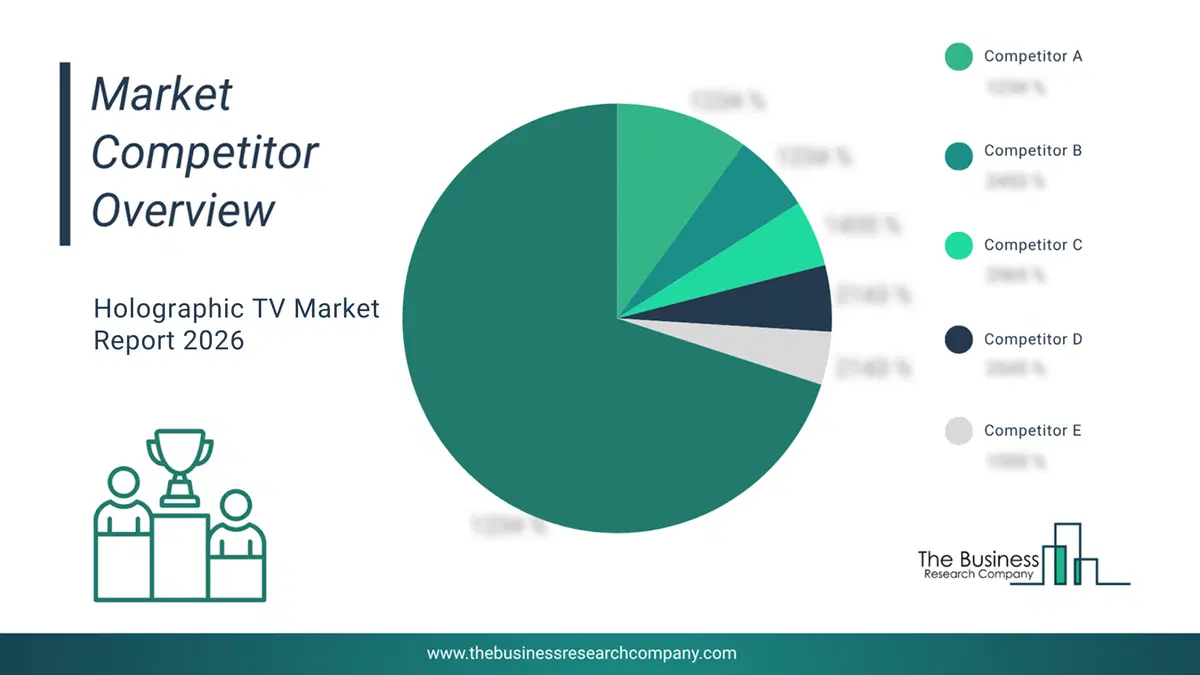
This chart is for illustrative purposes; the full report includes a detailed competitor analysis and comprehensive overview of the top 10 companies in the market.
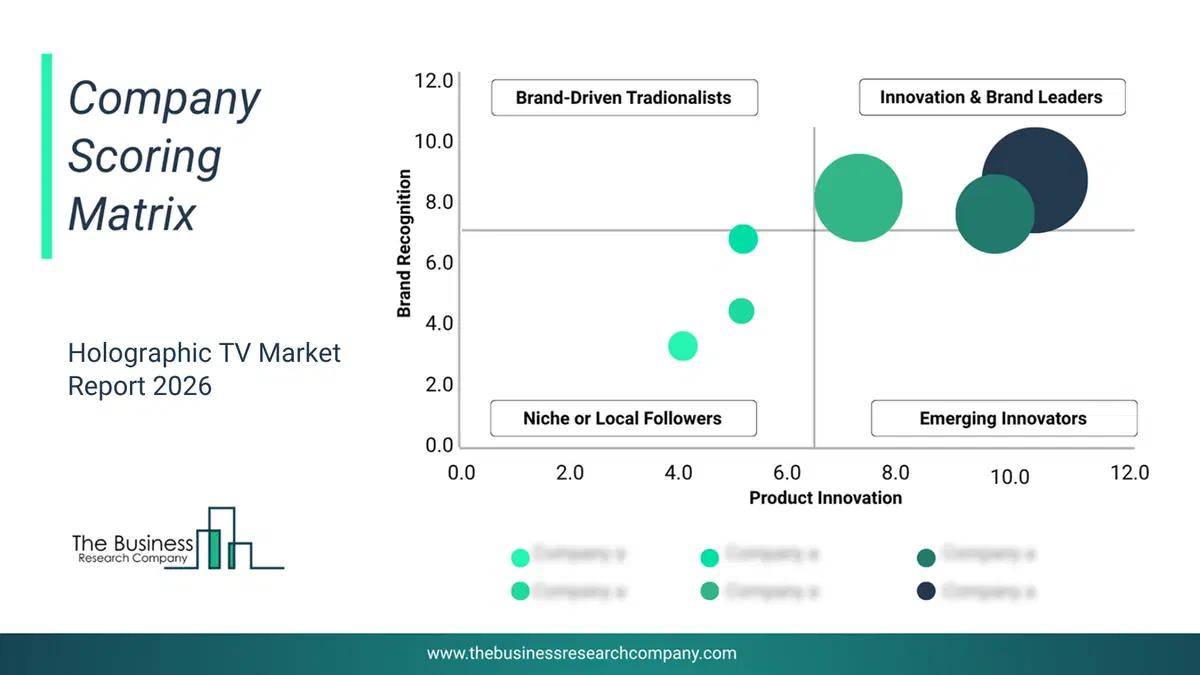
This chart maps companies by product innovation and brand strength, with bubble size indicating relative revenue, helping identify market leaders, challengers, and niche players. This is an illustrative chart; the full report provides a complete and accurate competitive analysis.
Global Holographic TV Market Trends and Insights
Major companies operating in the holographic TV market are focusing on developing innovative solutions, such as AI-powered holographic avatar displays, to meet the rising demand for immersive, interactive, and lifelike visual experiences in entertainment, communication, retail, and education. AI-powered holographic displays use advanced light-field projection, computer vision, and real-time rendering algorithms to create three-dimensional, viewable-from-all-angles virtual avatars or objects, offering a richer, more interactive experience compared with traditional flat-screen TVs that are limited to two-dimensional visuals and fixed perspectives. For instance, in November 2025, Akool Inc., a US-based immersive technology company, launched the Holographic Avatar Display Series, bringing AI-powered avatars into real-world environments for personal, commercial, and public applications. The series combines high-definition light-field projection with AI-driven avatar generation, enabling real-time animation, interactive gestures, and dynamic expression adaptation from multiple viewing angles without special glasses. It integrates voice and gesture control, can be customized for events, retail, entertainment, or remote communication, and features lifelike 3D rendering with adaptive AI behaviors. The solution seamlessly connects with digital content platforms to enhance engagement, create immersive experiences, and redefine interactions in both professional and consumer settings.What Are Latest Mergers And Acquisitions In The Holographic TV Market?
In August 2023, Leia Inc., a US-based manufacturer of holographic and 3D displays, acquired Dimenco B.V. for an undisclosed amount. Through the acquisition, Leia aims to create possibilities for widespread adoption and deliver 3D experiences to all platforms and devices. Dimenco B.V. is a Netherlands-based manufacturer of holographic television displays.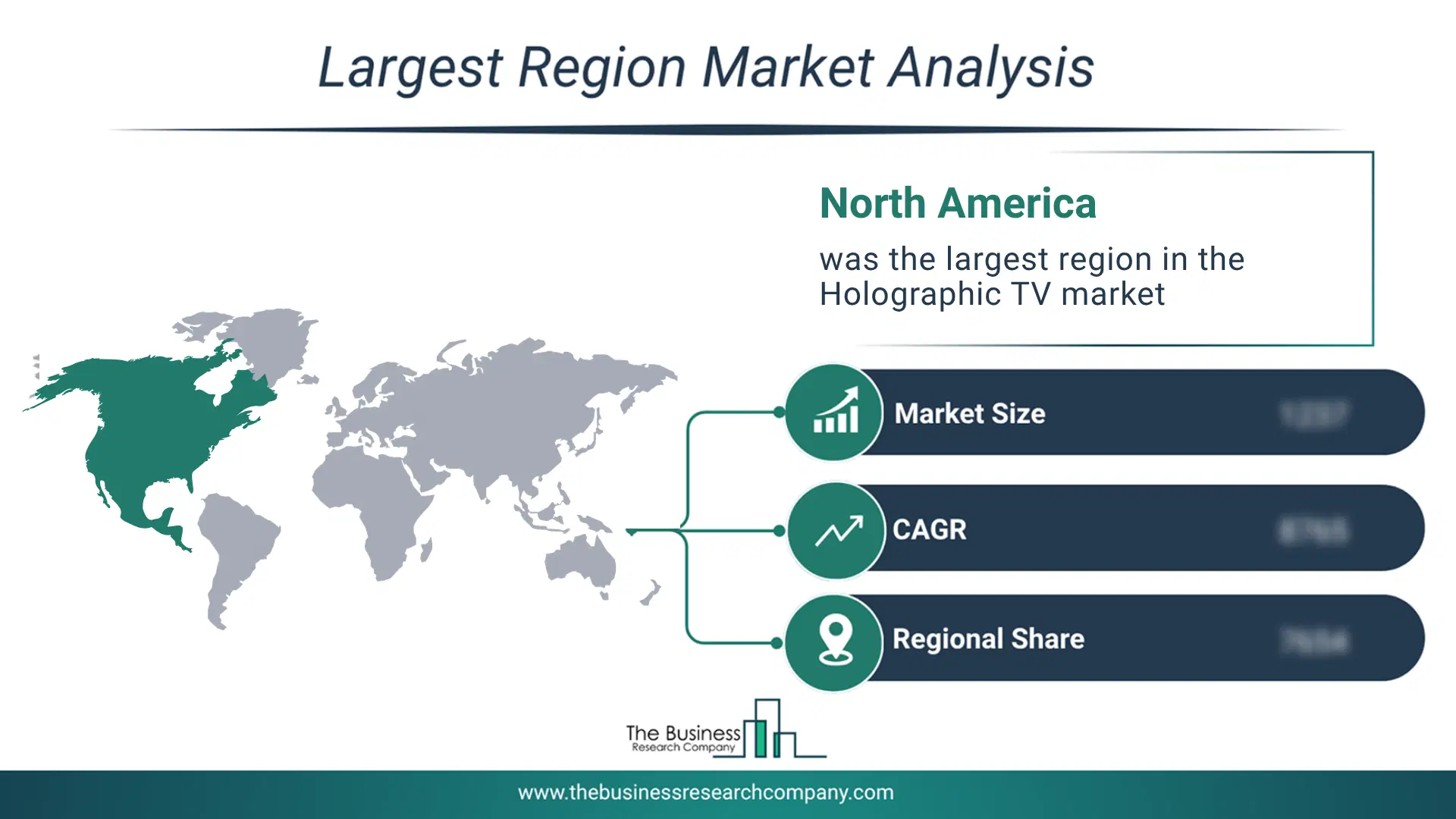
Regional Insights
North America was the largest region in the holographic TV market in 2025. Asia-Pacific is expected to be the fastest-growing region in the forecast period. The regions covered in this market report are Asia-Pacific, South East Asia, Western Europe, Eastern Europe, North America, South America, Middle East, Africa. The countries covered in this market report are Australia, Brazil, China, France, Germany, India, Indonesia, Japan, Taiwan, Russia, South Korea, UK, USA, Canada, Italy, SpainWhat Defines the Holographic TV Market?
The holographic TV market consists of the revenues earned by entities offering services such as interactive learning, realistic communication, innovative advertising, and immersive entertainment. The market value includes the value of related goods sold by the service provider or included within the service offering. The holographic TV market also includes sales of head-mounted holographic TVs, multi-user holographic TVs, and external single-user holographic desktop TVs. Values in this market are ‘factory gate’ values, that is the value of goods sold by the manufacturers or creators of the goods, whether to other entities (including downstream manufacturers, wholesalers, distributors and retailers) or directly to end customers. The value of goods in this market includes related services sold by the creators of the goods.How is Market Value Defined and Measured?
The market value is defined as the revenues that enterprises gain from the sale of goods and/or services within the specified market and geography through sales, grants, or donations in terms of the currency (in USD unless otherwise specified). The revenues for a specified geography are consumption values that are revenues generated by organizations in the specified geography within the market, irrespective of where they are produced. It does not include revenues from resales along the supply chain, either further along the supply chain or as part of other products.
This chart presents market attractiveness based on a quantitative evaluation of growth, competition, strategic alignment, and risk, offering a clear view of opportunity areas for decision-making. This chart is for illustrative purposes; the full report contains the complete analysis.

This chart highlights the Total Addressable Market (TAM) by estimating the maximum revenue opportunity using an assumption-driven approach, supporting strategic planning and opportunity sizing across markets. The chart is illustrative; the full report provides a more comprehensive analysis.
What Key Data and Analysis Are Included in the Holographic TV Market Report 2026?
The holographic tv market research report is one of a series of new reports from The Business Research Company that provides market statistics, including industry global market size, regional shares, competitors with the market share, detailed market segments, market trends and opportunities, and any further data you may need to thrive in the holographic tv industry. The market research report delivers a complete perspective of everything you need, with an in-depth analysis of the current and future state of the industry.Holographic TV Market Report Forecast Analysis
| Report Attribute | Details |
|---|---|
| Market Size Value In 2026 | $6.55 billion |
| Revenue Forecast In 2030 | $14 billion |
| Growth Rate | CAGR of 20.9% from 2026 to 2030 |
| Base Year For Estimation | 2025 |
| Actual Estimates/Historical Data | 2020-2025 |
| Forecast Period | 2026 - 2030 |
| Market Representation | Revenue in USD Billion and CAGR from 2026 to 2030 |
| Segments Covered | Type, Distribution Channel, End User |
| Regional Scope | Asia-Pacific, Western Europe, Eastern Europe, North America, South America, Middle East, Africa |
| Country Scope | The Countries Covered In This Market Report Are Australia, Brazil, China, France, Germany, India, Indonesia, Japan, Taiwan, Russia, South Korea, Uk, Usa, Canada, Italy, Spain. |
| Key Companies Profiled | Apple Inc., Google LLC, Samsung Electronics Co. Ltd, Microsoft Corporation, Sony Corporation, Panasonic Corporation, LG Electronics Inc., Qualcomm Inc., Mitsubishi Electric Corporation, Nvidia Corporation, Toshiba Corporation, Epson Corporation, Konica Minolta Inc., EON Reality, Ostendo Technologies Inc., Leia Inc., Hypervsn (Kino-mo Ltd.), AV Concepts Inc, Vuzix Corporation, Light Field Lab Inc., Avegant Corporation, RealView Imaging Ltd, Voxon Photonics Pty Ltd., SeeReal Technologies, Realfiction Holding AB, Holoxica Ltd, Musion Das Hologram Ltd (MDH Hologram), Looking Glass Factory Inc., Shenzhen SMX Display Technology Co. Ltd., Provision Holding Inc |
| Customization Scope | Request for Customization |
| Pricing And Purchase Options | Explore Purchase Options |