
Home Sleep Apnea Testing Devices Market Report 2026
Global Outlook – By Device Type (Portable Monitoring Devices, Home Sleep Tests (HST), Wearable Sleep Trackers, Monitoring And Diagnostic Equipment), By Technology (Oximetry, Actigraphy, Polysomnography, Other Technologies), By Patient Age Group (Adults (Aged 18-6, Seniors (Aged 65 And Above), Pediatric Patients (Aged 0-17), Middle-Aged Adults (Aged 45-6,), By Distribution Channel (Direct Sales, Online Sales, Retail Pharmacies, Health Care Institutions), By End User (Individuals (Home Users), Healthcare Providers, Diagnostic Laboratories, Sleep Centers) – Market Size, Trends, Strategies, and Forecast to 2030
Home Sleep Apnea Testing Devices Market Overview
• Home Sleep Apnea Testing Devices market size has reached to $1.98 billion in 2025 • Expected to grow to $3.24 billion in 2030 at a compound annual growth rate (CAGR) of 10.3% • Growth Driver: Rising Prevalence Of Sleep Disorders Driving The Growth Of The Market Due To Increasing Stress And Disrupted Sleep Patterns • Market Trend: Advancements In Home-Based Diagnostic Devices For Improved Sleep Apnea Detection • North America was the largest region in 2025 and Asia-Pacific is the fastest growing region.What Is Covered Under Home Sleep Apnea Testing Devices Market?
Home sleep apnea testing (HSAT) devices are portable diagnostic tools used at home to monitor airflow, oxygen levels, and breathing patterns during sleep, providing a convenient and cost-effective alternative to in-lab sleep studies. These devices are utilized by patients at home to record sleep-related physiological data, later analyzed by healthcare providers to diagnose sleep apnea. The main device types of home sleep apnea testing devices are portable monitoring devices, home sleep tests (HST), wearable sleep trackers, and monitoring and diagnostic equipment. Portable monitoring devices are compact tools designed to record sleep-related data at home to aid in the detection of sleep apnea. It utilizes different technologies such as oximetry, actigraphy, polysomnography, and others. These devices serve a wide range of age groups, including adults (18–64), seniors (65 and above), pediatric patients (0–17), and middle-aged adults (45–64). They are distributed through various distribution channels, including direct sales, online platforms, retail pharmacies, and healthcare institutions, and cater to end users, including individuals at home, healthcare providers, diagnostic laboratories, and sleep centers.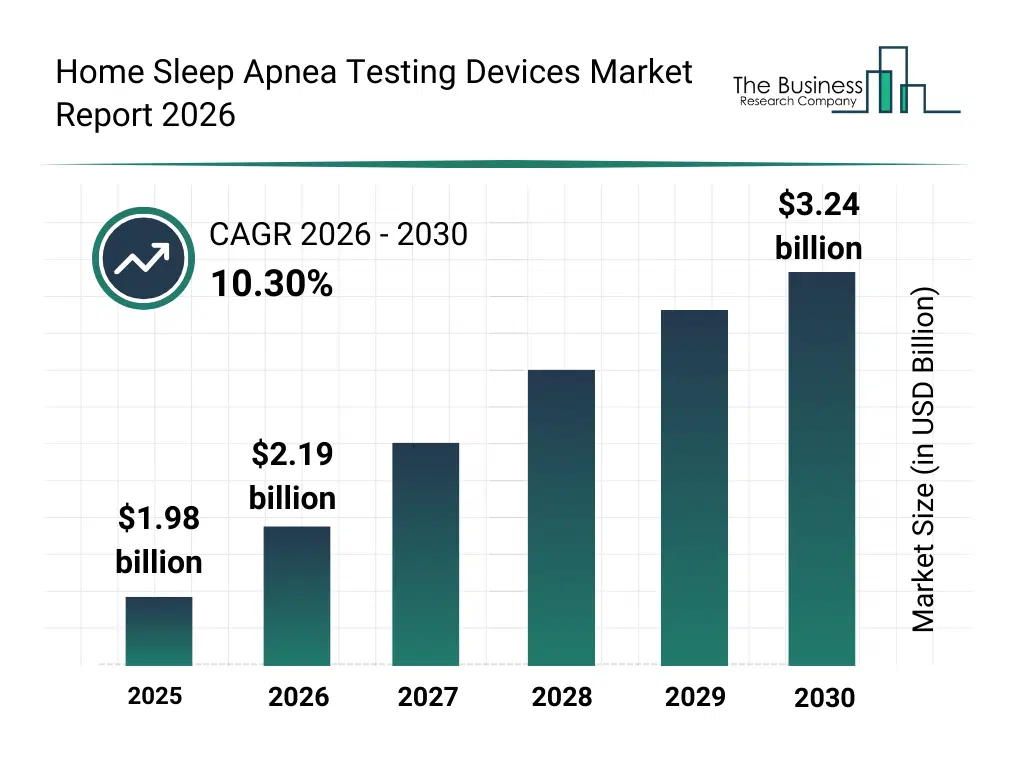
What Is The Home Sleep Apnea Testing Devices Market Size and Share 2026?
The home sleep apnea testing devices market size has grown rapidly in recent years. It will grow from $1.98 billion in 2025 to $2.19 billion in 2026 at a compound annual growth rate (CAGR) of 10.6%. The growth in the historic period can be attributed to limited availability of home-based sleep apnea devices, reliance on in-lab sleep studies, increasing prevalence of undiagnosed sleep apnea, growing awareness of sleep health, rising investment in healthcare infrastructure.What Is The Home Sleep Apnea Testing Devices Market Growth Forecast?
The home sleep apnea testing devices market size is expected to see rapid growth in the next few years. It will grow to $3.24 billion in 2030 at a compound annual growth rate (CAGR) of 10.3%. The growth in the forecast period can be attributed to advancements in portable monitoring and wearable technology, increasing integration with cloud-based analytics, growth in telemedicine and remote patient care, rising geriatric population with sleep disorders, expansion of distribution channels including online and retail pharmacies. Major trends in the forecast period include rising adoption of home-based sleep monitoring devices, increasing preference for wearable sleep trackers, growing awareness about sleep apnea and sleep disorders, expansion of remote patient monitoring and telehealth services, integration of patient data with healthcare provider platforms.
Global Home Sleep Apnea Testing Devices Market Segmentation
1) By Device Type: Portable Monitoring Devices, Home Sleep Tests (HST), Wearable Sleep Trackers, Monitoring And Diagnostic Equipment 2) By Technology: Oximetry, Actigraphy, Polysomnography, Other Technologies 3) By Patient Age Group: Adults (Aged 18-64), Seniors (Aged 65 And Above), Pediatric Patients (Aged 0-17), Middle-Aged Adults (Aged 45-64) 4) By Distribution Channel: Direct Sales, Online Sales, Retail Pharmacies, Health Care Institutions 5) By End User: Individuals (Home Users), Healthcare Providers, Diagnostic Laboratories, Sleep Centers Subsegments: 1) By Portable Monitoring Devices: Type III Monitors, Wireless Portable Monitors, Type IV Monitors 2) By Home Sleep Tests (HST): Unattended Home Sleep Test Devices, Self-Applied Home Sleep Test Kits 3) By Wearable Sleep Trackers: Wrist-Worn Devices, Headbands, Ring-Based Trackers 4) By Monitoring And Diagnostic Equipment: Oximeters, Nasal Flow Sensors, Respiratory Effort BeltsWhat Is The Driver Of The Home Sleep Apnea Testing Devices Market?
The increasing prevalence of sleep disorders is expected to propel the growth of the home sleep apnea testing devices market going forward. Sleep disorders are medical conditions that interfere with regular sleep patterns, impacting sleep quality, duration, or timing and resulting in daytime impairments. The rise in sleep disorders is attributed to growing levels of stress and anxiety, as these factors hinder the body’s ability to relax and sustain healthy sleep cycles. Home sleep apnea testing (HSAT) devices assist in diagnosing sleep disorders by tracking breathing patterns, airflow, and oxygen saturation during sleep in a home setting, allowing for the early identification and management of conditions such as obstructive sleep apnea. For instance, in November 2023, the National Health Service (NHS), a government agency in the UK, reported that 64.9% of individuals aged 17–23 experienced sleep problems on three or more nights in the previous week, higher than the rates recorded in children aged 8–16. The incidence was significantly higher in young women (74.7%) compared to young men (55.7%). Therefore, the increasing incidence of sleep disorders is driving the growth of the home sleep apnea testing devices industry.Key Players In The Global Home Sleep Apnea Testing Devices Market
Major companies operating in the home sleep apnea testing devices market are Koninklijke Philips N.V., ZOLL Itamar, ResMed Inc., Nihon Kohden Corporation, Contec Medical Systems Co. Ltd., Bittium Corporation, Cadwell Industries Inc., BMC Medical Co. Ltd, SOMNOmedics AG., Compumedics Limited, Allengers Medical Systems Limited, Advanced Brain Monitoring Inc., BetterNight, Acurable Limited, ApneaMed, Belun Technology Company Limited, Braebon Medical Corporation, DormoTech Medical GmbH, Nox Medical ehf., Onera Health B.V., PranaQ Ltd.
This chart is for illustrative purposes; the full report includes a detailed competitor analysis and comprehensive overview of the top 10 companies in the market.
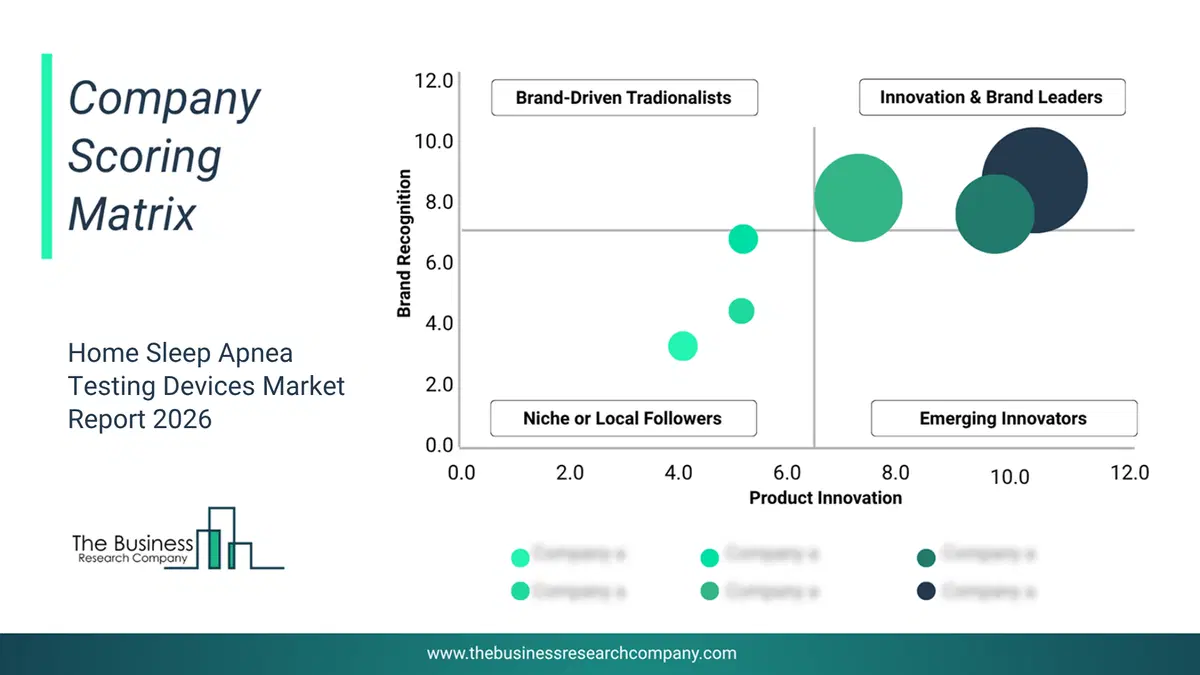
This chart maps companies by product innovation and brand strength, with bubble size indicating relative revenue, helping identify market leaders, challengers, and niche players. This is an illustrative chart; the full report provides a complete and accurate competitive analysis.
Global Home Sleep Apnea Testing Devices Market Trends and Insights
Major companies operating in the home sleep apnea testing devices market are focusing on developing technological innovations, such as home-based diagnostic devices, to enhance patient convenience, improve diagnostic precision, and support early detection and management of sleep apnea. A home-based diagnostic device refers to a portable medical tool that enables individuals to monitor and record key physiological parameters, such as airflow, oxygen saturation, and breathing patterns, within the comfort of their home environment for diagnosing conditions such as sleep apnea. For instance, in April 2025, ResMed Inc., a US-based medical device company, introduced NightOwl, a compact, wireless solution for sleep apnea diagnosis. It features an accurate, disposable fingertip sensor designed for home use, capturing up to 10 nights of data to reflect sleep variability and enhance diagnostic outcomes. The key benefits include simple self-application, elimination of bulky equipment, minimal disruption to sleep, auto-scored results accessible to clinicians through a cloud platform, and full disposability for user convenience and infection control.What Are Latest Mergers And Acquisitions In The Home Sleep Apnea Testing Devices Market?
In December 2024, BodiMetrics LLC, a US-based company specializing in portable vital signs and eHealth devices, partnered with EnsoData Inc. to improve sleep apnea diagnosis and monitoring. Together, they introduced a user-friendly, FDA-cleared wearable device that uses advanced AI for more accessible, affordable, and accurate detection. EnsoData Inc. is a US-based healthcare technology company that offers AI-powered software designed to enhance home sleep apnea testing devices.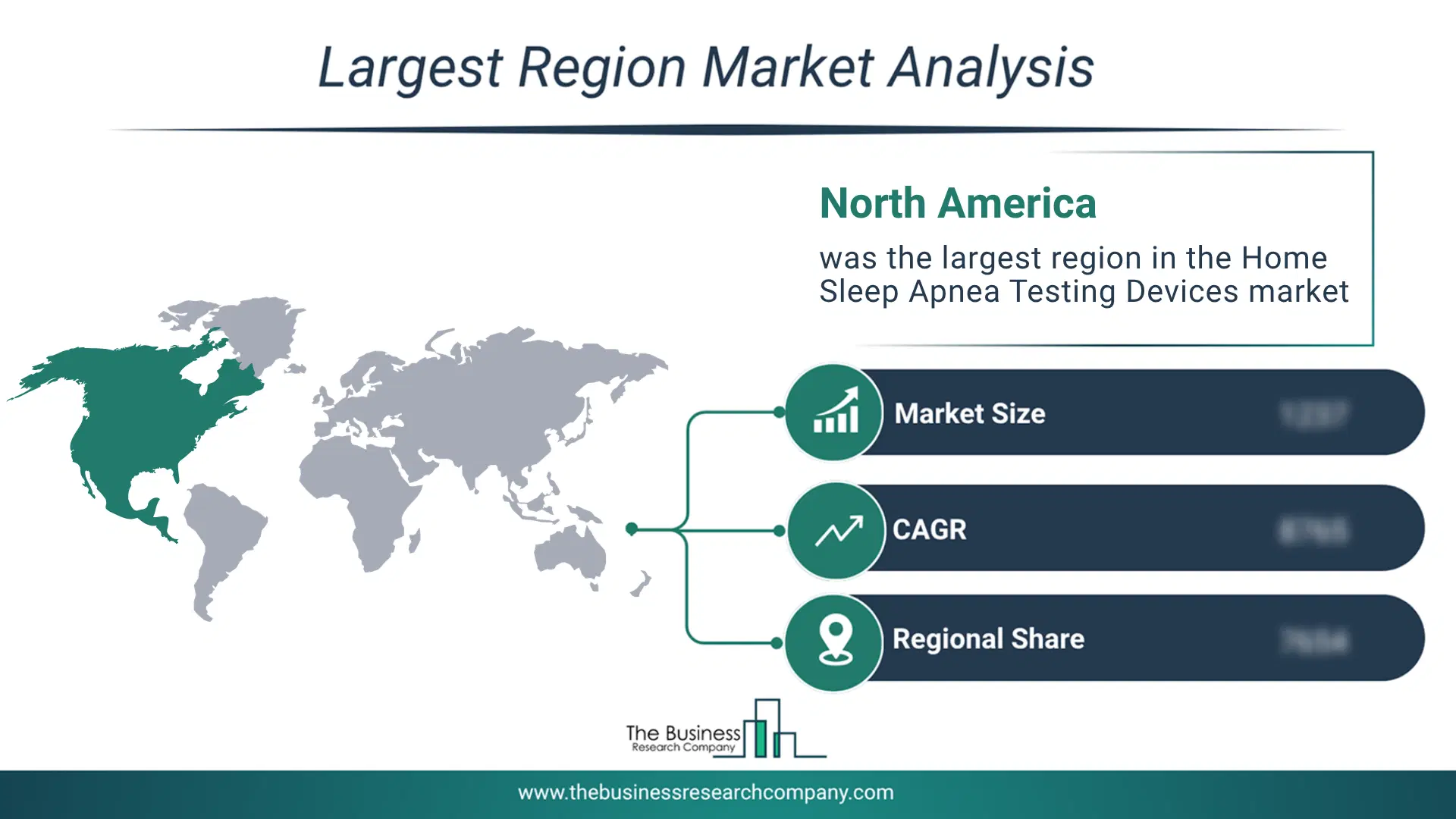
Regional Outlook
North America was the largest region in the home sleep apnea testing devices market in 2025. Asia-Pacific is expected to be the fastest-growing region in the forecast period. The regions covered in this market report are Asia-Pacific, South East Asia, Western Europe, Eastern Europe, North America, South America, Middle East, Africa. The countries covered in this market report are Australia, Brazil, China, France, Germany, India, Indonesia, Japan, Taiwan, Russia, South Korea, UK, USA, Canada, Italy, SpainWhat Defines the Home Sleep Apnea Testing Devices Market?
The home sleep apnea testing devices market consists of sales of portable sleep monitors, nasal airflow sensors, pulse oximeters, respiratory effort belts, and snore detection sensors. Values in this market are ‘factory gate’ values; that is, the value of goods sold by the manufacturers or creators of the goods, whether to other entities (including downstream manufacturers, wholesalers, distributors, and retailers) or directly to end customers. The value of goods in this market includes related services sold by the creators of the goods.How is Market Value Defined and Measured?
The market value is defined as the revenues that enterprises gain from the sale of goods and/or services within the specified market and geography through sales, grants, or donations in terms of the currency (in USD unless otherwise specified). The revenues for a specified geography are consumption values that are revenues generated by organizations in the specified geography within the market, irrespective of where they are produced. It does not include revenues from resales along the supply chain, either further along the supply chain or as part of other products.
This chart presents market attractiveness based on a quantitative evaluation of growth, competition, strategic alignment, and risk, offering a clear view of opportunity areas for decision-making. This chart is for illustrative purposes; the full report contains the complete analysis.

This chart highlights the Total Addressable Market (TAM) by estimating the maximum revenue opportunity using an assumption-driven approach, supporting strategic planning and opportunity sizing across markets. The chart is illustrative; the full report provides a more comprehensive analysis.
What Key Data and Analysis Are Included in the Home Sleep Apnea Testing Devices Market Report 2026?
The home sleep apnea testing devices market research report is one of a series of new reports from The Business Research Company that provides market statistics, including industry global market size, regional shares, competitors with the market share, detailed market segments, market trends and opportunities, and any further data you may need to thrive in the home sleep apnea testing devices industry. The market research report delivers a complete perspective of everything you need, with an in-depth analysis of the current and future state of the industry.Home Sleep Apnea Testing Devices Market Report Forecast Analysis
| Report Attribute | Details |
|---|---|
| Market Size Value In 2026 | $2.19 billion |
| Revenue Forecast In 2030 | $3.24 billion |
| Growth Rate | CAGR of 10.3% from 2026 to 2030 |
| Base Year For Estimation | 2025 |
| Actual Estimates/Historical Data | 2020-2025 |
| Forecast Period | 2026 - 2030 |
| Market Representation | Revenue in USD Billion and CAGR from 2026 to 2030 |
| Segments Covered | Device Type, Technology, Patient Age Group, Distribution Channel, End User |
| Regional Scope | Asia-Pacific, Western Europe, Eastern Europe, North America, South America, Middle East, Africa |
| Country Scope | The countries covered in the report are Australia, Brazil, China, France, Germany, India, Indonesia, Japan, Taiwan, Russia, South Korea, UK, USA, Canada, Italy, Spain. |
| Key Companies Profiled | Koninklijke Philips N.V., ZOLL Itamar, ResMed Inc., Nihon Kohden Corporation, Contec Medical Systems Co. Ltd., Bittium Corporation, Cadwell Industries Inc., BMC Medical Co. Ltd, SOMNOmedics AG., Compumedics Limited, Allengers Medical Systems Limited, Advanced Brain Monitoring Inc., BetterNight, Acurable Limited, ApneaMed, Belun Technology Company Limited, Braebon Medical Corporation, DormoTech Medical GmbH, Nox Medical ehf., Onera Health B.V., PranaQ Ltd. |
| Customization Scope | Request for Customization |
| Pricing And Purchase Options | Explore Purchase Options |