

Human Behavior Tool Market Report 2026
Global Outlook – By Component (Software, Services, Hardware), By Deployment Mode (Cloud-Based Or Software as a Service (SaaS), On-Premises), By Technology (Artificial Intelligence, Machine Learning, Data Analytics, Biometrics), By Application Or Use Case (Cybersecurity And Fraud Detection, Customer Experience (CX) And Marketing Optimization, Human Resources (HR) And Talent Management, Psychological Or Clinical Assessment, Education And Training), By End-User Industry (Retail And E-commerce, Banking, Financial Services And Insurance (BFSI), Healthcare And Life Sciences, Technology And Media, Education, Government And Public Sector, Manufacturing, Other Corporate Enterprises) – Market Size, Trends, Strategies, and Forecast to 2030
Human Behavior Tool Market Overview
• Human Behavior Tool market size has reached to $2.47 billion in 2025 • Expected to grow to $3.68 billion in 2030 at a compound annual growth rate (CAGR) of 8.2% • Growth Driver: Rising Demand For Behavior Analytics Fueling The Growth Of The Market Due To Growing Need For Evidence-Based Interventions • Market Trend: Integration Of Multimodal AI APIs For Advanced Behavioral Analysis And Assistive Application Development • North America was the largest region in 2025 and Asia-Pacific is the fastest growing region.What Is Covered Under Human Behavior Tool Market?
A human behavior tool is a system, framework, or software designed to observe, measure, and analyze patterns in human actions, decisions, and interactions. It uses behavioral data such as responses, preferences, emotional cues, and activity patterns to understand why people behave in certain ways. These tools are widely used in psychology, marketing, product design, and organizational development to improve decision-making, enhance user experiences, and predict future behavior. The main components of human behavior tools are including software, services, and hardware. Software refers to digital platforms and applications designed to analyze, model, and predict human behavior using computational methods, enabling organizations to make data-driven decisions across various domains. These tools can be deployed through cloud-based or software-as-a-service (SaaS) models, as well as on-premises installations. The leverage technologies including artificial intelligence, machine learning, data analytics, and biometrics. The applications and use cases such as cybersecurity and fraud detection, customer experience and marketing optimization, human resources and talent management, psychological or clinical assessment, and education and training and the key end-user industries including retail and e-commerce, banking, financial services and insurance (BFSI), healthcare and life sciences, technology and media, education, government and public sector, manufacturing, and others.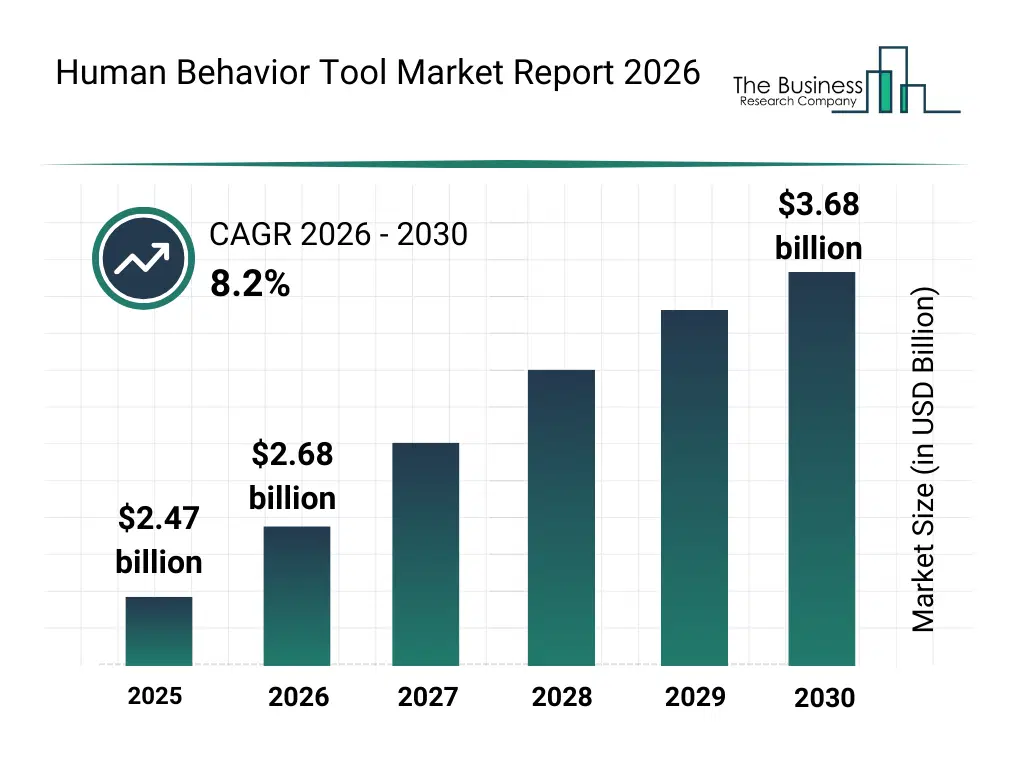
What Is The Human Behavior Tool Market Size and Share 2026?
The human behavior tool market size has grown strongly in recent years. It will grow from $2.47 billion in 2025 to $2.68 billion in 2026 at a compound annual growth rate (CAGR) of 8.5%. The growth in the historic period can be attributed to increasing demand for behavioral analytics, growing focus on employee productivity, rising adoption of sentiment and emotion analysis tools, expanding use of user behavior tracking in enterprises, increasing need for predictive decision-making.What Is The Human Behavior Tool Market Growth Forecast?
The human behavior tool market size is expected to see strong growth in the next few years. It will grow to $3.68 billion in 2030 at a compound annual growth rate (CAGR) of 8.2%. The growth in the forecast period can be attributed to growing integration of AI and machine learning in behavior analysis, increasing adoption of real-time monitoring platforms, rising demand for cognitive assessment and predictive modeling, expanding use of cloud-based behavior analytics solutions, growing emphasis on data-driven human performance optimization. Major trends in the forecast period include technology advancements in AI-powered behavioral insights, innovations in predictive modeling platforms, developments in real-time emotion and sentiment analysis, research and development in cognitive assessment algorithms, advancements in integrated human behavior analytics ecosystems.
Global Human Behavior Tool Market Segmentation
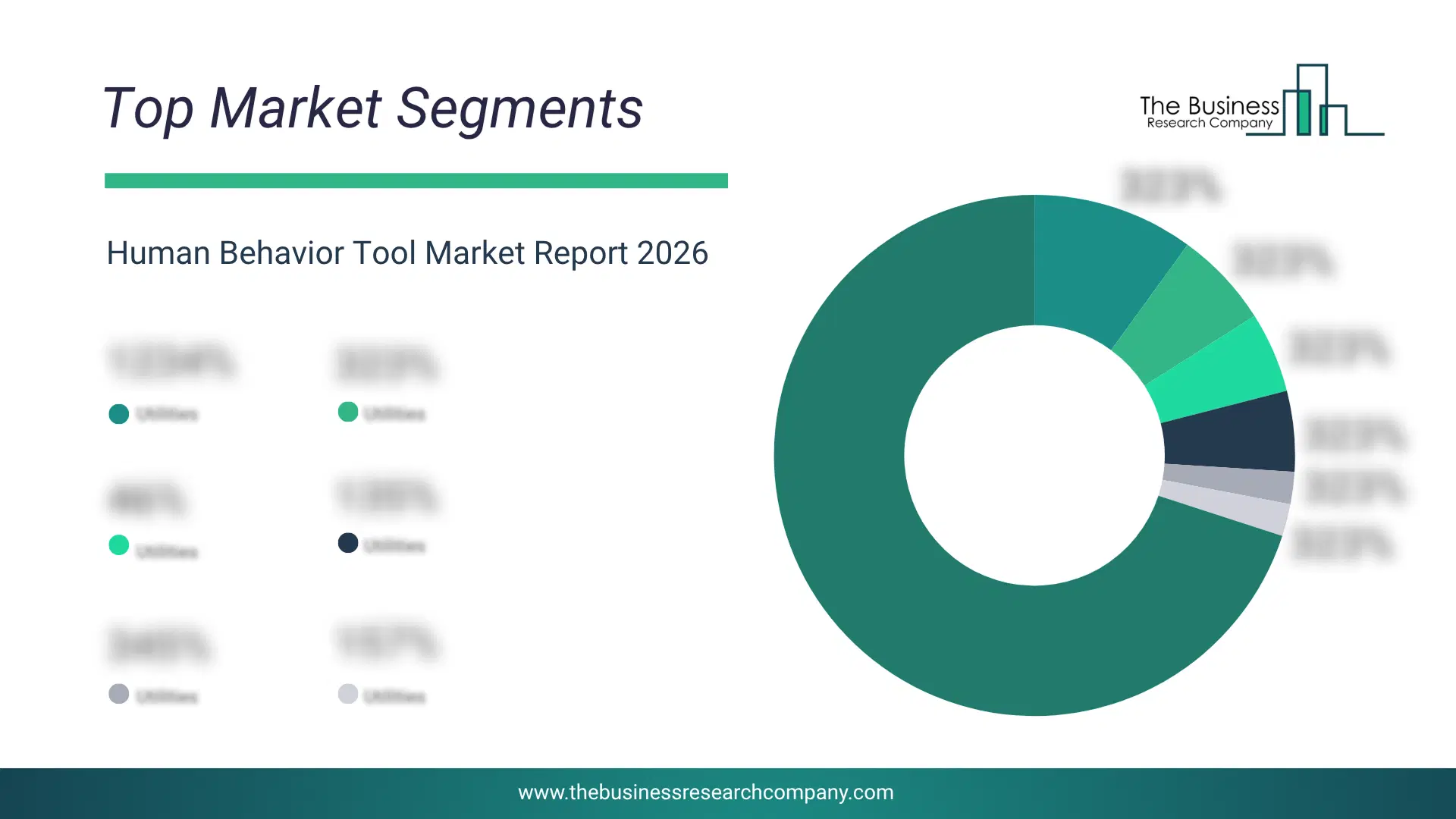
1) By Component: Software, Services, Hardware 2) By Deployment Mode: Cloud-Based Or Software as a Service (SaaS), On-Premises 3) By Technology: Artificial Intelligence, Machine Learning, Data Analytics, Biometrics 4) By Application Or Use Case: Cybersecurity And Fraud Detection, Customer Experience (CX) And Marketing Optimization, Human Resources (HR) And Talent Management, Psychological Or Clinical Assessment, Education And Training 5) By End-User Industry: Retail And E-commerce, Banking, Financial Services And Insurance (BFSI), Healthcare And Life Sciences, Technology And Media, Education, Government And Public Sector, Manufacturing, Other Corporate Enterprises Subsegments: 1) By Software: Behavioral Analytics Platforms, Emotion Recognition Software, User Interaction Monitoring Tools, Predictive Behavior Modeling Systems, Real Time Decision Analysis Solutions 2) By Services: Implementation And Integration Services, Training And Support Services, Consulting And Behavioral Strategy Services, Managed Behavior Analysis Services, Maintenance And Optimization Services 3) By Hardware: Sensor Enabled Behavior Tracking Devices, Biometric Monitoring Equipment, Wearable Interaction Measurement Tools, Environmental Behavior Capture Units, Cognitive Response Detection DevicesWhat Is The Driver Of The Human Behavior Tool Market?
The rising demand for behavior analytics is expected to propel the growth of the human behavior tool market going forward. Behavior analytics refers to the systematic use of data to understand, predict, and influence human actions and interactions within various environments. The demand for these analytics is increasing due to the growing necessity for data-driven decision-making in sectors such as healthcare, education, and corporate management to improve outcomes and efficiency. Human behavior tools support behavior analytics by providing the software and technological infrastructure required to collect, visualize, and interpret complex behavioral data accurately. For instance, in February 2025, according to the Behavior Analyst Certification Board (BACB), a US-based nonprofit organization, the demand for assistant behavior analysts in the United States increased by 131% in 2024 compared to 2023. Therefore, rising demand for behavior analytics is driving the growth of the human behavior tool industry.Key Players In The Global Human Behavior Tool Market
Major companies operating in the human behavior tool market are International Business Machines Corporation, Qualtrics International Inc., SHL Group Limited, Gallup Inc., Culture Amp Pty Ltd., Predictive Index LLC, HireVue Inc., NeuroLeadership Institute Inc., Hogan Assessment Systems Inc., NeuroSky Inc., Cogito Corporation, Crystal Knows Inc., Neuro-Insight Pty Ltd., Plum.io Inc., iMotions A/S, Sensum Technologies Pvt. Ltd., Humantic AI Inc., Receptiviti Inc., Behavioral Signals Technologies Ltd., Plum Analytics Canada Inc., Emotional Intelligence Appraisal LLC, Finding Mastery Inc.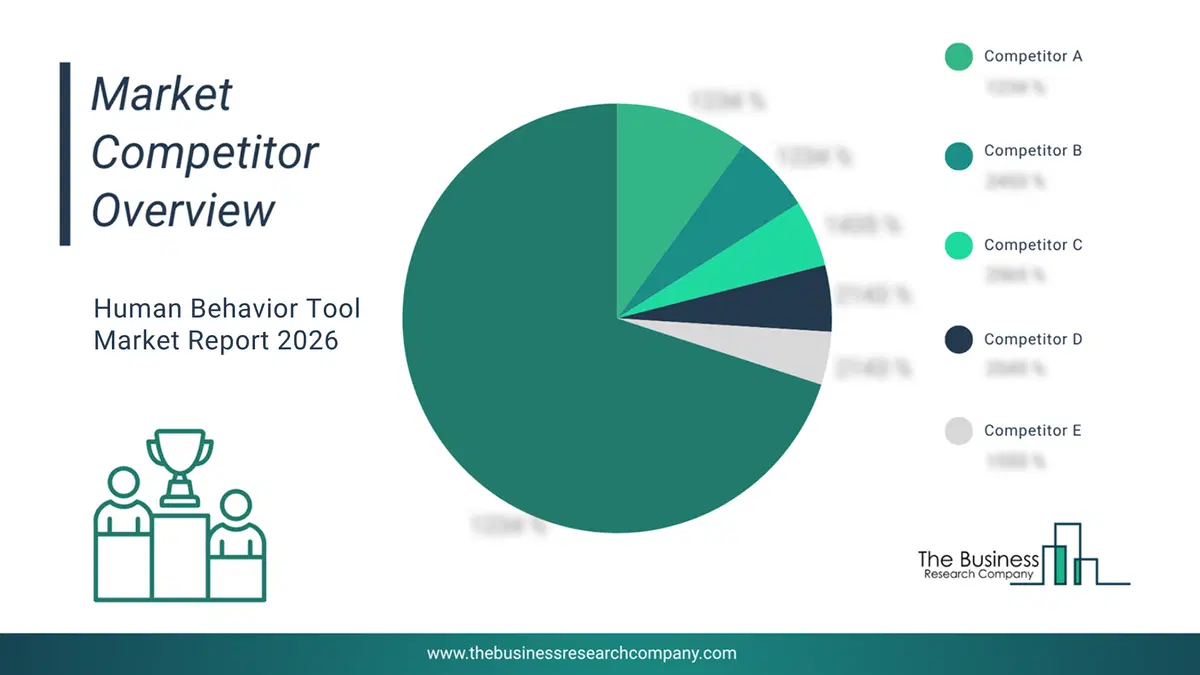
This chart is for illustrative purposes; the full report includes a detailed competitor analysis and comprehensive overview of the top 10 companies in the market.
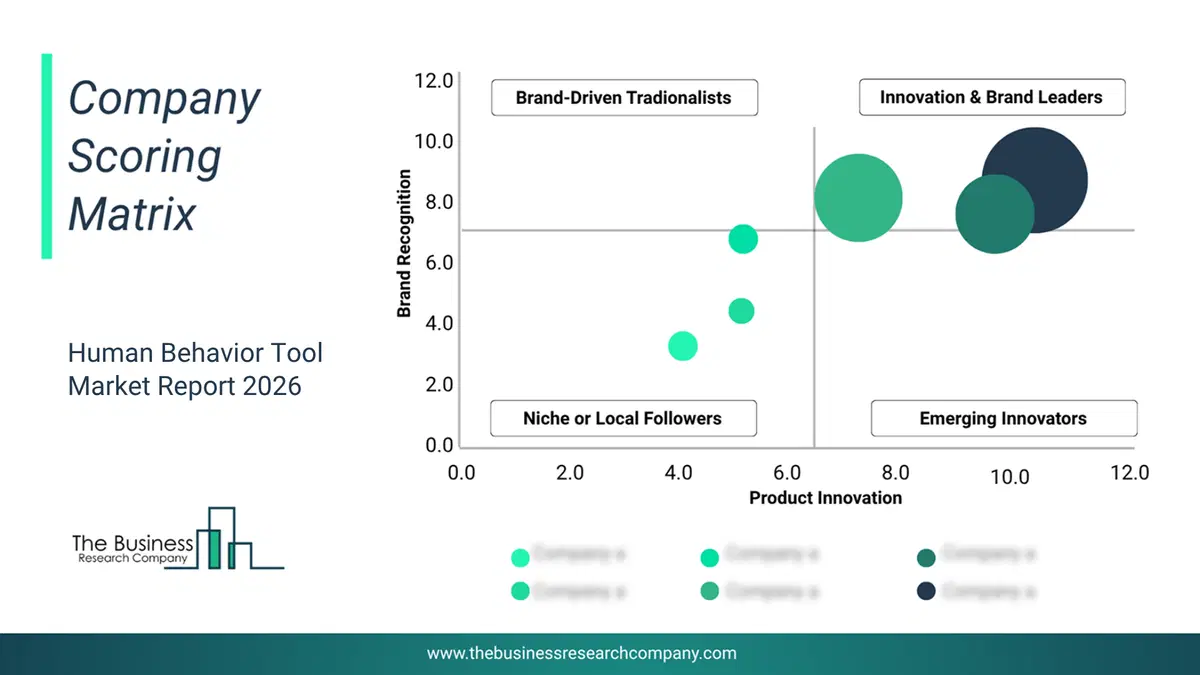
This chart maps companies by product innovation and brand strength, with bubble size indicating relative revenue, helping identify market leaders, challengers, and niche players. This is an illustrative chart; the full report provides a complete and accurate competitive analysis.
Global Human Behavior Tool Market Trends and Insights
Major companies operating in the human behavior tool market are focusing on developing technologically advanced models, such as multimodal AI application programming interfaces (APIs), to enable more sophisticated behavioral interpretation and assistive capabilities. Multimodal AI application programming interfaces (APIs) allow developers to build applications that can process and understand multiple forms of input, including text, images, and audio, that can analyze real-world visual cues, assess emotional context, and perform complex assistive tasks for users with diverse needs. For instance, in November 2023, OpenAI, a US-based artificial intelligence (AI) research organization, launched GPT-4 Turbo with Vision API at its inaugural DevDay. The platform enables developers to integrate visual analysis capabilities directly into their applications, allowing the AI to caption images, analyze real-world scenes in detail, and read documents with figures. The solution also introduced the Assistants API, which empowers the creation of purpose-built AI agents capable of following specific instructions, utilizing tools, and maintaining persistent memory to support long-term behavioral interactions.What Are Latest Mergers And Acquisitions In The Human Behavior Tool Market?
In January 2023, Sprout Social Inc., a US-based provider of cloud-based social media management software, acquired Repustate Inc. for an undisclosed amount. With this acquisition, Sprout Social aims to strengthen its artificial intelligence capabilities by integrating Repustate's advanced sentiment analysis and natural language processing (NLP) technology, enabling deeper customer insights and more sophisticated social listening tools. Repustate Inc. is a Canada-based text analytics and human behaviour analysis company specializing in AI-driven semantic interpretation for enterprise data.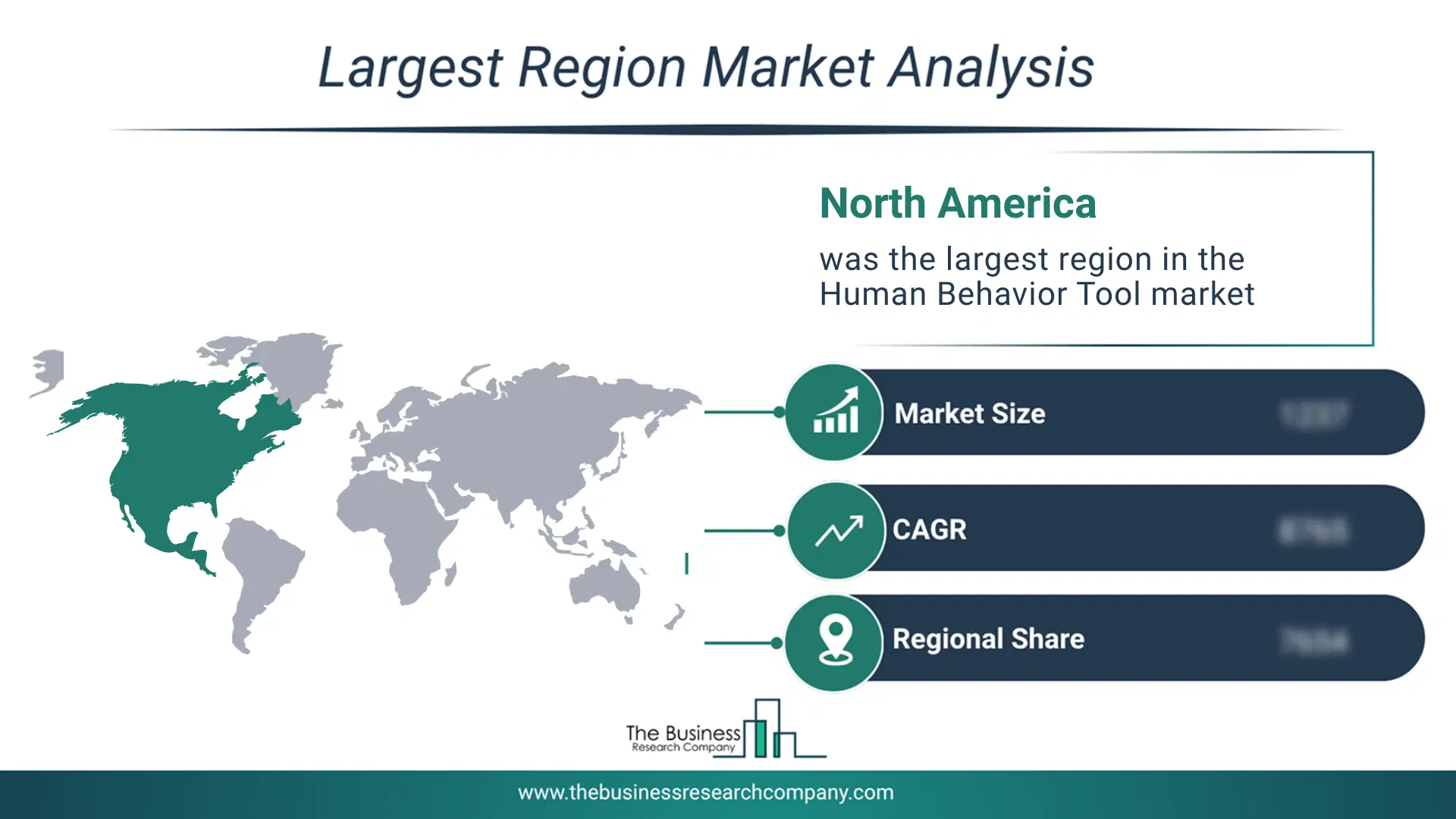
Regional Insights
North America was the largest region in the human behaviour tool market in 2025. Asia-Pacific is expected to be the fastest-growing region in the forecast period. The regions covered in this market report are Asia-Pacific, South East Asia, Western Europe, Eastern Europe, North America, South America, Middle East, Africa. The countries covered in this market report are Australia, Brazil, China, France, Germany, India, Indonesia, Japan, Taiwan, Russia, South Korea, UK, USA, Canada, Italy, Spain.What Defines the Human Behavior Tool Market?
The human behavior tool market consists of revenues earned by entities by providing services such as behavior monitoring and tracking, emotion and sentiment analysis, user pattern identification, predictive behavior modeling, cognitive and psychological assessment, personality and profile mapping, engagement and response analysis, real-time behavior insights, anomaly and risk behavior detection, and data visualization and reporting. The market value includes the value of related goods sold by the service provider or included within the service offering. The human behavior tool market includes sales of behavior analytics tools, sentiment analysis tools, behavioral prediction tools, biometric and emotion detection tools, user interaction tracking tools, cognitive assessment tools, behavioral profiling tools and decision-making analysis tools. Values in this market are ‘factory gate’ values, that is, the value of goods sold by the manufacturers or creators of the goods, whether to other entities (including downstream manufacturers, wholesalers, distributors, and retailers) or directly to end customers. The value of goods in this market includes related services sold by the creators of the goods.How is Market Value Defined and Measured?
The market value is defined as the revenues that enterprises gain from the sale of goods and/or services within the specified market and geography through sales, grants, or donations in terms of the currency (in USD unless otherwise specified). The revenues for a specified geography are consumption values that are revenues generated by organizations in the specified geography within the market, irrespective of where they are produced. It does not include revenues from resales along the supply chain, either further along the supply chain or as part of other products.
This chart presents market attractiveness based on a quantitative evaluation of growth, competition, strategic alignment, and risk, offering a clear view of opportunity areas for decision-making. This chart is for illustrative purposes; the full report contains the complete analysis.

This chart highlights the Total Addressable Market (TAM) by estimating the maximum revenue opportunity using an assumption-driven approach, supporting strategic planning and opportunity sizing across markets. The chart is illustrative; the full report provides a more comprehensive analysis.
What Key Data and Analysis Are Included in the Human Behavior Tool Market Report 2026?
The human behavior tool market research report is one of a series of new reports from The Business Research Company that provides market statistics, including industry global market size, regional shares, competitors with the market share, detailed market segments, market trends and opportunities, and any further data you may need to thrive in the human behavior tool industry. The market research report delivers a complete perspective of everything you need, with an in-depth analysis of the current and future state of the industry.Human Behavior Tool Market Report Forecast Analysis
| Report Attribute | Details |
|---|---|
| Market Size Value In 2026 | $2.68 billion |
| Revenue Forecast In 2030 | $3.68 billion |
| Growth Rate | CAGR of 8.5% from 2026 to 2030 |
| Base Year For Estimation | 2025 |
| Actual Estimates/Historical Data | 2020-2025 |
| Forecast Period | 2026 - 2030 |
| Market Representation | Revenue in USD Billion and CAGR from 2026 to 2030 |
| Segments Covered | Component, Deployment Mode, Technology, Application Or Use Case, End-User Industry |
| Regional Scope | Asia-Pacific, Western Europe, Eastern Europe, North America, South America, Middle East, Africa |
| Country Scope | The countries covered in the report are Australia, Brazil, China, France, Germany, India, Indonesia, Japan, Taiwan, Russia, South Korea, UK, USA, Canada, Italy, Spain. |
| Key Companies Profiled | International Business Machines Corporation, Qualtrics International Inc., SHL Group Limited, Gallup Inc., Culture Amp Pty Ltd., Predictive Index LLC, HireVue Inc., NeuroLeadership Institute Inc., Hogan Assessment Systems Inc., NeuroSky Inc., Cogito Corporation, Crystal Knows Inc., Neuro-Insight Pty Ltd., Plum.io Inc., iMotions A/S, Sensum Technologies Pvt. Ltd., Humantic AI Inc., Receptiviti Inc., Behavioral Signals Technologies Ltd., Plum Analytics Canada Inc., Emotional Intelligence Appraisal LLC, Finding Mastery Inc. |
| Customization Scope | Request for Customization |
| Pricing And Purchase Options | Explore Purchase Options |