
Hydrogen Aircraft Market Report 2026
Global Outlook – By Technology (Fully Hydrogen Powered Aircraft, Hybrid Electric Aircraft, Hydrogen Fuel Cell Aircraft, Liquid Hydrogen Aircraft), By Power Source (Hydrogen Combustion, Hydrogen Fuel Cell), By Range (20 Km To 100 Km, More Than 100 Km, Up To 20 Km), By Platform (Air Taxis, Business Jets, Unmanned Aerial Vehicles) – Market Size, Trends, Strategies, and Forecast to 2030
Hydrogen Aircraft Market Overview
• Hydrogen Aircraft market size has reached to $2.16 billion in 2025 • Expected to grow to $5.59 billion in 2030 at a compound annual growth rate (CAGR) of 20.6% • Growth Driver: Growth In Air Passenger Traffic Expected To Boost Hydrogen Aircraft Market • Market Trend: Strategic Partnerships To Gain A Competitive Edge • North America was the largest region and fastest growing region.What Is Covered Under Hydrogen Aircraft Market?
Hydrogen aircraft use hydrogen fuel to run an airplane. A hydrogen airplane may use hydrogen energy in two different ways. Hydrogen may be consumed in a jet engine or another internal combustion engine, or it can be utilized to power a propeller using a fuel cell. Hydrogen-powered planes have hydrogen fuel tanks built within the fuselage to store fuel. The main technologies of hydrogen aircraft include fully hydrogen-powered aircraft, hybrid electric aircraft, hydrogen fuel cell aircraft and liquid hydrogen aircraft. A fully hydrogen-powered aircraft refers to an aircraft that use only hydrogen for its operation as a power source. These aircraft produce zero carbon emissions when in flight. The power sources used in hydrogen aircraft include hydrogen combustion and hydrogen fuel cell. The various applications of hydrogen aircraft include air taxis, business jets and unmanned aerial vehicles. The aircraft’s ranges are 20 km to 100 km, more than 100 km and up to 20 km.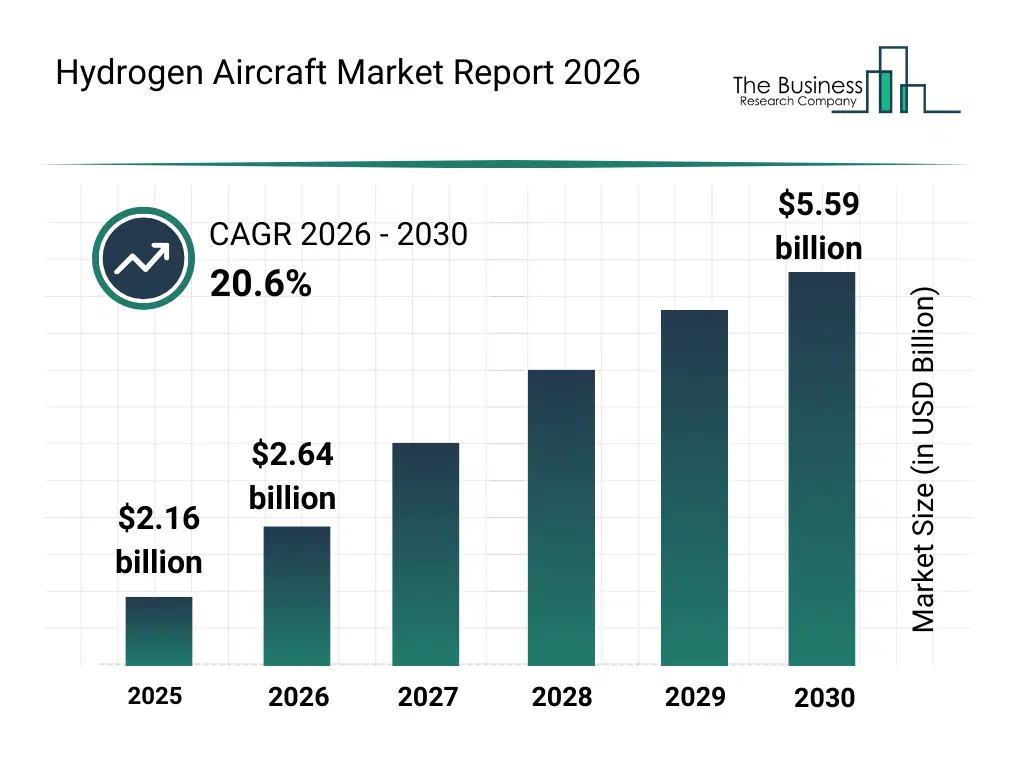
What Is The Hydrogen Aircraft Market Size and Share 2026?
The hydrogen aircraft market size has grown exponentially in recent years. It will grow from $2.16 billion in 2025 to $2.64 billion in 2026 at a compound annual growth rate (CAGR) of 22.1%. The growth in the historic period can be attributed to early experimentation with hydrogen combustion and fuel-cell propulsion concepts, rising investment in alternative aviation fuels to reduce emissions, development of lightweight composite materials for onboard hydrogen storage systems, initial prototyping of hydrogen aircraft components such as fuel cells and electric motors, increased governmental and institutional research funding for zero-emission aviation technologies.What Is The Hydrogen Aircraft Market Growth Forecast?
The hydrogen aircraft market size is expected to see exponential growth in the next few years. It will grow to $5.59 billion in 2030 at a compound annual growth rate (CAGR) of 20.6%. The growth in the forecast period can be attributed to growing demand for sustainable aviation solutions to meet global decarbonization targets, advancements in high-density hydrogen storage systems integrated within aircraft fuselage, scaling of fuel-cell powertrains for commercial and regional aircraft platforms, expansion of hydrogen production and airport refueling infrastructure, increasing collaboration among aircraft manufacturers and energy providers to commercialize hydrogen-powered aviation. Major trends in the forecast period include advanced hydrogen storage systems, lightweight composite materials for aircraft, high-efficiency hydrogen fuel cells, modular aircraft design for hydrogen integration, rapid refueling infrastructure development.
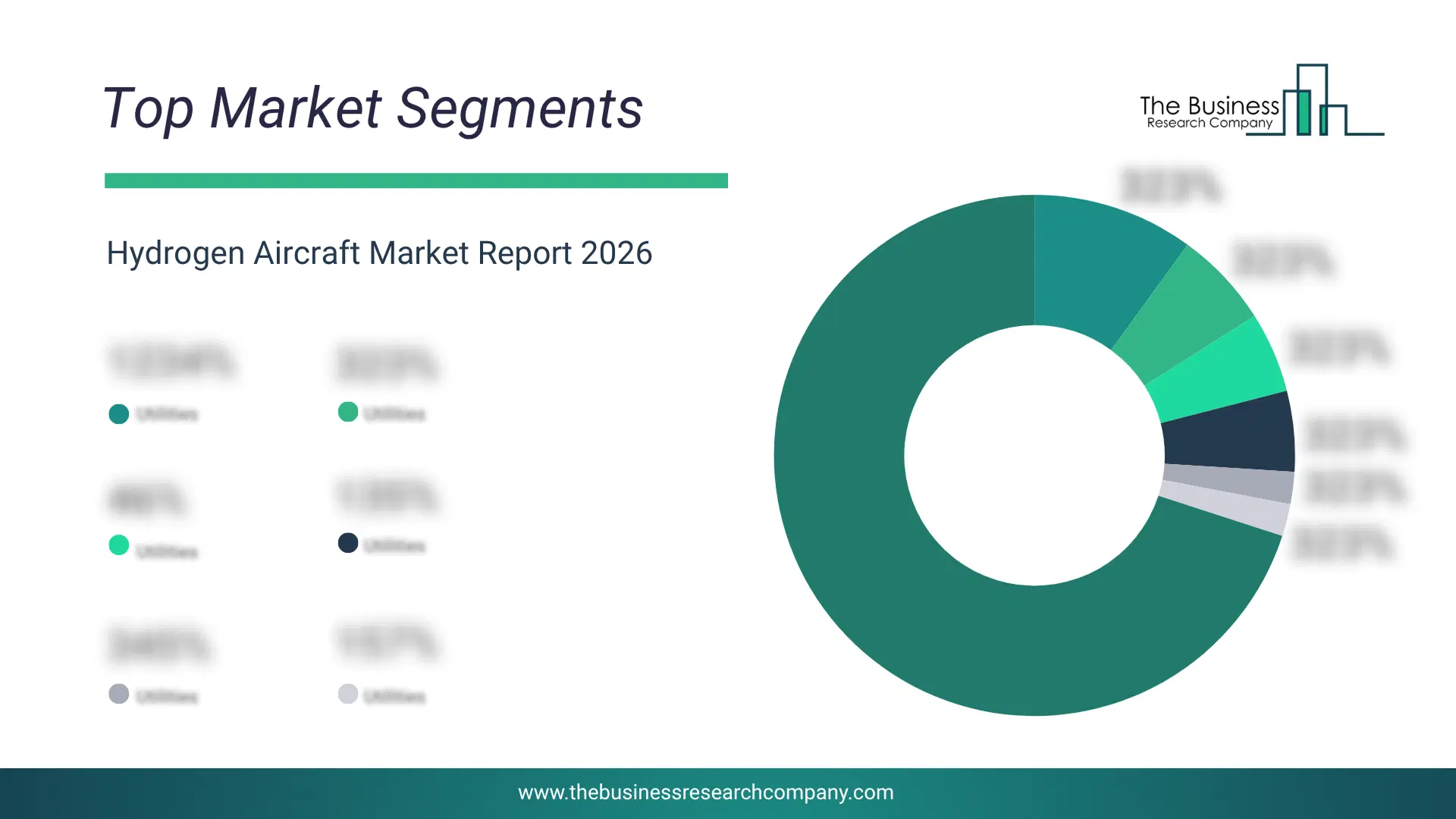
Global Hydrogen Aircraft Market Segmentation
1) By Technology: Fully Hydrogen Powered Aircraft, Hybrid Electric Aircraft, Hydrogen Fuel Cell Aircraft, Liquid Hydrogen Aircraft 2) By Power Source: Hydrogen Combustion, Hydrogen Fuel Cell 3) By Range: 20 Km To 100 Km, More Than 100 Km, Up To 20 Km 4) By Platform: Air Taxis, Business Jets, Unmanned Aerial Vehicles Subsegments: 1) By Fully Hydrogen Powered Aircraft: hydrogen combustion engines, Hydrogen Turbofan Engines 2) By Hybrid Electric Aircraft: Hydrogen-Electric Hybrid Systems, Battery-Hydrogen Hybrid Systems 3) By Hydrogen Fuel Cell Aircraft: Proton Exchange Membrane Fuel Cells (PEMFC), Solid Oxide Fuel Cells (SOFC) 4) By Liquid Hydrogen Aircraft: Liquid Hydrogen Storage Systems, Cryogenic Liquid Hydrogen SystemsWhat Is Driver Of The Hydrogen Aircraft Market?
The increase in air passenger traffic is expected to propel the growth of the hydrogen aircraft market. Air passenger traffic refers to scheduled passengers (number of people who have booked a flight with a commercial airline, excluding charter flights) handled by the global airline industry. With the rising number of passengers, more flights are in operation than ever before, leading to pollution due to the emittance of harmful gases by aircraft. To overcome the problem of pollution, hydrogen-based aircraft comes out to be a clean option. For instance, in April 2023, the International Air Transport Association (IATA), a Cuba-based trade association of the world's airlines, reported that global air travel continued to grow in February 2023, with total traffic measured in revenue passenger kilometers rising 55.5% compared to February 2022. Therefore, the increase in aviation will drive the hydrogen aircraft industry.Key Players In The Global Hydrogen Aircraft Market
Major companies operating in the hydrogen aircraft market are Aerodelft, Airbus SE, Apus Group, Doosan Mobility Innovation, Boeing Company, ZeroAvia Inc., HES Energy Systems Pte. Ltd., Universal Hydrogen Co., Pipistrel d.o.o Ajdovšcina, GKN Aerospace Ltd., Reaction Engines Ltd., Embraer SA, Ravn X, Alaka'i Technologies Co., HyPoint Inc., Faradair AeroSpace Ltd., Element One Inc., Rolls-Royce Plc,Groupe ADP, H2FLY GmbH, Pipistrel Aircraft d.o.o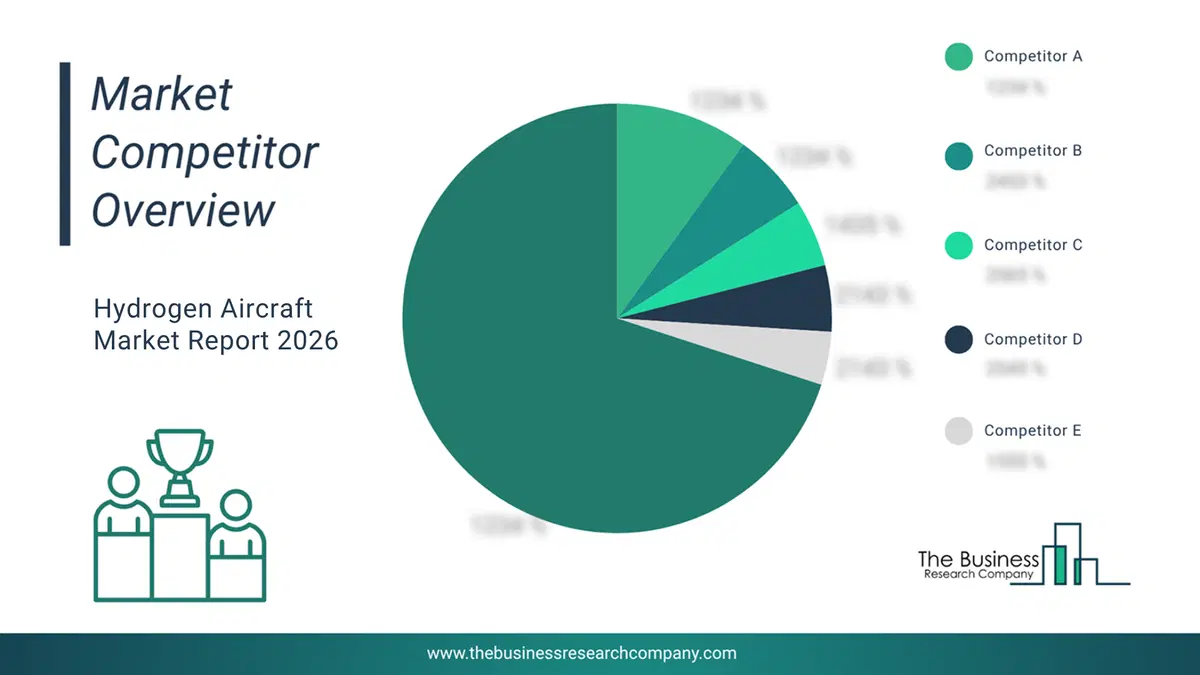
This chart is for illustrative purposes; the full report includes a detailed competitor analysis and comprehensive overview of the top 10 companies in the market.
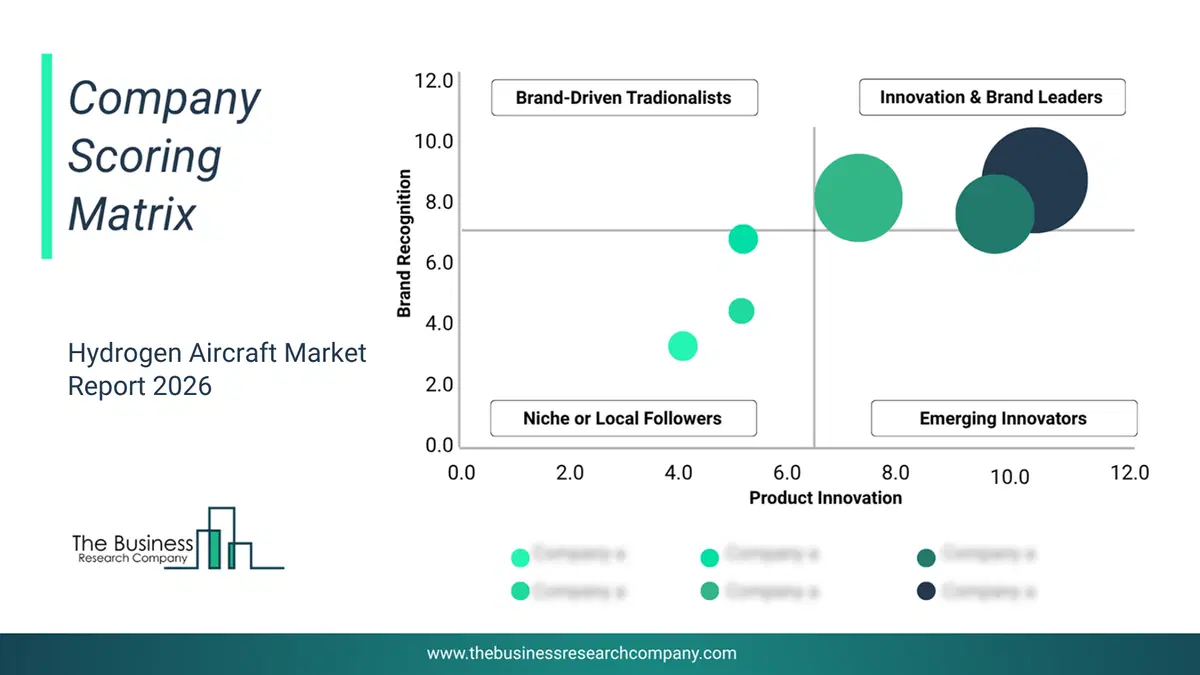
This chart maps companies by product innovation and brand strength, with bubble size indicating relative revenue, helping identify market leaders, challengers, and niche players. This is an illustrative chart; the full report provides a complete and accurate competitive analysis.
Global Hydrogen Aircraft Market Trends and Insights
Major companies operating in the hydrogen aircraft market are focused on developing strategic partnerships to drive revenues in the market. Strategic partnerships enable hydrogen aircraft companies to access critical resources, technology, and expertise, fostering innovation and sustainable growth in the aviation industry. For instance, in August 2023, ZeroAvia, a UK-based hydrogen-electric aviation company, partnered with Masdar, a UAE-based company to explore hydrogen production and supply for clean flight operations in North America and Europe. This collaboration aims to advance hydrogen-powered commercial flights, highlighting the potential for zero-emission aviation.What Are Latest Mergers And Acquisitions In The Hydrogen Aircraft Market? Heven Inc. Acquires Zepher Flight Labs to Boost Hydrogen Propulsion Technology
In April 2025, Heven Inc., a U.S.-based aerospace and defense company, acquired Zepher Flight Labs for an undisclosed amount. With this acquisition, Heven aims to strengthen its technological capabilities in hydrogen propulsion systems, accelerate the commercialization of next-generation eco-friendly drones, and expand its portfolio of sustainable aviation solutions for both defense and commercial markets. Zepher Flight Labs is a U.S.-based manufacturing company that offers hydrogen aircraft.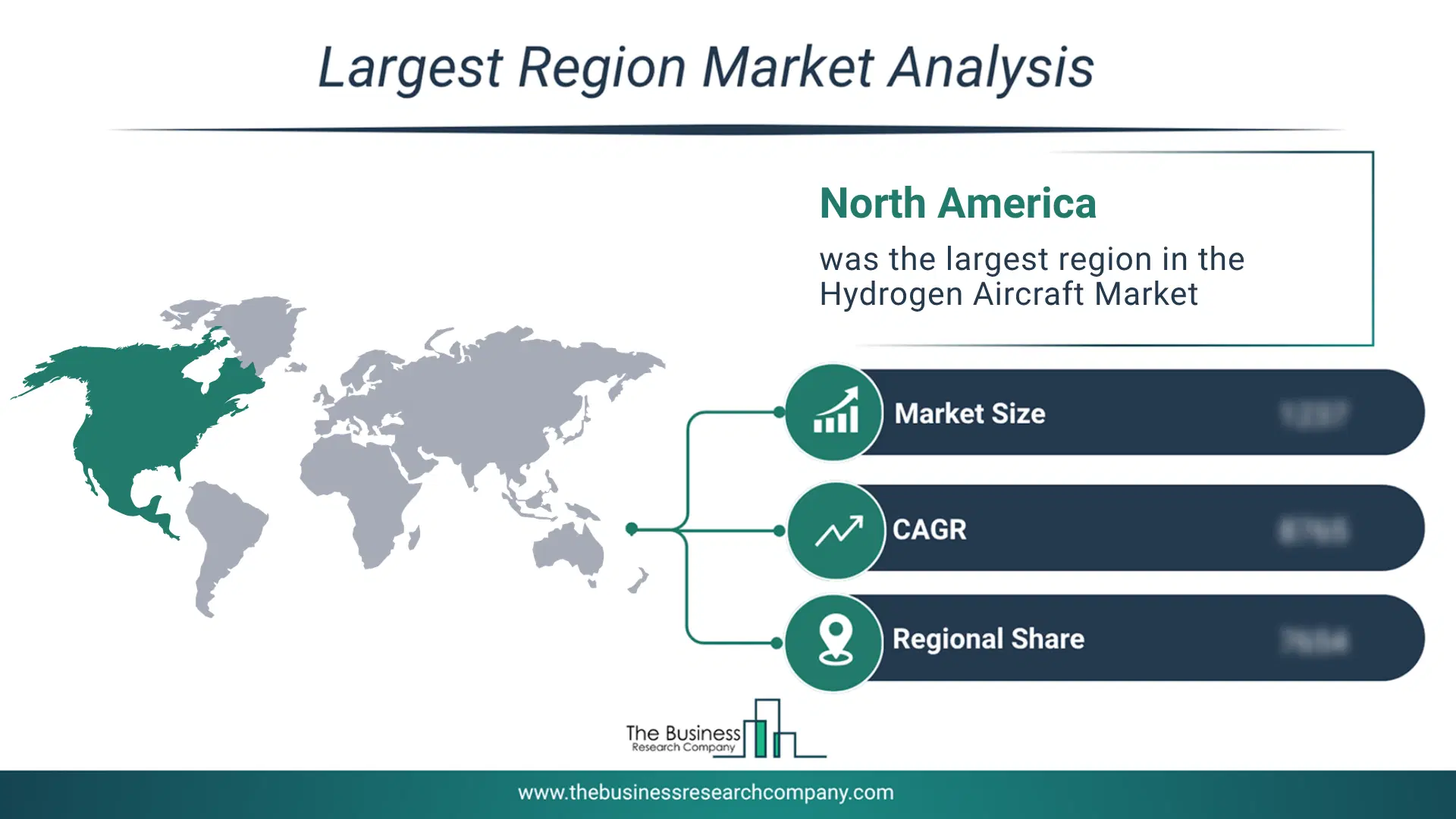
Regional Insights
North America was the largest region in the hydrogen aircraft market in 2025. North America is expected to be the fastest-growing region in the forecast period. The regions covered in this market report are Asia-Pacific, South East Asia, Western Europe, Eastern Europe, North America, South America, Middle East, Africa. The countries covered in this market report are Australia, Brazil, China, France, Germany, India, Indonesia, Japan, Taiwan, Russia, South Korea, UK, USA, Canada, Italy, SpainWhat Defines the Hydrogen Aircraft Market?
The hydrogen aircraft market consists of sales of hydrogen aircraft components including storage system, fuel cell and motor. Values in this market are ‘factory gate’ values, that is the value of goods sold by the manufacturers or creators of the goods, whether to other entities (including downstream manufacturers, wholesalers, distributors, and retailers) or directly to end customers. The value of goods in this market includes related services sold by the creators of the goods.How is Market Value Defined and Measured?
The market value is defined as the revenues that enterprises gain from the sale of goods and/or services within the specified market and geography through sales, grants, or donations in terms of the currency (in USD unless otherwise specified). The revenues for a specified geography are consumption values that are revenues generated by organizations in the specified geography within the market, irrespective of where they are produced. It does not include revenues from resales along the supply chain, either further along the supply chain or as part of other products.
This chart presents market attractiveness based on a quantitative evaluation of growth, competition, strategic alignment, and risk, offering a clear view of opportunity areas for decision-making. This chart is for illustrative purposes; the full report contains the complete analysis.

This chart highlights the Total Addressable Market (TAM) by estimating the maximum revenue opportunity using an assumption-driven approach, supporting strategic planning and opportunity sizing across markets. The chart is illustrative; the full report provides a more comprehensive analysis.
What Key Data and Analysis Are Included in the Hydrogen Aircraft Market Report 2026?
The hydrogen aircraft market research report is one of a series of new reports from The Business Research Company that provides market statistics, including industry global market size, regional shares, competitors with the market share, detailed market segments, market trends and opportunities, and any further data you may need to thrive in the hydrogen aircraft industry. The market research report delivers a complete perspective of everything you need, with an in-depth analysis of the current and future state of the industry.Hydrogen Aircraft Market Report Forecast Analysis
| Report Attribute | Details |
|---|---|
| Market Size Value In 2026 | $2.64 billion |
| Revenue Forecast In 2030 | $5.59 billion |
| Growth Rate | CAGR of 20.6% from 2026 to 2030 |
| Base Year For Estimation | 2025 |
| Actual Estimates/Historical Data | 2020-2025 |
| Forecast Period | 2026 - 2030 |
| Market Representation | Revenue in USD Billion and CAGR from 2026 to 2030 |
| Segments Covered | Technology, Power Source, Range, Platform |
| Regional Scope | Asia-Pacific, Western Europe, Eastern Europe, North America, South America, Middle East, Africa |
| Country Scope | The countries covered in the hydrogen aircraft market report are Australia, Brazil, China, France, Germany, India, Indonesia, Japan, Taiwan, Russia, South Korea, UK, USA, Canada, Italy, Spain |
| Key Companies Profiled | Aerodelft, Airbus SE, Apus Group, Doosan Mobility Innovation, Boeing Company, ZeroAvia Inc., HES Energy Systems Pte. Ltd., Universal Hydrogen Co., Pipistrel d.o.o Ajdovščina, GKN Aerospace Ltd., Reaction Engines Ltd., Embraer SA, Ravn X, Alaka'i Technologies Co., HyPoint Inc., Faradair AeroSpace Ltd., Element One Inc., Rolls-Royce Plc,Groupe ADP, H2FLY GmbH, Pipistrel Aircraft d.o.o |
| Customization Scope | Request for Customization |
| Pricing And Purchase Options | Explore Purchase Options |