
Ice Cream Market Report 2026
Global Outlook – By Type (Impulse Ice Cream, Take-Home Ice Cream, Artisanal Ice Cream ), By Flavor (Vanilla, Chocolate, Fruit, Other Flavors), By Packaging (Cup, Cone, Stick, Brick, Tub, Other Packaging ), By Category (Dairy, Non-Dairy), By Distribution Channels (Hypermarket Or Supermarket, Ice Cream Parlor, Online Retailer, Other Distribution Channels) – Market Size, Trends, Strategies, and Forecast to 2030
Ice Cream Market Overview
• Ice Cream market size has reached to $43.9 billion in 2025 • Expected to grow to $59.13 billion in 2030 at a compound annual growth rate (CAGR) of 6.3% • Growth Driver: Rising Consumer Expenditure on Fast Food Set To Drive Ice Cream Market Growth • Market Trend: Increasing Practices On Sustainable Practices In Ice Cream Market • Asia-Pacific was the largest region and fastest growing region.Market Gains By 2030 – Top Opportunities By Segment
Market Gain identifies the most promising market opportunities by highlighting the segments or products expected to generate the highest incremental revenue growth over the next five years.
What Is Covered Under Ice Cream Market?
Ice cream is a frozen delicacy made from milk, cream, sugar, and occasionally additional components. It usually combines stabilizers, such as gluten, which aids in the consistency of the mixture, in addition to sugar or sugar substitutes, which are typically added to give the sweet flavor. The main types of ice cream are impulse ice cream, take-home ice cream, and artisanal ice cream. Impulse ice creams are liquid-based frozen snacks on a stick. The various flavors involved are chocolate, fruit and others which are packed in cups, cones, sticks, bricks, tubs and others. It is available in dairy and non-dairy categories for sale in hypermarkets or supermarkets, ice cream parlors, online retailers, and others.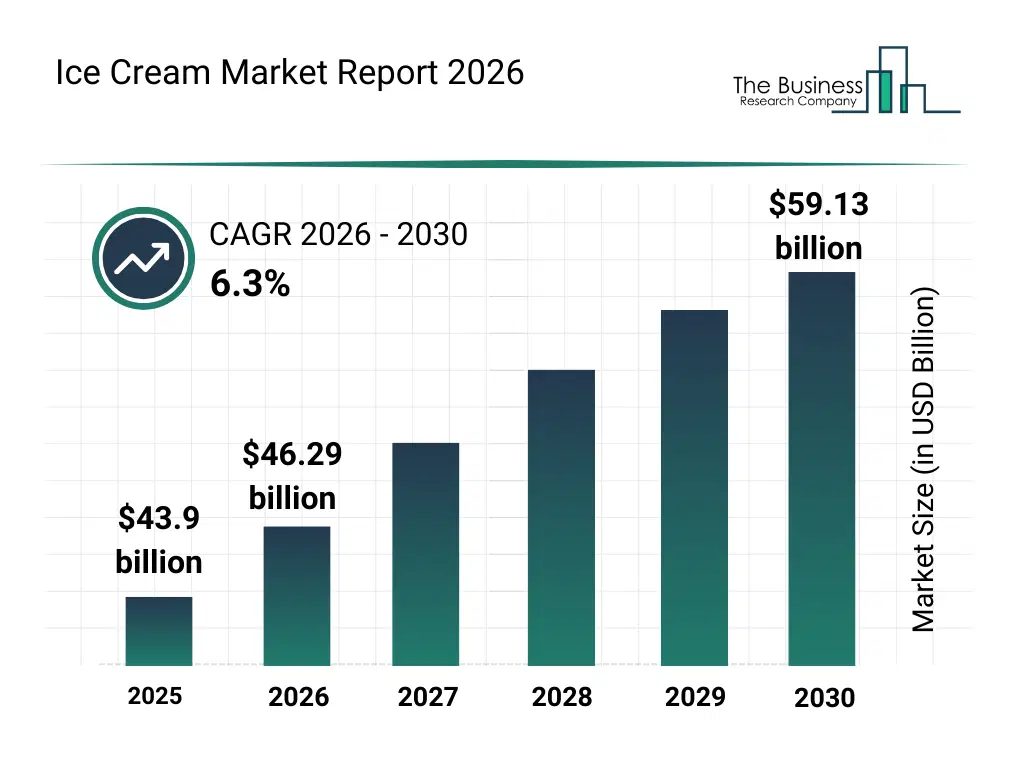
What Is The Ice Cream Market Size and Share 2026?
The ice cream market size has grown strongly in recent years. It will grow from $43.9 billion in 2025 to $46.29 billion in 2026 at a compound annual growth rate (CAGR) of 5.5%. The growth in the historic period can be attributed to expansion of urban consumer lifestyles, rising disposable income levels, growth of frozen dessert retailing, increasing availability of cold storage infrastructure, popularity of impulse dessert consumption.What Is The Ice Cream Market Growth Forecast?
The ice cream market size is expected to see strong growth in the next few years. It will grow to $59.13 billion in 2030 at a compound annual growth rate (CAGR) of 6.3%. The growth in the forecast period can be attributed to increasing demand for plant-based desserts, rising innovation in low-sugar formulations, expansion of online frozen food delivery, growing focus on sustainable packaging, increasing premiumization of frozen desserts. Major trends in the forecast period include rising demand for premium and artisanal ice cream, growing popularity of non-dairy and plant-based ice cream, expansion of novel and exotic flavor profiles, increasing focus on clean-label ingredients, enhanced packaging and cold chain innovation.
Global Ice Cream Market Segmentation
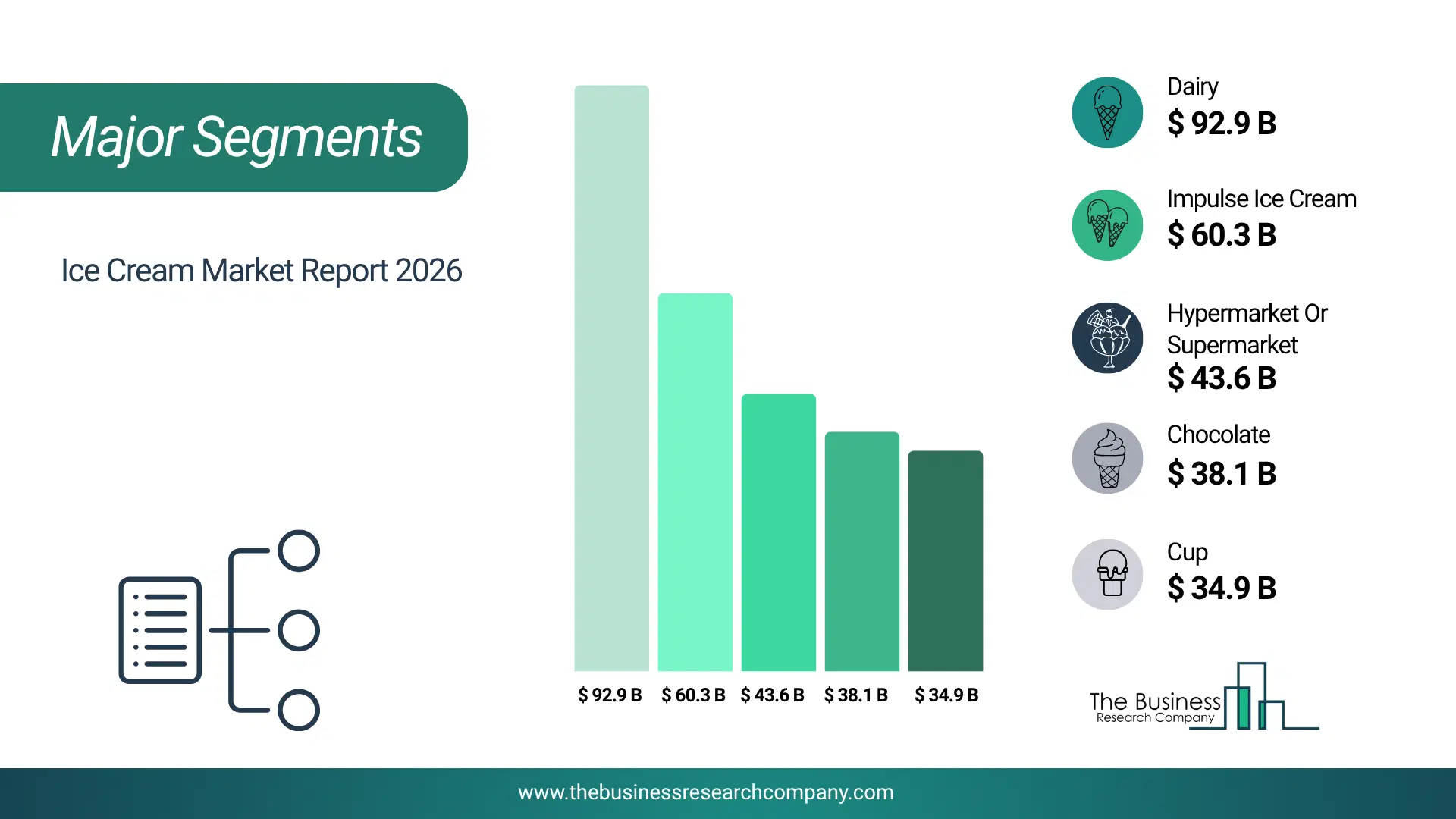
1) By Type: Impulse Ice Cream, Take-Home Ice Cream, Artisanal Ice Cream 2) By Flavor: Vanilla, Chocolate, Fruit, Other Flavors 3) By Packaging: Cup, Cone, Stick, Brick, Tub, Other Packaging 4) By Category: Dairy, Non-Dairy 5) By Distribution Channels: Hypermarket Or Supermarket, Ice Cream Parlor, Online Retailer, Other Distribution Channels Subsegments: 1) By Impulse Ice Cream: Single-Serve Cups, Cones, Bars And Popsicles, Sandwiches 2) By Take-Home Ice Cream: Family-Sized Tubs, Multi-Pack Containers 3) By Artisanal Ice Cream: Small Batch Ice Cream, Gourmet Flavors, Organic And Natural Ingredients The top segments in the ice cream market will be: • Dairy will reach $92940.32 Million by 2025. • Impulse Ice Cream will reach $60372.91 Million by 2025. • Hypermarket Or Supermarket will reach $43666.41 Million by 2025. • Chocolate will reach $38162.1 Million by 2025. • Cup will reach $34980.25 Million by 2025.What Is The Driver Of The Ice Cream Market?
Increasing consumer expenditure on fast food is expected to propel the growth of the ice cream market going forward. Consumer expenditure on fast food is the total amount of money spent by individuals and families on fast food items. Fast food and ice cream are both considered indulgent and handy meal alternatives that cater to similar customer tastes. Fast food restaurants frequently provide ice cream as a dessert option, making it easy for customers to include it in their purchases. Additionally, the growing café culture among millennials has boosted consumer spending on fast food. For instance, in August 2024, according to the Economic Research Service (ERS), a US-based principal agency of the USDA, in the United States, per capita spending on food away from home (including fast food) increased by 12.0% from 2022 to 2023, rising from $4,004 to $4,485 per person in 2023. Therefore, the increasing consumer expenditure on fast food will drive the fast food market.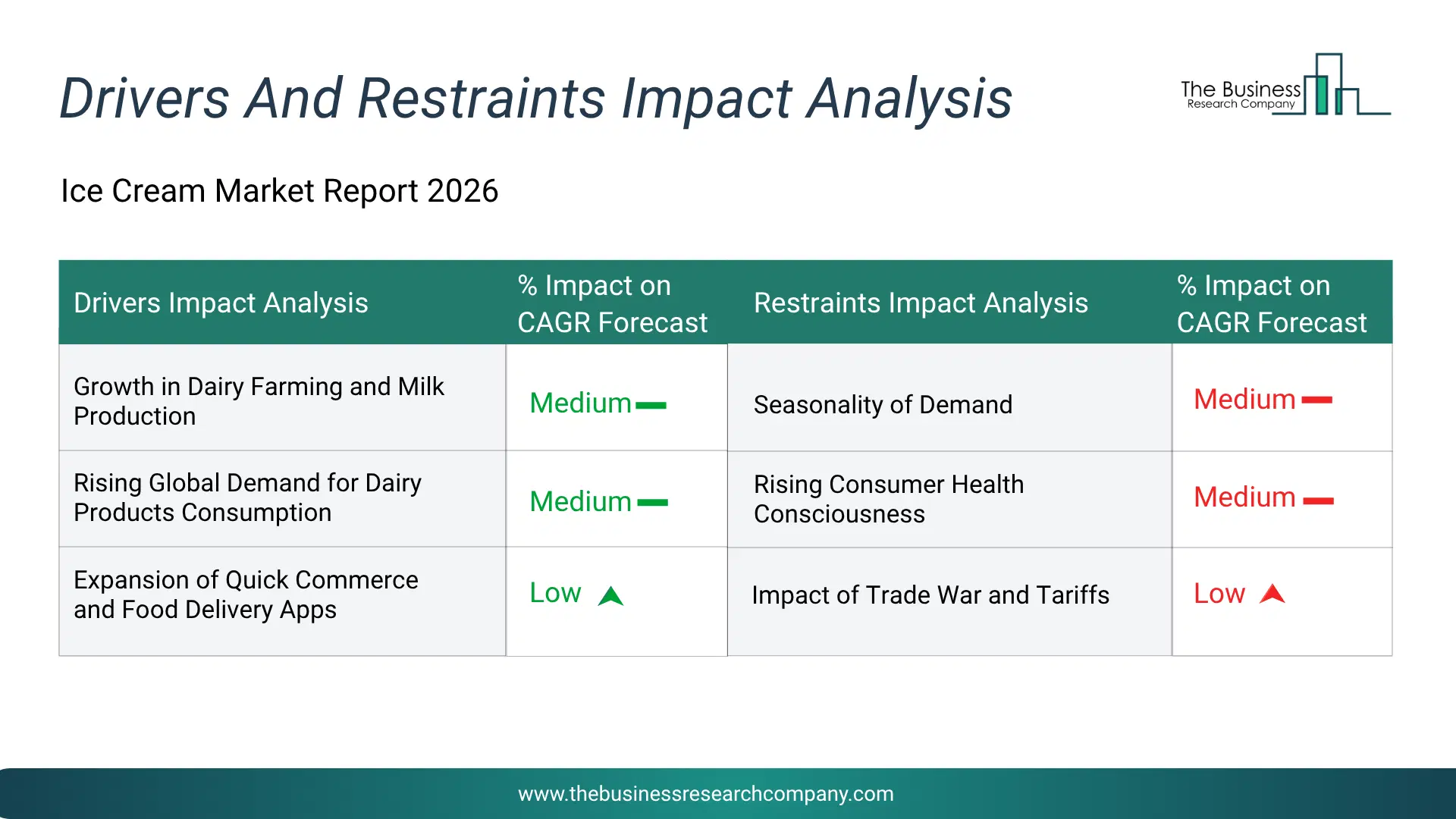
Infographic Chart Showing Key Market Drivers Analysis And Restraints For Ice Cream Market
The chart presents an impact analysis of key drivers and restraints, quantifying their relative influence on the market's growth rate and helping assess the balance between growth enablers and limiting factors. This chart offers a high-level perspective; the full report contains more detailed insights.
How Will The Drivers Impact Growth In The Global Ice Cream Market?
• Growth in Dairy Farming and Milk Production (Medium) – The growth in dairy farming and milk production will become a key driver of growth in the ice cream market by 2030. Ice cream manufacturing relies heavily on milk, cream and other dairy ingredients and the steady expansion of dairy farming ensures a reliable supply of these essential raw materials. Improvements in animal health, feed efficiency and farm management practices are expected to enhance productivity, while investments in modern dairy infrastructure will further strengthen the value chain. Rising output from key dairy-producing regions will help stabilize supply, support large-scale production, and enable the development of diverse ice cream varieties, including premium and indulgent offerings. As the availability of milk and dairy products continues to expand globally, ice cream manufacturers will be better positioned to innovate, meet growing consumer demand, and sustain long-term market growth. As a result, the growth in dairy farming and milk production is anticipated to contributing to a 1.5% annual growth in the market. • Rising Global Demand for Dairy Products Consumption (Medium) – The rising global demand for dairy products consumption will emerge as a major factor driving the expansion of the ice cream market by 2030. As consumers in emerging and developed economies continue to increase per capita consumption of milk, yogurt, cheese and other dairy goods, the demand for derivative and indulgent dairy-based products like ice cream will grow in tandem. The expansion of middle-class populations, changing dietary preferences favouring high-protein and calcium-rich foods and increasing retail access in rural and urban markets all contribute to this trend. Concurrently, dairy manufacturers are scaling capacity, improving cold chain logistics and enhancing processing efficiencies to meet the surging demand. As the dairy sector expands, downstream segments such as ice cream benefit from improved raw material availability, lower supply constraints, and stronger integration with dairy supply chains. Consequently, the rising global demand for dairy products consumption is projected to contributing to a 1.0% annual growth in the market. • Expansion of Quick Commerce and Food Delivery Apps (Low) – The expansion of quick commerce and food delivery apps as a major factor driving the expansion of the ice cream market by 2030. Rapid delivery models make frozen treats like ice cream more accessible, offering consumers the ability to satisfy cravings spontaneously without needing to visit physical stores. The convenience of ordering via apps, combined with delivery in short time windows, aligns with busy lifestyles and increasing demand for at-home indulgence. Furthermore, the proliferation of small dark stores and fulfilment centres near residential areas strengthens the logistics backbone necessary to support cold-chain and frozen item delivery. As digital infrastructure deepens and consumer expectations for convenience rise, these platforms will increasingly serve as key channels for ice cream brands to reach customers. Consequently, expansion of quick commerce and food delivery apps is projected to contributing to a 0.8% annual growth in the market. • Enhanced Cold-Chain and Distribution Improvements (Low) – The enhanced cold-chain and distribution improvements will emerge as a major factor driving the expansion of the ice cream market by 2030. Upgrades in refrigerated storage capacity, expansion of “new energy” refrigerated transport fleets and deployment of more sustainable logistics systems promise to improve the integrity and reach of frozen dessert supply chains. In China, cold storage volume has steadily increased, while sales of low emission refrigerated trucks have surged, supporting fresher, better-preserved ice cream across a wider geographic spread. With better cold transport and storage, ice cream producers can reduce losses due to melt-damage or spoilage, deliver products further afield and maintain consistent product quality even in warmer or remote regions. As distribution networks become more resilient and cold chain delays reduce, consumers stand to benefit from wider product variety and improved freshness. Consequently, the enhanced cold-chain and distribution improvements are projected to contributing to a 0.5% annual growth in the market.How Will The Restraints Impact Growth In The Global Ice Cream Market?
• Seasonality of Demand (Medium) – Seasonality of Demand will restrict the growth of the Ice Cream market during the forecast period. Ice cream consumption is highly seasonal in many regions, with peak demand during summer months. Seasonal fluctuations affect production planning, inventory management, and revenue stability. Seasonality creates operational challenges and limits the capacity utilization of ice cream manufacturing facilities. • Rising Consumer Health Consciousness (Low) – Rising Consumer Health Consciousness will restrict the growth of the Ice Cream market during the forecast period. Increasing health awareness and concerns about sugar, fat, and calorie content can affect ice cream consumption. Consumer preference for healthier alternatives may limit the growth of traditional ice cream products. Health-conscious consumer behavior can affect market growth and drive demand for healthier options. • Impact of Trade War and Tariffs (Low) – Impact of Trade War and Tariffs will restrict the growth of the Ice Cream market during the forecast period. Trade tariffs on dairy ingredients and ice cream products can affect pricing and availability. Trade barriers may impact the cost of imported ingredients used in ice cream production. Trade tensions can affect international ice cream trade and market expansion.Key Players In The Global Ice Cream Market
Major companies operating in the ice cream market are Nestle S.A., Unilever Group Plc, General Mills Inc., Blue Bell Creameries LP, Cold Stone Creamery Inc., American Dairy Queen Corporation, Lotte Confectionery Co Ltd, Inspire Brands Inc., Turkey Hill Dairy LP, Wells Enterprises Inc., NadaMoo! R&D Room LLC, Mars Inc., Inner Mongolia Yili Industrial Group Co Ltd, Froneri International Limited, Tillamook CCA, Amul, Amy's Ice Creams, Agropur Dairy Cooperative, Arla Foods AMBA, Chapman's, Prairie Farms Dairy Inc., Giffords Dairy Inc., Van Leeuwen Ice Cream, Adirondack Creamery Inc., Yasso Inc., Graeter's Ice Cream, Jeni's Splendid Ice Creams, Humphry Slocombe, Coolhaus, Ben & Jerry's Homemade Holdings Inc., Häagen-Dazs, Baskin Robbins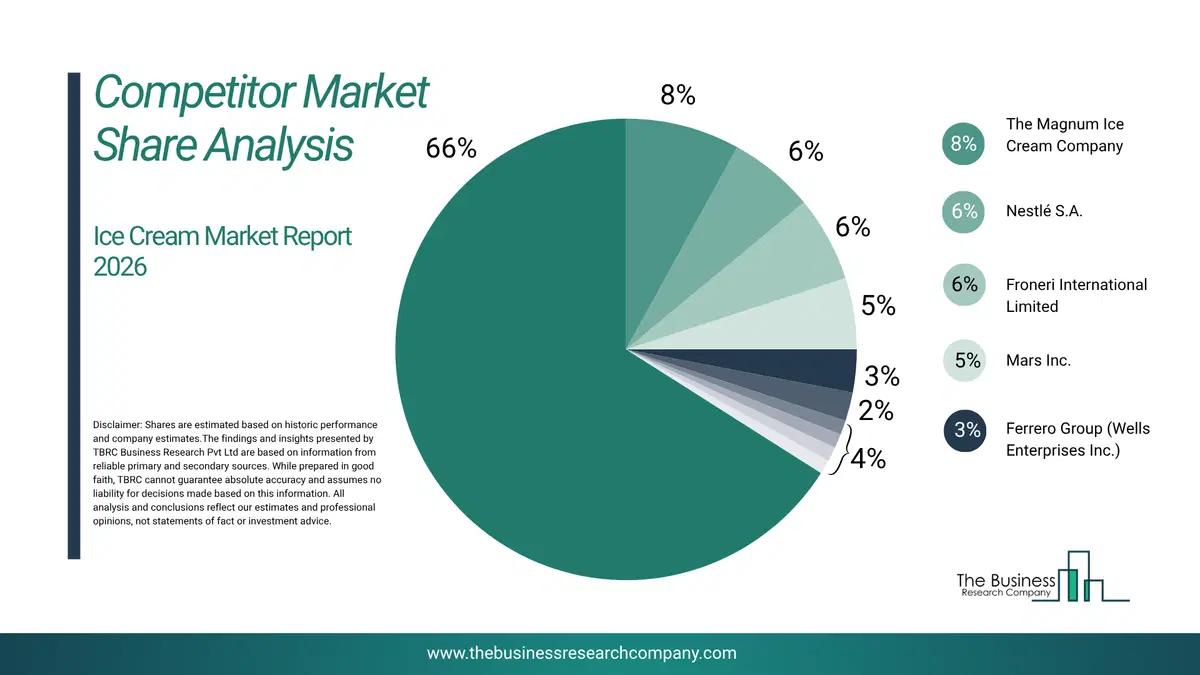
This chart is for illustrative purposes; the full report includes a detailed competitor analysis and comprehensive overview of the top 10 companies in the market.
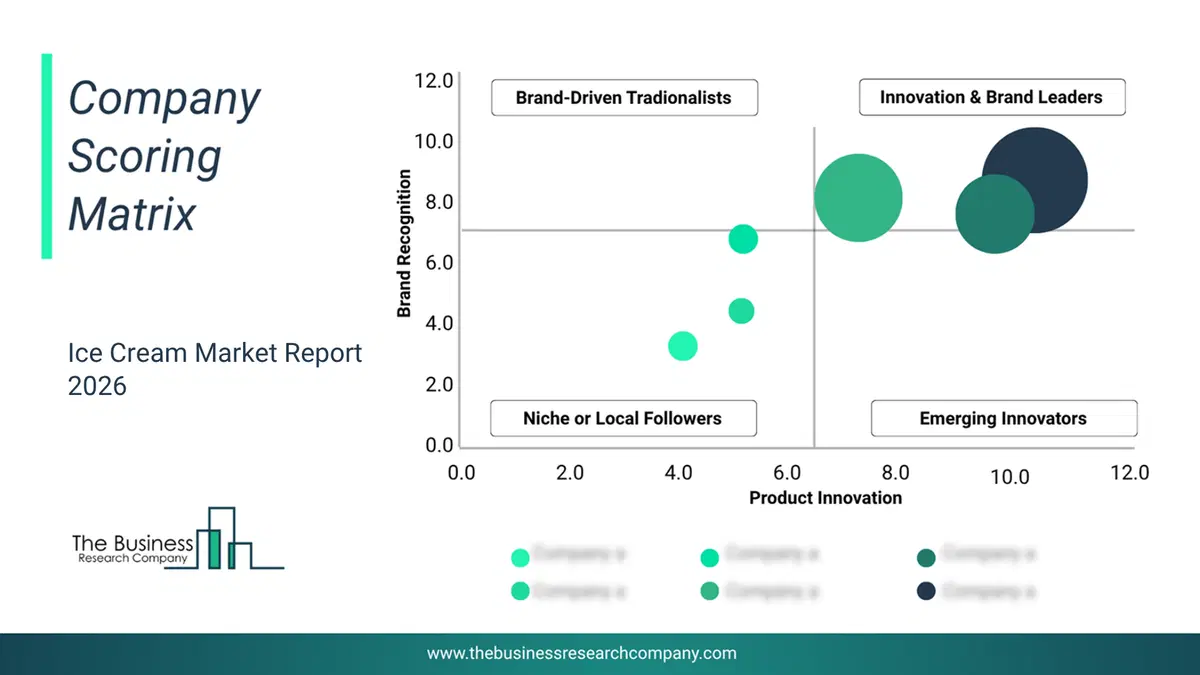
This chart maps companies by product innovation and brand strength, with bubble size indicating relative revenue, helping identify market leaders, challengers, and niche players. This is an illustrative chart; the full report provides a complete and accurate competitive analysis.
Global Ice Cream Market Trends and Insights
Major companies operating in the ice cream market are focusing on product innovations, such as plant-based and low-calorie options, to provide consumers with healthier alternatives while maintaining the traditional indulgence associated with ice cream. Mochi ice cream is a Japanese dessert consisting of small balls of ice cream wrapped in a chewy, sweet rice cake made from glutinous rice flour (mochi), offering a unique texture and flavor combination. For instance, in March 2023, Mochidoki, a US-based ice cream company, announced mochi ice cream brand is expanding its retail footprint to include 40 Amazon Fresh delivery regions offering five of the brand’s most popular flavours: Vanilla Chip, Strawberry, Cake Batter, Vegan Mango and Vegan Passionfruit.What Are Latest Mergers And Acquisitions In The Ice Cream Market?
In January 2025, Davidson Kempner Capital Management LP, a US-based investment management firm acquired YSCO for an undisclosed amount. With this acquisition, Davidson Kempner aims to accelerate its strategic push to build a leading global third-party ice-cream manufacturing platform by combining scale, production capacity and retailer relationships. YSCO NV is a Belgium-based ice-cream manufacturer that specializes in producing private-label ice cream.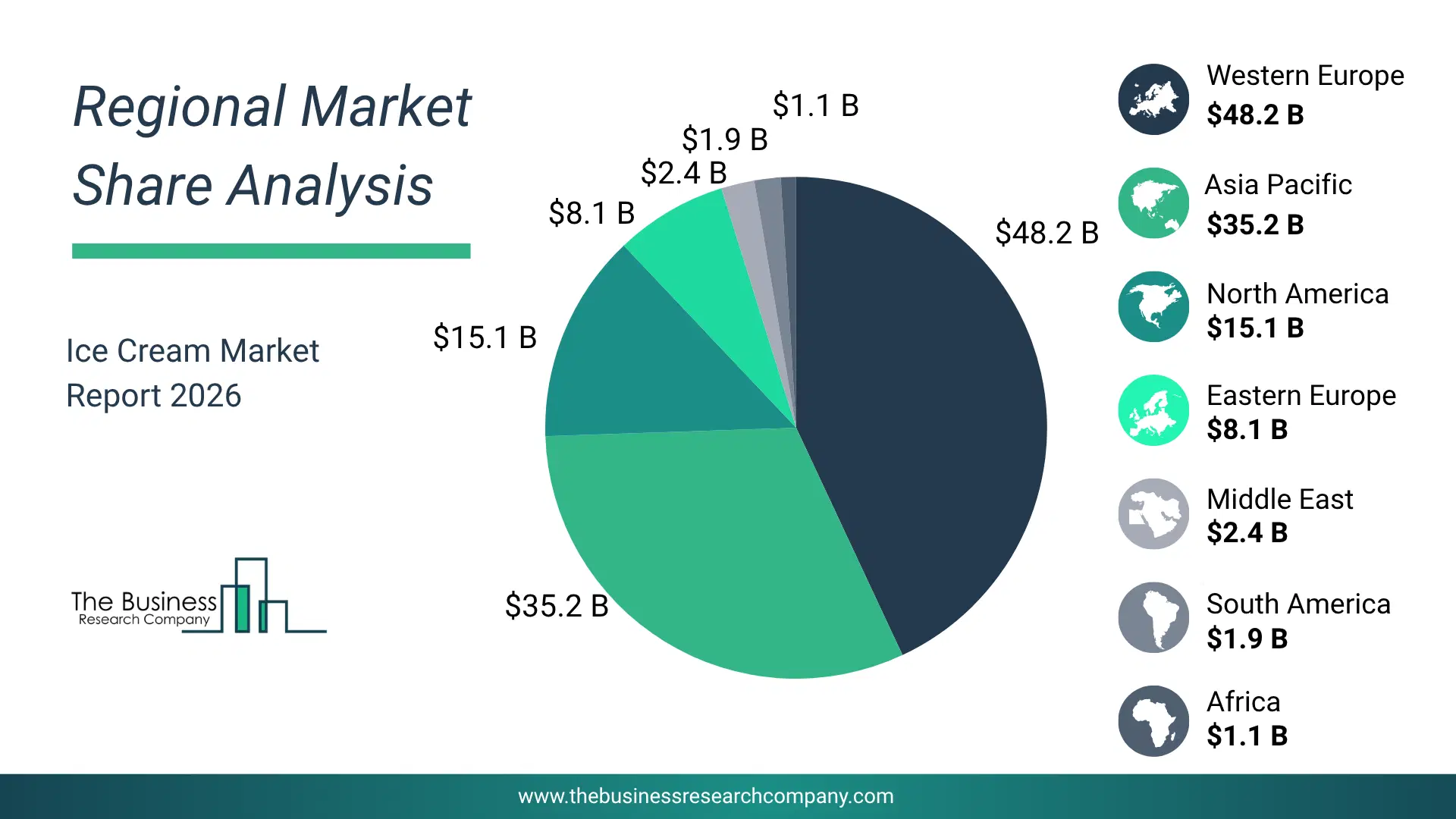
Regional Outlook
Asia-Pacific was the largest region in the ice cream market in 2025. Asia-pacific is expected to be the fastest-growing region in the ice cream market report during the forecast period. The regions covered in this market report are Asia-Pacific, South East Asia, Western Europe, Eastern Europe, North America, South America, Middle East and Africa. The countries covered in this market report are Australia, Brazil, China, France, Germany, India, Indonesia, Japan, Taiwan, Russia, South Korea, UK, USA, Italy, Spain, CanadaWhat Defines the Ice Cream Market?
The ice cream market consists of sales of gelato, frozen yogurt, sorbet, soft serve, mochi, sherbert, rolled ice cream. Values in this market are ‘factory gate’ values, that is the value of goods sold by the manufacturers or creators of the goods, whether to other entities (including downstream manufacturers, wholesalers, distributors, and retailers) or directly to end customers. The value of goods in this market includes related services sold by the creators of the goods.How is Market Value Defined and Measured?
The market value is defined as the revenues that enterprises gain from the sale of goods and/or services within the specified market and geography through sales, grants, or donations in terms of the currency (in USD unless otherwise specified). The revenues for a specified geography are consumption values that are revenues generated by organizations in the specified geography within the market, irrespective of where they are produced. It does not include revenues from resales along the supply chain, either further along the supply chain or as part of other products.
This chart presents market attractiveness based on a quantitative evaluation of growth, competition, strategic alignment, and risk, offering a clear view of opportunity areas for decision-making. This chart is for illustrative purposes; the full report contains the complete analysis.

This chart highlights the Total Addressable Market (TAM) by estimating the maximum revenue opportunity using an assumption-driven approach, supporting strategic planning and opportunity sizing across markets. The chart is illustrative; the full report provides a more comprehensive analysis.
What Key Data and Analysis Are Included in the Ice Cream Market Report 2026?
The ice cream market research report is one of a series of new reports from The Business Research Company that provides market statistics, including industry global market size, regional shares, competitors with the market share, detailed market segments, market trends and opportunities, and any further data you may need to thrive in the ice cream industry. The market research report delivers a complete perspective of everything you need, with an in-depth analysis of the current and future state of the industry.Ice Cream Market Report Forecast Analysis
| Report Attribute | Details |
|---|---|
| Market Size Value In 2026 | $46.29 billion |
| Revenue Forecast In 2030 | $59.13 billion |
| Growth Rate | CAGR of 5.5% from 2026 to 2030 |
| Base Year For Estimation | 2025 |
| Actual Estimates/Historical Data | 2020-2025 |
| Forecast Period | 2026 - 2030 |
| Market Representation | Revenue in USD Billion and CAGR from 2026 to 2030 |
| Segments Covered | Type, Flavor, Packaging, Category, Distribution Channels |
| Regional Scope | Asia-Pacific, Western Europe, Eastern Europe, North America, South America, Middle East, Africa |
| Country Scope | The countries covered in the report are Australia, Brazil, China, France, Germany, India, Indonesia, Japan, Taiwan, Russia, South Korea, UK, USA, Canada, Italy, Spain. |
| Key Companies Profiled | Nestle S.A., Unilever Group Plc, General Mills Inc., Blue Bell Creameries LP, Cold Stone Creamery Inc., American Dairy Queen Corporation, Lotte Confectionery Co Ltd, Inspire Brands Inc., Turkey Hill Dairy LP, Wells Enterprises Inc., NadaMoo! R&D Room LLC, Mars Inc., Inner Mongolia Yili Industrial Group Co Ltd, Froneri International Limited, Tillamook CCA, Amul, Amy's Ice Creams, Agropur Dairy Cooperative, Arla Foods AMBA, Chapman's, Prairie Farms Dairy Inc., Giffords Dairy Inc., Van Leeuwen Ice Cream, Adirondack Creamery Inc., Yasso Inc., Graeter's Ice Cream, Jeni's Splendid Ice Creams, Humphry Slocombe, Coolhaus, Ben & Jerry's Homemade Holdings Inc., Häagen-Dazs, Baskin Robbins |
| Customization Scope | Request for Customization |
| Pricing And Purchase Options | Explore Purchase Options |