
Industrial Water Treatment Chemicals Market Report 2026
Global Outlook – By Product (Antifoams, Oxygen Scavengers, Corrosion Inhibitors, Biocides and Disinfectants, Oxidants, PH Conditioners, Sludge Conditioners, Scale Inhibitors, Other Products), By Application (Raw Water Treatment, Cooling and Boilers, Effluent Water Treatment and Water Desalination), By End User (Oil and Gas, Power, Metal and Mining, Chemical, Other End Users) – Market Size, Trends, Strategies, and Forecast to 2030
Industrial Water Treatment Chemicals Market Overview
• Industrial Water Treatment Chemicals market size has reached to $33.69 billion in 2025 • Expected to grow to $41.17 billion in 2030 at a compound annual growth rate (CAGR) of 3.8% • Growth Driver: Industrialization And Automotive Sector Expansion Fuel Growth In The Industrial Water Treatment Chemicals Market • Market Trend: Gradient Launches Innovative CURE Chemicals To Revolutionize Water Treatment For Industrial Applications • Asia-Pacific was the largest region and fastest growing region.What Is Covered Under Industrial Water Treatment Chemicals Market?
Industrial water treatment chemicals such as coagulants, flocculants, and PH adjustment chemicals are used in wastewater treatment to adjust pH, begin coagulating solids in the wastewater, and remove bacteria before the wastewater is delivered to a clean or portable water supply for consumption. Industrial water treatment chemicals are segmented by product into antifoams, oxygen scavengers, corrosion inhibitors, biocides and disinfectants, oxidants, PH conditioners, sludge conditioners, scale inhibitors, and others. Antifoams are used in the application of microbiological fermentation techniques. Antifoams are also used by wiping on filling nozzles on a screen suspended above the foaming system rims of processing vats. The various end users are oil and gas, power, metal and mining, and chemicals. These are used in various applications such as raw water treatment, cooling and boilers, effluent water treatment, and water desalination.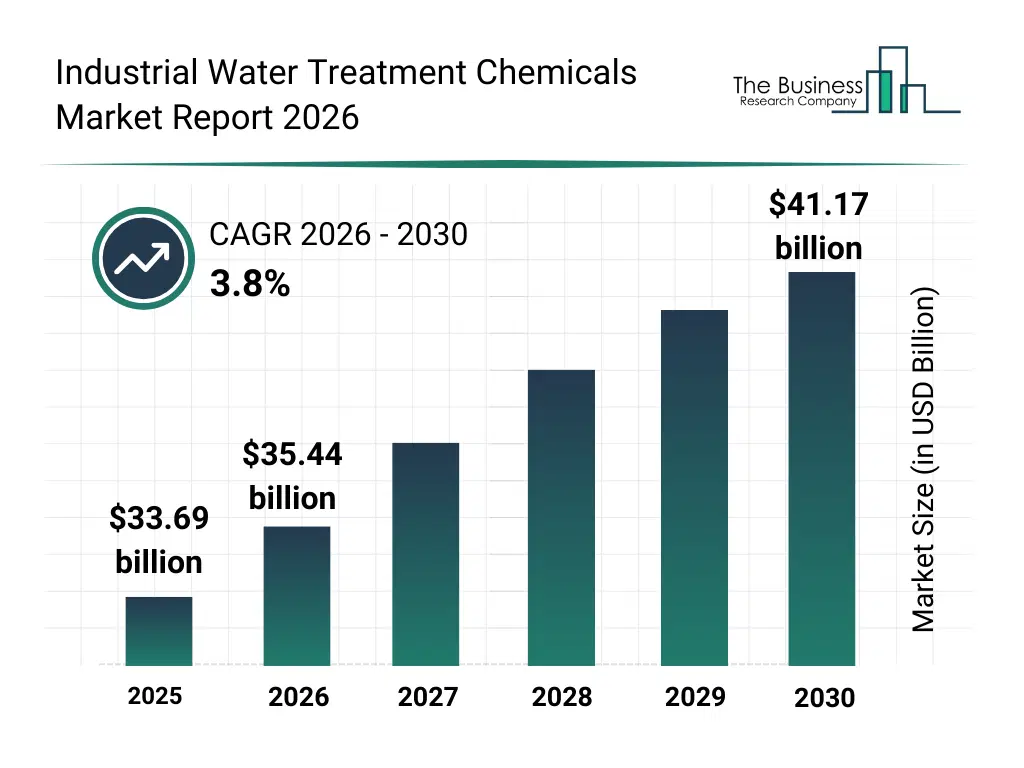
What Is The Industrial Water Treatment Chemicals Market Size and Share 2026?
The industrial water treatment chemicals market size has grown strongly in recent years. It will grow from $33.69 billion in 2025 to $35.44 billion in 2026 at a compound annual growth rate (CAGR) of 5.2%. The growth in the historic period can be attributed to expansion of industrial water usage, tightening wastewater discharge regulations, growth of power and oil and gas industries, increasing demand for cooling water treatment, availability of chemical treatment formulations.What Is The Industrial Water Treatment Chemicals Market Growth Forecast?
The industrial water treatment chemicals market size is expected to see steady growth in the next few years. It will grow to $41.17 billion in 2030 at a compound annual growth rate (CAGR) of 3.8%. The growth in the forecast period can be attributed to increasing water scarcity concerns, rising investments in industrial water recycling, expansion of desalination projects, growing adoption of digital water monitoring systems, increasing regulatory pressure on effluent quality. Major trends in the forecast period include increasing demand for advanced wastewater treatment solutions, rising use of specialty treatment chemicals, expansion of industrial effluent management systems, growing adoption of zero liquid discharge practices, enhanced focus on water reuse and recycling.
Global Industrial Water Treatment Chemicals Market Segmentation
1) By Product: Antifoams, Oxygen Scavengers, Corrosion Inhibitors, Biocides and Disinfectants, Oxidants, PH Conditioners, Sludge Conditioners, Scale Inhibitors, Other Products 2) By Application: Raw Water Treatment, Cooling and Boilers, Effluent Water Treatment and Water Desalination 3) By End User: Oil and Gas, Power, Metal and Mining, Chemical, Other End Users Subsegments: 1) By Antifoams: Silicone-based Antifoams, Non-silicone Antifoams 2) By Oxygen Scavengers: Liquid Oxygen Scavengers, Solid Oxygen Scavengers 3) By Corrosion Inhibitors: Organic Corrosion Inhibitors, Inorganic Corrosion Inhibitors 4) By Biocides and Disinfectants: Chlorine-based Biocides, Non-chlorine Biocides 5) By Oxidants: Hydrogen Peroxide, Ozone 6) By pH Conditioners: pH Reducers, pH Boosters 7) By Sludge Conditioners: Polymer-based Conditioners 8) By Chemical Additives: Scale Inhibitors 9) By Scale Inhibitors: Phosphate-based Scale Inhibitors, Non-phosphate Scale Inhibitors, 10) By Other Products: Flocculants, Defoamers.What Is The Driver Of The Industrial Water Treatment Chemicals Market?
Growth in industrialization and an expanding automotive sector are expected to propel the growth of the industrial water treatment chemicals market going forward. Industrialization refers to the development of industries on a wide scale, which significantly increases the demand for clean and treated water in manufacturing processes. The automotive sector, encompassing the production of cars, trucks, and other vehicles, also relies heavily on treated water for processes such as cooling, painting, and metal finishing. Growth in industrialization is particularly strong in emerging economies such as China and India, while the automotive sector continues to expand globally. For instance, in July 2025, according to Eurostat, a Luxembourg-based statistical office of the European Union, in May 2025, industrial production rose by 3.7% in the euro area and by 3.4% across the European Union (EU) compared with May 2024. Therefore, growth in industrialization and an expanding automotive sector are driving the growth of the industrial water treatment chemicals industry.Key Players In The Global Industrial Water Treatment Chemicals Market
Major companies operating in the industrial water treatment chemicals market are BWA Water Additives UK Ltd., Dow Chemical Company, Ecolab Inc., Ashland Water Technologies, Kemira Oyj, Solenis LLC, Suez S.A, BASF SE, DuPont de Nemours Inc., Lonza Group Ltd., Buckman Laboratories International Inc., Snf Pvt. Ltd., The Lubrizol Corporation, Chemtrade Co. Ltd., Solvay SA, Advanced Water Solutions, Kurita Water Industries Ltd., Shandong Taihe Water Treatment Technology Co. Ltd., Henan Qingshuiyuan Technology Co. Ltd., Feralco Deutschland GmbH, Aditya Birla Chemicals Ltd., Veolia Environnement SA, Danaher Corporation, Xylem Water Solutions India Private Limited, United Utilities Group plc, Evoqua Water Technologies Corp., Aquatech Water Treatment Products and Services Ltd., Aqseptence Group Pvt. Ltd., Ovivo Inc., Chemifloc Ltd., Lenntech B.V., Nouryon Chemicals Co. Ltd., USALCO LLC, WesTech Co. Ltd.
This chart is for illustrative purposes; the full report includes a detailed competitor analysis and comprehensive overview of the top 10 companies in the market.
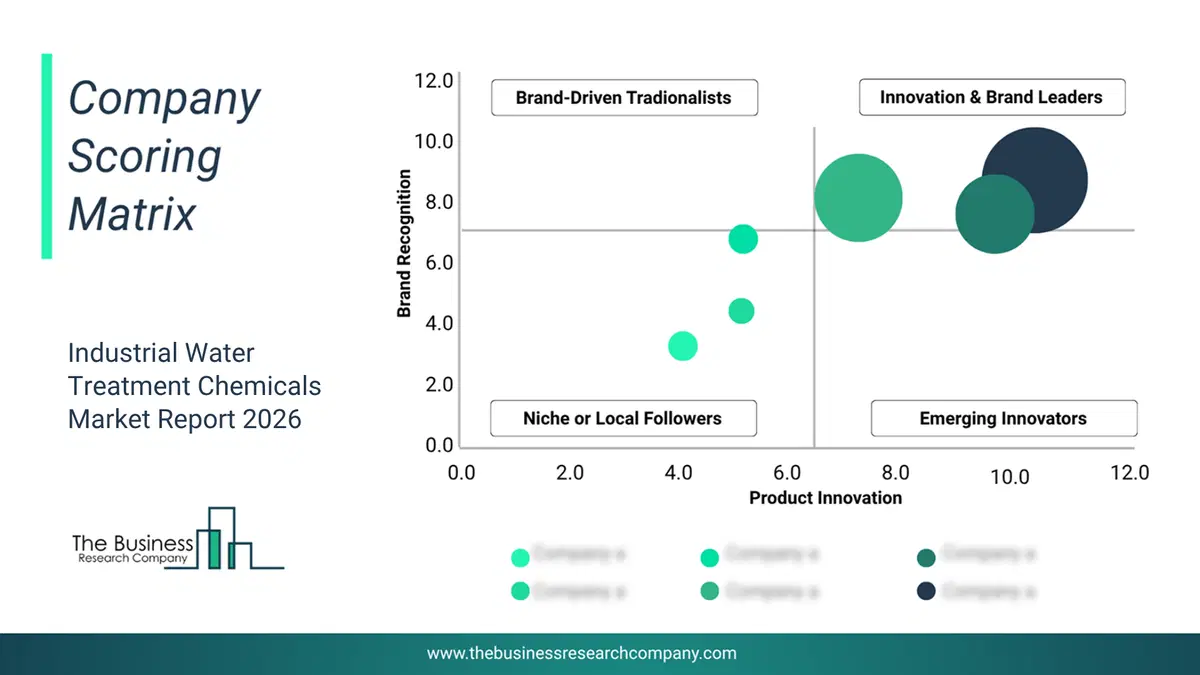
This chart maps companies by product innovation and brand strength, with bubble size indicating relative revenue, helping identify market leaders, challengers, and niche players. This is an illustrative chart; the full report provides a complete and accurate competitive analysis.
Global Industrial Water Treatment Chemicals Market Trends and Insights
Major companies operating in the industrial water treatment chemicals market are innovating advanced products, such as CURE Chemicals, to enhance the efficiency, sustainability, and effectiveness of water treatment processes across various industries. For instance, in April 2024, Gradient, a US-based company that provides water treatment technology launched CURE Chemicals. CURE Chemicals CURE Chemicals is a product aimed at enhancing water treatment solutions for essential industries. Developed through cutting-edge research and operational feedback, CURE Chemicals are engineered to optimize water quality, ensuring it meets the stringent demands of downstream processes or potable applications. The CURE Chemicals line includes over 300 proprietary formulations, encompassing corrosion and scale inhibitors, process chemicals, biocides, and antiscalants.What Are Latest Mergers And Acquisitions In The Industrial Water Treatment Chemicals Market?
In September 2024, Rochester Midland Corporation, a US-based chemical manufacturer acquired Norkem Group for an undisclosed amount. With this acquisition, Rochester Midland's aims to strengthen its position in the water treatment industry, accelerate growth and enhance service coverage for customers. Norkem Group is a Canada-based provider of water treatment chemicals for industries.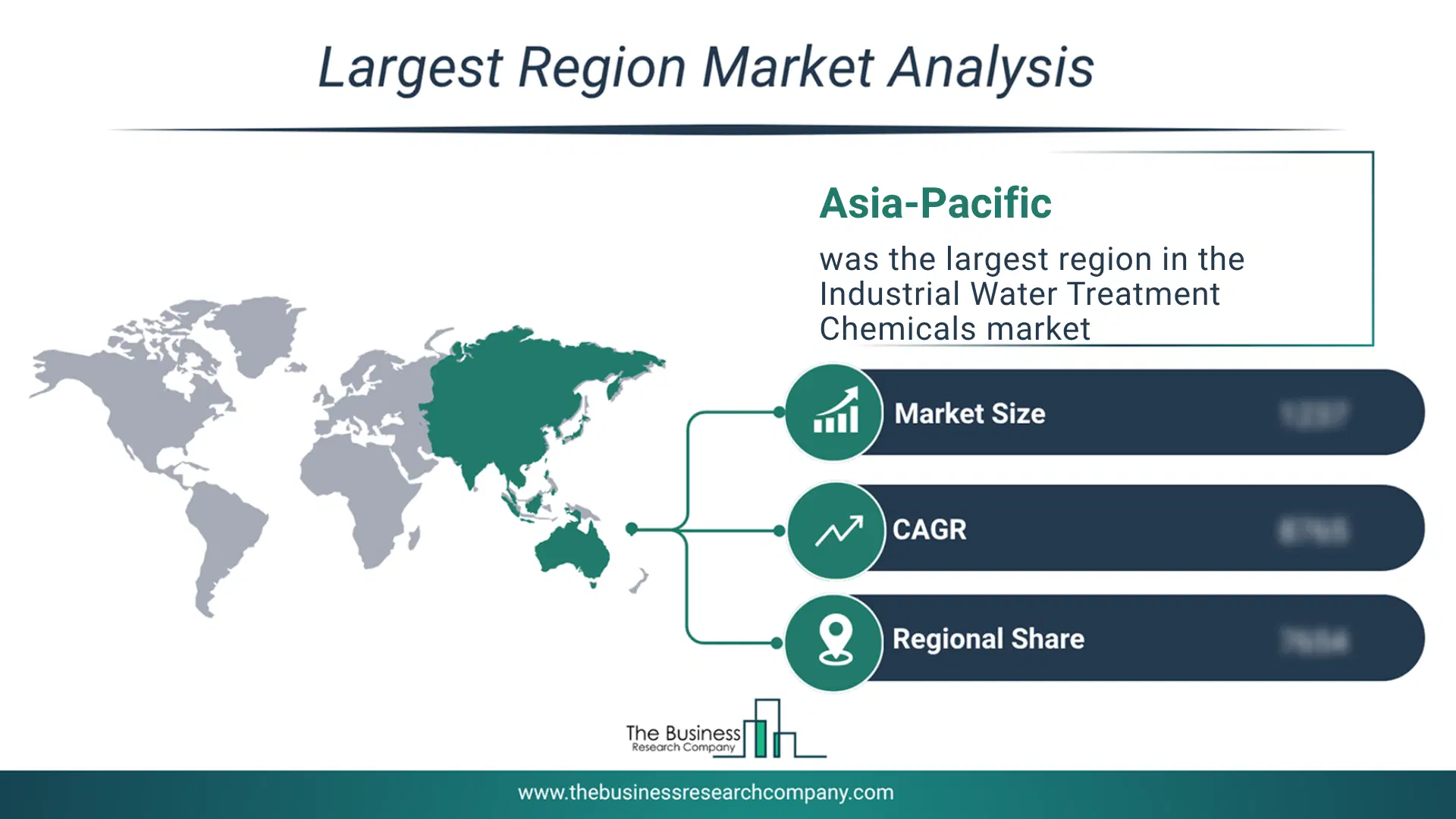
Regional Insights
Asia-Pacific was the largest region in the industrial water treatment chemicals market in 2025. Asia-Pacific is expected to be the fastest-growing region in the forecast period. The regions covered in this market report are Asia-Pacific, South East Asia, Western Europe, Eastern Europe, North America, South America, Middle East, Africa The countries covered in this market report are Australia, Brazil, China, France, Germany, India, Indonesia, Japan, Taiwan, Russia, South Korea, UK, USA, Canada, Italy, SpainWhat Defines the Industrial Water Treatment Chemicals Market?
The industrial water treatment chemicals market consists of sales of industrial water treatment chemical products such as algaecides and defoamers. Values in this market are ‘factory gate’ values, that is, the value of goods sold by the manufacturers or creators of the goods, whether to other entities (including downstream manufacturers, wholesalers, distributors, and retailers) or directly to end customers. The value of goods in this market includes related services sold by the creators of the goods.How is Market Value Defined and Measured?
The market value is defined as the revenues that enterprises gain from the sale of goods and/or services within the specified market and geography through sales, grants, or donations in terms of the currency (in USD unless otherwise specified). The revenues for a specified geography are consumption values that are revenues generated by organizations in the specified geography within the market, irrespective of where they are produced. It does not include revenues from resales along the supply chain, either further along the supply chain or as part of other products.
This chart presents market attractiveness based on a quantitative evaluation of growth, competition, strategic alignment, and risk, offering a clear view of opportunity areas for decision-making. This chart is for illustrative purposes; the full report contains the complete analysis.

This chart highlights the Total Addressable Market (TAM) by estimating the maximum revenue opportunity using an assumption-driven approach, supporting strategic planning and opportunity sizing across markets. The chart is illustrative; the full report provides a more comprehensive analysis.
What Key Data and Analysis Are Included in the Industrial Water Treatment Chemicals Market Report 2026?
The industrial water treatment chemicals market research report is one of a series of new reports from The Business Research Company that provides market statistics, including industry global market size, regional shares, competitors with the market share, detailed market segments, market trends and opportunities, and any further data you may need to thrive in the industrial water treatment chemicals industry. The market research report delivers a complete perspective of everything you need, with an in-depth analysis of the current and future state of the industry.Industrial Water Treatment Chemicals Market Report Forecast Analysis
| Report Attribute | Details |
|---|---|
| Market Size Value In 2026 | $35.44 billion |
| Revenue Forecast In 2030 | $41.17 billion |
| Growth Rate | CAGR of 5.2% from 2026 to 2030 |
| Base Year For Estimation | 2025 |
| Actual Estimates/Historical Data | 2020-2025 |
| Forecast Period | 2026 - 2030 |
| Market Representation | Revenue in USD Billion and CAGR from 2026 to 2030 |
| Segments Covered | Product, Application, End User |
| Regional Scope | Asia-Pacific, Western Europe, Eastern Europe, North America, South America, Middle East, Africa |
| Country Scope | The countries covered in this market report are Australia, Brazil, China, France, Germany, India, Indonesia, Japan, Taiwan, Russia, South Korea, UK, USA, Canada, Italy, Spain |
| Key Companies Profiled | BWA Water Additives UK Ltd., Dow Chemical Company, Ecolab Inc., Ashland Water Technologies, Kemira Oyj, Solenis LLC, Suez S.A, BASF SE, DuPont de Nemours Inc., Lonza Group Ltd., Buckman Laboratories International Inc., Snf Pvt. Ltd., The Lubrizol Corporation, Chemtrade Co. Ltd., Solvay SA, Advanced Water Solutions, Kurita Water Industries Ltd., Shandong Taihe Water Treatment Technology Co. Ltd., Henan Qingshuiyuan Technology Co. Ltd., Feralco Deutschland GmbH, Aditya Birla Chemicals Ltd., Veolia Environnement SA, Danaher Corporation, Xylem Water Solutions India Private Limited, United Utilities Group plc, Evoqua Water Technologies Corp., Aquatech Water Treatment Products and Services Ltd., Aqseptence Group Pvt. Ltd., Ovivo Inc., Chemifloc Ltd., Lenntech B.V., Nouryon Chemicals Co. Ltd., USALCO LLC, WesTech Co. Ltd. |
| Customization Scope | Request for Customization |
| Pricing And Purchase Options | Explore Purchase Options |