
Insect Growth Regulator Market Report 2026
Global Outlook – By Type (Chitin Synthesis Inhibitors, Juvenile Hormone Analogs And Mimics, Anti-Juvenile Hormone Agents), By Foam (Bait, Liquid, Aerosols), By Application (Agricultural, Livestock Pests, Commercial Pest Control) – Market Size, Trends, Strategies, and Forecast to 2030
Insect Growth Regulator Market Overview
• Insect Growth Regulator market size has reached to $1.06 billion in 2025 • Expected to grow to $1.55 billion in 2030 at a compound annual growth rate (CAGR) of 7.8% • Growth Driver: Environment-Friendly Solutions Fuel The Insect Growth Regulators Market • Market Trend: Modern Innovations Powering The Insect Growth Regulators Market • Asia-Pacific was the largest region in 2025 and Asia-Pacific is the fastest growing region.What Is Covered Under Insect Growth Regulator Market?
Insect growth regulators refer to a pesticide that imitates the hormones that young insects produce. They interfere with an insect's ability to grow, develop, or undergo metamorphosis. They also affect how insects reproduce. These are basically a pesticide that prevents insects from growing and maturing normally instead than killing them instantly like conventional insecticides do. The main types of insect growth regulators are chitin synthesis inhibitors, juvenile hormone analogs and mimics, and anti-juvenile hormone agents. Chitin synthesis inhibitors are chemically varied composites by inhibiting the process of chitin and the formation of an exoskeleton. Chitin synthesis inhibitors are used to regulate the development of fungal species and are widely used to mimic fleas that host on cattle and pets. These insect growth regulators (IGR) are based on foam types such as bait, liquid, and aerosols. These products are applied in agriculture, livestock pests, and commercial pest control.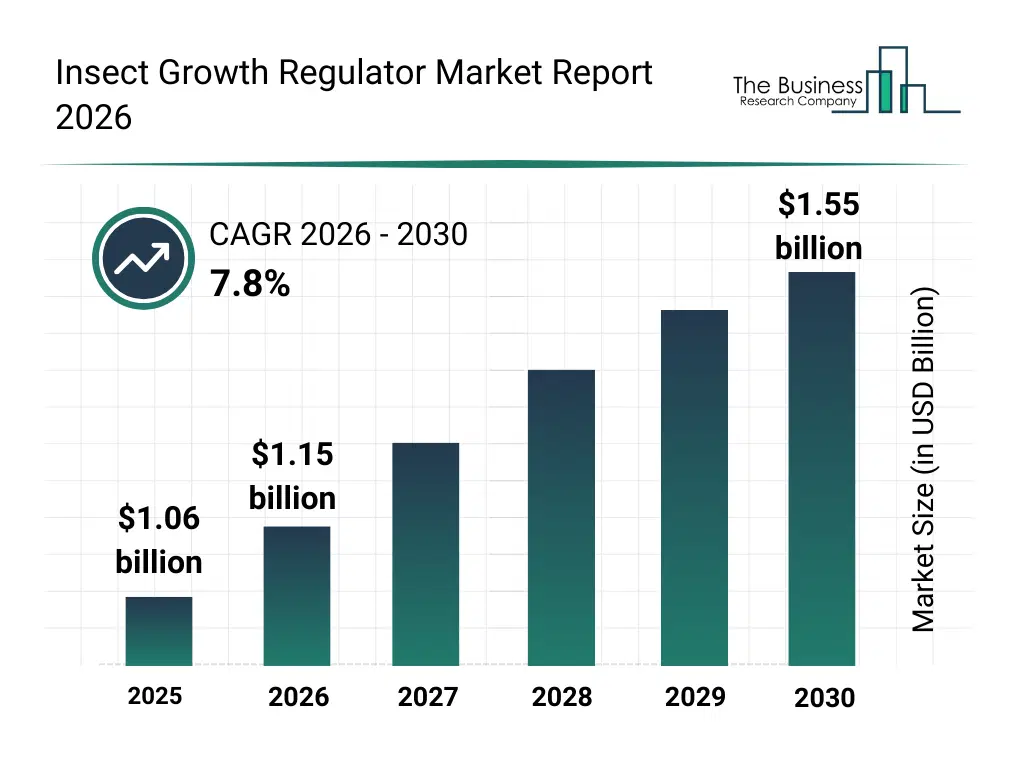
What Is The Insect Growth Regulator Market Size and Share 2026?
The insect growth regulator market size has grown strongly in recent years. It will grow from $1.06 billion in 2025 to $1.15 billion in 2026 at a compound annual growth rate (CAGR) of 8.3%. The growth in the historic period can be attributed to early adoption of selective pest control solutions, rising concern over toxic chemical pesticides, growth in agricultural pest infestations, increased regulatory restrictions on conventional insecticides, expansion of integrated pest management practices.What Is The Insect Growth Regulator Market Growth Forecast?
The insect growth regulator market size is expected to see strong growth in the next few years. It will grow to $1.55 billion in 2030 at a compound annual growth rate (CAGR) of 7.8%. The growth in the forecast period can be attributed to advancement in igr formulation technologies, rising demand for residue-free agricultural produce, expansion of commercial pest control services, increasing livestock production requiring safer pest treatments, growing government support for sustainable pest management. Major trends in the forecast period include growing demand for safer pest control alternatives, increased adoption of targeted insect development disruption products, rising use of igrs in livestock pest management, expansion of igr-based solutions in commercial pest control, development of new formulations such as baits and aerosols.
Global Insect Growth Regulator Market Segmentation
1) By Type: Chitin Synthesis Inhibitors, Juvenile Hormone Analogs And Mimics, Anti-Juvenile Hormone Agents 2) By Foam: Bait, Liquid, Aerosols 3) By Application: Agricultural, Livestock Pests, Commercial Pest Control Subsegments: 1) By Chitin Synthesis Inhibitors: Benzoylureas, Morpholine Derivatives 2) By Juvenile Hormone Analogs And Mimics: Methoprene, Pyriproxyfen 3) By Anti-Juvenile Hormone Agents: Hydroprene, FenoxycarbWhat Is Driver Of The Insect Growth Regulator Market?
The growing usage of environment-friendly pesticides is significantly contributing to the growth of the insect growth regulators market. Pesticides are chemical elements that are supposed to kill pests such as a virus, bacterium, antimicrobial, or disinfectant that deters, incapacitates, and kills, pests. Environment-friendly crop protection products are being used in organic farming which rapidly degrades and has a minimal environmental impact as these products are derived from natural sources. In addition, it also minimizes the potential risk of chronic poisoning caused by chemical insecticides among its applicants. For instance, in September 2024, according to a US-based US Home & Garden Pesticides company, pesticide sales are projected to grow at 2.8% annually, reaching $3.2 billion by 2028, following several years of volatility due to COVID-driven spikes in gardening activity. Therefore, increasing demand for the growing usage of environment friendly pesticides contributes to the growth of the insect growth regulators industry.Key Players In The Global Insect Growth Regulator Market
Major companies operating in the insect growth regulator market are Bayer AG, Syngenta AG, Sumitomo Chemical Co., Ltd., Adama Agricultural Solutions Ltd., Nufarm Limited, HELM Agro US, Inc., Russell IPM Ltd., Valent U.S.A. Corporation, McLaughlin Gormley King Company, Dow AgroSciences (Dow Inc.), BASF SE, Control Solutions, Inc., Central Life Sciences LLC, Central Garden & Pet Company, UPL Limited, Pi Industries, Sipcam Agro USA, Inc., Crystal Crop Protection Pvt. Ltd., FMC Corporation, Isagro S.p.A., Nisso Chemical Co., Ltd., Nichino Europe Co., Ltd., Arysta LifeScience (now part of UPL), Dhanuka Agritech Ltd., United Phosphorus Limited (UPL)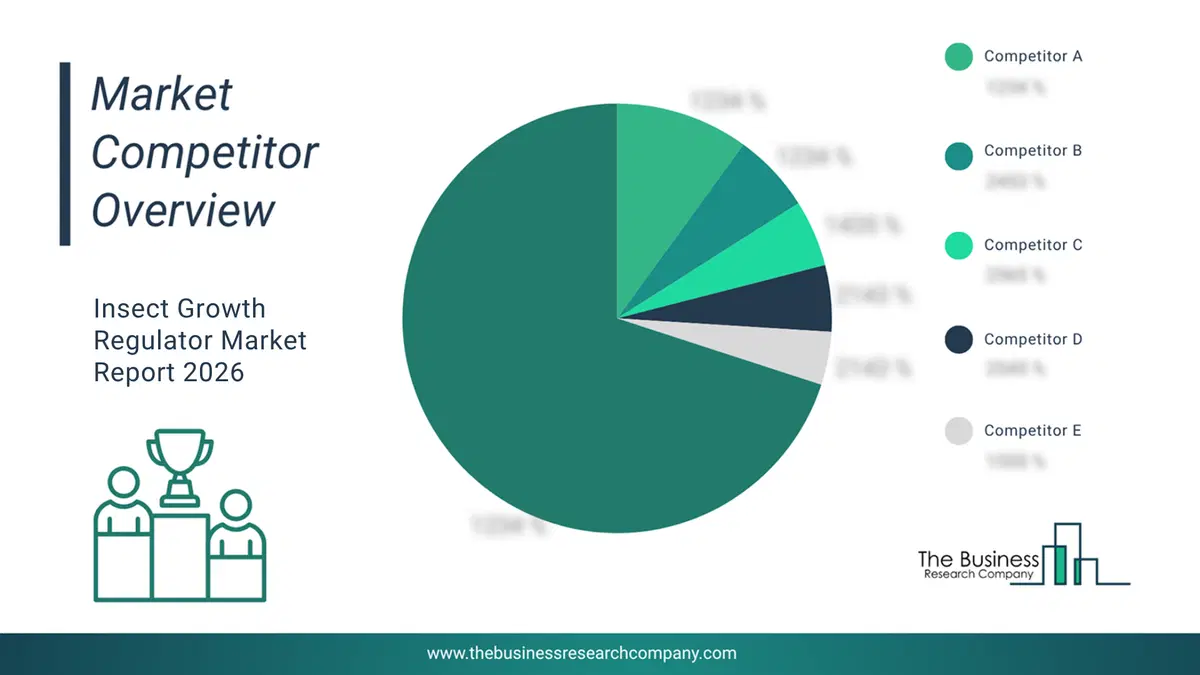
This chart is for illustrative purposes; the full report includes a detailed competitor analysis and comprehensive overview of the top 10 companies in the market.
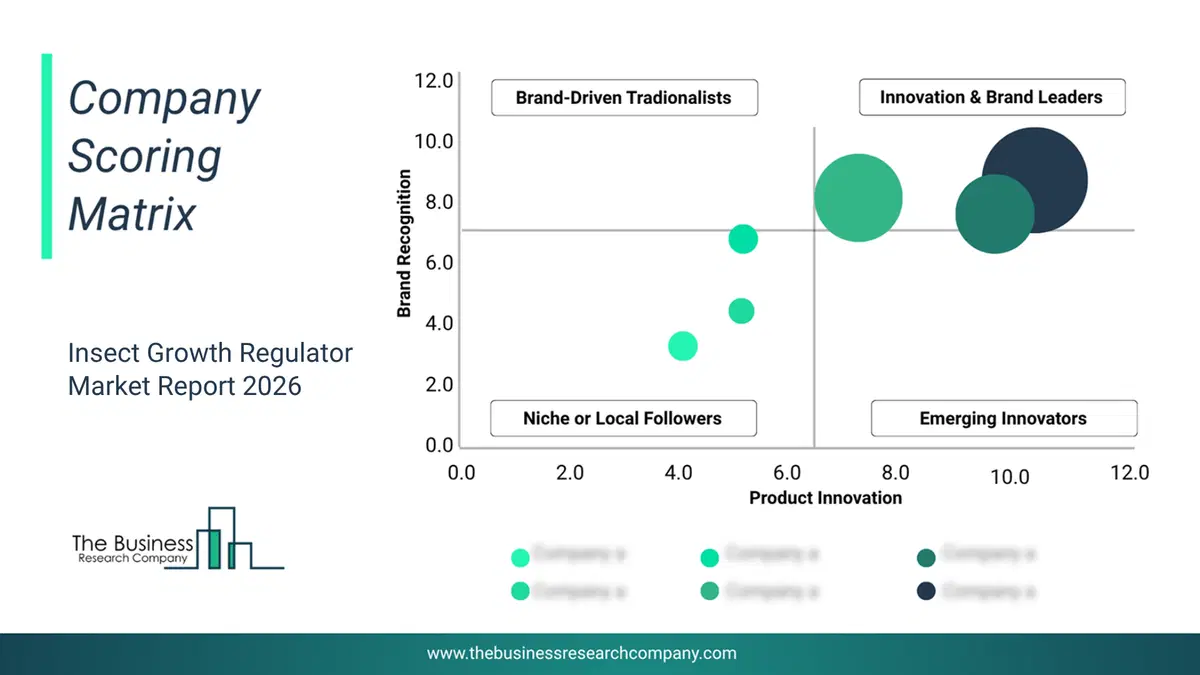
This chart maps companies by product innovation and brand strength, with bubble size indicating relative revenue, helping identify market leaders, challengers, and niche players. This is an illustrative chart; the full report provides a complete and accurate competitive analysis.
Global Insect Growth Regulator Market Trends and Insights
Major companies operating in the insect growth regulator market are focusing on technological advancements such as developing advanced insecticides to gain a competitive edge. For instance, in April 2024, Bayer, a German-based pharmaceutics company, launched its first biological insecticide for arable crops, having secured an exclusive license from UK-based AlphaBio Control. Targeted for an initial launch in 2028, this innovative product will specifically address pests like the cabbage stem flea beetle, which poses significant threats to crops such as oilseed rape and cereals. The new bioinsecticide is designed to align with Bayer's commitment to sustainable agriculture, offering farmers a solution that reduces environmental impact while maintaining crop health.What Are Latest Mergers And Acquisitions In The Insect Growth Regulator Market? Envu (Environmental Science) Definitive agreement to acquire In2Care
In October 2024, Envu, a US-based environmental science company, acquired In2Care for an undisclosed amount. With this acquisition, Envu aims to diversify its mosquito management portfolio by incorporating In2Care’s patented InsecTech technology, enhancing Envu’s product offerings for nuisance mosquito control and vector-borne disease prevention globally. In2Care is a Netherlands-based technology company specializing in the development and commercialization of novel mosquito control products, including a patented static-charged coating technology applied on netting to deliver lethal doses of biocide powders to mosquitoes, currently deployed in professional mosquito stations in multiple countries.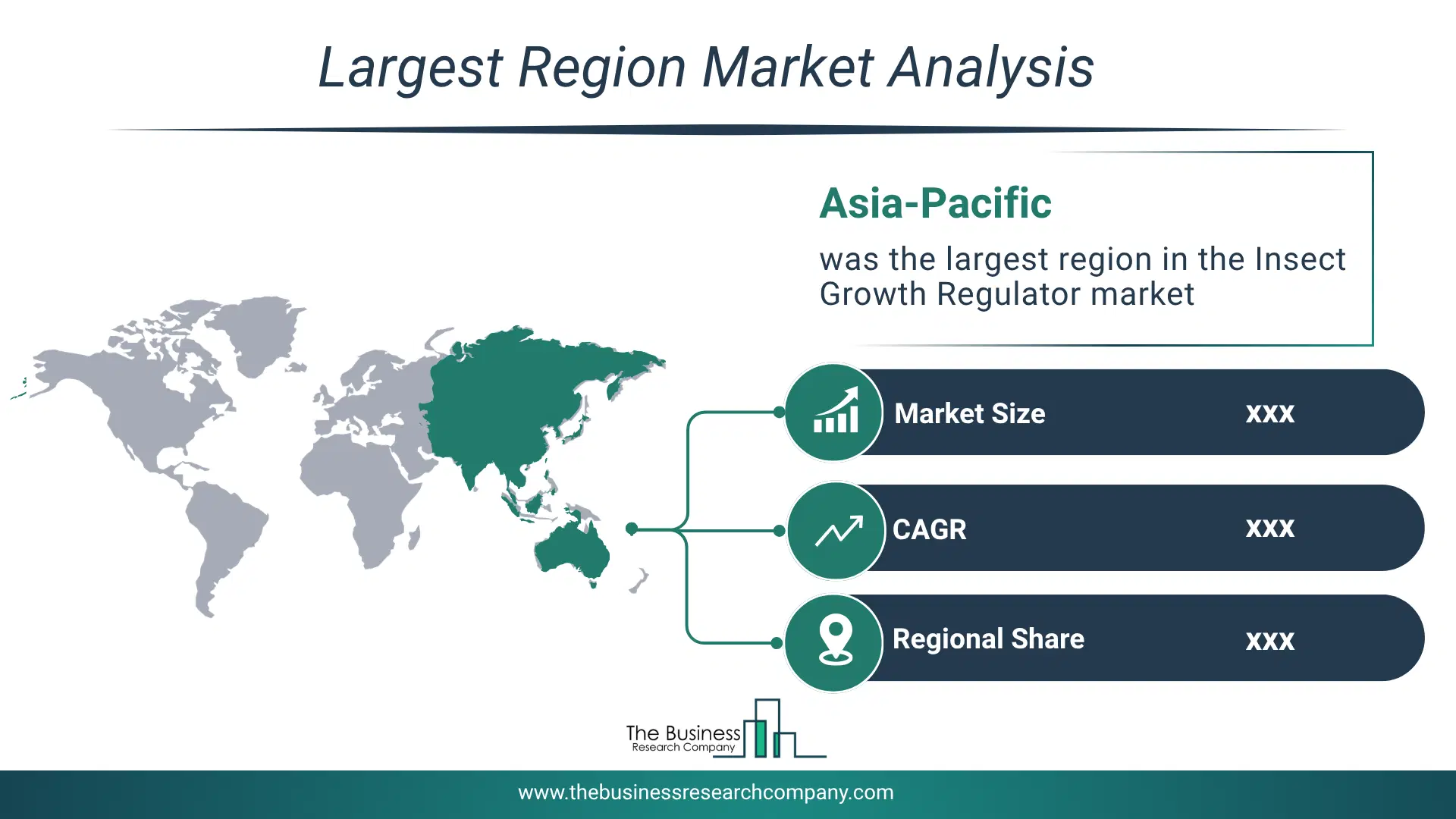
Regional Outlook
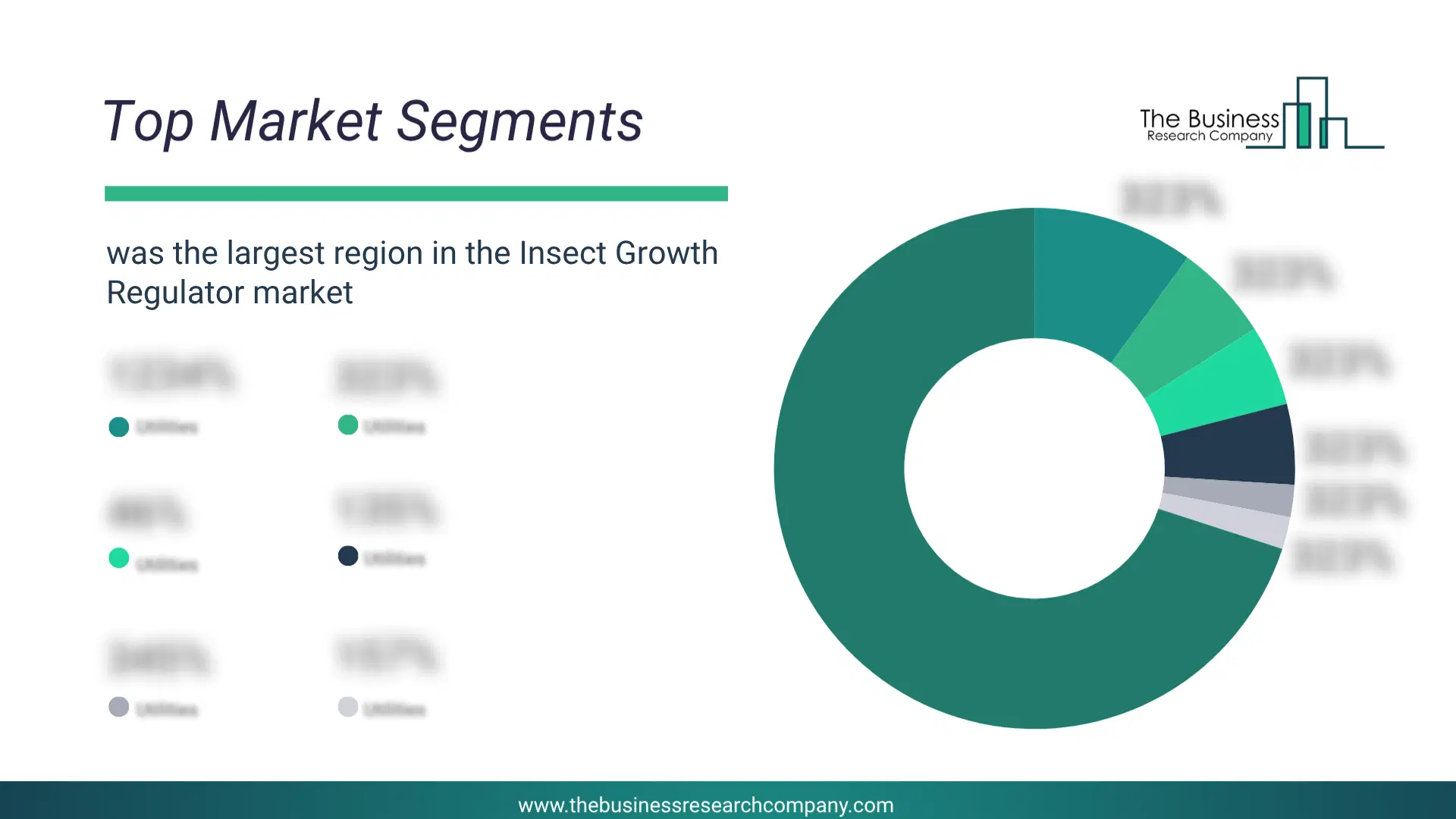
Asia-Pacific was the largest region in the regulator market in 2025 and is also expected to be the fastest-growing region in the forecast period. The regions covered in this market report are Asia-Pacific, South East Asia, Western Europe, Eastern Europe, North America, South America, Middle East, Africa. The countries covered in this market report are Australia, Brazil, China, France, Germany, India, Indonesia, Japan, Taiwan, Russia, South Korea, UK, USA, Canada, Italy, SpainWhat Defines the Insect Growth Regulator Market?
The insect growth regulators market consists of sales ebufenozide, methoxyfenozide, halofenozide, and chromafenozide. Values in this market are ‘factory gate’ values, that is the value of goods sold by the manufacturers or creators of the goods, whether to other entities (including downstream manufacturers, wholesalers, distributors and retailers) or directly to end customers. The value of goods in this market includes related services sold by the creators of the goods.How is Market Value Defined and Measured?
The market value is defined as the revenues that enterprises gain from the sale of goods and/or services within the specified market and geography through sales, grants, or donations in terms of the currency (in USD unless otherwise specified). The revenues for a specified geography are consumption values that are revenues generated by organizations in the specified geography within the market, irrespective of where they are produced. It does not include revenues from resales along the supply chain, either further along the supply chain or as part of other products.
This chart presents market attractiveness based on a quantitative evaluation of growth, competition, strategic alignment, and risk, offering a clear view of opportunity areas for decision-making. This chart is for illustrative purposes; the full report contains the complete analysis.

This chart highlights the Total Addressable Market (TAM) by estimating the maximum revenue opportunity using an assumption-driven approach, supporting strategic planning and opportunity sizing across markets. The chart is illustrative; the full report provides a more comprehensive analysis.
What Key Data and Analysis Are Included in the Insect Growth Regulator Market Report 2026?
The insect growth regulator market research report is one of a series of new reports from The Business Research Company that provides market statistics, including industry global market size, regional shares, competitors with the market share, detailed market segments, market trends and opportunities, and any further data you may need to thrive in the insect growth regulator industry. The market research report delivers a complete perspective of everything you need, with an in-depth analysis of the current and future state of the industry.Insect Growth Regulator Market Report Forecast Analysis
| Report Attribute | Details |
|---|---|
| Market Size Value In 2026 | $1.15 billion |
| Revenue Forecast In 2030 | $1.55 billion |
| Growth Rate | CAGR of 7.8% from 2026 to 2030 |
| Base Year For Estimation | 2025 |
| Actual Estimates/Historical Data | 2020-2025 |
| Forecast Period | 2026 - 2030 |
| Market Representation | Revenue in USD Billion and CAGR from 2026 to 2030 |
| Segments Covered | Type, Foam, Application |
| Regional Scope | Asia-Pacific, Western Europe, Eastern Europe, North America, South America, Middle East, Africa |
| Country Scope | The countries covered in the report are Australia, Brazil, China, France, Germany, India, Indonesia, Japan, Taiwan, Russia, South Korea, UK, USA, Canada, Italy, Spain |
| Key Companies Profiled | Bayer AG, Syngenta AG, Sumitomo Chemical Co., Ltd., Adama Agricultural Solutions Ltd., Nufarm Limited, HELM Agro US, Inc., Russell IPM Ltd., Valent U.S.A. Corporation, McLaughlin Gormley King Company, Dow AgroSciences (Dow Inc.), BASF SE, Control Solutions, Inc., Central Life Sciences LLC, Central Garden & Pet Company, UPL Limited, Pi Industries, Sipcam Agro USA, Inc., Crystal Crop Protection Pvt. Ltd., FMC Corporation, Isagro S.p.A., Nisso Chemical Co., Ltd., Nichino Europe Co., Ltd., Arysta LifeScience (now part of UPL), Dhanuka Agritech Ltd., United Phosphorus Limited (UPL) |
| Customization Scope | Request for Customization |
| Pricing And Purchase Options | Explore Purchase Options |