
Intracranial Hematoma Drug Market Report 2026
Global Outlook – By Drug Class (Hemostatic Agents, Antihypertensive Agents, Osmotic Agents, Anticonvulsants, Antifibrinolytic Agents, Calcium Channel Blockers, Sedatives And Analgesics), By Mechanism Of Action (Coagulation Enhancers, Blood Pressure Reduction Agents, Intracranial Pressure Reduction Agents, Neuroprotective Agents, Anti-Inflammatory And Edema Reduction Agents, Seizure Prevention Agents), By Route Of Administration (Intravenous, Oral, Intramuscular, Intrathecal), By Distribution Channel (Hospital Pharmacies, Retail Pharmacies, Online Pharmacies), By End User (Hospitals, Sleep Clinics, Homecare Settings, Other End Users) – Market Size, Trends, Strategies, and Forecast to 2035
Intracranial Hematoma Drug Market Overview
• Intracranial Hematoma Drug market size has reached to $1.75 billion in 2025 • Expected to grow to $2.79 billion in 2030 at a compound annual growth rate (CAGR) of 9.7% • Growth Driver: Rising Incidence Of Traumatic Brain Injuries Driving The Market Growth Due To Increasing Demand For Intracranial Hematoma Treatment • Market Trend: Advancement In Targeted Hemostatic Therapies Enhances Rapid Bleeding Control And Neurological Outcomes • North America was the largest region in 2025 and Asia-Pacific is the fastest growing region.What Is Covered Under Intracranial Hematoma Drug Market?
Intracranial hematoma drugs refer to medications used to manage and treat bleeding within the skull caused by ruptured blood vessels, often resulting from trauma or underlying medical conditions. These drugs work by controlling intracranial pressure, preventing further bleeding, reducing inflammation, and stabilizing the patient’s neurological condition. Intracranial hematoma drugs play a critical role in improving patient outcomes by supporting recovery and minimizing complications associated with brain hemorrhage. The main drug classes of intracranial hematoma drug include hemostatic agents, antihypertensive agents, osmotic agents, anticonvulsants, antifibrinolytic agents, calcium channel blockers, and sedatives and analgesics. Hemostatic agents refer to medications used to promote blood clot formation and control intracranial bleeding in patients with brain hematoma conditions. The mechanism of action framework includes coagulation enhancers, blood pressure reduction agents, intracranial pressure reduction agents, neuroprotective agents, anti-inflammatory and edema reduction agents, and seizure prevention agents and the various routes of administration involved are intravenous, oral, intramuscular, and intrathecal. The key applications of intravenous, oral, intramuscular, and intrathecal, while the end-use includes hospitals, sleep clinics, homecare settings, and other end users.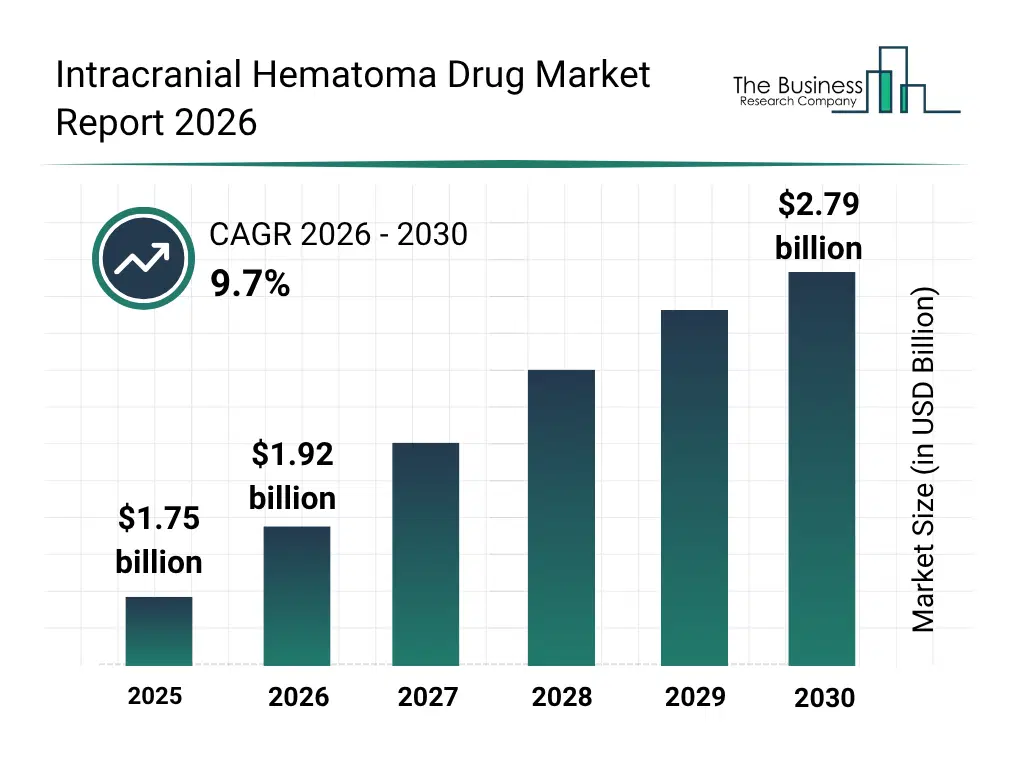
What Is The Intracranial Hematoma Drug Market Size and Share 2026?
The intracranial hematoma drug market size has grown strongly in recent years.It will grow from $1.75 billion in 2025 to $1.92 billion in 2026 at a compound annual growth rate (CAGR) of 9.5%. The growth in the historic period can be attributed to rising incidence of traumatic brain injuries, limited availability of advanced neurocritical care drugs, growing hospital admissions for stroke and hemorrhage cases, increased adoption of osmotic therapy drugs, expansion of emergency care infrastructure.What Is The Intracranial Hematoma Drug Market Growth Forecast?
The intracranial hematoma drug market size is expected to see strong growth in the next few years.It will grow to $2.79 billion by 2030 at a compound annual growth rate (CAGR) of 9.7%. The growth in the forecast period can be attributed to advancement in neuroprotective drug development, integration of ai-based neurological monitoring systems, increasing demand for targeted intracranial pressure management therapies, growth in precision medicine for brain disorders, rising investment in neurocritical care research.Major trends in the forecast period include ai-driven neurocritical care decision support systems, precision drug delivery systems for intracranial pressure management, real-time brain imaging analytics integration in emergency care, smart ICU monitoring for neurotrauma patients, cloud-based neurological patient data management platforms.
Global Intracranial Hematoma Drug Market Segmentation
1) By Drug Class: Hemostatic Agents, Antihypertensive Agents, Osmotic Agents, Anticonvulsants, Antifibrinolytic Agents, Calcium Channel Blockers, Sedatives And Analgesics 2) By Mechanism Of Action: Coagulation Enhancers, Blood Pressure Reduction Agents, Intracranial Pressure Reduction Agents, Neuroprotective Agents, Anti-Inflammatory And Edema Reduction Agents, Seizure Prevention Agents 3) By Route Of Administration: Intravenous, Oral, Intramuscular, Intrathecal 4) By Distribution Channel: Hospital Pharmacies, Retail Pharmacies, Online Pharmacies 5) By End User: Hospitals, Sleep Clinics, Homecare Settings, Other End Users Subsegments: 1) By Hemostatic Agents: Activated Factor Seven, Tranexamic Acid, Aminocaproic Acid, Fibrinogen Concentrate 2) By Antihypertensive Agents: Beta Blockers, Angiotensin Converting Enzyme Inhibitors, Angiotensin Receptor Blockers, Diuretics, Vasodilators 3) By Osmotic Agents: Mannitol, Hypertonic Saline, Glycerol, Urea 4) By Anticonvulsants: Phenytoin, Levetiracetam, Valproic Acid, Carbamazepine 5) By Antifibrinolytic Agents: Tranexamic Acid, Aminocaproic Acid, Aprotinine 6) By Calcium Channel Blockers: Nimodipine, Nicardipine, Diltiazem, Verapamil 7) By Sedatives And Analgesics: Propofol, Midazolam, Fentanyl, Morphine, DexmedetomidineWhat Are The Drivers Of The Intracranial Hematoma Drug Market?
The rising incidence of traumatic brain injuries is expected to propel the growth of the intracranial hematoma drug industry going forward.Traumatic brain injuries (TBIs) are disruptions in normal brain function caused by a bump, blow, jolt to the head, or a penetrating head injury.The growing prevalence of TBIs is largely driven by an aging population, as older adults are more susceptible to falls, leading to a higher rate of severe head injuries that require medical intervention.The increasing occurrence of traumatic brain injuries amplifies the need for intracranial hematoma drug targeting intracranial hematomas, as bleeding within the skull is among the most critical and life-threatening consequences of such injuries.For instance, in September 2025, according to the South Dakota Department of Health, a US-based government health agency, TBI-related deaths in the state rose from 241 in 2023 to 267 in 2024, reflecting an 11% increase.Therefore, the rising incidence of traumatic brain injuries is driving the growth of the intracranial hematoma drug industry. The increasing healthcare expenditure is expected to propel the growth of the intracranial hematoma drug industry going forward.Healthcare expenditure is the total spending on healthcare goods and services, including hospital care, pharmaceuticals, and preventive services, by governments, private organizations, and individuals.The rise in healthcare expenditure is due to increasing government funding, which strengthens healthcare infrastructure and expands access to advanced medical treatments.Intracranial hematoma drugs help optimize healthcare spending by enabling effective management of brain hemorrhage, improving survival rates, and reducing long-term treatment costs through timely intervention.For instance, in April 2025, according to the Office for National Statistics, a UK-based government statistics authority, healthcare expenditure reached £252 billion ($289.89 billion) in 2023, reflecting a 5.9% nominal increase compared to 2022.Therefore, the increasing healthcare expenditure is driving the growth of the intracranial hematoma drug industry.Key Players In The Global Intracranial Hematoma Drug Market
Major companies operating in the intracranial hematoma drug market are Johnson & Johnson Services Inc., Pfizer Inc., Bayer AG, AstraZeneca PLC, Boehringer Ingelheim International GmbH, Teva Pharmaceutical Industries Ltd., Baxter International Inc., Grifols S. A., Sun Pharmaceutical Industries Limited, Aurobindo Pharma Limited, Dr. Reddy’s Laboratories Limited, Octapharma AG, Amneal Pharmaceuticals Inc., Zydus Lifesciences Limited, CSL Behring LLC, Otsuka Pharmaceutical Co. Ltd., Alveron Pharma AB, Acticor Biotech SA, Aegis Lifesciences Private Limited, Acasti Pharma Inc.Global Intracranial Hematoma Drug Market Trends and Insights
Major companies operating in the intracranial hematoma drug market are focusing on developing innovative therapies such as ready-to-use injectables to address unmet clinical needs, improve patient survival rates, and enable faster emergency intervention. Ready-to-use injectables are sterile, pre-formulated medications designed for immediate administration without requiring dilution or reconstitution. For instance, in April 2023, Alveron Pharma, a Netherlands-based developer of a unique coagulation platform technology, initiated a Phase 1 clinical trial of its novel drug candidate OKL-1111 for the treatment of intracranial hemorrhage. The drug is designed as a rapid, first-line therapy with a universal mode of action that does not require identification of the specific anticoagulant, significantly reducing treatment delays. It is being developed as a ready-to-use injectable solution, eliminating time-consuming preparation steps, and is intended to quickly reverse the effects of anticoagulants and platelet inhibitors to prevent hematoma expansion. Additionally, preclinical data indicate a low risk of thrombotic complications, enabling faster administration and potential use even in emergency settings, such as ambulances, thereby improving overall patient outcomes.Regional Insights
North America was the largest region in the intracranial hematoma drug market in 2025. Asia-Pacific is expected to be the fastest-growing region in the forecast period. The regions covered in this market report are Asia-Pacific, South East Asia, Western Europe, Eastern Europe, North America, South America, Middle East and Africa. The countries covered in this market report are Australia, Brazil, China, France, Germany, India, Indonesia, Japan, Taiwan, Russia, South Korea, UK, USA, Canada, Italy, Spain.What Defines the Intracranial Hematoma Drug Market?
The intracranial hematoma drug market consists of sales of mannitol injection, hypertonic saline solution, tranexamic acid injection, prothrombin complex concentrate, fresh frozen plasma, and recombinant factor VIIa injection. Values in this market are ‘factory gate’ values, that is, the value of goods sold by the manufacturers or creators of the goods, whether to other entities (including downstream manufacturers, wholesalers, distributors, and retailers) or directly to end customers. The value of goods in this market includes related services sold by the creators of the goods.What is the Market Assessment and Strategic Outlook for the Intracranial Hematoma Drug Industry?
The intracranial hematoma drug market research report is one of a series of new reports from The Business Research Company that provides market statistics, including industry global market size, regional shares, competitors with the market share, detailed market segments, market trends and opportunities, and any further data you may need to thrive in the intracranial hematoma drug industry. The market research report delivers a complete perspective of everything you need, with an in-depth analysis of the current and future state of the industry.What is the Market Assessment and Strategic Outlook for the Intracranial Hematoma Drug Market Report 2026?
The intracranial hematoma drug market research report is one of a series of new reports from The Business Research Company that provides intracranial hematoma drug market statistics, including intracranial hematoma drug industry global market size, regional shares, competitors with a intracranial hematoma drug market share, detailed intracranial hematoma drug market segments, market trends and opportunities, and any further data you may need to thrive in the intracranial hematoma drug industry. This intracranial hematoma drug market research report delivers a complete perspective of everything you need, with an in-depth analysis of the current and future scenario of the industry.Intracranial Hematoma Drug Market Report Forecast Analysis
| Report Attribute | Details |
|---|---|
| Market Size Value In 2026 | $1.92 billion |
| Revenue Forecast In 2035 | $2.79 billion |
| Growth Rate | CAGR of 9.7% from 2026 to 2035 |
| Base Year For Estimation | 2025 |
| Actual Estimates/Historical Data | 2020-2025 |
| Forecast Period | 2026 - 2030 - 2035 |
| Market Representation | Revenue in USD Billion and CAGR from 2026 to 2035 |
| Segments Covered | Drug Class, Mechanism Of Action, Route Of Administration, Distribution Channel, End User |
| Regional Scope | Asia-Pacific, Western Europe, Eastern Europe, North America, South America, Middle East, Africa |
| Country Scope | The countries covered in the report are Australia, Brazil, China, France, Germany, India, Indonesia, Japan, Taiwan, Russia, South Korea, UK, USA, Canada, Italy, Spain. |
| Key Companies Profiled | Johnson & Johnson Services Inc., Pfizer Inc., Bayer AG, AstraZeneca PLC, Boehringer Ingelheim International GmbH, Teva Pharmaceutical Industries Ltd., Baxter International Inc., Grifols S. A., Sun Pharmaceutical Industries Limited, Aurobindo Pharma Limited, Dr. Reddy’s Laboratories Limited, Octapharma AG, Amneal Pharmaceuticals Inc., Zydus Lifesciences Limited, CSL Behring LLC, Otsuka Pharmaceutical Co. Ltd., Alveron Pharma AB, Acticor Biotech SA, Aegis Lifesciences Private Limited, Acasti Pharma Inc. |
| Customization Scope | Request for Customization |
| Pricing And Purchase Options | Explore Purchase Options |